Toilet
ProductAlso known as: flush toilet, gravity-flush toilet, two-piece toilet, WC, commode
Overview
A flush toilet has about a dozen parts you can name, and nearly all of them live in the tank. The Toilet Bowl and the Toilet Tank are the two pieces of vitreous china; the Fill Valve Assembly refills the tank after a flush, the Flush Valve Assembly releases the water into the bowl when the handle is pressed, and the Tank-to-Bowl Kit, Floor Mount Kit and Water Supply Kit connect the fixture to the bowl, the floor and the water supply. A Toilet Seat Assembly finishes it. Everything in the tank is a replaceable part that costs a few dollars, and almost every toilet repair is one of them.
This page describes a two-piece gravity-flush toilet, the type in most homes. One-piece toilets fuse tank and bowl into a single casting with the same internals; pressure-assisted, wall-hung and tankless commercial toilets replace the gravity tank with a pressure vessel or a flushometer valve.
The parts of a toilet and what each does
Bowl. The Toilet Bowl is the base of the fixture: a Vitreous China Bowl Casting casting with a rim, a water-holding well and an integral Glazed Trapway, the S-shaped passage that leads from the well to the outlet at the floor. The trapway is the toilet's trap: the water standing in the bend seals the drain and stops sewer gas coming back into the room. Around the rim a channel of small holes lets tank water wash the bowl walls; at the bottom, the Siphon Jet aims a stream directly into the trapway to start the flush. Trapways are glazed inside on better toilets so waste does not catch.
Tank. The Toilet Tank is the reservoir above the bowl, a Vitreous China Tank holding 4.8 L (1.28 US gallons) on a modern water-saving toilet, up to 13 L on older ones, closed by a loose Tank Lid. Height is what matters: the tank stores water at a level above the bowl so that gravity can dump it fast enough to trigger a siphon.
Fill valve. The Fill Valve Assembly is the tall column on the left side of the tank. Its Ballcock Fill Valve opens when the water level drops and closes when the tank is full, sensed by the Float Cup that rides up and down the column on the water surface. Older toilets used a ballcock, a float ball on an arm; the float-cup design does the same job in less space. A thin Refill Tube runs from the valve to the overflow tube so that some water is sent to refill the bowl's well while the tank fills. The Fill Shank + Lock Nut passes through the bottom of the tank and is sealed with an O-Ring Set and lock nut; the supply line connects underneath it.
Flush valve. The Flush Valve Assembly is the large opening in the tank floor and the parts that control it. The Flush Valve Body is the seat, sealed from below to the tank by the Flush Valve Seat Gasket. Covering it is the Flapper / Canister Seal, a rubber disc on a hinge, or a canister seal on newer designs, that holds the water back. Pressing the handle turns the Flush Lever / Trip Arm, a trip arm inside the tank, which pulls the Lift Chain and lifts the flapper. Water rushes into the bowl until the tank empties enough for the flapper to drop back onto its seat. The Overflow Tube is the open pipe standing up from the valve body: if the fill valve ever fails to shut off, water spills down it into the bowl instead of over the tank rim onto the floor. A small Coil Spring in the canister type returns the seal.
Tank-to-bowl kit. The Tank-to-Bowl Kit is a large sponge or rubber gasket around the flush valve outlet plus two or three brass bolts with rubber washers. The gasket seals the joint between tank and bowl so that flush water goes into the bowl and nowhere else; the bolts clamp the two pieces of china together without cracking them.
Floor mount kit. The Floor Mount Kit fixes the bowl to the drain. A wax ring (or a waxless rubber seal) sits between the bowl outlet and the closet flange, the fitting at the top of the drain pipe, making a watertight and gas-tight joint. Two closet bolts rise from slots in the flange through the bowl's base and are tightened under decorative caps. This joint is why a toilet should never rock: movement breaks the wax seal and lets water into the floor.
Water supply kit. The Water Supply Kit is the shutoff valve on the wall or floor and the flexible braided supply line that runs from it to the fill valve shank. The shutoff is the first thing to close before any repair.
Seat. The Toilet Seat Assembly is a hinged seat and lid bolted to two holes in the bowl rim, in plastic or enamelled wood, often with a soft-close hinge and quick-release mounts for cleaning.
Fasteners. A general Fastener Set covers the mounting screws, caps and washers not included in the kits above.
How a flush works
Pressing the handle lifts the flapper. Several litres of water leave the tank in a few seconds, partly through the rim holes to scrub the bowl and mostly through the siphon jet aimed into the trapway. The sudden flow fills the trapway completely, and a full pipe running downhill pulls the water behind it: that is a siphon, and it empties the bowl in one pull rather than letting it drain slowly. When the water level in the bowl drops below the trapway inlet, air breaks the siphon with the characteristic gurgle. Meanwhile the flapper has closed, the float cup has dropped, and the fill valve is running: most of its output refills the tank, and the refill tube tops up the bowl so a fresh water seal stands in the trap. When the float reaches the set level the valve shuts and the toilet is ready again, about a minute after the flush started.
Materials
Bowl and tank are vitreous china, a clay body fired with a glass glaze that is non-porous, hard and easy to clean; it is also brittle, which is why every bolt on a toilet is tightened only until snug. The valve bodies are ABS or polypropylene, the flapper is a chlorine-resistant rubber, the bolts are brass, and the seals are rubber, sponge or wax. A toilet contains no metal that can rust into the water path, which is one reason the design has hardly changed since the 1880s.
Common failures
A toilet that runs continuously has either a worn flapper that no longer seals or a fill valve that does not shut off; both are replaced from the top of the tank without tools beyond a sponge. A weak flush means the flapper is closing too early (shorten the chain) or the rim holes are scaled up. Water on the floor at the base means the wax ring has failed, and the toilet has to be lifted to replace it. A tank that leaks at the bolts needs new tank-to-bowl washers. The china itself almost never fails unless it is cracked by over-tightening or impact.
Common questions
What are the parts inside a toilet tank called?
The fill valve with its float cup and refill tube, the flush valve with its flapper (or canister seal), overflow tube, trip lever and lift chain, and the tank-to-bowl gasket and bolts underneath.
What is the part that stops a toilet from running?
The flapper. It seals the flush valve seat at the bottom of the tank. When it wears, warps or gets a mineral deposit on its rim, water leaks past it into the bowl, the level drops, and the fill valve keeps topping the tank up. A new flapper is the usual fix; if the water level is too high and spilling down the overflow tube, adjust or replace the fill valve instead.
What is the toilet trapway?
The S-shaped passage cast into the bowl between the bowl and the outlet. Water standing in it seals off the drain so sewer gas cannot enter the room, and the flush works by filling it completely to start a siphon.
How much water does a toilet use per flush?
A modern toilet uses 4.8 L (1.28 gallons), the WaterSense limit in the United States; standard-efficiency models use 6 L (1.6 gallons); toilets from before the 1990s used 13 L (3.5 gallons) or more. Dual-flush toilets offer a half flush of about 3 L for liquids.
Is a toilet one piece or two?
Most are two-piece: a separate tank bolted to the bowl with a gasket between them. One-piece toilets cast both as a single unit, which removes the tank-to-bowl joint and is easier to clean, at a higher price and weight.
Toilet parts and their functions
9 top-level parts · 36 parts in total · full bill of materials below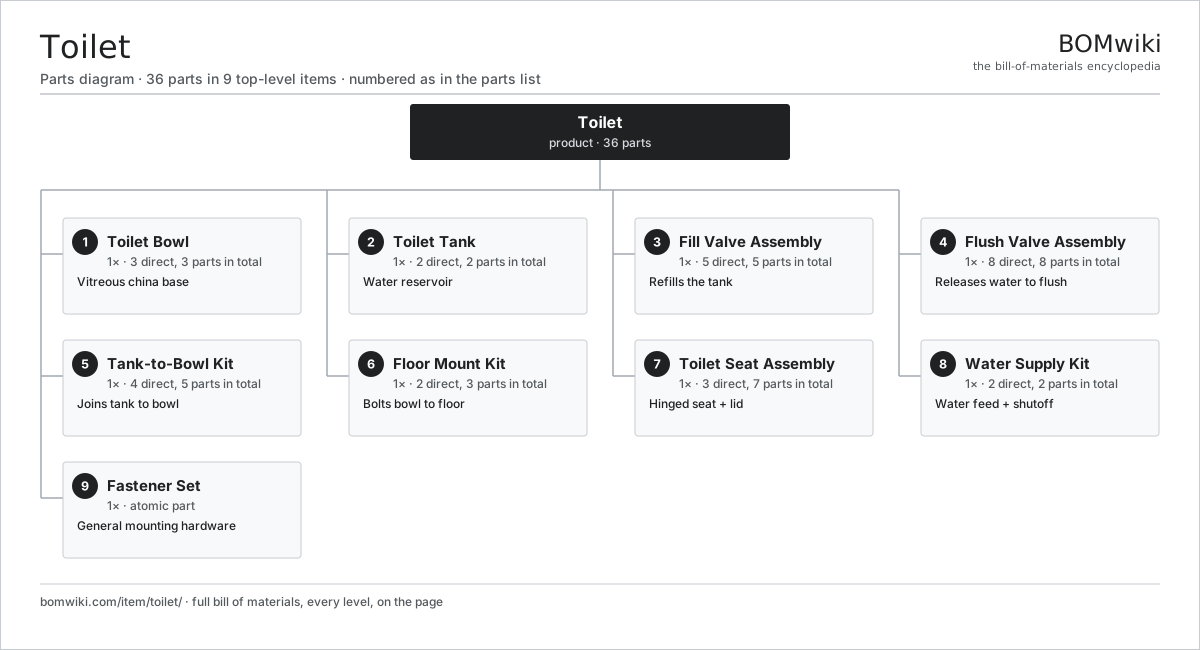
| # | Part | Qty | What it does |
|---|---|---|---|
| 1 | Toilet Bowl 3 parts | 1× | Vitreous china base |
| 2 | Toilet Tank 2 parts | 1× | Water reservoir |
| 3 | Fill Valve Assembly 5 parts | 1× | Refills the tank |
| 4 | Flush Valve Assembly 8 parts | 1× | Releases water to flush |
| 5 | Tank-to-Bowl Kit 4 parts | 1× | Joins tank to bowl |
| 6 | Floor Mount Kit 2 parts | 1× | Bolts bowl to floor |
| 7 | Toilet Seat Assembly 3 parts | 1× | Hinged seat + lid |
| 8 | Water Supply Kit 2 parts | 1× | Water feed + shutoff |
| 9 | Fastener Set | 1× | General mounting hardware |
3D model
No 3D model yet. Have a CAD file of this? Add a 3D model. STL renders right on this page; STEP, FreeCAD, and OpenSCAD sources are welcome too (openly licensed, like all 3D models on BOMwiki).
Build & assembly graph
expand / collapse · shared sub-assemblies converge · links to related products · est. labourTap an assembly to expand/collapse · tap a part to open it · use “Open page” for any node · drag to pan, scroll to zoom.
Bill of materials for Toilet
9 top-level lines · 38 rows shown · 36 parts total · indented to 3 levels| # | Item / sub-assembly | Part no. | Qty/assy | Ext. qty | Parts | Type |
|---|---|---|---|---|---|---|
| 1 | Toilet Bowl 3 parts | toilet-bowl | 1× | 1 | 3 | assembly |
| 1.1 | Vitreous China Bowl Casting | toilet-china-bowl | 1× | 1 | · | part |
| 1.2 | Glazed Trapway | toilet-trapway | 1× | 1 | · | part |
| 1.3 | Siphon Jet | toilet-siphon-jet | 1× | 1 | · | part |
| 2 | Toilet Tank 2 parts | toilet-tank | 1× | 1 | 2 | assembly |
| 2.1 | Vitreous China Tank | toilet-china-tank | 1× | 1 | · | part |
| 2.2 | Tank Lid | toilet-tank-lid | 1× | 1 | · | part |
| 3 | Fill Valve Assembly 5 parts | toilet-fill-valve-assy | 1× | 1 | 5 | assembly |
| 3.1 | Ballcock Fill Valve | toilet-fill-valve | 1× | 1 | · | part |
| 3.2 | Float Cup | toilet-float-cup | 1× | 1 | · | part |
| 3.3 | Refill Tube | toilet-refill-tube | 1× | 1 | · | part |
| 3.4 | Fill Shank + Lock Nut | toilet-fill-shank | 1× | 1 | · | part |
| 3.5 | O-Ring Set | oring-set | 1× | 1 | · | part |
| 4 | Flush Valve Assembly 8 parts | toilet-flush-valve-assy | 1× | 1 | 8 | assembly |
| 4.1 | Flush Valve Body | toilet-flush-valve-body | 1× | 1 | · | part |
| 4.2 | Flapper / Canister Seal | toilet-flapper | 1× | 1 | · | part |
| 4.3 | Overflow Tube | toilet-overflow-tube | 1× | 1 | · | part |
| 4.4 | Flush Lever / Trip Arm | toilet-flush-lever | 1× | 1 | · | part |
| 4.5 | Lift Chain | toilet-flush-chain | 1× | 1 | · | part |
| 4.6 | Flush Valve Seat Gasket | toilet-flush-seat-gasket | 1× | 1 | · | part |
| 4.7 | O-Ring Set | oring-set | 1× | 1 | · | part |
| 4.8 | Coil Spring | coil-spring | 1× | 1 | · | part |
| 5 | Tank-to-Bowl Kit 4 parts | toilet-tank-to-bowl-kit | 1× | 1 | 5 | assembly |
| 5.1 | Tank-to-Bowl Bolt | toilet-tank-bolts | 2× | 2 | · | part |
| 5.2 | Spud Gasket | toilet-spud-gasket | 1× | 1 | · | part |
| 5.3 | O-Ring Set | oring-set | 1× | 1 | · | part |
| 5.4 | Fastener Set | fastener-set | 1× | 1 | · | part |
| 6 | Floor Mount Kit 2 parts | toilet-floor-mount-kit | 1× | 1 | 3 | assembly |
| 6.1 | Closet Bolt + Cap | toilet-closet-bolts | 2× | 2 | · | part |
| 6.2 | Wax Ring Seal | toilet-wax-ring | 1× | 1 | · | part |
| 7 | Toilet Seat Assembly 3 parts | toilet-seat-assy | 1× | 1 | 7 | assembly |
| 7.1 | Seat Ring + Lid | toilet-seat | 1× | 1 | · | part |
| 7.2 | Seat Hinge | toilet-seat-hinges | 2× | 2 | · | part |
| 7.3 | Seat Bumper | toilet-seat-bumpers | 4× | 4 | · | part |
| 8 | Water Supply Kit 2 parts | toilet-supply-kit | 1× | 1 | 2 | assembly |
| 8.1 | Braided Supply Line | toilet-supply-line | 1× | 1 | · | part |
| 8.2 | Angle Stop Valve | toilet-angle-stop | 1× | 1 | · | part |
| 9 | Fastener Set | fastener-set | 1× | 1 | · | part |
Something wrong in this list? Report a problem with this BOM.
Related products
same domain, ranked by shared parts Heat-Pump Water Heater
152 parts · shares 2 with this page
 Kitchen Faucet
35 parts · shares 2 with this page
 Reduced-Pressure Backflow Preventer
50 parts · shares 2 with this page
 Shallow-Well Jet Pump
49 parts · shares 2 with this page
Thermostatic Shower Panel
44 parts · shares 2 with this page
Variable-Speed Pool Pump
62 parts · shares 2 with this page
Sourcing: possible vendors
Browse the supplier directory → Prices, MOQ, and lead times are algorithmic estimates, not quotes, and not claims about these companies. Company mappings are curated by keyword; est. price band $20–$3k. How estimates work| Vendor | HQ | Specialty | MOQ | Lead time |
|---|---|---|---|---|
|
🇺🇸Kohler
kohler.com ↗
|
Kohler, US | Plumbing fixtures | 1,000 units | 6–12 wks |
|
🇯🇵TOTO
toto.com ↗
|
Kitakyushu, JP | Sanitaryware | 1,000 units | 6–12 wks |
|
🇯🇵LIXIL
lixil.com ↗
|
Tokyo, JP | Plumbing (Grohe, American Std) | 1,000 units | 6–12 wks |
|
🇺🇸Moen
moen.com ↗
|
North Olmsted, US | Faucets & fixtures | 1,000 units | 6–12 wks |
|
🇨🇭Geberit
geberit.com ↗
|
Rapperswil, CH | Sanitary systems | 1,000 units | 6–12 wks |
1,534-word article