Folding Pocket Knife
ProductOverview
A folding pocket knife is a single-blade cutting tool that collapses into the handle for safe carry. The design focuses on one high-quality Blade Assembly and a simple Lock Mechanism Assembly that prevents accidental closure during use. Unlike a multi-tool, it is not trying to be everything; instead, it commits to being a very sharp, very reliable knife.
The blade is held closed by friction and springs, nested between two Left Handle Scale and Right Handle Scale handle scales. When you open the knife, the Lock Mechanism Assembly engages and locks the blade fully open. A Pocket Clip Assembly allows you to carry it clipped to a jeans pocket, visible and always ready. Many pocket knives are carry items for outdoor work, utility tasks, or self-defense.
The Pivot Joint Assembly system is critical: precision washers must be tight enough to avoid blade wobble but loose enough to allow smooth, fluid opening. This is why artisanal knife makers spend hours tuning the pivot; a properly fitted knife opens with a satisfying snap, while a poorly fitted knife feels cheap and unreliable.
How it works
The Blade Tang passes through the center of the handle. It is wider than the gap between the Left Handle Scale and Right Handle Scale, so the blade cannot fall out sideways. Two metal Scale Rivets permanently fasten each scale to the tang, creating a sandwich.
The Pivot Pin is the hinge that allows the blade to swing open and closed. It passes through a hole drilled in the Blade Tang and is supported by the scales. On either side of the pin sit Inner Pivot Washer friction washers (typically bronze or hardened steel) and Outer Pivot Washer ball bearings or additional friction washers. These washers control the blade's opening resistance and prevent side-to-side play.
When you open the knife, the Blade Return Spring (a coil or leaf spring anchored to one scale) resists the motion, creating tension that makes the opening feel intentional rather than floppy. As the blade nears the fully open position, the Lock Bar engages a Lock Notch milled into the blade tang, locking it in place. The Lock Spring keeps the lock bar pressed firmly against the tang.
To close the knife, you must push the Lock Bar (usually a short lever on the handle side), which disengages the notch and allows the blade to swing closed. This two-step action, unlock, then close, prevents accidental closure if the blade is bumped.
The Blade Edge is honed to a fine point, typically 15–20 degrees per side for general cutting. A coarser edge (~25 degrees) is more durable; a finer edge (~10 degrees) is sharper but rolls more easily.
Blade steel and sharpness
The Blade Blank is the most expensive component. High-carbon stainless steels like AUS-8 or 14C28N retain an edge well and resist rust; pure carbon steels like 1095 or O1 are easier to sharpen but rust if not oiled. Budget knives use 420 stainless, which is corrosion-resistant but holds an edge poorly and is tedious to sharpen.
Edge retention is measured in how many cuts through a specific material (usually corrugated cardboard) the blade makes before becoming noticeably dull. A quality Blade Edge honed at 17 degrees per side might cut ~200 feet of cardboard before dulling; a cheap edge might manage only 50 feet.
The Blade Finish (hardening and tempering) is crucial. If done wrong, the steel becomes brittle and chips; if done right, it balances hardness (for edge retention) with toughness (for impact resistance). Proper hardening produces a blade that feels alive when you sharpen it, with the steel responding to the stone predictably.
Lock mechanism reliability
The Lock Mechanism Assembly must be absolutely reliable; a blade that closes unexpectedly during use is dangerous and can cause injury. The Lock Bar must stay engaged until deliberately pushed; the Lock Spring must provide enough force to resist vibration and accidental bumps.
Friction liner locks (where a metal bar rubs against the tang) are simple and reliable but wear over time. The contact surfaces can develop flat spots that eventually allow slip. Frame locks (where the handle scale itself is the locking mechanism) are more complex but potentially more durable because they distribute stress over a larger area.
Some premium knives use ball-bearing lock bars (the Lock Bar rides on tiny ball bearings) to reduce friction and allow a lighter lock that still resists slip.
Maintenance and sharpening
A pocket knife requires light maintenance. Oil the Pivot Pin and Inner Pivot Washer occasionally to keep the action smooth. Clean the blade after use, especially if you've cut acidic materials (like lemon) or salty water, which accelerate corrosion.
Sharpening is the main task. A fine whetstone (1500–4000 grit) or a ceramic rod maintains the edge between deep sharpenings. A stropping leather (charging with stropping compound) maintains the edge for weeks between sharpening sessions.
If the Lock Mechanism Assembly starts to slip, you can sometimes re-tension the Lock Spring by bending it slightly. If the Pivot Joint Assembly becomes loose or stiff, you may need to partially disassemble the handle to adjust the Inner Pivot Washer friction.
Folding Pocket Knife parts and their functions
6 top-level parts · 22 parts in total · full bill of materials below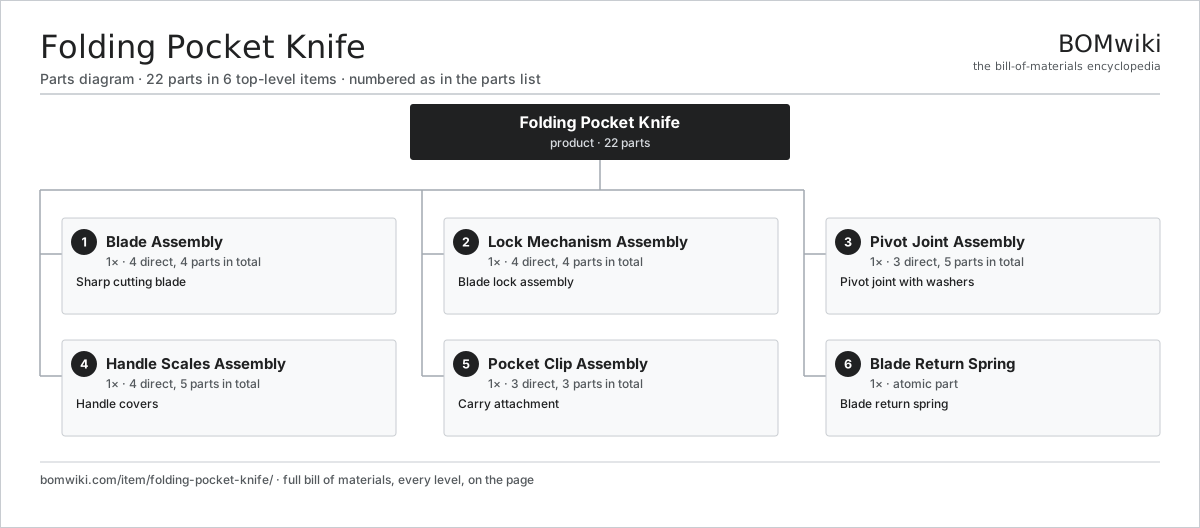
| # | Part | Qty | What it does |
|---|---|---|---|
| 1 | Blade Assembly 4 parts | 1× | Sharp cutting blade |
| 2 | Lock Mechanism Assembly 4 parts | 1× | Blade lock assembly |
| 3 | Pivot Joint Assembly 3 parts | 1× | Pivot joint with washers |
| 4 | Handle Scales Assembly 4 parts | 1× | Handle covers |
| 5 | Pocket Clip Assembly 3 parts | 1× | Carry attachment |
| 6 | Blade Return Spring | 1× | Blade return spring |
3D model
No 3D model yet. Have a CAD file of this? Add a 3D model. STL renders right on this page; STEP, FreeCAD, and OpenSCAD sources are welcome too (openly licensed, like all 3D models on BOMwiki).
Build & assembly graph
expand / collapse · shared sub-assemblies converge · links to related products · est. labourTap an assembly to expand/collapse · tap a part to open it · use “Open page” for any node · drag to pan, scroll to zoom.
Bill of materials for Folding Pocket Knife
6 top-level lines · 24 rows shown · 22 parts total · indented to 3 levels| # | Item / sub-assembly | Part no. | Qty/assy | Ext. qty | Parts | Type |
|---|---|---|---|---|---|---|
| 1 | Blade Assembly 4 parts | folding-pocket-knife-blade | 1× | 1 | 4 | assembly |
| 1.1 | Blade Blank | folding-pocket-knife-blade-blank | 1× | 1 | · | part |
| 1.2 | Blade Edge | folding-pocket-knife-blade-edge | 1× | 1 | · | part |
| 1.3 | Blade Tang | folding-pocket-knife-blade-tang | 1× | 1 | · | part |
| 1.4 | Blade Finish | folding-pocket-knife-blade-finish | 1× | 1 | · | part |
| 2 | Lock Mechanism Assembly 4 parts | folding-pocket-knife-lock-mechanism | 1× | 1 | 4 | assembly |
| 2.1 | Lock Bar | folding-pocket-knife-lock-bar | 1× | 1 | · | part |
| 2.2 | Lock Spring | folding-pocket-knife-lock-spring | 1× | 1 | · | part |
| 2.3 | Lock Notch | folding-pocket-knife-lock-notch | 1× | 1 | · | part |
| 2.4 | Lock Bar Rivet | folding-pocket-knife-lockbar-rivet | 1× | 1 | · | part |
| 3 | Pivot Joint Assembly 3 parts | folding-pocket-knife-pivot | 1× | 1 | 5 | assembly |
| 3.1 | Pivot Pin | folding-pocket-knife-pivot-pin | 1× | 1 | · | part |
| 3.2 | Inner Pivot Washer | folding-pocket-knife-pivot-washer-inner | 2× | 2 | · | part |
| 3.3 | Outer Pivot Washer | folding-pocket-knife-pivot-washer-outer | 2× | 2 | · | part |
| 4 | Handle Scales Assembly 4 parts | folding-pocket-knife-scales | 1× | 1 | 5 | assembly |
| 4.1 | Left Handle Scale | folding-pocket-knife-scale-left | 1× | 1 | · | part |
| 4.2 | Right Handle Scale | folding-pocket-knife-scale-right | 1× | 1 | · | part |
| 4.3 | Scale Material | folding-pocket-knife-scale-material | 1× | 1 | · | part |
| 4.4 | Scale Rivet | folding-pocket-knife-scale-rivet | 2× | 2 | · | part |
| 5 | Pocket Clip Assembly 3 parts | folding-pocket-knife-pocket-clip | 1× | 1 | 3 | assembly |
| 5.1 | Clip Body | folding-pocket-knife-clip-body | 1× | 1 | · | part |
| 5.2 | Clip Spring | folding-pocket-knife-clip-spring | 1× | 1 | · | part |
| 5.3 | Clip Rivet | folding-pocket-knife-clip-rivet | 1× | 1 | · | part |
| 6 | Blade Return Spring | folding-pocket-knife-spring | 1× | 1 | · | part |
Something wrong in this list? Report a problem with this BOM.
Sourcing: possible vendors
Browse the supplier directory → Prices, MOQ, and lead times are algorithmic estimates, not quotes, and not claims about these companies. Company mappings are curated by keyword; est. price band $30–$800. How estimates work| Vendor | HQ | Specialty | MOQ | Lead time |
|---|---|---|---|---|
| stanleyblackanddecker.com ↗ | New Britain, US | Tools (DeWalt, Craftsman) | 500 units | 6–12 wks |
| bosch-professional.com ↗ | Leinfelden, DE | Power tools | 500 units | 6–12 wks |
| ttigroup.com ↗ | Hong Kong, CN | Tools (Milwaukee, Ryobi) | 500 units | 6–12 wks |
|
🇯🇵Makita
makita.com ↗
|
Anjo, JP | Power tools | 500 units | 6–12 wks |
|
🇨🇭Hilti
hilti.com ↗
|
Schaan, CH | Construction tools | 500 units | 6–12 wks |
957-word article