Gas Balloon
ProductOverview
A gas balloon flies on the buoyancy of a light gas held in a closed envelope, not on heated air. Helium or hydrogen sealed inside the Envelope weighs far less than the air it displaces, and that difference lifts the craft. Unlike a hot-air balloon there is no burner, so flight is silent and can last for days. The trade is that the pilot cannot simply add heat to climb. Altitude is managed by venting gas to go down and dropping ballast to go up, and both are finite resources that have to be spent carefully across a long flight.
The load path is the defining feature. The envelope fabric is gas-tight but not strong enough to carry the basket, so the lift is collected by a Suspension Net cast over the whole envelope, gathered into a Load Ring, and passed down to the Basket. The fabric holds gas, the net holds weight.
Envelope
The Envelope is built from tapered Envelope Gore panels seamed pole to pole into a sphere, each panel in polyurethane-coated nylon. A Gas-Barrier Coating gas barrier slows the inevitable diffusion of helium or hydrogen, which sets the practical flight duration. At the base an open Appendix tube serves two jobs: it is the fill point on the ground, and in flight it stays open so gas can expand out as the balloon climbs into thinner air rather than bursting the envelope. Vertical Load Tape webbing along every seam channels envelope loads into the net, and a reinforced Valve Port Ring ring at the crown mounts the gas valve. For landing the envelope carries a sealed Rip Panel that is torn open to deflate fast.
Net and suspension
The Suspension Net is a knotted mesh of Net Cord draped over the envelope, reinforced where it gathers at the crown by Crown Tab tabs. The mesh narrows down to a set of Suspension Line ropes that meet at the Load Ring. Because the net wraps the whole upper surface, it spreads the lifting force evenly into the fabric instead of concentrating it at a few hard points, which is what lets a thin coated envelope carry a loaded basket.
Basket
Crew ride in the Basket, traditionally a Wicker Body woven from willow or rattan on a marine-plywood Basket Floor. Wicker is still used because it flexes on landing and absorbs impact better than a rigid box. A padded Rim Rail gives the crew something to brace against on touchdown, and the basket hangs from the load ring on four Suspension Cable corners. Wooden Landing Skid runners protect the base, and a Ballast Rail around the rim carries the ballast bags within easy reach.
Valve and lift control
Descent and deflation run through the Valve System. The Crown Valve at the top is held shut by a Coil Spring and a Valve Spring, and the pilot vents gas by pulling the Valve Line that runs down the centre of the envelope, then lets it reseat. A separate, deliberately coloured Rip Line is pulled only on landing to open the rip panel. Mixing the two lines up is dangerous, so they are kept visually distinct. Climbing works the opposite way: the pilot lightens the craft from the Ballast System.
Ballast and flight management
The Ballast System is how a gas balloon trims without fuel. Sand Ballast Bag units hang on Ballast Clip releases, and emptying one makes the balloon lighter so it rises. A long Trail Rope dragged near the ground gives automatic fine trim: when the balloon sinks, more rope rests on the ground and lightens the load, so it self-levels. A Drag Anchor grapnel is dropped to stop drift once the crew commit to landing. Managing this finite ballast against the slow, steady gas loss is the entire skill of the sport, which is why distance and endurance gas races reward careful pilots over many hours or days.
Instruments and use
The Instruments pack carries a barometric Altimeter, a sensitive Variometer that warns of climb or sink before it is large, a GPS Tracker tracker for the retrieve crew, and an aviation Aviation Radio. The electronics run on a Bare PCB with an Microcontroller, a Pressure Sensor, and a Power Supply. Gas balloons today fly mainly in distance racing such as long endurance cups, in scientific and atmospheric sampling roles, and in sport flying where the silence and long duration are the appeal. Hydrogen gives more lift and is cheaper but is flammable, so helium is used wherever cost and supply allow.
Gas Balloon parts and their functions
6 top-level parts · 145 parts in total · full bill of materials below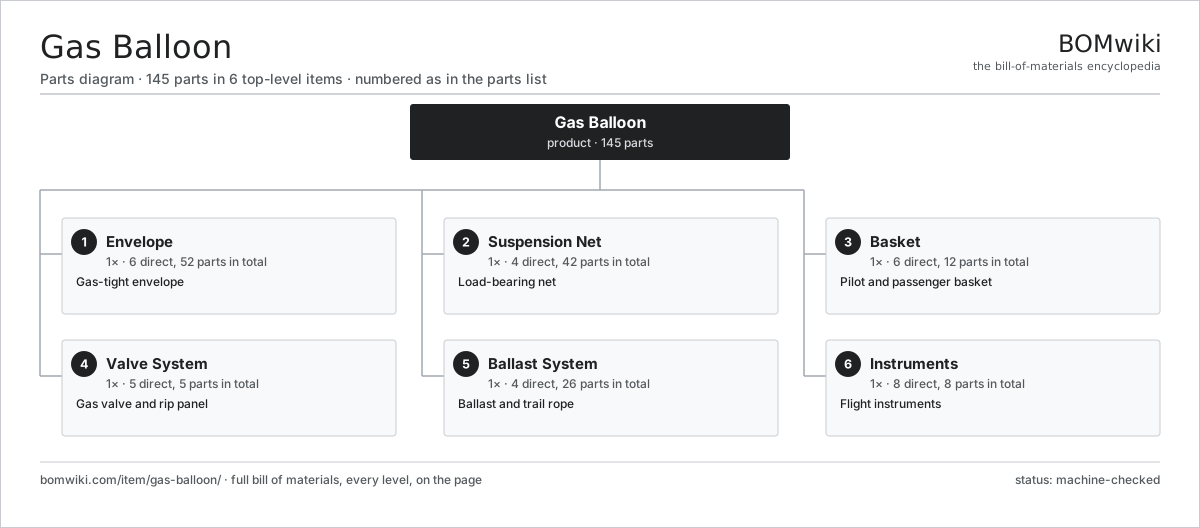
| # | Part | Qty | What it does |
|---|---|---|---|
| 1 | Envelope 6 parts | 1× | Gas-tight envelope |
| 2 | Suspension Net 4 parts | 1× | Load-bearing net |
| 3 | Basket 6 parts | 1× | Pilot and passenger basket |
| 4 | Valve System 5 parts | 1× | Gas valve and rip panel |
| 5 | Ballast System 4 parts | 1× | Ballast and trail rope |
| 6 | Instruments 8 parts | 1× | Flight instruments |
3D model
No 3D model yet. Have a CAD file of this? Add a 3D model. STL renders right on this page; STEP, FreeCAD, and OpenSCAD sources are welcome too (openly licensed, like all 3D models on BOMwiki).
Build & assembly graph
expand / collapse · shared sub-assemblies converge · links to related products · est. labourTap an assembly to expand/collapse · tap a part to open it · use “Open page” for any node · drag to pan, scroll to zoom.
Bill of materials for Gas Balloon
6 top-level lines · 39 rows shown · 145 parts total · indented to 3 levels| # | Item / sub-assembly | Part no. | Qty/assy | Ext. qty | Parts | Type |
|---|---|---|---|---|---|---|
| 1 | Envelope 6 parts | gas-balloon-envelope | 1× | 1 | 52 | assembly |
| 1.1 | Envelope Gore | gas-balloon-gore | 24× | 24 | · | part |
| 1.2 | Gas-Barrier Coating | gas-balloon-coating | 1× | 1 | · | part |
| 1.3 | Appendix | gas-balloon-appendix | 1× | 1 | · | part |
| 1.4 | Rip Panel | gas-balloon-rip-panel | 1× | 1 | · | part |
| 1.5 | Load Tape | gas-balloon-load-tape | 24× | 24 | · | part |
| 1.6 | Valve Port Ring | gas-balloon-valve-port | 1× | 1 | · | part |
| 2 | Suspension Net 4 parts | gas-balloon-net | 1× | 1 | 42 | assembly |
| 2.1 | Net Cord | gas-balloon-net-cord | 1× | 1 | · | part |
| 2.2 | Load Ring | gas-balloon-load-ring | 1× | 1 | · | part |
| 2.3 | Suspension Line | gas-balloon-suspension-line | 16× | 16 | · | part |
| 2.4 | Crown Tab | gas-balloon-net-tab | 24× | 24 | · | part |
| 3 | Basket 6 parts | gas-balloon-basket | 1× | 1 | 12 | assembly |
| 3.1 | Wicker Body | gas-balloon-wicker-body | 1× | 1 | · | part |
| 3.2 | Basket Floor | gas-balloon-floor | 1× | 1 | · | part |
| 3.3 | Rim Rail | gas-balloon-rim-rail | 1× | 1 | · | part |
| 3.4 | Suspension Cable | gas-balloon-suspension-cable | 4× | 4 | · | part |
| 3.5 | Landing Skid | gas-balloon-skid | 4× | 4 | · | part |
| 3.6 | Ballast Rail | gas-balloon-ballast-rail | 1× | 1 | · | part |
| 4 | Valve System 5 parts | gas-balloon-valve-system | 1× | 1 | 5 | assembly |
| 4.1 | Crown Valve | gas-balloon-crown-valve | 1× | 1 | · | part |
| 4.2 | Valve Line | gas-balloon-valve-line | 1× | 1 | · | part |
| 4.3 | Rip Line | gas-balloon-rip-line | 1× | 1 | · | part |
| 4.4 | Valve Spring | gas-balloon-valve-spring | 1× | 1 | · | part |
| 4.5 | Coil Spring | coil-spring | 1× | 1 | · | part |
| 5 | Ballast System 4 parts | gas-balloon-ballast-system | 1× | 1 | 26 | assembly |
| 5.1 | Ballast Bag | gas-balloon-ballast-bag | 12× | 12 | · | part |
| 5.2 | Trail Rope | gas-balloon-trail-rope | 1× | 1 | · | part |
| 5.3 | Ballast Clip | gas-balloon-ballast-clip | 12× | 12 | · | part |
| 5.4 | Drag Anchor | gas-balloon-drag-anchor | 1× | 1 | · | part |
| 6 | Instruments 8 parts | gas-balloon-instruments | 1× | 1 | 8 | assembly |
| 6.1 | Altimeter | gas-balloon-altimeter | 1× | 1 | · | part |
| 6.2 | Variometer | gas-balloon-variometer | 1× | 1 | · | part |
| 6.3 | GPS Tracker | gas-balloon-gps | 1× | 1 | · | part |
| 6.4 | Aviation Radio | gas-balloon-radio | 1× | 1 | · | part |
| 6.5 | Bare PCB | pcb-bare | 1× | 1 | · | part |
| 6.6 | Microcontroller | mcu | 1× | 1 | · | part |
| 6.7 | Pressure Sensor | pressure-sensor | 1× | 1 | · | part |
| 6.8 | Power Supply | power-supply | 1× | 1 | · | part |
Related products
same domain, ranked by shared parts Floatplane
813 parts · shares 2 with this page
Floatplane
813 parts · shares 2 with this page
 Flying Boat
4,224 parts · shares 2 with this page
Flying Boat
4,224 parts · shares 2 with this page
 Freighter Aircraft
6,717 parts · shares 2 with this page
Freighter Aircraft
6,717 parts · shares 2 with this page
 Turboprop Airliner
3,298 parts · shares 2 with this page
Turboprop Airliner
3,298 parts · shares 2 with this page
 Agricultural Helicopter
133 parts · shares 1 with this page
Agricultural Helicopter
133 parts · shares 1 with this page
 Full-Flight Simulator
379 parts · shares 1 with this page
Full-Flight Simulator
379 parts · shares 1 with this page
Sourcing: possible vendors
Browse the supplier directory → Prices, MOQ, and lead times are algorithmic estimates, not quotes, and not claims about these companies. Company mappings are curated by keyword; est. price band $50k–$300M. How estimates work| Vendor | HQ | Specialty | MOQ | Lead time |
|---|---|---|---|---|
|
🇺🇸Boeing
boeing.com ↗
|
Arlington, US | Aerospace OEM | made to order | 40–80 wks |
|
🇫🇷Airbus
airbus.com ↗
|
Toulouse, FR | Aerospace OEM | made to order | 40–80 wks |
| lockheedmartin.com ↗ | Bethesda, US | Aerospace & defense | made to order | 40–80 wks |
|
🇧🇷Embraer
embraer.com ↗
|
São José dos Campos, BR | Aircraft OEM | made to order | 40–80 wks |
| txtav.com ↗ | Wichita, US | Aircraft OEM | made to order | 40–80 wks |
829-word article