Weather Balloon
ProductOverview
A Weather Balloon is an expendable system that lifts a small instrument package, the radiosonde, through the troposphere and into the stratosphere to measure the vertical structure of the atmosphere. National weather services launch these soundings on a fixed schedule, usually at 00 and 12 UTC, from hundreds of sites worldwide. The data feed numerical forecast models and define the upper-air profiles that surface stations cannot see.
The flight has a simple shape. A latex envelope filled with helium or hydrogen rises at roughly 5 m/s. As it climbs the surrounding pressure falls, so the gas inside expands and the envelope grows. A balloon that is 1.5-2 m across at launch reaches 6-8 m near the top of its flight. At an altitude of 30-35 km the latex can no longer stretch and the envelope bursts. A small parachute then lowers the package back to the ground.
The complete system has six parts: the Balloon Envelope, the Suspension Train that hangs everything below it, the Parachute Recovery for recovery, the Radiosonde that carries the sensors and the radio, an optional Camera Payload, and a Cutdown & Ballast mechanism for flights that need a controlled end.
Balloon envelope
The Balloon Envelope is the lifting element. The Latex Balloon is dipped from natural rubber and weighs between 600 and 1500 g depending on the target altitude; heavier envelopes carry more gas and reach higher before they fail. Latex is used because it stretches to several times its launch size while staying thin enough to remain light.
Gas enters through the Inflation Neck Tube, which is the thick stub left from the dipping mandrel. During filling the Gas Fill Fitting couples the neck to the cylinder regulator, and the Fill Nozzle & Valve meters the flow and shuts off when the free lift is correct. Inside that nozzle a Inflation Check Valve keeps gas from escaping while the operator works, sealed against the Nozzle Body with an O-Ring Set. Once filled the neck is folded and held by the Neck Tie-Off Band. Operators set free lift by weighing the balloon against a fixed nozzle lift, which fixes the ascent rate near the standard 5 m/s.
Radiosonde instrument package
The Radiosonde is the measuring instrument, and at 250-400 g it is the heaviest single payload. Its electronics sit inside the Sonde Housing, an expanded-foam box that insulates the parts from air that can fall below -60 C in the upper troposphere. The Foam Enclosure Box and Foam Lid also cushion the landing impact.
The air sensors must sit clear of the warm box, so they ride on the Sensor Boom. A fast Temperature Thermistor reads air temperature, a Humidity Sensor reads relative humidity, and a Radiation Shield Coating coating keeps direct sunlight from heating the sensors and biasing the readings.
The Transmitter Board runs the package. Its Microcontroller samples the sensors, reads pressure from a Pressure Sensor backed by a Barometer reference, and takes position from a GPS Module. Successive GPS fixes give the horizontal drift of the balloon, which is reported as the wind speed and direction at each level. The board frames all of this into a telemetry stream and sends it through a RF Transmitter Module on the 403 MHz meteorological band, radiated by the Telemetry Antenna. A ground receiver decodes the stream in real time. Power comes from the Battery Pack, whose Lithium Cell units are lithium chemistry chosen for steady output in the cold.
Recovery system
When the latex bursts the package is suddenly in free fall, so the Parachute Recovery must already be rigged in line above it. The Parachute Canopy is ripstop nylon sized to bring the descent back toward 5 m/s near the surface, with a Apex Spill Hole Tape at the apex that bleeds air and stops the canopy from rocking. The Shroud Line Set tie the canopy to the train through a Parachute Swivel that lets the package rotate without twisting the lines.
Between the balloon and the payload sits the Suspension Train. A String Unwinder Reel pays out 30-60 m of Unwinder Cord from its Unwinder Spool after launch, so the heavy sonde hangs well below the balloon and away from cloud and precipitation. The Load Line carries the main load, a Elastic Shock Cord absorbs the snap when the balloon bursts, and Train Snap Connector links join the segments.
How a sounding works
Filling targets a free lift that sets the ascent rate near 5 m/s. The balloon climbs for 90-150 minutes, and the radiosonde reports pressure, temperature, humidity and GPS position the whole way up. Because the gas expands as the pressure drops, the envelope keeps growing until it reaches 6-8 m and bursts at 30-35 km. The parachute then carries the package down. Most sondes land in open country and are never recovered, so the instrument is built to be inexpensive and disposable rather than reusable.
Variants and use
Routine soundings carry only the radiosonde. Research and education flights often add the Camera Payload, where a Camera Module feeds a Recorder Board that writes to an SD card, all in a foam Camera Foam Box on its own LiPo Cell. Flights over controlled airspace or near borders use the Cutdown & Ballast assembly: a Cutdown Timer Board times a Nichrome Line Cutter that melts the Load Line on command, ending the flight before the balloon drifts out of the permitted area, sometimes after releasing a Ballast Bag to adjust the ascent. The same airframe therefore serves the daily operational network, atmospheric research campaigns, and amateur high-altitude photography with only payload changes.
Weather Balloon parts and their functions
6 top-level parts · 216 parts in total · full bill of materials below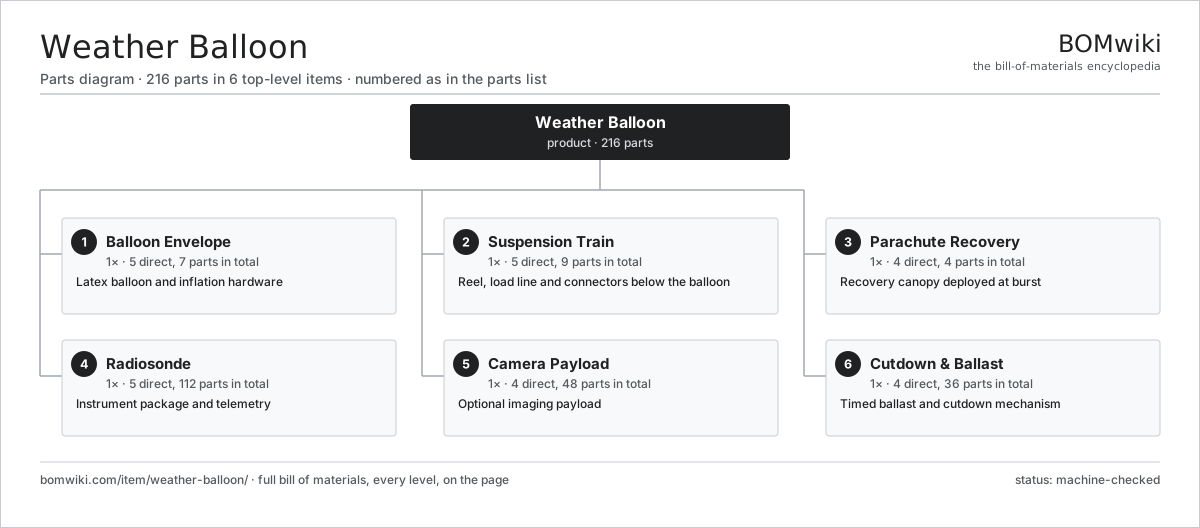
| # | Part | Qty | What it does |
|---|---|---|---|
| 1 | Balloon Envelope 5 parts | 1× | Latex balloon and inflation hardware |
| 2 | Suspension Train 5 parts | 1× | Reel, load line and connectors below the balloon |
| 3 | Parachute Recovery 4 parts | 1× | Recovery canopy deployed at burst |
| 4 | Radiosonde 5 parts | 1× | Instrument package and telemetry |
| 5 | Camera Payload 4 parts | 1× | Optional imaging payload |
| 6 | Cutdown & Ballast 4 parts | 1× | Timed ballast and cutdown mechanism |
3D model
No 3D model yet. Have a CAD file of this? Add a 3D model. STL renders right on this page; STEP, FreeCAD, and OpenSCAD sources are welcome too (openly licensed, like all 3D models on BOMwiki).
Build & assembly graph
expand / collapse · shared sub-assemblies converge · links to related products · est. labourTap an assembly to expand/collapse · tap a part to open it · use “Open page” for any node · drag to pan, scroll to zoom.
Bill of materials for Weather Balloon
6 top-level lines · 70 rows shown · 216 parts total · indented to 3 levels| # | Item / sub-assembly | Part no. | Qty/assy | Ext. qty | Parts | Type |
|---|---|---|---|---|---|---|
| 1 | Balloon Envelope 5 parts | weather-balloon-envelope | 1× | 1 | 7 | assembly |
| 1.1 | Latex Balloon | weather-balloon-latex-balloon | 1× | 1 | · | part |
| 1.2 | Inflation Neck Tube | weather-balloon-neck-tube | 1× | 1 | · | part |
| 1.3 | Fill Nozzle & Valve 3 parts | weather-balloon-fill-nozzle | 1× | 1 | 3 | assembly |
| 1.3.1 | Nozzle Body | weather-balloon-nozzle-body | 1× | 1 | · | part |
| 1.3.2 | Inflation Check Valve | weather-balloon-check-valve | 1× | 1 | · | part |
| 1.3.3 | O-Ring Set | oring-set | 1× | 1 | · | part |
| 1.4 | Gas Fill Fitting | weather-balloon-fill-fitting | 1× | 1 | · | part |
| 1.5 | Neck Tie-Off Band | weather-balloon-neck-band | 1× | 1 | · | part |
| 2 | Suspension Train 5 parts | weather-balloon-suspension-train | 1× | 1 | 9 | assembly |
| 2.1 | String Unwinder Reel 3 parts | weather-balloon-unwinder | 1× | 1 | 3 | assembly |
| 2.1.1 | Unwinder Spool | weather-balloon-unwinder-spool | 1× | 1 | · | part |
| 2.1.2 | Unwinder Cord | weather-balloon-unwinder-cord | 1× | 1 | · | part |
| 2.1.3 | Unwinder Housing | weather-balloon-unwinder-housing | 1× | 1 | · | part |
| 2.2 | Load Line | weather-balloon-load-line | 1× | 1 | · | part |
| 2.3 | Anti-Spin Swivel | weather-balloon-swivel | 1× | 1 | · | part |
| 2.4 | Train Snap Connector | weather-balloon-train-connector | 3× | 3 | · | part |
| 2.5 | Elastic Shock Cord | weather-balloon-shock-cord | 1× | 1 | · | part |
| 3 | Parachute Recovery 4 parts | weather-balloon-parachute | 1× | 1 | 4 | assembly |
| 3.1 | Parachute Canopy | weather-balloon-canopy | 1× | 1 | · | part |
| 3.2 | Shroud Line Set | weather-balloon-suspension-lines | 1× | 1 | · | part |
| 3.3 | Parachute Swivel | weather-balloon-parachute-swivel | 1× | 1 | · | part |
| 3.4 | Apex Spill Hole Tape | weather-balloon-spill-hole | 1× | 1 | · | part |
| 4 | Radiosonde 5 parts | weather-balloon-radiosonde | 1× | 1 | 112 | assembly |
| 4.1 | Sonde Housing 3 parts | weather-balloon-sonde-housing | 1× | 1 | 3 | assembly |
| 4.1.1 | Foam Enclosure Box | weather-balloon-foam-box | 1× | 1 | · | part |
| 4.1.2 | Foam Lid | weather-balloon-foam-lid | 1× | 1 | · | part |
| 4.1.3 | Attachment Loop | weather-balloon-attachment-loop | 1× | 1 | · | part |
| 4.2 | Sensor Boom 5 parts | weather-balloon-sensor-boom | 1× | 1 | 5 | assembly |
| 4.2.1 | Boom Arm | weather-balloon-boom-arm | 1× | 1 | · | part |
| 4.2.2 | Temperature Thermistor | weather-balloon-temp-thermistor | 1× | 1 | · | part |
| 4.2.3 | Humidity Sensor | weather-balloon-humidity-sensor | 1× | 1 | · | part |
| 4.2.4 | Radiation Shield Coating | weather-balloon-radiation-shield | 1× | 1 | · | part |
| 4.2.5 | Connector | connector | 1× | 1 | · | part |
| 4.3 | Transmitter Board 9 parts | weather-balloon-transmitter-board | 1× | 1 | 99 | assembly |
| 4.3.1 | Bare PCB | pcb-bare | 1× | 1 | · | part |
| 4.3.2 | Microcontroller | mcu | 1× | 1 | · | part |
| 4.3.3 | GPS Module | gps-module | 1× | 1 | · | part |
| 4.3.4 | Pressure Sensor | pressure-sensor | 1× | 1 | · | part |
| 4.3.5 | Barometer | barometer | 1× | 1 | · | part |
| 4.3.6 | RF Transmitter Module | weather-balloon-rf-transmitter | 1× | 1 | · | part |
| 4.3.7 | Temperature Thermistor | weather-balloon-temp-thermistor | 1× | 1 | · | part |
| 4.3.8 | SMD Passive (R/C/L) | smd-passives | 90× | 90 | · | part |
| 4.3.9 | Connector | connector | 2× | 2 | · | part |
| 4.4 | Telemetry Antenna | weather-balloon-antenna | 1× | 1 | · | part |
| 4.5 | Battery Pack 3 parts | weather-balloon-battery-pack | 1× | 1 | 4 | assembly |
| 4.5.1 | Lithium Cell | weather-balloon-battery-cell | 2× | 2 | · | part |
| 4.5.2 | Battery Holder | weather-balloon-battery-holder | 1× | 1 | · | part |
| 4.5.3 | Wire Bundle | wire-bundle | 1× | 1 | · | part |
| 5 | Camera Payload 4 parts | weather-balloon-camera-payload | 1× | 1 | 48 | assembly |
| 5.1 | Camera Module 3 parts | weather-balloon-camera-module | 1× | 1 | 3 | assembly |
| 5.1.1 | CMOS Image Sensor | image-sensor | 1× | 1 | · | part |
| 5.1.2 | Lens Assembly | camera-lens | 1× | 1 | · | part |
| 5.1.3 | Bare PCB | pcb-bare | 1× | 1 | · | part |
| 5.2 | Recorder Board 4 parts | weather-balloon-recorder-board | 1× | 1 | 43 | assembly |
| 5.2.1 | Bare PCB | pcb-bare | 1× | 1 | · | part |
| 5.2.2 | Microcontroller | mcu | 1× | 1 | · | part |
| 5.2.3 | SD Storage Card | weather-balloon-sd-card | 1× | 1 | · | part |
| 5.2.4 | SMD Passive (R/C/L) | smd-passives | 40× | 40 | · | part |
| 5.3 | Camera Foam Box | weather-balloon-camera-box | 1× | 1 | · | part |
| 5.4 | LiPo Cell | lipo-cell | 1× | 1 | · | part |
| 6 | Cutdown & Ballast 4 parts | weather-balloon-cutdown | 1× | 1 | 36 | assembly |
| 6.1 | Cutdown Timer Board 4 parts | weather-balloon-cutdown-board | 1× | 1 | 33 | assembly |
| 6.1.1 | Bare PCB | pcb-bare | 1× | 1 | · | part |
| 6.1.2 | Microcontroller | mcu | 1× | 1 | · | part |
| 6.1.3 | Relay | relay | 1× | 1 | · | part |
| 6.1.4 | SMD Passive (R/C/L) | smd-passives | 30× | 30 | · | part |
| 6.2 | Nichrome Line Cutter | weather-balloon-nichrome-cutter | 1× | 1 | · | part |
| 6.3 | Ballast Bag | weather-balloon-ballast-bag | 1× | 1 | · | part |
| 6.4 | Release Clip | weather-balloon-release-clip | 1× | 1 | · | part |
Related products
same domain, ranked by shared parts Cargo Delivery Drone
545 parts · shares 5 with this page
Cargo Delivery Drone
545 parts · shares 5 with this page
 Fixed-Wing Survey Drone
382 parts · shares 5 with this page
Fixed-Wing Survey Drone
382 parts · shares 5 with this page
 Fixed-Wing UAV
308 parts · shares 5 with this page
Fixed-Wing UAV
308 parts · shares 5 with this page
 Quadcopter Drone
244 parts · shares 5 with this page
Parcel Delivery Drone
564 parts · shares 4 with this page
Quadcopter Drone
244 parts · shares 5 with this page
Parcel Delivery Drone
564 parts · shares 4 with this page
 Micro Racing Quadcopter
506 parts · shares 4 with this page
Micro Racing Quadcopter
506 parts · shares 4 with this page
Sourcing: possible vendors
Browse the supplier directory → Prices, MOQ, and lead times are algorithmic estimates, not quotes, and not claims about these companies. Company mappings are curated by keyword; est. price band $50k–$300M. How estimates work| Vendor | HQ | Specialty | MOQ | Lead time |
|---|---|---|---|---|
|
🇺🇸Boeing
boeing.com ↗
|
Arlington, US | Aerospace OEM | made to order | 40–80 wks |
|
🇫🇷Airbus
airbus.com ↗
|
Toulouse, FR | Aerospace OEM | made to order | 40–80 wks |
| lockheedmartin.com ↗ | Bethesda, US | Aerospace & defense | made to order | 40–80 wks |
|
🇧🇷Embraer
embraer.com ↗
|
São José dos Campos, BR | Aircraft OEM | made to order | 40–80 wks |
| txtav.com ↗ | Wichita, US | Aircraft OEM | made to order | 40–80 wks |
1,015-word article