Gyroplane
ProductOverview
A gyroplane (autogyro) is a rotorcraft in which the rotor is never powered in flight. Air flowing up through the rotor disc keeps it spinning, autorotation, and the spinning rotor produces lift exactly as a helicopter rotor does. Forward thrust comes from a separate engine-driven Pusher Propeller in pusher configuration. The result is an aircraft that cannot hover but also cannot stall: as long as air flows through the disc, the Rotor System keeps turning and lifting, which is why a gyroplane can fly controlled at 30 km/h and land in a few metres.
The configuration described here is the modern two-seat tandem layout: a composite Cabin Pod on a Keel Beam, a Mast carrying the rotor above the centre of gravity, an 85 kW turbocharged boxer Engine behind the cabin, and an Empennage working in the propeller slipstream.
Autorotation
In powered rotorcraft the engine drives the rotor and the airflow comes down through the disc. In a gyroplane the disc is tilted slightly aft, so flight airspeed pushes air up through it. Each blade section sees a local airflow whose direction, over the inner two-thirds of the disc, tilts the aerodynamic force vector slightly forward of the rotation axis, that forward component is what drives the rotor. The system is self-governing: if rotor rpm decays, blade angle of attack rises, driving torque increases and rpm recovers. In flight the rotor settles between 300 and 400 rpm with no pilot input and no governor.
The rotor itself is mechanically simple compared with a helicopter's. Two extruded aluminium Rotor Blade members are clamped by a Hub Bar that fixes their pitch permanently; there is no collective, no swashplate and no lead-lag hinge. The blade pair flaps as a single see-saw on the Teeter Block, equalising lift between the advancing and retreating sides. Control is by tilting the whole Rotor Head: the Control Stick moves rigid Control Push Rod links that tilt the Pitch-Roll Gimbal, steering the disc in pitch and roll. The Mast carries the full aircraft weight in flight as pure tension and bending from the Rotor Spindle.
Power and prerotation
The engine is a four-cylinder boxer with dual Ignition Module redundancy, liquid-cooled heads served by a Radiator and Coolant Pump, and a Turbocharger that holds rated power to altitude. A Reduction Gearbox brings 5800 crankshaft rpm down to about 2400 rpm at the three-blade pusher propeller, with sprung torsional damping protecting the gear mesh from power pulses.
A stationary rotor produces no lift, and accelerating it by taxiing alone would need a very long runway. The Prerotator solves this: before takeoff, a Prerotator Clutch takes drive from the engine through a Flexible Shaft up the mast, where a Bendix Drive pinion engages the Ring Gear under the rotor hub and spins the rotor to about 220 rpm. The pilot then disengages the drive, releases the brakes and accelerates; airflow takes over and spins the rotor up to flight rpm during the 70–120 m roll. The Rotor Tachometer, fed by a Hall Sensor on the hub, is the go/no-go instrument for the entire manoeuvre, attempting takeoff below prerotation rpm risks blade flap and a rollover.
Stability and control
Yaw control is conventional: Rudder Pedal pairs drive the Rudder through Rudder Cable runs, and because the rudder sits directly in the propeller slipstream it is effective from the first metre of the takeoff roll. The fixed Horizontal Stabilizer with its vertical tip end plates damps pitch oscillation, an important addition in modern designs, since the bare rotor-and-pod configuration of early homebuilts was prone to pilot-induced pitch oscillation and, in designs with a thrust line far above the centre of gravity, to power push-over. Current factory machines place the thrust line close to the vertical centre of gravity and carry generous tail volume, which is much of why the type's accident rate has fallen.
Landing exploits the rotor's stored energy. The approach is flown steeply at 80–100 km/h; in the flare, disc angle of attack increases, rotor rpm rises briefly, and the energy in the 8.4 m rotor cushions the touchdown. Ground roll is often zero to fifteen metres. The fixed Landing Gear with glass-fibre Main Gear Leg springs and hydraulic Main Wheel Brake discs needs no retraction or oleo servicing.
Operations
Gyroplanes occupy the niche between fixed-wing ultralights and helicopters: roughly fixed-wing operating costs with helicopter-like low-speed handling and gust tolerance. The high disc loading in turbulence terms, the rotor responds to gusts by flapping rather than by tossing the airframe, makes them notably comfortable in conditions that ground light aeroplanes. Typical missions are training, patrol, photography and touring at a 145 km/h cruise, with a 70 L tank giving around four hours endurance. They cannot hover; sustained zero-airspeed flight decays rotor rpm, and the Instrument Panel panel exists above all to keep the pilot watching airspeed and rotor speed together.
Gyroplane parts and their functions
9 top-level parts · 168 parts in total · full bill of materials below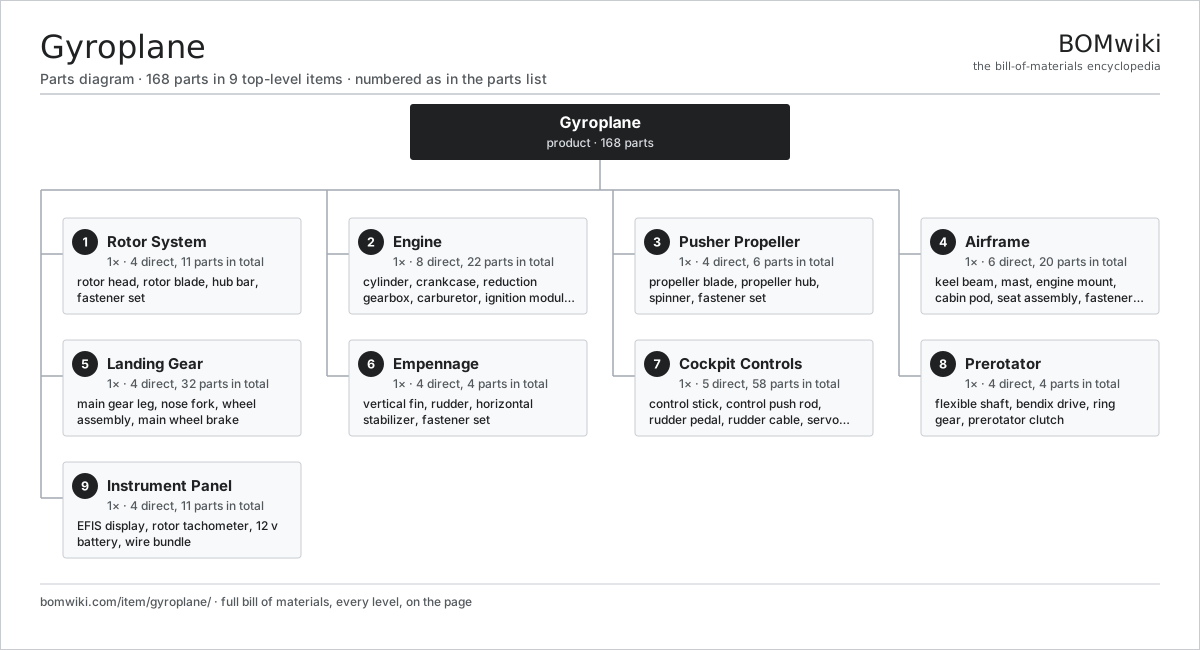
| # | Part | Qty | What it does |
|---|---|---|---|
| 1 | Rotor System 4 parts | 1× | Two-blade teetering rotor of 8.4 m diameter that autorotates at 300-400 rpm in flight. |
| 2 | Engine 8 parts | 1× | Four-cylinder turbocharged boxer engine of 85 kW driving the pusher propeller. |
| 3 | Pusher Propeller 4 parts | 1× | Three-blade composite pusher propeller behind the cabin. |
| 4 | Airframe 6 parts | 1× | Keel-and-mast structure carrying cabin, engine and rotor loads. |
| 5 | Landing Gear 4 parts | 1× | Fixed tricycle gear with steerable nosewheel. |
| 6 | Empennage 4 parts | 1× | Tail surfaces in the propeller slipstream giving yaw and pitch stability. |
| 7 | Cockpit Controls 5 parts | 1× | Stick, pedals and trim system linking the pilot to rotor head and rudder. |
| 8 | Prerotator 4 parts | 1× | Engine-driven spin-up system bringing the rotor to about 220 rpm before takeoff. |
| 9 | Instrument Panel 4 parts | 1× | Flight and engine instruments including the critical rotor tachometer. |
3D model
No 3D model yet. Have a CAD file of this? Add a 3D model. STL renders right on this page; STEP, FreeCAD, and OpenSCAD sources are welcome too (openly licensed, like all 3D models on BOMwiki).
Build & assembly graph
expand / collapse · shared sub-assemblies converge · links to related products · est. labourTap an assembly to expand/collapse · tap a part to open it · use “Open page” for any node · drag to pan, scroll to zoom.
Bill of materials for Gyroplane
9 top-level lines · 81 rows shown · 168 parts total · indented to 3 levels| # | Item / sub-assembly | Part no. | Qty/assy | Ext. qty | Parts | Type |
|---|---|---|---|---|---|---|
| 1 | Rotor System 4 parts | gyroplane-rotor-system | 1× | 1 | 11 | assembly |
| 1.1 | Rotor Head 5 parts | gyroplane-rotor-head | 1× | 1 | 7 | assembly |
| 1.1.1 | Teeter Block | gyroplane-teeter-block | 1× | 1 | · | part |
| 1.1.2 | Rotor Spindle | gyroplane-rotor-spindle | 1× | 1 | · | part |
| 1.1.3 | Pitch-Roll Gimbal | gyroplane-pitch-roll-gimbal | 1× | 1 | · | part |
| 1.1.4 | Ball Bearing | ball-bearing | 3× | 3 | · | part |
| 1.1.5 | Hall Sensor | hall-sensor | 1× | 1 | · | part |
| 1.2 | Rotor Blade | gyroplane-rotor-blade | 2× | 2 | · | part |
| 1.3 | Hub Bar | gyroplane-hub-bar | 1× | 1 | · | part |
| 1.4 | Fastener Set | fastener-set | 1× | 1 | · | part |
| 2 | Engine 8 parts | gyroplane-engine | 1× | 1 | 22 | assembly |
| 2.1 | Cylinder | gyroplane-cylinder | 4× | 4 | · | part |
| 2.2 | Crankcase | gyroplane-crankcase | 1× | 1 | · | part |
| 2.3 | Reduction Gearbox 5 parts | gyroplane-reduction-gearbox | 1× | 1 | 10 | assembly |
| 2.3.1 | Helical Gear Pair | gear-pair | 1× | 1 | · | part |
| 2.3.2 | Gearbox Housing | gearbox-housing | 1× | 1 | · | part |
| 2.3.3 | Coil Spring | coil-spring | 4× | 4 | · | part |
| 2.3.4 | Ball Bearing | ball-bearing | 2× | 2 | · | part |
| 2.3.5 | Oil Seal | oil-seal | 2× | 2 | · | part |
| 2.4 | Carburetor | gyroplane-carburetor | 2× | 2 | · | part |
| 2.5 | Ignition Module | gyroplane-ignition-module | 2× | 2 | · | part |
| 2.6 | Turbocharger | gyroplane-turbocharger | 1× | 1 | · | part |
| 2.7 | Radiator | radiator | 1× | 1 | · | part |
| 2.8 | Coolant Pump | coolant-pump | 1× | 1 | · | part |
| 3 | Pusher Propeller 4 parts | gyroplane-propeller | 1× | 1 | 6 | assembly |
| 3.1 | Propeller Blade | gyroplane-prop-blade | 3× | 3 | · | part |
| 3.2 | Propeller Hub | gyroplane-prop-hub | 1× | 1 | · | part |
| 3.3 | Spinner | gyroplane-spinner | 1× | 1 | · | part |
| 3.4 | Fastener Set | fastener-set | 1× | 1 | · | part |
| 4 | Airframe 6 parts | gyroplane-airframe | 1× | 1 | 20 | assembly |
| 4.1 | Keel Beam | gyroplane-keel-beam | 1× | 1 | · | part |
| 4.2 | Mast | gyroplane-mast | 1× | 1 | · | part |
| 4.3 | Engine Mount | gyroplane-engine-mount | 1× | 1 | · | part |
| 4.4 | Cabin Pod | gyroplane-cabin-pod | 1× | 1 | · | part |
| 4.5 | Seat Assembly 5 parts | seat-assembly | 2× | 2 | 7 | assembly |
| 4.5.1 | Seat Frame | seat-frame | 1× | 2 | · | part |
| 4.5.2 | Seat Foam | seat-foam | 2× | 4 | · | part |
| 4.5.3 | Seat Cover | seat-cover | 1× | 2 | · | part |
| 4.5.4 | Seat Motor | seat-motor | 2× | 4 | · | part |
| 4.5.5 | Seat Heater Mat | seat-heater | 1× | 2 | · | part |
| 4.6 | Fastener Set | fastener-set | 2× | 2 | · | part |
| 5 | Landing Gear 4 parts | gyroplane-landing-gear | 1× | 1 | 32 | assembly |
| 5.1 | Main Gear Leg | gyroplane-main-gear-leg | 2× | 2 | · | part |
| 5.2 | Nose Fork | gyroplane-nose-fork | 1× | 1 | · | part |
| 5.3 | Wheel Assembly 5 parts | wheel-assembly | 3× | 3 | 9 | assembly |
| 5.3.1 | Alloy Wheel | alloy-wheel | 1× | 3 | · | part |
| 5.3.2 | Tire | tire | 1× | 3 | · | part |
| 5.3.3 | TPMS Sensor | tpms-sensor | 1× | 3 | · | part |
| 5.3.4 | Lug Nut | lug-nut | 5× | 15 | · | part |
| 5.3.5 | Valve Stem | valve-stem | 1× | 3 | · | part |
| 5.4 | Main Wheel Brake | gyroplane-main-brake | 2× | 2 | · | part |
| 6 | Empennage 4 parts | gyroplane-empennage | 1× | 1 | 4 | assembly |
| 6.1 | Vertical Fin | gyroplane-vertical-fin | 1× | 1 | · | part |
| 6.2 | Rudder | gyroplane-rudder | 1× | 1 | · | part |
| 6.3 | Horizontal Stabilizer | gyroplane-horizontal-stabilizer | 1× | 1 | · | part |
| 6.4 | Fastener Set | fastener-set | 1× | 1 | · | part |
| 7 | Cockpit Controls 5 parts | gyroplane-controls | 1× | 1 | 58 | assembly |
| 7.1 | Control Stick | gyroplane-control-stick | 2× | 2 | · | part |
| 7.2 | Control Push Rod | gyroplane-push-rod | 4× | 4 | · | part |
| 7.3 | Rudder Pedal | gyroplane-rudder-pedal | 2× | 2 | · | part |
| 7.4 | Rudder Cable | gyroplane-rudder-cable | 2× | 2 | · | part |
| 7.5 | Servo Motor 4 parts | servo-motor | 2× | 2 | 24 | assembly |
| 7.5.1 | Stator Assembly 3 parts + deeper › | stator-assembly | 1× | 2 | 3 | assembly |
| 7.5.2 | Rotor Assembly 4 parts + deeper › | rotor-assembly | 1× | 2 | 19 | assembly |
| 7.5.3 | Encoder | encoder | 1× | 2 | · | part |
| 7.5.4 | Motor Housing | motor-housing | 1× | 2 | · | part |
| 8 | Prerotator 4 parts | gyroplane-prerotator | 1× | 1 | 4 | assembly |
| 8.1 | Flexible Shaft | gyroplane-flex-shaft | 1× | 1 | · | part |
| 8.2 | Bendix Drive | gyroplane-bendix-drive | 1× | 1 | · | part |
| 8.3 | Ring Gear | gyroplane-ring-gear | 1× | 1 | · | part |
| 8.4 | Prerotator Clutch | gyroplane-prerotator-clutch | 1× | 1 | · | part |
| 9 | Instrument Panel 4 parts | gyroplane-instruments | 1× | 1 | 11 | assembly |
| 9.1 | EFIS Display 5 parts | gyroplane-efis | 1× | 1 | 8 | assembly |
| 9.1.1 | LCD Panel | lcd-panel | 1× | 1 | · | part |
| 9.1.2 | Bare PCB | pcb-bare | 1× | 1 | · | part |
| 9.1.3 | Microcontroller | mcu | 1× | 1 | · | part |
| 9.1.4 | Pressure Sensor | pressure-sensor | 2× | 2 | · | part |
| 9.1.5 | Connector | connector | 3× | 3 | · | part |
| 9.2 | Rotor Tachometer | gyroplane-rotor-tach | 1× | 1 | · | part |
| 9.3 | 12 V Battery | lv-battery | 1× | 1 | · | part |
| 9.4 | Wire Bundle | wire-bundle | 1× | 1 | · | part |
Something wrong in this list? Report a problem with this BOM.
Related products
same domain, ranked by shared parts Ultralight Aircraft
455 parts · shares 25 with this page
Ultralight Aircraft
455 parts · shares 25 with this page
 Amphibious Seaplane
163 parts · shares 18 with this page
Amphibious Seaplane
163 parts · shares 18 with this page
 Business Jet
1,654 parts · shares 25 with this page
Business Jet
1,654 parts · shares 25 with this page
 Full-Flight Simulator
379 parts · shares 19 with this page
Full-Flight Simulator
379 parts · shares 19 with this page
 Sailplane Glider
139 parts · shares 15 with this page
Sailplane Glider
139 parts · shares 15 with this page
 Agricultural Aircraft
233 parts · shares 15 with this page
Agricultural Aircraft
233 parts · shares 15 with this page
Sourcing: possible vendors
Browse the supplier directory → Prices, MOQ, and lead times are algorithmic estimates, not quotes, and not claims about these companies. Company mappings are curated by keyword; est. price band $50k–$300M. How estimates work| Vendor | HQ | Specialty | MOQ | Lead time |
|---|---|---|---|---|
|
🇺🇸Boeing
boeing.com ↗
|
Arlington, US | Aerospace OEM | made to order | 40–80 wks |
|
🇫🇷Airbus
airbus.com ↗
|
Toulouse, FR | Aerospace OEM | made to order | 40–80 wks |
| lockheedmartin.com ↗ | Bethesda, US | Aerospace & defense | made to order | 40–80 wks |
|
🇧🇷Embraer
embraer.com ↗
|
São José dos Campos, BR | Aircraft OEM | made to order | 40–80 wks |
| txtav.com ↗ | Wichita, US | Aircraft OEM | made to order | 40–80 wks |
871-word article