Biplane
ProductOverview
A biplane is a fixed-wing aircraft with two main wings mounted one above the other. Stacking the wings lets the aircraft generate the needed lift in a much shorter span than a single wing of the same area, and bracing the two together into a rigid box makes that structure stiff without the heavy internal spar a long cantilever monoplane wing needs. This was decisive in early aviation when materials were weak: the biplane bought strength and roll authority cheaply, at the cost of the extra drag from struts and wires. The same configuration survives today in trainers, aerobatic mounts, and sport aircraft where ruggedness and slow, controllable handling matter more than top speed.
The structure breaks into a Wing Cellule, a Fuselage, a Empennage, a Powerplant, Landing Gear, Flight Controls, and the Cockpit. The wings and tail are mostly fabric over a frame, and the loads are carried by a welded steel-tube core and a lattice of bracing wires.
Wing cellule
The Wing Cellule is the defining assembly. An Upper Wing sits above a two-panel Lower Wing, joined by vertical Interplane Strut members and held to the fuselage by Cabane Strut supports. The two wings and struts form a box that Bracing Wire bracing triangulates into a rigid, light cell. Inside each wing, two Wing Spar members carry the bending load, around sixteen to eighteen built-up Wing Rib trusses set the airfoil, a plywood Leading Edge resists torsion, and a doped Fabric Covering forms the skin. Compression Strut members hold the spars apart against the wire tension. Roll control comes from an Aileron on each lower wing, swinging on Aileron Hinge fittings. The wings are usually set with positive stagger, the upper wing slightly forward, which improves the pilot view and the stall behaviour.
Fuselage and tail
The Fuselage is a welded Fuselage Truss of 4130 chromoly tube, a space frame that carries every major load between engine, wings, and tail. A stainless Firewall separates the engine bay, while Former and spruce Stringer strips build the rounded shape that the fabric covering follows, capped behind the cockpit by a plywood Turtle Deck. The Empennage gives stability and control: a fixed Horizontal Stabilizer and Vertical Fin provide pitch and yaw stability, while a hinged Elevator pair and a Rudder provide control, all braced by Tail Brace Wire wires and driven through Control Horn levers.
Powerplant
The classic Powerplant is a Radial Engine, an air-cooled piston engine with its cylinders arranged in a circle around the crankcase. Each finned Cylinder radiates around a cast Crankcase, the pistons drive through a single Master Rod that the others articulate from, and twin Magneto units feed the plugs for redundancy. A Carburettor meters the mixture, and the crank turns on Ball Bearing supports with an Oil Seal pair. Power reaches the air through a laminated wooden Propeller of fixed pitch. The engine hangs from a welded Engine Mount ring behind the firewall, an aluminium Cowling ducts cooling air over the cylinders, and a Fuel Tank and Oil Tank feed the dry-sump radial.
Landing gear and controls
The Landing Gear is a fixed tailwheel arrangement. Two streamlined Main Gear Leg vees carry a cross Axle and spoked Main Wheel units, with rubber Shock Bungee cord and a Coil Spring taking the landing shock. A steerable Tailwheel supports the rear and helps ground steering. The Flight Controls are a cable system: the Control Stick and Rudder Pedals pull Control Cable runs over Cable Pulley sheaves and Bellcrank levers to the surfaces, with Turnbuckle adjusters setting cable tension. The directness of cables to surfaces gives the crisp, immediate feel that makes biplanes good aerobatic aircraft.
Cockpit and use
The Cockpit is typically open, single or tandem, with a Seat sized for a parachute, a small acrylic Windscreen, a webbing Pilot Harness, and a Throttle Quadrant for throttle and mixture. The Instrument Panel carries airspeed, altimeter, tachometer, and oil gauges, fed by Pressure Sensor elements. Biplanes are flown today as trainers, in aerobatic competition, in agricultural and banner-towing work where the short span and rugged structure earn their keep, and on the warbird and sport circuit. Their strengths are slow, forgiving handling, short field performance, and structural toughness; their weakness is the parasitic drag of the braced wing cell, which caps cruise speed and is why monoplanes displaced them for fast transport.
Rigging and maintenance
A biplane is only as good as its rig. Each Bracing Wire is tensioned to a set value, and the whole Wing Cellule has to be trammelled so the wings sit at the correct gap, stagger, and incidence. A wire that is too slack lets the structure flex and lose its shape in flight, while one that is too tight preloads the Wing Spar members and adds drag. Because the airframe is fabric over wood and steel, it needs regular inspection for corrosion in the Fuselage Truss, rot in the spruce spars and Wing Rib trusses, and tears or loosening in the doped Fabric Covering. Owners recover the fabric every couple of decades and check the welds, fittings, and Turnbuckle wire ends each season. The Radial Engine adds its own routine: the lower Cylinder units can pool oil when parked, so the Propeller is pulled through by hand before start to clear any hydraulic lock that could bend the Master Rod. This hands-on upkeep is part of why biplanes endure as a hobbyist and heritage type even though their working role has shrunk to training, display, and a few agricultural and banner-tow operations.
Biplane parts and their functions
7 top-level parts · 177 parts in total · full bill of materials below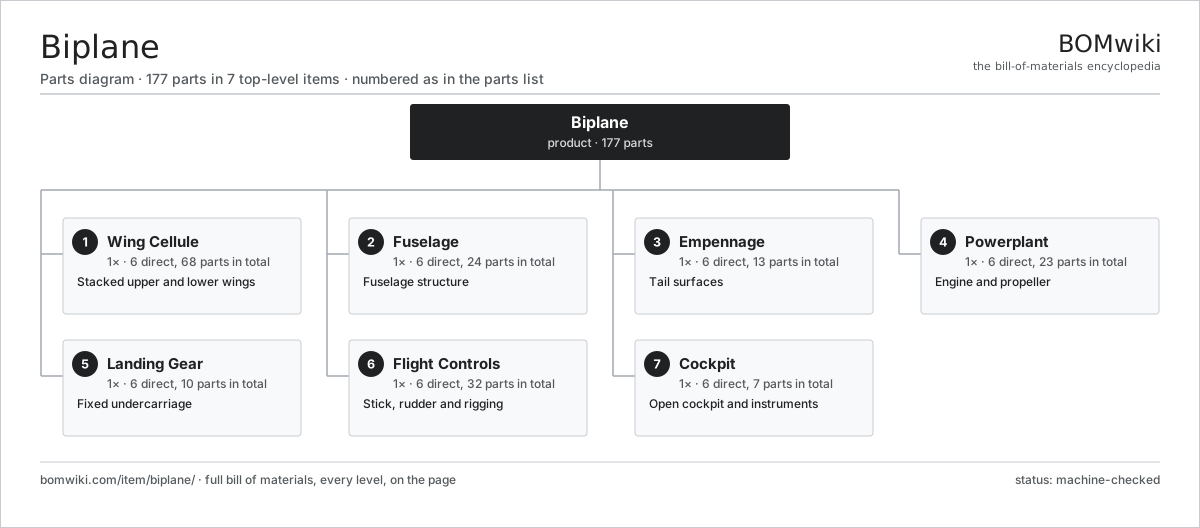
| # | Part | Qty | What it does |
|---|---|---|---|
| 1 | Wing Cellule 6 parts | 1× | Stacked upper and lower wings |
| 2 | Fuselage 6 parts | 1× | Fuselage structure |
| 3 | Empennage 6 parts | 1× | Tail surfaces |
| 4 | Powerplant 6 parts | 1× | Engine and propeller |
| 5 | Landing Gear 6 parts | 1× | Fixed undercarriage |
| 6 | Flight Controls 6 parts | 1× | Stick, rudder and rigging |
| 7 | Cockpit 6 parts | 1× | Open cockpit and instruments |
3D model
No 3D model yet. Have a CAD file of this? Add a 3D model. STL renders right on this page; STEP, FreeCAD, and OpenSCAD sources are welcome too (openly licensed, like all 3D models on BOMwiki).
Build & assembly graph
expand / collapse · shared sub-assemblies converge · links to related products · est. labourTap an assembly to expand/collapse · tap a part to open it · use “Open page” for any node · drag to pan, scroll to zoom.
Bill of materials for Biplane
7 top-level lines · 66 rows shown · 177 parts total · indented to 3 levels| # | Item / sub-assembly | Part no. | Qty/assy | Ext. qty | Parts | Type |
|---|---|---|---|---|---|---|
| 1 | Wing Cellule 6 parts | biplane-wing-cellule | 1× | 1 | 68 | assembly |
| 1.1 | Upper Wing 5 parts | biplane-upper-wing | 1× | 1 | 26 | assembly |
| 1.1.1 | Wing Spar | biplane-spar | 2× | 2 | · | part |
| 1.1.2 | Wing Rib | biplane-wing-rib | 18× | 18 | · | part |
| 1.1.3 | Leading Edge | biplane-leading-edge | 1× | 1 | · | part |
| 1.1.4 | Fabric Covering | biplane-fabric-covering | 1× | 1 | · | part |
| 1.1.5 | Compression Strut | biplane-compression-strut | 4× | 4 | · | part |
| 1.2 | Lower Wing 5 parts | biplane-lower-wing | 1× | 1 | 24 | assembly |
| 1.2.1 | Wing Spar | biplane-spar | 2× | 2 | · | part |
| 1.2.2 | Wing Rib | biplane-wing-rib | 16× | 16 | · | part |
| 1.2.3 | Leading Edge | biplane-leading-edge | 1× | 1 | · | part |
| 1.2.4 | Fabric Covering | biplane-fabric-covering | 1× | 1 | · | part |
| 1.2.5 | Aileron Hinge | biplane-aileron-hinge | 4× | 4 | · | part |
| 1.3 | Interplane Strut | biplane-interplane-strut | 4× | 4 | · | part |
| 1.4 | Cabane Strut | biplane-cabane-strut | 4× | 4 | · | part |
| 1.5 | Bracing Wire | biplane-flying-wire | 8× | 8 | · | part |
| 1.6 | Aileron | biplane-aileron | 2× | 2 | · | part |
| 2 | Fuselage 6 parts | biplane-fuselage | 1× | 1 | 24 | assembly |
| 2.1 | Fuselage Truss | biplane-fuselage-truss | 1× | 1 | · | part |
| 2.2 | Firewall | biplane-firewall | 1× | 1 | · | part |
| 2.3 | Former | biplane-formers | 8× | 8 | · | part |
| 2.4 | Stringer | biplane-stringer | 12× | 12 | · | part |
| 2.5 | Turtle Deck | biplane-turtle-deck | 1× | 1 | · | part |
| 2.6 | Fabric Covering | biplane-fabric-covering | 1× | 1 | · | part |
| 3 | Empennage 6 parts | biplane-empennage | 1× | 1 | 13 | assembly |
| 3.1 | Horizontal Stabilizer | biplane-horizontal-stabilizer | 1× | 1 | · | part |
| 3.2 | Elevator | biplane-elevator | 2× | 2 | · | part |
| 3.3 | Vertical Fin | biplane-vertical-fin | 1× | 1 | · | part |
| 3.4 | Rudder | biplane-rudder | 1× | 1 | · | part |
| 3.5 | Tail Brace Wire | biplane-tail-brace-wire | 4× | 4 | · | part |
| 3.6 | Control Horn | biplane-control-horn | 4× | 4 | · | part |
| 4 | Powerplant 6 parts | biplane-powerplant | 1× | 1 | 23 | assembly |
| 4.1 | Radial Engine 7 parts | biplane-radial-engine | 1× | 1 | 18 | assembly |
| 4.1.1 | Cylinder | biplane-cylinder | 7× | 7 | · | part |
| 4.1.2 | Master Rod | biplane-master-rod | 1× | 1 | · | part |
| 4.1.3 | Crankcase | biplane-crankcase | 1× | 1 | · | part |
| 4.1.4 | Magneto | biplane-magneto | 2× | 2 | · | part |
| 4.1.5 | Carburettor | biplane-carburetor | 1× | 1 | · | part |
| 4.1.6 | Ball Bearing | ball-bearing | 4× | 4 | · | part |
| 4.1.7 | Oil Seal | oil-seal | 2× | 2 | · | part |
| 4.2 | Propeller | biplane-propeller | 1× | 1 | · | part |
| 4.3 | Engine Mount | biplane-engine-mount | 1× | 1 | · | part |
| 4.4 | Cowling | biplane-cowling | 1× | 1 | · | part |
| 4.5 | Fuel Tank | biplane-fuel-tank | 1× | 1 | · | part |
| 4.6 | Oil Tank | biplane-oil-tank | 1× | 1 | · | part |
| 5 | Landing Gear 6 parts | biplane-landing-gear | 1× | 1 | 10 | assembly |
| 5.1 | Main Gear Leg | biplane-main-gear-leg | 2× | 2 | · | part |
| 5.2 | Axle | biplane-axle | 1× | 1 | · | part |
| 5.3 | Main Wheel | biplane-wheel | 2× | 2 | · | part |
| 5.4 | Shock Bungee | biplane-bungee | 2× | 2 | · | part |
| 5.5 | Tailwheel | biplane-tailwheel | 1× | 1 | · | part |
| 5.6 | Coil Spring | coil-spring | 2× | 2 | · | part |
| 6 | Flight Controls 6 parts | biplane-flight-controls | 1× | 1 | 32 | assembly |
| 6.1 | Control Stick | biplane-control-stick | 1× | 1 | · | part |
| 6.2 | Rudder Pedals | biplane-rudder-pedals | 1× | 1 | · | part |
| 6.3 | Control Cable | biplane-control-cable | 8× | 8 | · | part |
| 6.4 | Cable Pulley | biplane-pulley | 12× | 12 | · | part |
| 6.5 | Turnbuckle | biplane-turnbuckle | 8× | 8 | · | part |
| 6.6 | Bellcrank | biplane-bellcrank | 2× | 2 | · | part |
| 7 | Cockpit 6 parts | biplane-cockpit | 1× | 1 | 7 | assembly |
| 7.1 | Seat | biplane-seat | 1× | 1 | · | part |
| 7.2 | Windscreen | biplane-windscreen | 1× | 1 | · | part |
| 7.3 | Instrument Panel | biplane-instrument-panel | 1× | 1 | · | part |
| 7.4 | Pilot Harness | biplane-harness | 1× | 1 | · | part |
| 7.5 | Throttle Quadrant | biplane-throttle-quadrant | 1× | 1 | · | part |
| 7.6 | Pressure Sensor | pressure-sensor | 2× | 2 | · | part |
Related products
same domain, ranked by shared parts Bush Plane
415 parts · shares 2 with this page
Bush Plane
415 parts · shares 2 with this page
 Floatplane
813 parts · shares 2 with this page
Floatplane
813 parts · shares 2 with this page
 Flying Boat
4,224 parts · shares 2 with this page
Flying Boat
4,224 parts · shares 2 with this page
 Freighter Aircraft
6,717 parts · shares 2 with this page
Freighter Aircraft
6,717 parts · shares 2 with this page
 Gyroplane
168 parts · shares 2 with this page
Gyroplane
168 parts · shares 2 with this page
 Turboprop Airliner
3,298 parts · shares 2 with this page
Turboprop Airliner
3,298 parts · shares 2 with this page
Sourcing: possible vendors
Browse the supplier directory → Prices, MOQ, and lead times are algorithmic estimates, not quotes, and not claims about these companies. Company mappings are curated by keyword; est. price band $50k–$300M. How estimates work| Vendor | HQ | Specialty | MOQ | Lead time |
|---|---|---|---|---|
|
🇺🇸Boeing
boeing.com ↗
|
Arlington, US | Aerospace OEM | made to order | 40–80 wks |
|
🇫🇷Airbus
airbus.com ↗
|
Toulouse, FR | Aerospace OEM | made to order | 40–80 wks |
| lockheedmartin.com ↗ | Bethesda, US | Aerospace & defense | made to order | 40–80 wks |
|
🇧🇷Embraer
embraer.com ↗
|
São José dos Campos, BR | Aircraft OEM | made to order | 40–80 wks |
| txtav.com ↗ | Wichita, US | Aircraft OEM | made to order | 40–80 wks |
999-word article