Powered Paraglider
ProductOverview
A powered paraglider, or paramotor, is the simplest powered aircraft a person can launch on foot. It pairs a flexible ram-air Ram-Air Wing with a backpack Paramotor, so the pilot runs a few steps to inflate the canopy, the propeller pulls them forward, and the wing lifts them off. There is no fuselage, no undercarriage, and no runway. The whole machine folds into a car boot, and a flight needs only an open field and light wind.
The design splits cleanly into a soft part and a hard part. The soft part is the canopy and its lines, identical in principle to an unpowered paraglider. The hard part is the engine, Propeller Cage, frame and fuel, carried in the Harness & Frame on the pilot back. Thrust and the wing are deliberately decoupled: the engine only supplies forward speed, and the wing turns that speed into lift the same way it would in a glide.
The wing
The Ram-Air Wing is a ram-air aerofoil sewn from coated ripstop nylon. A Top Skin and Bottom Skin enclose around 40 Cell Rib panels that divide the wing into cells. Cell Intake intakes along the leading edge scoop air as the wing moves, pressurising every cell so the fabric holds a rigid aerofoil with no internal structure. Load runs from the canopy down a cascading Suspension Lines of sheathed aramid lines into four Riser straps at the harness. Paramotor wings add Reflex Rib sections at the trailing edge that give a reflex profile, keeping the wing pressurised and resistant to collapse under the extra speed and thrust that power adds.
Engine and drive
The Two-Stroke Engine is an air-cooled single-cylinder two-stroke of roughly 180 to 250 cc making 12 to 20 kW. A Nikasil-bored Cylinder runs a Piston on a forged Crankshaft, sealed by an Oil Seal pair and an O-Ring Set. Fuel comes from a Diaphragm Carburettor, a diaphragm type that meters correctly at any pitch attitude because the pilot is rarely level. A Recoil Starter starter, a Ignition Coil coil and a CDI Module module run the spark, and a tuned Tuned Exhaust scavenges the cylinder for power. The crankshaft turns far too fast for an efficient propeller, so a Reduction Drive belt drive on Ball Bearing supports steps the speed down through a Drive Pulley and Driven Pulley before the Drive Belt turns the Propeller, a composite pusher around 1.1 to 1.3 m across.
Cage and frame
Because the propeller spins inches from the pilot back and the suspension lines, a Propeller Cage is mandatory. A Cage Ring hoop carries Cage Netting across the propeller arc, braced by Cage Spoke members, and built from Cage Segment arcs so it can break down for transport with a Fastener Set. The cage and engine hang on a tubular Backpack Frame through Anti-Vibration Mount isolators that damp the two-stroke vibration. The pilot sits into a Pilot Seat, steers partly by leaning against a Weight-Shift Bar, and clips the risers to Harness Carabiner links. A Reserve Parachute parachute rides in a side container in case the canopy collapses too low to recover.
Fuel and controls
The Fuel System is deliberately simple. A translucent Fuel Tank of 9 to 13 L sits under the seat so the pilot can read the level in flight, feeding pre-mixed two-stroke fuel through a Fuel Line and Fuel Filter, primed on the ground with a Primer Bulb bulb. The pilot flies with a Hand Throttle in one hand, often cruise-lockable, and a Brake Toggle in each hand for turning and flaring the wing. A Kill Switch cuts ignition, and Trim Adjuster straps shift the wing between a slow, stable setting and a faster cruise. A Wire Bundle carries the throttle and kill signals.
Use and operation
Powered paragliders fly recreationally and for light work such as aerial photo, survey, and crop scouting. Endurance runs 2.5 to 4 hours on a tank, cruise sits around 35 to 55 km/h, and the unit weighs 22 to 34 kg, light enough to launch on foot. Operation is weather-limited: the soft wing wants light, smooth wind, so flights cluster around dawn and dusk when the air is calm. The flexible canopy can collapse in turbulence, which is why reflex profiling, careful active piloting, and a packed reserve all matter. Startup, layout, and a wing inflation check precede every launch, and the engine is shut down before the pilot unclips, since the propeller stays a hazard until it stops.
Powered Paraglider parts and their functions
6 top-level parts · 114 parts in total · full bill of materials below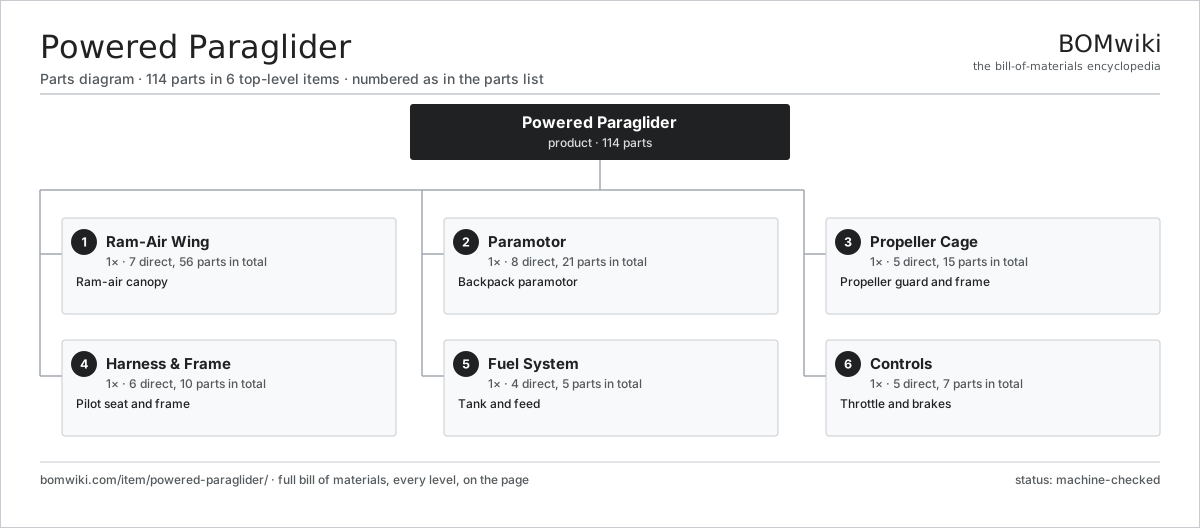
| # | Part | Qty | What it does |
|---|---|---|---|
| 1 | Ram-Air Wing 7 parts | 1× | Ram-air canopy |
| 2 | Paramotor 8 parts | 1× | Backpack paramotor |
| 3 | Propeller Cage 5 parts | 1× | Propeller guard and frame |
| 4 | Harness & Frame 6 parts | 1× | Pilot seat and frame |
| 5 | Fuel System 4 parts | 1× | Tank and feed |
| 6 | Controls 5 parts | 1× | Throttle and brakes |
3D model
No 3D model yet. Have a CAD file of this? Add a 3D model. STL renders right on this page; STEP, FreeCAD, and OpenSCAD sources are welcome too (openly licensed, like all 3D models on BOMwiki).
Build & assembly graph
expand / collapse · shared sub-assemblies converge · links to related products · est. labourTap an assembly to expand/collapse · tap a part to open it · use “Open page” for any node · drag to pan, scroll to zoom.
Bill of materials for Powered Paraglider
6 top-level lines · 51 rows shown · 114 parts total · indented to 3 levels| # | Item / sub-assembly | Part no. | Qty/assy | Ext. qty | Parts | Type |
|---|---|---|---|---|---|---|
| 1 | Ram-Air Wing 7 parts | powered-paraglider-wing | 1× | 1 | 56 | assembly |
| 1.1 | Top Skin | powered-paraglider-top-skin | 1× | 1 | · | part |
| 1.2 | Bottom Skin | powered-paraglider-bottom-skin | 1× | 1 | · | part |
| 1.3 | Cell Rib | powered-paraglider-rib | 40× | 40 | · | part |
| 1.4 | Cell Intake | powered-paraglider-cell-opening | 1× | 1 | · | part |
| 1.5 | Suspension Lines | powered-paraglider-line-set | 1× | 1 | · | part |
| 1.6 | Riser | powered-paraglider-riser | 4× | 4 | · | part |
| 1.7 | Reflex Rib | powered-paraglider-reflex-rib | 8× | 8 | · | part |
| 2 | Paramotor 8 parts | powered-paraglider-motor-unit | 1× | 1 | 21 | assembly |
| 2.1 | Two-Stroke Engine 7 parts | powered-paraglider-engine | 1× | 1 | 8 | assembly |
| 2.1.1 | Cylinder | powered-paraglider-cylinder | 1× | 1 | · | part |
| 2.1.2 | Piston | powered-paraglider-piston | 1× | 1 | · | part |
| 2.1.3 | Crankshaft | powered-paraglider-crankshaft | 1× | 1 | · | part |
| 2.1.4 | Diaphragm Carburettor | powered-paraglider-carburetor | 1× | 1 | · | part |
| 2.1.5 | Recoil Starter | powered-paraglider-recoil | 1× | 1 | · | part |
| 2.1.6 | Oil Seal | oil-seal | 2× | 2 | · | part |
| 2.1.7 | O-Ring Set | oring-set | 1× | 1 | · | part |
| 2.2 | Reduction Drive 3 parts | powered-paraglider-reduction | 1× | 1 | 4 | assembly |
| 2.2.1 | Drive Pulley | powered-paraglider-drive-pulley | 1× | 1 | · | part |
| 2.2.2 | Driven Pulley | powered-paraglider-driven-pulley | 1× | 1 | · | part |
| 2.2.3 | Ball Bearing | ball-bearing | 2× | 2 | · | part |
| 2.3 | Propeller | powered-paraglider-propeller | 1× | 1 | · | part |
| 2.4 | Tuned Exhaust | powered-paraglider-exhaust | 1× | 1 | · | part |
| 2.5 | Ignition Coil | powered-paraglider-ignition | 1× | 1 | · | part |
| 2.6 | CDI Module | powered-paraglider-cdi | 1× | 1 | · | part |
| 2.7 | Drive Belt | drive-belt | 1× | 1 | · | part |
| 2.8 | Ball Bearing | ball-bearing | 4× | 4 | · | part |
| 3 | Propeller Cage 5 parts | powered-paraglider-cage | 1× | 1 | 15 | assembly |
| 3.1 | Cage Ring | powered-paraglider-cage-ring | 1× | 1 | · | part |
| 3.2 | Cage Spoke | powered-paraglider-cage-spoke | 8× | 8 | · | part |
| 3.3 | Cage Netting | powered-paraglider-cage-netting | 1× | 1 | · | part |
| 3.4 | Cage Segment | powered-paraglider-cage-segment | 4× | 4 | · | part |
| 3.5 | Fastener Set | fastener-set | 1× | 1 | · | part |
| 4 | Harness & Frame 6 parts | powered-paraglider-harness | 1× | 1 | 10 | assembly |
| 4.1 | Backpack Frame | powered-paraglider-frame | 1× | 1 | · | part |
| 4.2 | Pilot Seat | powered-paraglider-seat | 1× | 1 | · | part |
| 4.3 | Weight-Shift Bar | powered-paraglider-comfort-bar | 1× | 1 | · | part |
| 4.4 | Anti-Vibration Mount | powered-paraglider-shock-mount | 4× | 4 | · | part |
| 4.5 | Harness Carabiner | powered-paraglider-carabiner | 2× | 2 | · | part |
| 4.6 | Reserve Parachute | powered-paraglider-reserve | 1× | 1 | · | part |
| 5 | Fuel System 4 parts | powered-paraglider-fuel-system | 1× | 1 | 5 | assembly |
| 5.1 | Fuel Tank | powered-paraglider-fuel-tank | 1× | 1 | · | part |
| 5.2 | Fuel Line | powered-paraglider-fuel-line | 2× | 2 | · | part |
| 5.3 | Primer Bulb | powered-paraglider-primer | 1× | 1 | · | part |
| 5.4 | Fuel Filter | powered-paraglider-fuel-filter | 1× | 1 | · | part |
| 6 | Controls 5 parts | powered-paraglider-controls | 1× | 1 | 7 | assembly |
| 6.1 | Hand Throttle | powered-paraglider-throttle | 1× | 1 | · | part |
| 6.2 | Brake Toggle | powered-paraglider-brake-toggle | 2× | 2 | · | part |
| 6.3 | Kill Switch | powered-paraglider-kill-switch | 1× | 1 | · | part |
| 6.4 | Trim Adjuster | powered-paraglider-trim | 2× | 2 | · | part |
| 6.5 | Wire Bundle | wire-bundle | 1× | 1 | · | part |
Related products
same domain, ranked by shared parts Floatplane
813 parts · shares 3 with this page
Floatplane
813 parts · shares 3 with this page
 Agricultural Helicopter
133 parts · shares 2 with this page
Agricultural Helicopter
133 parts · shares 2 with this page
 Paramotor
63 parts · shares 2 with this page
Paramotor
63 parts · shares 2 with this page
 Agricultural Aircraft
233 parts · shares 2 with this page
Agricultural Aircraft
233 parts · shares 2 with this page
 Aircraft APU
106 parts · shares 2 with this page
Aircraft APU
106 parts · shares 2 with this page
 Amphibious Seaplane
163 parts · shares 2 with this page
Amphibious Seaplane
163 parts · shares 2 with this page
Sourcing: possible vendors
Browse the supplier directory → Prices, MOQ, and lead times are algorithmic estimates, not quotes, and not claims about these companies. Company mappings are curated by keyword; est. price band $50k–$300M. How estimates work| Vendor | HQ | Specialty | MOQ | Lead time |
|---|---|---|---|---|
|
🇺🇸Boeing
boeing.com ↗
|
Arlington, US | Aerospace OEM | made to order | 40–80 wks |
|
🇫🇷Airbus
airbus.com ↗
|
Toulouse, FR | Aerospace OEM | made to order | 40–80 wks |
| lockheedmartin.com ↗ | Bethesda, US | Aerospace & defense | made to order | 40–80 wks |
|
🇧🇷Embraer
embraer.com ↗
|
São José dos Campos, BR | Aircraft OEM | made to order | 40–80 wks |
| txtav.com ↗ | Wichita, US | Aircraft OEM | made to order | 40–80 wks |
831-word article