Bicycle
ProductAlso known as: bike, pushbike, road bike, hybrid bike
Overview
A bicycle is the most efficient machine ever built for moving a person, and it does it with roughly a dozen named parts. The Frame and Fork are the structure. Two Bicycle Wheel assemblies carry it on the road. The Drivetrain turns the rider's pedalling into motion at the rear wheel, the Brake Set stop it, and the Handlebar and Saddle are where the rider holds on and sits. Between them are the small parts that make the structure movable: the headset that lets the fork steer, the stem that joins bars to fork, the seatpost that sets saddle height, and the bottom bracket the cranks spin on.
This page describes a road or hybrid bicycle with a diamond frame, 700c wheels and derailleur gears. Mountain bikes add suspension and wider tyres; single-speed and hub-geared bikes replace the derailleurs; an E-Bike adds a motor and battery to the same skeleton.
The parts of a bicycle and what each does
Frame. The Frame is the diamond of tubes everything attaches to: the top tube and down tube meet at the head tube in front and at the seat tube behind, with the seat tube dropping to the bottom bracket shell, and two pairs of thinner tubes, the seat stays and chain stays, running back to the rear wheel. It is a truss: every tube is loaded mainly in tension or compression, which is why a frame of 1.5 kg carries a 90 kg rider. Aluminium alloy is the usual material on this class of bike; steel is heavier and more comfortable, carbon fibre lighter and stiffer, titanium in between and expensive.
Fork. The Fork holds the front wheel and steers it. Two blades come down from a crown to the front hub, and a steerer tube rises from the crown through the frame's head tube. The fork blades are raked forward, and the angle of the steerer, the head angle, combined with that rake gives a bicycle its self-centring steering: let go of the bars and the front wheel straightens itself.
Headset. The Headset is the pair of bearings at the top and bottom of the head tube that the fork's steerer turns in. It is the one bearing on a bike loaded by every bump from the front wheel, and a loose or notchy headset is felt immediately as a knock or a wheel that wants to stay pointed straight.
Handlebar and stem. The Handlebar is the rider's steering input and second point of support. Drop bars on a road bike offer three hand positions; flat bars on a hybrid one. The Stem clamps the bar and bolts to the top of the fork steerer, and its length and angle set the rider's reach. Brake and shift levers mount on the bar.
Wheels. Each Bicycle Wheel is a tensioned structure that is stronger for its weight than anything else on the bike. The Rim is an aluminium or carbon hoop with a bead seat for the tyre and a brake track or disc mount. Thirty-two or so steel Spoke wires run from the rim to flanges on the Hub, each pulled to around 100 kg of tension; the wheel holds the rider because the spokes above the hub are pulling, not because the spokes below are pushing. The Hub is a Hub Shell spinning on two sets of Ball Bearing around a fixed Axle; the rear hub also carries the freehub body that the cassette slides onto and that lets the wheel coast. The Bicycle Tire is a fabric-and-rubber casing with a bead that hooks under the rim edge, inflated to 4 to 7 bar by an Inner Tube or, on tubeless setups, sealed directly against the rim.
Drivetrain. The Drivetrain carries power from feet to rear wheel. The rider's feet push Pedal pairs on the arms of the Crankset, which turns on the bottom bracket bearings and carries one or two chainrings. A roller Chain runs from a chainring to one of the sprockets on the Cassette at the rear hub, and a Derailleur at each end moves the chain sideways between rings and sprockets to change gear. On this bike a compact 50/34 crankset and a nine-speed cassette give eighteen gears, from a low around 34 by 32 for climbing to a high of 50 by 11 for descending.
Bottom bracket. The Bottom Bracket is the bearing set in the frame's bottom bracket shell that the crank spindle turns on. It takes the full pedalling load at every stroke and is the bearing most often replaced.
Shifters. The Shifter levers on the handlebar pull or release a cable in indexed clicks, and each click moves a derailleur exactly one gear. On road bikes the shifters are integrated with the brake levers; electronic shifters replace the cable with a wire or radio link and a small motor at each derailleur.
Brakes. The Brake Set are a caliper at each wheel. Pulling a Brake Lever on the bar tensions a Brake Cable, and the Brake Caliper squeezes a pair of Brake Pad Set blocks against the rim's brake track or, on disc brakes, against a steel rotor bolted to the hub. Hydraulic disc brakes replace the cable with a sealed fluid line and are now standard on all but the lightest road bikes.
Saddle and seatpost. The Saddle is a shaped shell on two rails, padded and covered, and the Seatpost is the tube it clamps to, which slides into the frame's seat tube and is fixed at the height that puts the rider's leg almost straight at the bottom of the stroke. Saddle height is the single adjustment that most affects comfort and power.
How a bicycle works
The rider pushes the pedals in circles; the cranks turn the chainring, the chain turns the cassette, and the cassette turns the rear wheel. Gearing sets the ratio: in a high gear one turn of the pedals turns the wheel three or four times for speed on the flat, in a low gear barely once for climbing. The front wheel is steered through the fork and headset, but the bicycle stays upright mainly by the rider's small steering corrections and the geometry that makes the front wheel turn into a lean, not by gyroscopic effect. The wheels' tension structure absorbs the road; the frame's truss carries the loads; and because a bicycle has no engine and weighs a tenth of its rider, almost all the energy the rider puts in ends up as motion, which is why a person on a bicycle is the most efficient traveller in the animal kingdom.
Materials
Frames and forks are 6061 or 7005 aluminium, chromoly steel, carbon fibre or titanium. Rims are aluminium or carbon, spokes stainless steel, hubs aluminium with steel bearings. The drivetrain is steel and aluminium with a chain of hardened steel plates and rollers. Tyres are nylon or cotton casing under vulcanised rubber with a Kevlar or steel bead. Saddles are nylon shells with foam or gel under leather or synthetic cover.
Common failures
Punctures, by far. Then a worn chain, which stretches with use and, left too long, wears the cassette and chainrings to match; a chain checker tells when to change it. Brake pads wear and are replaced in minutes. Cables stretch and gears drift out of index, fixed with a quarter turn of the barrel adjuster. Bearings in the bottom bracket, hubs and headset wear over years and are replaced. Rims wear where the brakes rub on rim-brake bikes. A crashed frame is inspected for cracks and, if carbon, often retired.
Common questions
What are the parts of a bicycle called?
Frame, fork, headset, stem, handlebar, brake levers and shifters, wheels (rim, spokes, hub, tyre, inner tube), drivetrain (pedals, cranks and chainrings, bottom bracket, chain, cassette, front and rear derailleurs), brakes (calipers, pads, cables or hoses), saddle and seatpost.
How many gears does a bicycle have?
Multiply the chainrings by the sprockets: two rings and a nine-speed cassette give eighteen. Modern road bikes run one or two rings with eleven or twelve sprockets; single-speed bikes have one gear and no derailleurs.
What holds a bicycle wheel together?
Spoke tension. Each spoke is tightened to roughly 100 kg, and the rim is held round by the balance of those pulls. The wheel carries load by the spokes at the top pulling the hub up, not by the spokes at the bottom pushing.
What part of a bike wears out first?
The tyres and the chain. A chain lasts 3,000 to 8,000 km depending on care; replacing it on time saves the cassette and chainrings, which cost far more.
What is the difference between a road bike and a hybrid?
Geometry and contact points. A road bike has drop bars, narrow tyres at high pressure and a lower, longer position; a hybrid has flat bars, wider tyres and an upright position. The parts list is otherwise the same.
Bicycle parts and their functions
12 top-level parts · 100 parts in total · full bill of materials below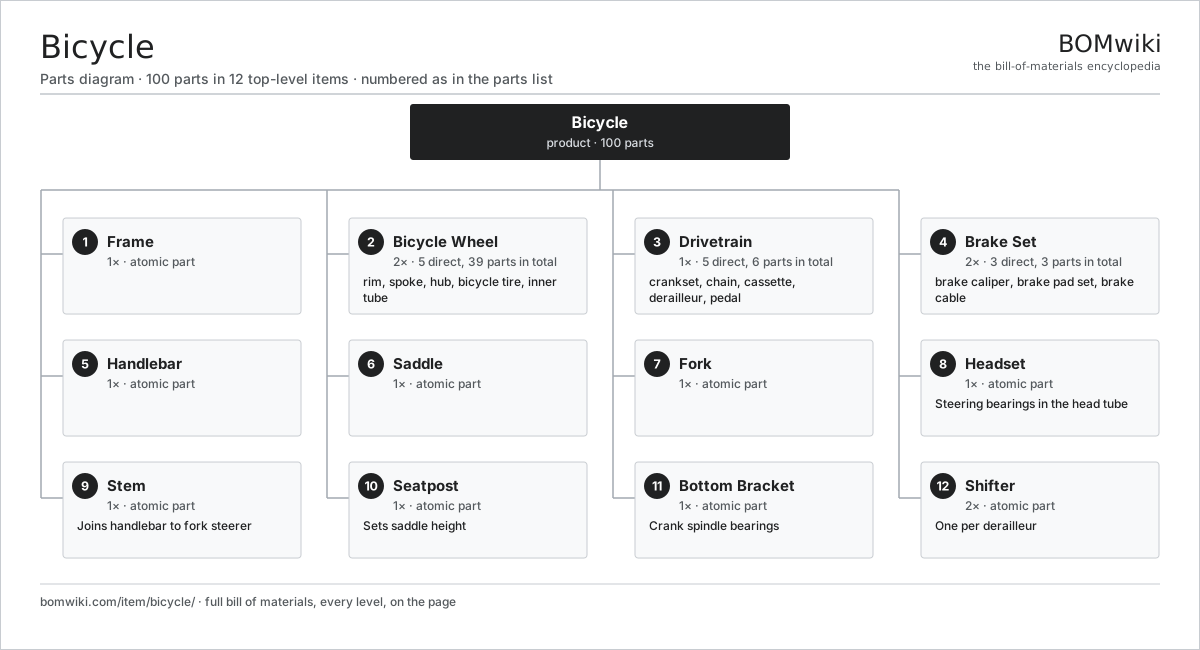
| # | Part | Qty | What it does |
|---|---|---|---|
| 1 | Frame | 1× | |
| 2 | Bicycle Wheel 5 parts | 2× | |
| 3 | Drivetrain 5 parts | 1× | |
| 4 | Brake Set 3 parts | 2× | |
| 5 | Handlebar | 1× | |
| 6 | Saddle | 1× | |
| 7 | Fork | 1× | |
| 8 | Headset | 1× | Steering bearings in the head tube |
| 9 | Stem | 1× | Joins handlebar to fork steerer |
| 10 | Seatpost | 1× | Sets saddle height |
| 11 | Bottom Bracket | 1× | Crank spindle bearings |
| 12 | Shifter | 2× | One per derailleur |
3D model
No 3D model yet. Have a CAD file of this? Add a 3D model. STL renders right on this page; STEP, FreeCAD, and OpenSCAD sources are welcome too (openly licensed, like all 3D models on BOMwiki).
Build & assembly graph
expand / collapse · shared sub-assemblies converge · links to related products · est. labourTap an assembly to expand/collapse · tap a part to open it · use “Open page” for any node · drag to pan, scroll to zoom.
Bill of materials for Bicycle
12 top-level lines · 28 rows shown · 100 parts total · indented to 3 levels| # | Item / sub-assembly | Part no. | Qty/assy | Ext. qty | Parts | Type |
|---|---|---|---|---|---|---|
| 1 | Frame | bike-frame | 1× | 1 | · | part |
| 2 | Bicycle Wheel 5 parts | bike-wheel | 2× | 2 | 39 | assembly |
| 2.1 | Rim | bike-rim | 1× | 2 | · | part |
| 2.2 | Spoke | spoke | 32× | 64 | · | part |
| 2.3 | Hub 3 parts | bike-hub | 1× | 2 | 4 | assembly |
| 2.3.1 | Hub Shell | hub-shell | 1× | 2 | · | part |
| 2.3.2 | Ball Bearing | ball-bearing | 2× | 4 | · | part |
| 2.3.3 | Axle | axle | 1× | 2 | · | part |
| 2.4 | Bicycle Tire | bike-tire | 1× | 2 | · | part |
| 2.5 | Inner Tube | inner-tube | 1× | 2 | · | part |
| 3 | Drivetrain 5 parts | drivetrain | 1× | 1 | 6 | assembly |
| 3.1 | Crankset | crankset | 1× | 1 | · | part |
| 3.2 | Chain | chain | 1× | 1 | · | part |
| 3.3 | Cassette | cassette | 1× | 1 | · | part |
| 3.4 | Derailleur | derailleur | 1× | 1 | · | part |
| 3.5 | Pedal | pedal | 2× | 2 | · | part |
| 4 | Brake Set 3 parts | bike-brakes | 2× | 2 | 3 | assembly |
| 4.1 | Brake Caliper | brake-caliper-bike | 1× | 2 | · | part |
| 4.2 | Brake Pad Set | brake-pad-set | 1× | 2 | · | part |
| 4.3 | Brake Cable | brake-cable | 1× | 2 | · | part |
| 5 | Handlebar | handlebar-bike | 1× | 1 | · | part |
| 6 | Saddle | bike-saddle | 1× | 1 | · | part |
| 7 | Fork | bike-fork | 1× | 1 | · | part |
| 8 | Headset | bike-headset | 1× | 1 | · | part |
| 9 | Stem | bike-stem | 1× | 1 | · | part |
| 10 | Seatpost | bike-seatpost | 1× | 1 | · | part |
| 11 | Bottom Bracket | bike-bottom-bracket | 1× | 1 | · | part |
| 12 | Shifter | bike-shifter | 2× | 2 | · | part |
Something wrong in this list? Report a problem with this BOM.
Related products
same domain, ranked by shared parts


Sourcing: possible vendors
Browse the supplier directory → Prices, MOQ, and lead times are algorithmic estimates, not quotes, and not claims about these companies. Company mappings are curated by keyword; est. price band $200–$12k. How estimates work| Vendor | HQ | Specialty | MOQ | Lead time |
|---|---|---|---|---|
|
🇹🇼Giant
giant-bicycles.com ↗
|
Taichung, TW | Bicycles | 500 units | 6–12 wks |
|
🇺🇸Trek
trekbikes.com ↗
|
Waterloo, US | Bicycles | 500 units | 6–12 wks |
| specialized.com ↗ | Morgan Hill, US | Bicycles | 500 units | 6–12 wks |
| cannondale.com ↗ | Wilton, US | Bicycles | 500 units | 6–12 wks |
| herocycles.com ↗ | Ludhiana, IN | bicycles | 500 units | 6–12 wks |
1,533-word article