Cycle Rickshaw
ProductOverview
A cycle rickshaw is a human-powered three-wheeled vehicle built to carry fare-paying passengers over short distances. The driver sits at the front and pedals, while one or two passengers ride on a bench behind, shaded by a folding canopy. The design has served dense towns and cities across South and Southeast Asia for over a century because it is cheap to build, simple to repair, and able to thread through narrow lanes and congested markets where larger vehicles cannot pass.
The vehicle splits into a forward rider section and a rear passenger section, joined by a single welded steel chassis. The Frame Assembly carries the pedal drivetrain and the steering up front, and the Passenger Seat and rear axle at the back. The single front wheel is steered and is not driven; drive goes only to the two rear wheels. Above the seat sits a folding hood that protects passengers from sun and rain.
Frame and layout
The Main Frame is a forward triangle of mild-steel tube around 25 mm in diameter, holding the head tube, the bottom bracket shell, and the seat post for the driver. Behind it, the Rear Platform is a heavier rectangular frame of 28 mm tube that spans the rear track and supports both the passenger bench and the live axle. Two axle brackets are welded to the platform to clamp the axle bearing housings, and two seat pillars rise vertically to anchor the backrest and the canopy hoops. A Foot Board gives passengers a flat surface for their feet. The whole structure is deliberately overbuilt in steel so that village welders can repair it with basic equipment, trading weight for serviceability. Joints are gas-welded rather than brazed, and the tube gauge is heavier than a bicycle would use, since the vehicle spends its life under near-constant load on rough surfaces. Mounting points for the seat, the canopy, and the brakes are all welded directly to the frame, which means a worn bracket is repaired by grinding and re-welding rather than by ordering a replacement part.
Drive and rear axle
Propulsion begins at the crank set, 170 mm steel arms turning a 46-tooth chainwheel. The rider pushes rubber-block pedals mounted on the cranks, which spin in the Bottom Bracket. A long Chain runs rearward to an 18-tooth sprocket on the rear axle, giving a roughly 2.5:1 reduction that favours torque over top speed, the right choice for moving a loaded vehicle from rest.
The Rear Axle Assembly is the part that most distinguishes a cycle rickshaw from a bicycle. Rather than a differential, it uses a single solid live axle that ties both rear wheels together. Both wheels turn at the same speed at all times. This makes the axle cheap and almost maintenance-free, at the cost of some tyre scrub during tight turns since the inside and outside wheels are forced through the same rotation. The axle runs in cartridge bearings inside two bearing housings, sealed by grease seals. A freewheel ratchet lets the driver coast downhill without the pedals spinning back.
Wheels and steering
The Front Wheel is a 26-inch spoked wheel with a 1.75-inch tyre, laced on a plain hub with 36 spokes. The two rear wheels are smaller at 24 inches but built on a heavier rim with a 2.0-inch load tyre, because they carry the passenger weight. Steering is direct and simple: the rider turns the wide Handlebar, which rotates the Front Fork in the Head Tube through a cup-and-cone Headset. The wide bar gives the leverage needed for low-speed manoeuvring through crowds.
Seating and weather protection
The Passenger Seat is a welded bench frame around 900 mm wide, topped with a coir or foam cushion and a padded Backrest. Two springs under the bench soften the ride over rough streets, and side rails give passengers a handhold. Over the seat, the Canopy Assembly uses three nesting steel bows carrying a coated canvas cover. The hood folds back on pivot hinges in fair weather, and roll-down curtains close off the sides against driving rain.
Braking and use
Braking is split between a front rim caliper and a rear band brake on the live axle, both pulled by handlebar levers through cables. The band brake supplies most of the stopping force because the rear axle carries the load. Cycle rickshaws operate at walking-to-jogging pace and stop frequently, so the brakes prioritise reliability and easy adjustment over outright power. In recent decades many operators have added a small electric hub motor and battery to ease pedalling on inclines, creating the electric rickshaw, but the pedal version remains common for its near-zero running cost.
Cycle Rickshaw parts and their functions
8 top-level parts · 175 parts in total · full bill of materials below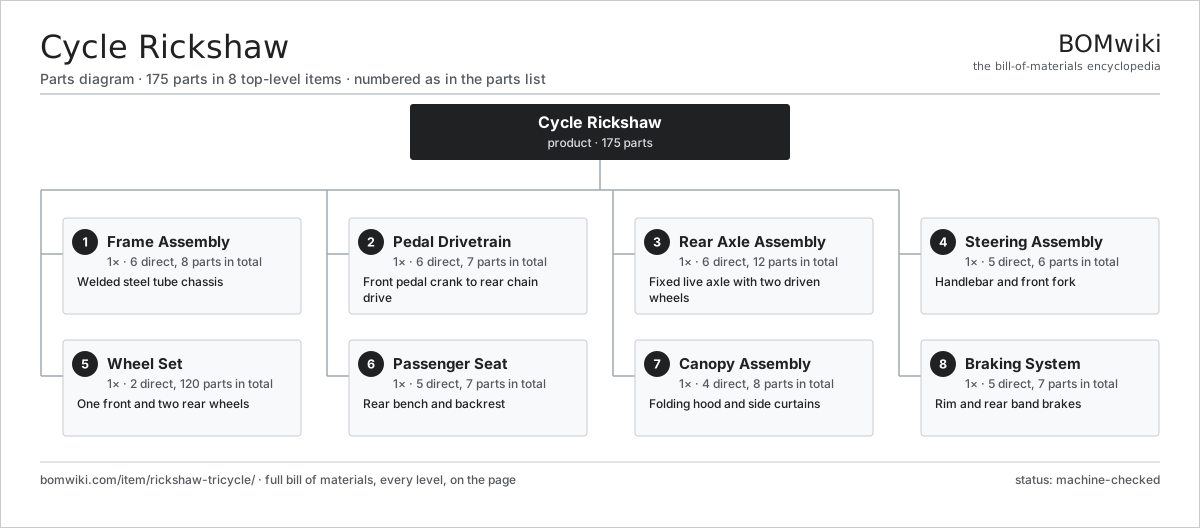
| # | Part | Qty | What it does |
|---|---|---|---|
| 1 | Frame Assembly 6 parts | 1× | Welded steel tube chassis |
| 2 | Pedal Drivetrain 6 parts | 1× | Front pedal crank to rear chain drive |
| 3 | Rear Axle Assembly 6 parts | 1× | Fixed live axle with two driven wheels |
| 4 | Steering Assembly 5 parts | 1× | Handlebar and front fork |
| 5 | Wheel Set 2 parts | 1× | One front and two rear wheels |
| 6 | Passenger Seat 5 parts | 1× | Rear bench and backrest |
| 7 | Canopy Assembly 4 parts | 1× | Folding hood and side curtains |
| 8 | Braking System 5 parts | 1× | Rim and rear band brakes |
3D model
No 3D model yet. Have a CAD file of this? Add a 3D model. STL renders right on this page; STEP, FreeCAD, and OpenSCAD sources are welcome too (openly licensed, like all 3D models on BOMwiki).
Build & assembly graph
expand / collapse · shared sub-assemblies converge · links to related products · est. labourTap an assembly to expand/collapse · tap a part to open it · use “Open page” for any node · drag to pan, scroll to zoom.
Bill of materials for Cycle Rickshaw
8 top-level lines · 57 rows shown · 175 parts total · indented to 3 levels| # | Item / sub-assembly | Part no. | Qty/assy | Ext. qty | Parts | Type |
|---|---|---|---|---|---|---|
| 1 | Frame Assembly 6 parts | rickshaw-tricycle-frame | 1× | 1 | 8 | assembly |
| 1.1 | Main Frame | rickshaw-tricycle-main-frame | 1× | 1 | · | part |
| 1.2 | Rear Platform | rickshaw-tricycle-rear-platform | 1× | 1 | · | part |
| 1.3 | Axle Bracket | rickshaw-tricycle-axle-bracket | 2× | 2 | · | part |
| 1.4 | Seat Pillar | rickshaw-tricycle-seat-pillar | 2× | 2 | · | part |
| 1.5 | Foot Board | rickshaw-tricycle-foot-board | 1× | 1 | · | part |
| 1.6 | Fastener Set | fastener-set | 1× | 1 | · | part |
| 2 | Pedal Drivetrain 6 parts | rickshaw-tricycle-drivetrain | 1× | 1 | 7 | assembly |
| 2.1 | Crank Set | rickshaw-tricycle-crank | 1× | 1 | · | part |
| 2.2 | Pedal | rickshaw-tricycle-pedal | 2× | 2 | · | part |
| 2.3 | Chainwheel | rickshaw-tricycle-chainwheel | 1× | 1 | · | part |
| 2.4 | Chain | chain | 1× | 1 | · | part |
| 2.5 | Axle Sprocket | rickshaw-tricycle-axle-sprocket | 1× | 1 | · | part |
| 2.6 | Bottom Bracket | rickshaw-tricycle-bottom-bracket | 1× | 1 | · | part |
| 3 | Rear Axle Assembly 6 parts | rickshaw-tricycle-rear-axle | 1× | 1 | 12 | assembly |
| 3.1 | Live Axle | rickshaw-tricycle-live-axle | 1× | 1 | · | part |
| 3.2 | Axle Bearing Housing | rickshaw-tricycle-axle-bearing-housing | 2× | 2 | · | part |
| 3.3 | Ball Bearing | ball-bearing | 4× | 4 | · | part |
| 3.4 | Wheel Hub | rickshaw-tricycle-wheel-hub | 2× | 2 | · | part |
| 3.5 | Freewheel Ratchet | rickshaw-tricycle-freewheel-ratchet | 1× | 1 | · | part |
| 3.6 | Oil Seal | oil-seal | 2× | 2 | · | part |
| 4 | Steering Assembly 5 parts | rickshaw-tricycle-steering | 1× | 1 | 6 | assembly |
| 4.1 | Handlebar | rickshaw-tricycle-handlebar | 1× | 1 | · | part |
| 4.2 | Front Fork | rickshaw-tricycle-fork | 1× | 1 | · | part |
| 4.3 | Head Tube | rickshaw-tricycle-head-tube | 1× | 1 | · | part |
| 4.4 | Headset | rickshaw-tricycle-headset | 1× | 1 | · | part |
| 4.5 | Hand Grip | rickshaw-tricycle-grip | 2× | 2 | · | part |
| 5 | Wheel Set 2 parts | rickshaw-tricycle-wheel-set | 1× | 1 | 120 | assembly |
| 5.1 | Front Wheel 6 parts | rickshaw-tricycle-front-wheel | 1× | 1 | 42 | assembly |
| 5.1.1 | Rim | bike-rim | 1× | 1 | · | part |
| 5.1.2 | Spoke | spoke | 36× | 36 | · | part |
| 5.1.3 | Hub Shell | hub-shell | 1× | 1 | · | part |
| 5.1.4 | Ball Bearing | ball-bearing | 2× | 2 | · | part |
| 5.1.5 | Bicycle Tire | bike-tire | 1× | 1 | · | part |
| 5.1.6 | Inner Tube | inner-tube | 1× | 1 | · | part |
| 5.2 | Rear Wheel 4 parts | rickshaw-tricycle-rear-wheel | 2× | 2 | 39 | assembly |
| 5.2.1 | Rear Rim | rickshaw-tricycle-rear-rim | 1× | 2 | · | part |
| 5.2.2 | Spoke | spoke | 36× | 72 | · | part |
| 5.2.3 | Rear Tyre | rickshaw-tricycle-rear-tyre | 1× | 2 | · | part |
| 5.2.4 | Inner Tube | inner-tube | 1× | 2 | · | part |
| 6 | Passenger Seat 5 parts | rickshaw-tricycle-passenger-seat | 1× | 1 | 7 | assembly |
| 6.1 | Seat Frame | rickshaw-tricycle-seat-frame | 1× | 1 | · | part |
| 6.2 | Seat Cushion | rickshaw-tricycle-seat-cushion | 1× | 1 | · | part |
| 6.3 | Backrest | rickshaw-tricycle-backrest | 1× | 1 | · | part |
| 6.4 | Coil Spring | coil-spring | 2× | 2 | · | part |
| 6.5 | Armrest | rickshaw-tricycle-armrest | 2× | 2 | · | part |
| 7 | Canopy Assembly 4 parts | rickshaw-tricycle-canopy | 1× | 1 | 8 | assembly |
| 7.1 | Canopy Bow | rickshaw-tricycle-canopy-bow | 3× | 3 | · | part |
| 7.2 | Canopy Fabric | rickshaw-tricycle-canopy-fabric | 1× | 1 | · | part |
| 7.3 | Side Curtain | rickshaw-tricycle-side-curtain | 2× | 2 | · | part |
| 7.4 | Canopy Hinge | rickshaw-tricycle-canopy-hinge | 2× | 2 | · | part |
| 8 | Braking System 5 parts | rickshaw-tricycle-braking | 1× | 1 | 7 | assembly |
| 8.1 | Front Rim Brake | rickshaw-tricycle-front-brake | 1× | 1 | · | part |
| 8.2 | Rear Band Brake | rickshaw-tricycle-rear-band-brake | 1× | 1 | · | part |
| 8.3 | Brake Lever | brake-lever | 2× | 2 | · | part |
| 8.4 | Brake Cable | brake-cable | 2× | 2 | · | part |
| 8.5 | Brake Pad Set | brake-pad-set | 1× | 1 | · | part |
Related products
same domain, ranked by shared parts


Sourcing: possible vendors
Browse the supplier directory → Prices, MOQ, and lead times are algorithmic estimates, not quotes, and not claims about these companies. Company mappings are curated by keyword; est. price band $200–$12k. How estimates work| Vendor | HQ | Specialty | MOQ | Lead time |
|---|---|---|---|---|
|
🇹🇼Giant
giant-bicycles.com ↗
|
Taichung, TW | Bicycles | 500 units | 6–12 wks |
|
🇺🇸Trek
trekbikes.com ↗
|
Waterloo, US | Bicycles | 500 units | 6–12 wks |
| specialized.com ↗ | Morgan Hill, US | Bicycles | 500 units | 6–12 wks |
|
🇹🇼Merida
merida-bikes.com ↗
|
Yuanlin, TW | Bicycles | 500 units | 6–12 wks |
| cannondale.com ↗ | Wilton, US | Bicycles | 500 units | 6–12 wks |
937-word article