Intraoral Camera
ProductOverview
An intraoral camera is a pen-sized video camera a dentist moves around inside the patient's mouth, streaming live close-up images to the chairside monitor. Its diagnostic value is straightforward, a fractured cusp, a failing margin, or a lingual lesion that is hard to see directly fills a 24-inch screen at up to 100× effective magnification, but its biggest documented effect is on communication: patients who see their own cracked amalgam accept treatment they would have declined on a dentist's verbal description. Captured frames go into the chart as legal documentation and insurance evidence, alongside radiographs they complement (the camera sees surfaces; X-rays see inside).
Optics
Everything optical is packed into the last 15 mm of the wand. Behind a sealed Sapphire Tip Window of sapphire, chosen because it shrugs off contact with enamel and rotary instruments, a View Prism folds the optical axis 90° so the side-facing tip looks down onto occlusal surfaces the way a mouth mirror would. The multi-element Lens Assembly focuses onto a 1/4-inch CMOS Image Sensor running 1080p at 30 frames per second.
Focus is the interesting engineering problem: the camera must resolve a single molar cusp at 5 mm and a full arch at 50 mm, inside a wand too thin for a conventional voice-coil focus mechanism. Current designs use a Liquid Autofocus Lens, an electrowetting cell in which a voltage reshapes the meniscus between two immiscible liquids, changing focal power in milliseconds with no moving parts, no wear, and no susceptibility to autoclave-adjacent thermal cycling. An IR-Cut Filter keeps infrared out of the color path so tooth shades on screen match reality, which matters when the screen image is used for restorative shade discussion.
Illumination and fluorescence
The mouth is dark, wet, and specular, so the camera carries its own light: a ring of six to eight White LED Die dies around the lens, behind a Diffuser Ring that spreads the output so wet enamel does not throw blown-out hot spots into the image. High color rendering (CRI above 90) at roughly 5500 K is specified for the same shade-fidelity reason as the IR filter.
Many models add a second mode. Switching the LED Driver to the 405 nm Violet LED (405 nm) pair excites tissue fluorescence: healthy enamel fluoresces green, while demineralized carious tissue, and the porphyrins produced by cariogenic bacteria in plaque and calculus, fluoresce red. With a matched filter this turns the camera into a screening tool for early occlusal caries and residual plaque, catching lesions before they are radiographically obvious.
Image pipeline and interface
The Sensor Flex Cable carries raw MIPI sensor data down the narrow Tip Neck to the ISP Board, where a Compute SoC Module performs demosaic, white balance, and correction of the wide-angle lens distortion, then encodes the stream as a standard UVC webcam device over the USB Cable. UVC compliance is deliberate: the camera works with any imaging or practice-management software without drivers. Wireless variants swap the cable for a Wi-Fi Module and an in-wand LiPo Cell, trading a charging requirement for a cordless field of movement around the chair.
Capture ergonomics assume gloved, busy hands. The Capture Button freezes the live frame so the dentist can inspect before saving; the Motion Sensor wakes the camera when lifted from its Wand Holder and enables hold-still auto-capture, so a steady two-second hover photographs the tooth with no button press at all. Docking the wand pauses the stream and shields the tip window.
Infection control
The wand sits in a patient's mouth, so the hygiene system is as central as the optics. Before every patient, a single-use Disposable Barrier Sleeve, a polyethylene barrier with an optically clear window panel, is drawn over the whole wand from the Sleeve Dispenser Box; the Sleeve Retention Collar tensions the window flat against the lens so the barrier never wrinkles into the image. Between patients the sleeved-then-stripped wand still gets an intermediate-level disinfectant wipe, which is why the Wand Shell is sealed with an O-Ring Set and finished in chemical-resistant polymer. The sleeve is a regulated medical barrier (FDA Class I), and skipping it is an infection-control violation, not a shortcut, the camera cannot be autoclaved.
Place in the operatory
Intraoral cameras occupy the documentation-and-communication niche between the mouth mirror and the intraoral 3D scanner: cheaper and faster than a scanner, infinitely more shareable than a mirror view. Typical practice integrates the live feed into the chart software, tagging each captured frame to a tooth number, with fluorescence screenshots tracked across recall visits to watch whether an early lesion is arresting or progressing.
Intraoral Camera parts and their functions
6 top-level parts · 228 parts in total · full bill of materials below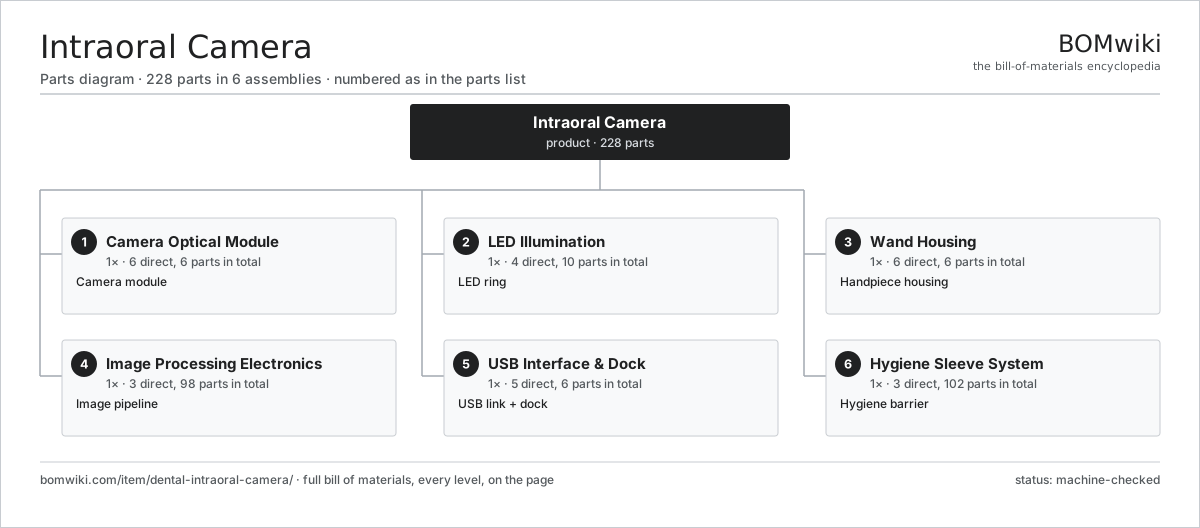
| # | Part | Qty | What it does |
|---|---|---|---|
| 1 | Camera Optical Module 6 parts | 1× | Camera module |
| 2 | LED Illumination 4 parts | 1× | LED ring |
| 3 | Wand Housing 6 parts | 1× | Handpiece housing |
| 4 | Image Processing Electronics 3 parts | 1× | Image pipeline |
| 5 | USB Interface & Dock 5 parts | 1× | USB link + dock |
| 6 | Hygiene Sleeve System 3 parts | 1× | Hygiene barrier |
3D model
No 3D model yet. Have a CAD file of this? Add a 3D model — STL renders right on this page; STEP, FreeCAD, and OpenSCAD sources are welcome too (openly licensed, like all 3D models on BOMwiki).
Build & assembly graph
expand / collapse · shared sub-assemblies converge · links to related products · est. labourTap an assembly to expand/collapse · tap a part to open it · use “Open page” for any node · drag to pan, scroll to zoom.
Bill of materials for Intraoral Camera
6 top-level lines · 38 rows shown · 228 parts total · indented to 3 levels| # | Item / sub-assembly | Part no. | Qty/assy | Ext. qty | Parts | Type |
|---|---|---|---|---|---|---|
| 1 | Camera Optical Module 6 parts | dental-intraoral-camera-optics | 1× | 1 | 6 | assembly |
| 1.1 | Lens Assembly | camera-lens | 1× | 1 | · | part |
| 1.2 | CMOS Image Sensor | image-sensor | 1× | 1 | · | part |
| 1.3 | Liquid Autofocus Lens | dental-intraoral-camera-liquid-lens | 1× | 1 | · | part |
| 1.4 | IR-Cut Filter | dental-intraoral-camera-ir-filter | 1× | 1 | · | part |
| 1.5 | Sapphire Tip Window | dental-intraoral-camera-window | 1× | 1 | · | part |
| 1.6 | View Prism | dental-intraoral-camera-mirror-prism | 1× | 1 | · | part |
| 2 | LED Illumination 4 parts | dental-intraoral-camera-illumination | 1× | 1 | 10 | assembly |
| 2.1 | White LED Die | dental-intraoral-camera-white-led | 6× | 6 | · | part |
| 2.2 | Violet LED (405 nm) | dental-intraoral-camera-violet-led | 2× | 2 | · | part |
| 2.3 | LED Driver | dental-intraoral-camera-led-driver | 1× | 1 | · | part |
| 2.4 | Diffuser Ring | dental-intraoral-camera-diffuser-ring | 1× | 1 | · | part |
| 3 | Wand Housing 6 parts | dental-intraoral-camera-wand | 1× | 1 | 6 | assembly |
| 3.1 | Wand Shell | dental-intraoral-camera-wand-shell | 1× | 1 | · | part |
| 3.2 | Tip Neck | dental-intraoral-camera-tip-neck | 1× | 1 | · | part |
| 3.3 | Capture Button | dental-intraoral-camera-capture-button | 1× | 1 | · | part |
| 3.4 | Motion Sensor | dental-intraoral-camera-motion-sensor | 1× | 1 | · | part |
| 3.5 | O-Ring Set | oring-set | 1× | 1 | · | part |
| 3.6 | Fastener Set | fastener-set | 1× | 1 | · | part |
| 4 | Image Processing Electronics 3 parts | dental-intraoral-camera-electronics | 1× | 1 | 98 | assembly |
| 4.1 | ISP Board 5 parts | dental-intraoral-camera-isp-board | 1× | 1 | 96 | assembly |
| 4.1.1 | Bare PCB | pcb-bare | 1× | 1 | · | part |
| 4.1.2 | Compute SoC Module | soc-module | 1× | 1 | · | part |
| 4.1.3 | Microcontroller | mcu | 1× | 1 | · | part |
| 4.1.4 | SMD Passive (R/C/L) | smd-passives | 90× | 90 | · | part |
| 4.1.5 | Connector | connector | 3× | 3 | · | part |
| 4.2 | Sensor Flex Cable | dental-intraoral-camera-flex-cable | 1× | 1 | · | part |
| 4.3 | Status LED | dental-intraoral-camera-status-led | 1× | 1 | · | part |
| 5 | USB Interface & Dock 5 parts | dental-intraoral-camera-interface | 1× | 1 | 6 | assembly |
| 5.1 | USB Cable | dental-intraoral-camera-usb-cable | 1× | 1 | · | part |
| 5.2 | Wand Holder | dental-intraoral-camera-holder | 1× | 1 | · | part |
| 5.3 | Wi-Fi Module | dental-intraoral-camera-wifi-module | 1× | 1 | · | part |
| 5.4 | LiPo Cell | lipo-cell | 1× | 1 | · | part |
| 5.5 | Connector | connector | 2× | 2 | · | part |
| 6 | Hygiene Sleeve System 3 parts | dental-intraoral-camera-sleeve-system | 1× | 1 | 102 | assembly |
| 6.1 | Disposable Barrier Sleeve | dental-intraoral-camera-sleeve | 100× | 100 | · | part |
| 6.2 | Sleeve Retention Collar | dental-intraoral-camera-sleeve-collar | 1× | 1 | · | part |
| 6.3 | Sleeve Dispenser Box | dental-intraoral-camera-sleeve-dispenser | 1× | 1 | · | part |
Related products
same domain, ranked by shared parts Intraoral Scanner
240 parts · shares 3 with this page
Intraoral Scanner
240 parts · shares 3 with this page
 Dental Curing Light
26 parts · shares 3 with this page
Dental Curing Light
26 parts · shares 3 with this page
 Dental X-Ray Unit
113 parts · shares 3 with this page
Dental X-Ray Unit
113 parts · shares 3 with this page
 Panoramic Dental X-Ray
507 parts · shares 3 with this page
Veterinary ICU Cage
293 parts · shares 3 with this page
Panoramic Dental X-Ray
507 parts · shares 3 with this page
Veterinary ICU Cage
293 parts · shares 3 with this page
 Dental Cone Beam CT
523 parts · shares 2 with this page
Dental Cone Beam CT
523 parts · shares 2 with this page
Sourcing: possible vendors
Prices, MOQ, and lead times are algorithmic estimates, not quotes, and not claims about these companies. Company mappings are curated by keyword; est. price band $200–$200k. How estimates work| Vendor | HQ | Specialty | MOQ | Lead time |
|---|---|---|---|---|
| dentsplysirona.com ↗ | Charlotte, US | Dental equipment | 100 units | 10–16 wks |
|
🇺🇸Envista
envistaco.com ↗
|
Brea, US | Dental (KaVo, Nobel) | 100 units | 10–16 wks |
|
🇫🇮Planmeca
planmeca.com ↗
|
Helsinki, FI | Dental units & imaging | 100 units | 10–16 wks |
|
🇺🇸A-dec
a-dec.com ↗
|
Newberg, US | Dental chairs & delivery | 100 units | 10–16 wks |
|
🇺🇸Midmark
midmark.com ↗
|
Versailles, US | Medical & veterinary equipment | 100 units | 10–16 wks |
837-word article