LED Ring Light
ProductOverview
Ring lights are circular LED fixtures used extensively in content creation, video conferencing, portraiture, and social media streaming. The ring geometry produces flattering shadow-free illumination: when positioned directly in front of a camera or subject, the circular geometry and proximity ensure even light distribution across the face, eliminating harsh shadows while producing the characteristic "ring-light catchlight" (bright reflection in the eyes) favored by content creators.
The LED ring array consists of two interleaved LED chains, one warm (3000 K) and one cool (6500 K), soldered around a flexible circular PCB. The dual-channel design allows the user to continuously blend color temperature from 100% warm to 100% cool, tuning the light's appearance to match room lighting, subject skin tone, or creative preference. A silicone diffusion sleeve over the ring eliminates the appearance of individual LEDs, creating a soft, uniform glow.
The dual-channel driver accepts AC line power and independently regulates the current flowing through each LED chain. When the user adjusts the color slider on the control panel, the PWM duty cycle of the warm chain increases while the cool chain decreases (or vice versa), continuously blending the output from pure warm to pure daylight without color temperature jumps.
The tripod base and center phone mount position the ring light above the subject's eye level, with the smartphone positioned precisely at ring center. This arrangement ensures that both the video camera and the subject's face are illuminated uniformly by the same ring light source, minimizing the unflattering "lit from below" appearance of many alternative lighting setups.
Ring geometry and shadow elimination
Traditional key-fill lighting systems use a single light source positioned at 45° angle, creating distinct shadows on the opposite side of the face that require a fill light or reflector to soften. This two-light setup is space-intensive and requires careful angle adjustment for optimal results.
The ring light's circular geometry provides light from all angles simultaneously around the subject. When centered at the camera axis, a ring light casts no prominent directional shadows, the light arrives simultaneously from 360° around the subject's head. This produces the "catchlight" effect: a bright, ring-shaped reflection in the eyes, visible in the camera image, that conveys liveliness and engagement.
The downside of ring lighting is that it can appear flat if used as the sole light source. Advanced users position a secondary fill reflector positioned beneath or behind the ring to add subtle modeling shadows that enhance facial contours. For professional video work, the ring light often functions as key fill, with a secondary 3-point lighting rig providing directional accent and background light.
Dual-channel color mixing
The human eye is trichromatic and responds to red, green, and blue wavelengths, but most commercial LED systems use either warm (3000 K) or cool (6500 K) pre-mixed white LEDs, forcing users to choose a single color temperature. Ring lights overcome this limitation by driving two independent LED chains, one optimized for warm output and one for cool, allowing precise color blending at the driver level.
The warm LED chain (3000 K, 80+ CRI) consists of 20–40 LEDs wired in series-parallel strings, each LED operating at a nominal 20 mA. A dedicated buck converter regulates the current delivered to the warm chain from 0 (off) to 500 mA (maximum brightness). Similarly, the cool LED chain (6500 K, 90+ CRI) operates on an independent cool current source, allowing simultaneous adjustment without crosstalk.
When the user slides the color temperature slider to 3500 K (between 3000 K and 6500 K), the control board increases the warm channel to 70% duty cycle and reduces the cool channel to 30%. The two outputs sum at the ring PCB, blending the light in real-time. This approach yields a continuous color temperature spectrum from 3000–6500 K without the abrupt temperature jumps seen in single-channel systems.
The resulting color rendering remains consistent across the blend range because both chains are high-CRI (>90), avoiding the greenish or magenta casts common in cheaper color-mixing systems that use standard (CRI 70) LEDs.
Optical quality and diffusion
Direct viewing of individual LED emitters (even high-efficiency ones) appears harsh and causes eye strain during extended video sessions. The silicone diffusion sleeve scatters light from the LED array into a soft, uniform emission pattern.
The sleeve is a translucent white silicone tube (2–3 mm wall thickness) slipped over the flexible ring PCB. Light from the discrete LEDs undergoes multiple internal reflections within the opaque silicone, homogenizing the output so that the ring appears as a continuous glowing surface when viewed head-on. The diffusion reduces peak intensity (lux) by ~30–40% but improves perceived comfort by a factor of 5–10.
An optional frosted acrylic diffusion filter can be mounted at the ring opening, providing secondary diffusion for extra-soft light in studio applications. This two-stage diffusion (tube + filter) is used in professional setups where image quality and subject comfort are paramount.
The inner ring surface is finished with specular aluminum coating, redirecting stray photons that would otherwise escape through the ring's open core back toward the subject. This passive reflector improves efficacy by ~15–20% without adding electrical complexity.
Tripod mounting and positioning
The adjustable tripod base allows positioning the ring light at variable distances and angles. A typical workflow places the phone holder at approximately 300–600 mm in front of the subject, with the tripod extending the ring light 600–1200 mm above ground level. This height allows the ring light to be positioned at or slightly above eye level, producing the most flattering lighting angle for facial video.
The telescoping center column adjusts from 300 mm (compact tabletop setup) to 1200 mm (standing overhead setup), accommodating different room layouts and use cases. The ball-and-socket joint allows ±30° pan and tilt, enabling fine-tuning of the ring's angle relative to the camera or subject.
The phone mount arm articulates independently of the ring's ball head, allowing the smartphone camera to be positioned precisely at ring center while the ring itself is angled relative to the subject's face. This decoupling is useful for makeup tutorials or product demonstrations where the optimal lighting angle differs from the optimal camera angle.
Control and user interface
The control panel houses simple PWM electronics mapping user inputs to color mixing. The brightness potentiometer is typically a 100-position rotary encoder allowing 1% incremental steps from 0 to 100%. The color temperature slider is a linear potentiometer mapping the full range from 3000 K (pure warm) through 4500 K (neutral) to 6500 K (cool), with tactile position detents every 500 K for quick presets.
An illuminated power button and status LED indicate active operation. Some models include a wireless remote allowing on-off and brightness control without touching the ring light, useful for interview or presentation setups where the speaker should not reach the light.
Applications and use cases
Content creation (YouTube, TikTok): Ring lights are the de facto standard for bedroom studio setups. The combination of flattering facial lighting, integrated camera mount, and adjustable color temperature allows content creators to achieve broadcast-quality video with minimal equipment investment.
Video conferencing: Ring lights improve appearance on Zoom, Teams, or other video calls, providing soft fill light that reduces on-camera fatigue and improves perceived professionalism. The circular catchlight adds a subtle "live" quality compared to typical overhead office lighting.
Makeup tutorials and beauty vlogging: The shadow-free light and high CRI output are essential for accurately showing makeup application and product color. Content creators use the warm/cool slider to match ring light to the viewer's home lighting conditions, reducing color space mismatch.
Portraiture and product photography: Professional photographers use ring lights for macro portraiture, jewelry photography, and product close-ups. The zero-shadow quality is ideal for even product illumination in e-commerce contexts.
Medical and dental documentation: Ring lights are used in surgical and dental photography to illuminate the field while positioning the camera at the light's center, ensuring minimal shadow.
Thermal management and efficiency
LED-based ring lights are thermally simple compared to incandescent or halogen alternatives, generating only 20–50 W of total waste heat. The aluminum ring frame acts as a heatsink, passively dissipating heat generated by the LED array through convection to the ambient air. No active cooling is required, and the fixture remains safe to touch after extended use.
Color mixing does introduce a minor thermal imbalance: the warm and cool channels may operate at different thermal conditions when only one is active. Both current sources are designed with sufficient headroom to handle this without thermal runaway or lumen flicker, though high-end professional models include a temperature-compensating MCU that adjusts PWM duty cycles to maintain stable brightness across temperature swings.
Regulatory and safety
Ring lights sold in consumer markets are typically Class C (non-medical) devices or exempt fixtures under:
- IEC 62471 (photobiological safety; ring lights are safe from a photon-toxicity perspective at typical distances)
- IEC 60598-1 (general safety requirements for luminaires)
- FCC Part 15 (unintentional radiators; the PWM frequency and controller must not radiate RF energy exceeding permitted limits)
Professional models used in television production may be subject to stricter flicker and color rendering standards (e.g., SMPTE specifications for broadcast lighting), but consumer ring lights are generally exempt.
The main safety consideration is electrical: the control electronics and power supply must be properly isolated and surge-protected to prevent shocks or fire hazards. UL/CE certification is standard on reputable models.
LED Ring Light parts and their functions
7 top-level parts · 26 parts in total · full bill of materials below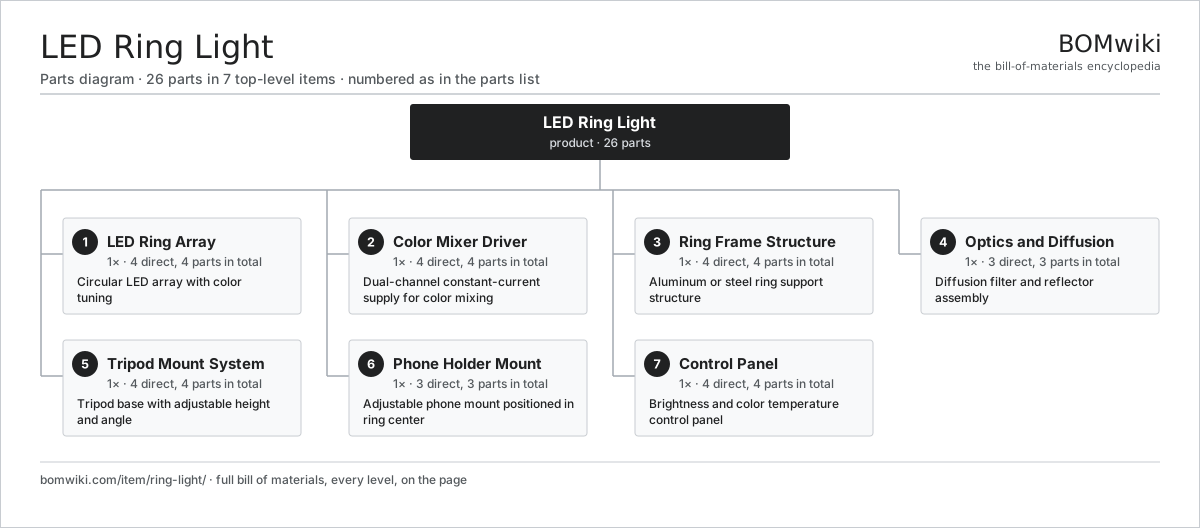
| # | Part | Qty | What it does |
|---|---|---|---|
| 1 | LED Ring Array 4 parts | 1× | Circular LED array with color tuning |
| 2 | Color Mixer Driver 4 parts | 1× | Dual-channel constant-current supply for color mixing |
| 3 | Ring Frame Structure 4 parts | 1× | Aluminum or steel ring support structure |
| 4 | Optics and Diffusion 3 parts | 1× | Diffusion filter and reflector assembly |
| 5 | Tripod Mount System 4 parts | 1× | Tripod base with adjustable height and angle |
| 6 | Phone Holder Mount 3 parts | 1× | Adjustable phone mount positioned in ring center |
| 7 | Control Panel 4 parts | 1× | Brightness and color temperature control panel |
3D model
No 3D model yet. Have a CAD file of this? Add a 3D model. STL renders right on this page; STEP, FreeCAD, and OpenSCAD sources are welcome too (openly licensed, like all 3D models on BOMwiki).
Build & assembly graph
expand / collapse · shared sub-assemblies converge · links to related products · est. labourTap an assembly to expand/collapse · tap a part to open it · use “Open page” for any node · drag to pan, scroll to zoom.
Bill of materials for LED Ring Light
7 top-level lines · 33 rows shown · 26 parts total · indented to 3 levels| # | Item / sub-assembly | Part no. | Qty/assy | Ext. qty | Parts | Type |
|---|---|---|---|---|---|---|
| 1 | LED Ring Array 4 parts | ring-light-led-ring | 1× | 1 | 4 | assembly |
| 1.1 | Ring PCB | ring-light-ring-pcb | 1× | 1 | · | part |
| 1.2 | Warm LED Chain | ring-light-warm-leds | 1× | 1 | · | part |
| 1.3 | Cool LED Chain | ring-light-cool-leds | 1× | 1 | · | part |
| 1.4 | Diffusion Sleeve | ring-light-diffuse-cap | 1× | 1 | · | part |
| 2 | Color Mixer Driver 4 parts | ring-light-driver | 1× | 1 | 4 | assembly |
| 2.1 | Driver PCB | ring-light-driver-pcb | 1× | 1 | · | part |
| 2.2 | Warm Current Source | ring-light-current-source-1 | 1× | 1 | · | part |
| 2.3 | Cool Current Source | ring-light-current-source-2 | 1× | 1 | · | part |
| 2.4 | Power Supply | power-supply | 1× | 1 | · | part |
| 3 | Ring Frame Structure 4 parts | ring-light-frame | 1× | 1 | 4 | assembly |
| 3.1 | Ring Body | ring-light-ring-body | 1× | 1 | · | part |
| 3.2 | Reflector Insert | ring-light-reflector-insert | 1× | 1 | · | part |
| 3.3 | Mounting Bracket | ring-light-mounting-bracket | 1× | 1 | · | part |
| 3.4 | Fastener Set | fastener-set | 1× | 1 | · | part |
| 4 | Optics and Diffusion 3 parts | ring-light-optics | 1× | 1 | 3 | assembly |
| 4.1 | Diffusion Filter | ring-light-diffusion-filter | 1× | 1 | · | part |
| 4.2 | Fill Reflector | ring-light-fill-reflector | 1× | 1 | · | part |
| 4.3 | Filter Frame | ring-light-filter-frame | 1× | 1 | · | part |
| 5 | Tripod Mount System 4 parts | ring-light-mount | 1× | 1 | 4 | assembly |
| 5.1 | Tripod Base | ring-light-tripod-base | 1× | 1 | · | part |
| 5.2 | Center Column | ring-light-center-column | 1× | 1 | · | part |
| 5.3 | Ball Head | ring-light-ball-head | 1× | 1 | · | part |
| 5.4 | Friction Lock | ring-light-friction-lock | 1× | 1 | · | part |
| 6 | Phone Holder Mount 3 parts | ring-light-phone-holder | 1× | 1 | 3 | assembly |
| 6.1 | Holder Arm | ring-light-holder-arm | 1× | 1 | · | part |
| 6.2 | Phone Clamp | ring-light-phone-clamp | 1× | 1 | · | part |
| 6.3 | Cold-Shoe Mount | ring-light-hotshoe-mount | 1× | 1 | · | part |
| 7 | Control Panel 4 parts | ring-light-control | 1× | 1 | 4 | assembly |
| 7.1 | Control MCU | ring-light-control-mcu | 1× | 1 | · | part |
| 7.2 | Brightness Dial | ring-light-brightness-dial | 1× | 1 | · | part |
| 7.3 | Color Slider | ring-light-color-slider | 1× | 1 | · | part |
| 7.4 | Power Switch | ring-light-power-switch | 1× | 1 | · | part |
Something wrong in this list? Report a problem with this BOM.
Related products
same domain, ranked by shared parts Aviation Obstruction Light
192 parts · shares 1 with this page
Canopy Light
26 parts · shares 1 with this page
Cleanroom Luminaire
22 parts · shares 1 with this page
Explosion-Proof Light Fixture
31 parts · shares 1 with this page
Aviation Obstruction Light
192 parts · shares 1 with this page
Canopy Light
26 parts · shares 1 with this page
Cleanroom Luminaire
22 parts · shares 1 with this page
Explosion-Proof Light Fixture
31 parts · shares 1 with this page
 Heliport Beacon
39 parts · shares 1 with this page
Industrial UV Curing Lamp
300 parts · shares 1 with this page
Heliport Beacon
39 parts · shares 1 with this page
Industrial UV Curing Lamp
300 parts · shares 1 with this page
Sourcing: possible vendors
Browse the supplier directory → Prices, MOQ, and lead times are algorithmic estimates, not quotes, and not claims about these companies. Company mappings are curated by keyword; est. price band $3–$2k. How estimates work| Vendor | HQ | Specialty | MOQ | Lead time |
|---|---|---|---|---|
|
🇳🇱Signify
signify.com ↗
|
Eindhoven, NL | Lighting (Philips Hue) | 2,000 units | 6–10 wks |
| acuitybrands.com ↗ | Atlanta, US | Lighting & controls | 2,000 units | 6–10 wks |
|
🇦🇹Zumtobel
zumtobelgroup.com ↗
|
Dornbirn, AT | Lighting | 2,000 units | 6–10 wks |
| creelighting.com ↗ | Racine, US | LED lighting | 2,000 units | 6–10 wks |
|
🇮🇳Havells
havells.com ↗
|
Noida, IN | Electrical & lighting | 2,000 units | 6–10 wks |
1,733-word article