Earth Observation Satellite
ProductOverview
An Earth observation satellite is a camera in orbit. It flies a few hundred kilometers up in a low, near-polar orbit, and as it circles the planet the Earth rotates beneath it, so over a few weeks the whole surface passes under its field of view. Its task is to capture sharp, well-calibrated imagery, store it onboard, and dump that data to the ground whenever it passes over a receiving station. Almost everything in the design exists either to make the picture sharp or to keep the picture flowing to the ground.
The satellite is built as a Bus Structure hosting an Imaging Payload. The supporting subsystems are an Attitude Control that aims and steadies the camera, an Power Subsystem subsystem, an Onboard Data Handling that runs the spacecraft and stores images, an Communications subsystem with two links, an Propulsion Subsystem subsystem to fight atmospheric drag, and an Thermal Control subsystem that keeps the optics stable.
Bus structure
The Bus Structure does more than hold parts together; it preserves alignment. The camera and the star trackers that measure where it is pointed must stay locked relative to each other, because any flex between them shows up as a geolocation error in the imagery. A stiff Baseplate carries launch loads, Side Panel honeycomb faces close out the bus and mount electronics, and a low-expansion Optical Bench holds the instrument and the attitude sensors on one rigid reference. A set of machined Bracket Set fittings mount the smaller units.
Imaging payload
The Imaging Payload is the instrument that makes the pictures. Light enters the Telescope, a reflective two-mirror system: a large lightweighted Primary Mirror gathers the scene and a smaller Secondary Mirror folds the long focal length into a short Telescope Tube. The mirrors sit in flexured Mirror Mount fittings that hold them without distorting their figure, and a Focus Mechanism trims focus against thermal drift in orbit.
At the focus is the Focal-Plane Assembly, where light becomes data. Several Detector Array sensors, each behind its own Spectral Filter, capture the panchromatic and color bands. An Focal-Plane Cooler holds the detectors cold to keep noise down, and a Focal-Plane Board reads them out. The Payload Electronics digitize, correct, and format the signal through an Image Processor into image data. An onboard Calibration Unit gives the instrument a known reference so the imagery stays consistent over years, and an Stray-Light Baffle keeps stray light off the focal plane.
Attitude control
The Attitude Control is what lets a satellite moving at 7 km/s take a sharp picture. To image a target it must slew quickly, then hold dead still while the shutter is open. Reaction Wheel units provide that slew and steadiness without spending propellant. To know where it is pointed, the satellite uses Star Tracker cameras backed by an Fiber-Optic Gyro between updates, with Sun Sensor units for coarse reference and a GPS Receiver supplying the position and time that geolocate each frame. Because the wheels gradually saturate, Magnetorquer coils push against the surrounding magnetic field to bleed momentum back out. An ADCS Computer ties the loop together.
Power and data handling
The Power Subsystem subsystem runs the imaging in daylight and survives the night side of each orbit. Deployable Solar Array wings on Array Drive mechanisms track the sun and charge a lithium Lithium Battery through an Power Distribution Unit that distributes the bus. Because the satellite passes in and out of sunlight roughly fifteen times a day, the battery cycles far more often than a geostationary one, which drives its sizing.
The Onboard Data Handling subsystem runs the spacecraft and, just as important, stores the imagery. An Onboard Computer built on a radiation-hardened CPU commands the bus, while an Mass Memory Unit unit of solid-state Memory Module banks buffers captured images until a ground station comes into view, since the satellite spends most of each orbit out of contact. An Data Bus and a set of Remote Terminal units connect the computer to every subsystem.
Communications, propulsion, and thermal
The Communications subsystem carries two very different loads. A modest S-Band Transponder handles commands and health telemetry, the link operators always need. A much faster X-Band Transmitter, fed by a high-rate High-Rate Modulator through a directional X-Band Antenna, dumps the stored imagery during the few minutes the satellite is over a station. The Propulsion Subsystem subsystem matters because air drag at low altitude slowly lowers the orbit; small Thruster units fed from a Propellant Tank periodically reboost and trim the orbit so the imaging swath keeps repeating on schedule.
The Thermal Control subsystem protects image quality. The telescope's alignment depends on temperature, so an MLI Blanket, Radiator panels, Heat Pipe runs, and closed-loop Heater units driven by Thermistor sensors hold the optics and detectors at a stable set point. Variants range from small high-resolution commercial imagers to large multispectral and radar platforms, but the chain of gather light, steady the camera, store the data, and downlink it stays the same.
Earth Observation Satellite parts and their functions
8 top-level parts · 1,879 parts in total · full bill of materials below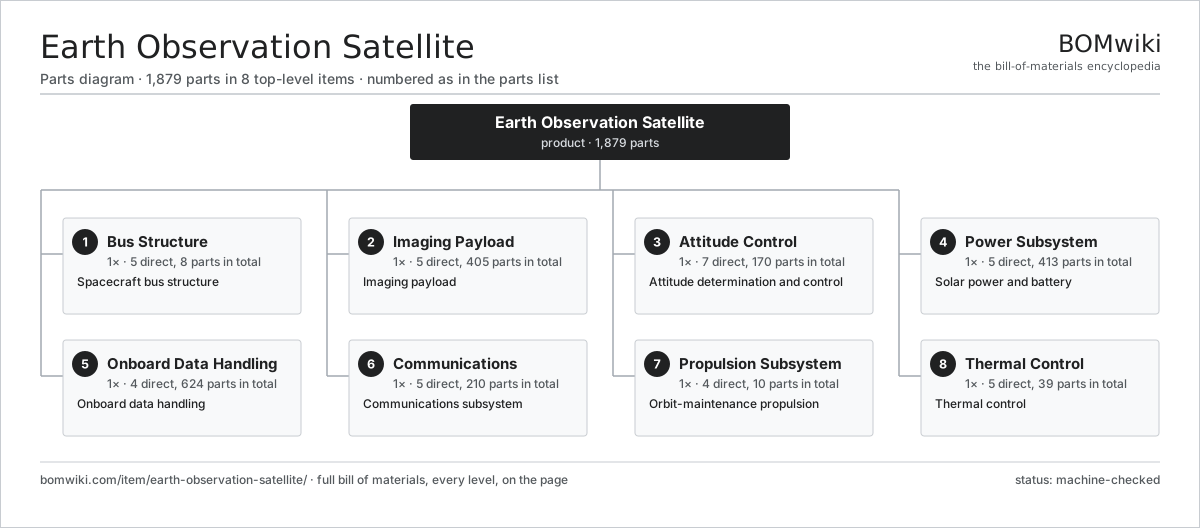
| # | Part | Qty | What it does |
|---|---|---|---|
| 1 | Bus Structure 5 parts | 1× | Spacecraft bus structure |
| 2 | Imaging Payload 5 parts | 1× | Imaging payload |
| 3 | Attitude Control 7 parts | 1× | Attitude determination and control |
| 4 | Power Subsystem 5 parts | 1× | Solar power and battery |
| 5 | Onboard Data Handling 4 parts | 1× | Onboard data handling |
| 6 | Communications 5 parts | 1× | Communications subsystem |
| 7 | Propulsion Subsystem 4 parts | 1× | Orbit-maintenance propulsion |
| 8 | Thermal Control 5 parts | 1× | Thermal control |
3D model
No 3D model yet. Have a CAD file of this? Add a 3D model. STL renders right on this page; STEP, FreeCAD, and OpenSCAD sources are welcome too (openly licensed, like all 3D models on BOMwiki).
Build & assembly graph
expand / collapse · shared sub-assemblies converge · links to related products · est. labourTap an assembly to expand/collapse · tap a part to open it · use “Open page” for any node · drag to pan, scroll to zoom.
Bill of materials for Earth Observation Satellite
8 top-level lines · 93 rows shown · 1,879 parts total · indented to 3 levels| # | Item / sub-assembly | Part no. | Qty/assy | Ext. qty | Parts | Type |
|---|---|---|---|---|---|---|
| 1 | Bus Structure 5 parts | eos-bus-structure | 1× | 1 | 8 | assembly |
| 1.1 | Baseplate | eos-baseplate | 1× | 1 | · | part |
| 1.2 | Side Panel | eos-side-panel | 4× | 4 | · | part |
| 1.3 | Optical Bench | eos-optical-bench | 1× | 1 | · | part |
| 1.4 | Bracket Set | eos-bracket-set | 1× | 1 | · | part |
| 1.5 | Fastener Set | fastener-set | 1× | 1 | · | part |
| 2 | Imaging Payload 5 parts | eos-optical-payload | 1× | 1 | 405 | assembly |
| 2.1 | Telescope 5 parts | eos-telescope | 1× | 1 | 7 | assembly |
| 2.1.1 | Primary Mirror | eos-primary-mirror | 1× | 1 | · | part |
| 2.1.2 | Secondary Mirror | eos-secondary-mirror | 1× | 1 | · | part |
| 2.1.3 | Mirror Mount | eos-mirror-mount | 3× | 3 | · | part |
| 2.1.4 | Telescope Tube | eos-telescope-tube | 1× | 1 | · | part |
| 2.1.5 | Focus Mechanism | eos-focus-mechanism | 1× | 1 | · | part |
| 2.2 | Focal-Plane Assembly 4 parts | eos-focal-plane | 1× | 1 | 131 | assembly |
| 2.2.1 | Detector Array | eos-detector-array | 4× | 4 | · | part |
| 2.2.2 | Spectral Filter | eos-spectral-filter | 4× | 4 | · | part |
| 2.2.3 | Focal-Plane Cooler | eos-fpa-cooler | 1× | 1 | · | part |
| 2.2.4 | Focal-Plane Board 3 parts + deeper › | eos-fpa-board | 1× | 1 | 122 | assembly |
| 2.3 | Payload Electronics 4 parts | eos-payload-electronics | 1× | 1 | 265 | assembly |
| 2.3.1 | Bare PCB | pcb-bare | 2× | 2 | · | part |
| 2.3.2 | Microcontroller | mcu | 2× | 2 | · | part |
| 2.3.3 | Image Processor | eos-video-processor | 1× | 1 | · | part |
| 2.3.4 | SMD Passive (R/C/L) | smd-passives | 260× | 260 | · | part |
| 2.4 | Calibration Unit | eos-calibration-unit | 1× | 1 | · | part |
| 2.5 | Stray-Light Baffle | eos-baffle | 1× | 1 | · | part |
| 3 | Attitude Control 7 parts | eos-adcs | 1× | 1 | 170 | assembly |
| 3.1 | Reaction Wheel | eos-reaction-wheel | 4× | 4 | · | part |
| 3.2 | Star Tracker | eos-star-tracker | 2× | 2 | · | part |
| 3.3 | Fiber-Optic Gyro | eos-gyro | 1× | 1 | · | part |
| 3.4 | Magnetorquer | eos-magnetorquer | 3× | 3 | · | part |
| 3.5 | Sun Sensor | eos-sun-sensor | 6× | 6 | · | part |
| 3.6 | GPS Receiver | eos-gps-receiver | 1× | 1 | · | part |
| 3.7 | ADCS Computer 3 parts | eos-adcs-computer | 1× | 1 | 153 | assembly |
| 3.7.1 | Bare PCB | pcb-bare | 1× | 1 | · | part |
| 3.7.2 | Microcontroller | mcu | 2× | 2 | · | part |
| 3.7.3 | SMD Passive (R/C/L) | smd-passives | 150× | 150 | · | part |
| 4 | Power Subsystem 5 parts | eos-power | 1× | 1 | 413 | assembly |
| 4.1 | Solar Array 3 parts | eos-solar-array | 2× | 2 | 6 | assembly |
| 4.1.1 | Solar Panel | eos-solar-panel | 3× | 6 | · | part |
| 4.1.2 | Array Hinge | eos-array-hinge | 2× | 4 | · | part |
| 4.1.3 | Array Yoke | eos-array-yoke | 1× | 2 | · | part |
| 4.2 | Array Drive | eos-array-drive | 2× | 2 | · | part |
| 4.3 | Lithium Battery 3 parts | eos-battery | 1× | 1 | 99 | assembly |
| 4.3.1 | Space Li-ion Cell | eos-battery-cell | 16× | 16 | · | part |
| 4.3.2 | Battery Electronics 3 parts + deeper › | eos-battery-bms | 1× | 1 | 82 | assembly |
| 4.3.3 | Battery Housing | eos-battery-housing | 1× | 1 | · | part |
| 4.4 | Power Distribution Unit 4 parts | eos-pcdu | 1× | 1 | 299 | assembly |
| 4.4.1 | Bare PCB | pcb-bare | 2× | 2 | · | part |
| 4.4.2 | Microcontroller | mcu | 1× | 1 | · | part |
| 4.4.3 | Relay | relay | 16× | 16 | · | part |
| 4.4.4 | SMD Passive (R/C/L) | smd-passives | 280× | 280 | · | part |
| 4.5 | Wire Bundle | wire-bundle | 1× | 1 | · | part |
| 5 | Onboard Data Handling 4 parts | eos-obdh | 1× | 1 | 624 | assembly |
| 5.1 | Onboard Computer 4 parts | eos-obc | 1× | 1 | 204 | assembly |
| 5.1.1 | Bare PCB | pcb-bare | 1× | 1 | · | part |
| 5.1.2 | Microcontroller | mcu | 2× | 2 | · | part |
| 5.1.3 | Radiation-Hardened CPU | eos-rad-cpu | 1× | 1 | · | part |
| 5.1.4 | SMD Passive (R/C/L) | smd-passives | 200× | 200 | · | part |
| 5.2 | Mass Memory Unit 4 parts | eos-mass-memory | 1× | 1 | 171 | assembly |
| 5.2.1 | Bare PCB | pcb-bare | 2× | 2 | · | part |
| 5.2.2 | Memory Module | eos-memory-module | 8× | 8 | · | part |
| 5.2.3 | Microcontroller | mcu | 1× | 1 | · | part |
| 5.2.4 | SMD Passive (R/C/L) | smd-passives | 160× | 160 | · | part |
| 5.3 | Data Bus | eos-data-bus | 1× | 1 | · | part |
| 5.4 | Remote Terminal 3 parts | eos-remote-terminal | 4× | 4 | 62 | assembly |
| 5.4.1 | Bare PCB | pcb-bare | 1× | 4 | · | part |
| 5.4.2 | Microcontroller | mcu | 1× | 4 | · | part |
| 5.4.3 | SMD Passive (R/C/L) | smd-passives | 60× | 240 | · | part |
| 6 | Communications 5 parts | eos-comms | 1× | 1 | 210 | assembly |
| 6.1 | X-Band Transmitter 4 parts | eos-xband-transmitter | 1× | 1 | 113 | assembly |
| 6.1.1 | Bare PCB | pcb-bare | 1× | 1 | · | part |
| 6.1.2 | Microcontroller | mcu | 1× | 1 | · | part |
| 6.1.3 | X-Band RF Module | eos-xband-rf | 1× | 1 | · | part |
| 6.1.4 | SMD Passive (R/C/L) | smd-passives | 110× | 110 | · | part |
| 6.2 | S-Band Transponder 4 parts | eos-sband-transponder | 1× | 1 | 93 | assembly |
| 6.2.1 | Bare PCB | pcb-bare | 1× | 1 | · | part |
| 6.2.2 | Microcontroller | mcu | 1× | 1 | · | part |
| 6.2.3 | S-Band RF Module | eos-sband-rf | 1× | 1 | · | part |
| 6.2.4 | SMD Passive (R/C/L) | smd-passives | 90× | 90 | · | part |
| 6.3 | X-Band Antenna | eos-xband-antenna | 1× | 1 | · | part |
| 6.4 | S-Band Antenna | eos-sband-antenna | 2× | 2 | · | part |
| 6.5 | High-Rate Modulator | eos-modulator | 1× | 1 | · | part |
| 7 | Propulsion Subsystem 4 parts | eos-propulsion | 1× | 1 | 10 | assembly |
| 7.1 | Thruster | eos-thruster | 4× | 4 | · | part |
| 7.2 | Propellant Tank | eos-prop-tank | 1× | 1 | · | part |
| 7.3 | Propellant Valve | eos-prop-valve | 4× | 4 | · | part |
| 7.4 | Feed System | eos-prop-feed | 1× | 1 | · | part |
| 8 | Thermal Control 5 parts | eos-thermal | 1× | 1 | 39 | assembly |
| 8.1 | MLI Blanket | eos-mli-blanket | 1× | 1 | · | part |
| 8.2 | Radiator | eos-radiator | 2× | 2 | · | part |
| 8.3 | Heat Pipe | eos-heat-pipe | 6× | 6 | · | part |
| 8.4 | Heater | eos-heater | 10× | 10 | · | part |
| 8.5 | Thermistor | eos-thermistor | 20× | 20 | · | part |
Sourcing: possible vendors
Browse the supplier directory → Prices, MOQ, and lead times are algorithmic estimates, not quotes, and not claims about these companies. Company mappings are curated by keyword; est. price band $50k–$500M. How estimates work| Vendor | HQ | Specialty | MOQ | Lead time |
|---|---|---|---|---|
|
🇺🇸SpaceX
spacex.com ↗
|
Hawthorne, US | Launch & spacecraft | made to order | 52–104 wks |
| northropgrumman.com ↗ | Falls Church, US | Space & defense | made to order | 52–104 wks |
|
🇫🇷Airbus
airbus.com ↗
|
Toulouse, FR | Aerospace OEM | made to order | 52–104 wks |
| rocketlabusa.com ↗ | Long Beach, US | Launch & spacecraft | made to order | 52–104 wks |
| thalesaleniaspace.com ↗ | Cannes, FR | Satellites | made to order | 52–104 wks |
882-word article