Nanosatellite
ProductOverview
A nanosatellite is a complete spacecraft shrunk to the size of a loaf of bread and built largely from commercial parts. Most follow the CubeSat standard, which defines a 10-centimeter cube as one unit, or 1U, and lets builders stack units into 3U, 6U, or larger satellites. The standard exists so that a small mission can buy a ride as secondary payload, slide into a standardized deployer, and be flung into orbit without custom integration. The design philosophy is the opposite of a flagship satellite: keep it cheap, keep it small, accept commercial-grade parts and shorter life, and fly one focused instrument.
The satellite is organized as a CubeSat Frame holding a stack of boards. Those boards are the Electrical Power System power system, the Onboard Computer computer, the Attitude Control attitude control, the Radio Subsystem radio, and the Mission Payload that defines the mission. A Deployer Interface handles the transition from stowed in the deployer to alive in orbit.
Structure
The CubeSat Frame is a standardized skeleton. Four anodized Corner Rail members run along the corners; these rails are the only surfaces that touch the deployer, and they guide the satellite smoothly out on its spring. A set of Frame Ring members ties the rails into a rigid cube, Side Panel faces close it out and carry body-mounted solar cells, and a Stack Standoff set holds the circuit boards in a stack on the common PC/104 footprint that most CubeSat electronics share. That shared footprint is what makes the ecosystem work, since boards from different vendors bolt into the same stack.
Power system
The Electrical Power System is a complete power plant on a tight budget. Body-mounted Solar Panel units, each carrying a couple of Solar Cell devices and a Coarse Sun Sensor, generate power on whichever faces see the sun, and two Deployable Array wings fold out after launch to roughly double the area on larger satellites. The wings are held folded by a Burn-Wire Release release, a clever low-cost trick where a resistor heats up and melts a nylon tie, freeing a spring Array Hinge to swing the panel out. A small Battery Pack of commercial cells, kept warm by a Battery Heater, carries the satellite through eclipse, and an EPS Board with several DC-DC Regulator regulators distributes the bus rails and can switch power to misbehaving boards.
Computer and attitude control
The Onboard Computer is the flight computer, and on a nanosatellite it really is just one board: an Microcontroller running the software, Flash Memory for storage, a Watchdog that resets the processor if a radiation upset hangs it, and a Real-Time Clock for timekeeping. Because the parts are commercial rather than radiation-hardened, the watchdog and software recovery do the work that expensive hardened silicon does on a big satellite.
The Attitude Control gives the satellite enough pointing to do its job at minimum cost. Magnetorquer coils torque against the surrounding magnetic field for coarse control and detumbling right after release, while small Miniature Reaction Wheel units provide finer pointing and slews when the mission needs to aim the camera or antenna. A Magnetometer, a MEMS IMU, and Fine Sun Sensor units feed an ADCS Board that estimates orientation and drives the actuators.
Radio and payload
The Radio Subsystem subsystem keeps the satellite reachable. A UHF Transceiver handles commands and telemetry over a deployable Deployable Antenna made of Tape Antenna Element elements, springy strips of tape-measure steel that coil up for launch and snap straight when their burn wire releases. Missions that produce a lot of data add a faster S-Band Transmitter to dump payload data during a ground pass, with both radios sharing a RF Interface Board interface.
The Mission Payload is the entire reason the satellite exists, and everything else is sized to serve it. A common payload is a Compact Imager built around a Image Sensor and a compact Lens, used for low-cost Earth imaging or technology demonstration. Other missions fly a Mission Sensor such as a radio receiver for tracking ships and aircraft, or an environment sensor. Whatever the instrument, it gets its own Payload Board and a Payload Memory buffer.
Deployment and life
The Deployer Interface manages the riskiest moment, leaving the deployer. A Remove-Before-Flight Pin keeps the satellite completely inert during launch integration so it cannot wake up inside the rocket. As the satellite slides out, Deployment Switch contacts release and power the spacecraft on, and a Separation Spring gives it a gentle push clear of the deployer and the other satellites sharing it. Because nanosatellites fly low and use commercial parts, their lives are short, typically one to three years before atmospheric drag pulls them down to burn up, which is by design a built-in disposal that keeps them from becoming long-lived debris. Variants run from a single 1U technology demonstrator to 6U and 12U platforms that approach the capability of a small conventional satellite at a fraction of the cost.
Nanosatellite parts and their functions
7 top-level parts · 737 parts in total · full bill of materials below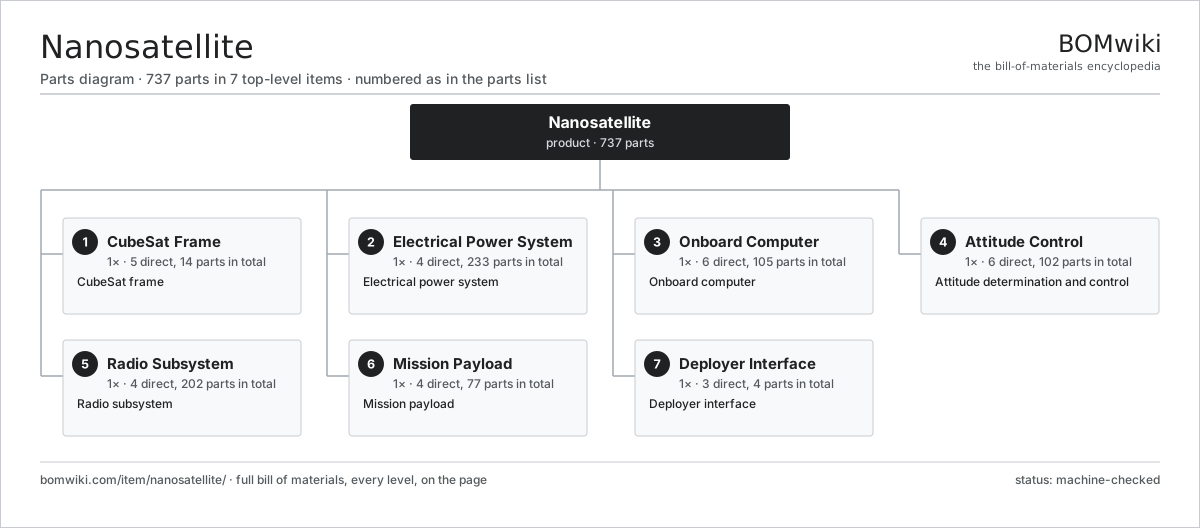
| # | Part | Qty | What it does |
|---|---|---|---|
| 1 | CubeSat Frame 5 parts | 1× | CubeSat frame |
| 2 | Electrical Power System 4 parts | 1× | Electrical power system |
| 3 | Onboard Computer 6 parts | 1× | Onboard computer |
| 4 | Attitude Control 6 parts | 1× | Attitude determination and control |
| 5 | Radio Subsystem 4 parts | 1× | Radio subsystem |
| 6 | Mission Payload 4 parts | 1× | Mission payload |
| 7 | Deployer Interface 3 parts | 1× | Deployer interface |
3D model
No 3D model yet. Have a CAD file of this? Add a 3D model. STL renders right on this page; STEP, FreeCAD, and OpenSCAD sources are welcome too (openly licensed, like all 3D models on BOMwiki).
Build & assembly graph
expand / collapse · shared sub-assemblies converge · links to related products · est. labourTap an assembly to expand/collapse · tap a part to open it · use “Open page” for any node · drag to pan, scroll to zoom.
Bill of materials for Nanosatellite
7 top-level lines · 73 rows shown · 737 parts total · indented to 3 levels| # | Item / sub-assembly | Part no. | Qty/assy | Ext. qty | Parts | Type |
|---|---|---|---|---|---|---|
| 1 | CubeSat Frame 5 parts | nano-structure | 1× | 1 | 14 | assembly |
| 1.1 | Corner Rail | nano-rail | 4× | 4 | · | part |
| 1.2 | Frame Ring | nano-frame-ring | 4× | 4 | · | part |
| 1.3 | Side Panel | nano-side-panel | 4× | 4 | · | part |
| 1.4 | Stack Standoff | nano-pc104-standoff | 1× | 1 | · | part |
| 1.5 | Fastener Set | fastener-set | 1× | 1 | · | part |
| 2 | Electrical Power System 4 parts | nano-eps | 1× | 1 | 233 | assembly |
| 2.1 | Solar Panel 3 parts | nano-solar-panel | 6× | 6 | 4 | assembly |
| 2.1.1 | Solar Cell | nano-solar-cell | 2× | 12 | · | part |
| 2.1.2 | Bare PCB | pcb-bare | 1× | 6 | · | part |
| 2.1.3 | Coarse Sun Sensor | nano-sun-sensor | 1× | 6 | · | part |
| 2.2 | Deployable Array 3 parts | nano-deployable-array | 2× | 2 | 10 | assembly |
| 2.2.1 | Solar Panel 3 parts + deeper › | nano-solar-panel | 2× | 4 | 4 | assembly |
| 2.2.2 | Array Hinge | nano-array-hinge | 1× | 2 | · | part |
| 2.2.3 | Burn-Wire Release | nano-burn-wire | 1× | 2 | · | part |
| 2.3 | Battery Pack 2 parts | nano-battery | 1× | 1 | 57 | assembly |
| 2.3.1 | Li-ion Cell | nano-battery-cell | 4× | 4 | · | part |
| 2.3.2 | Battery Board 4 parts + deeper › | nano-battery-board | 1× | 1 | 53 | assembly |
| 2.4 | EPS Board 5 parts | nano-eps-board | 1× | 1 | 132 | assembly |
| 2.4.1 | Bare PCB | pcb-bare | 1× | 1 | · | part |
| 2.4.2 | Microcontroller | mcu | 1× | 1 | · | part |
| 2.4.3 | DC-DC Regulator | nano-dcdc | 4× | 4 | · | part |
| 2.4.4 | Relay | relay | 6× | 6 | · | part |
| 2.4.5 | SMD Passive (R/C/L) | smd-passives | 120× | 120 | · | part |
| 3 | Onboard Computer 6 parts | nano-obc | 1× | 1 | 105 | assembly |
| 3.1 | Bare PCB | pcb-bare | 1× | 1 | · | part |
| 3.2 | Microcontroller | mcu | 1× | 1 | · | part |
| 3.3 | Flash Memory | nano-flash | 1× | 1 | · | part |
| 3.4 | Watchdog | nano-watchdog | 1× | 1 | · | part |
| 3.5 | Real-Time Clock | nano-rtc | 1× | 1 | · | part |
| 3.6 | SMD Passive (R/C/L) | smd-passives | 100× | 100 | · | part |
| 4 | Attitude Control 6 parts | nano-adcs | 1× | 1 | 102 | assembly |
| 4.1 | Magnetorquer | nano-magnetorquer | 3× | 3 | · | part |
| 4.2 | Miniature Reaction Wheel | nano-reaction-wheel | 3× | 3 | · | part |
| 4.3 | Magnetometer | nano-magnetometer | 1× | 1 | · | part |
| 4.4 | MEMS IMU | nano-imu | 1× | 1 | · | part |
| 4.5 | Fine Sun Sensor | nano-fine-sun-sensor | 2× | 2 | · | part |
| 4.6 | ADCS Board 3 parts | nano-adcs-board | 1× | 1 | 92 | assembly |
| 4.6.1 | Bare PCB | pcb-bare | 1× | 1 | · | part |
| 4.6.2 | Microcontroller | mcu | 1× | 1 | · | part |
| 4.6.3 | SMD Passive (R/C/L) | smd-passives | 90× | 90 | · | part |
| 5 | Radio Subsystem 4 parts | nano-comms | 1× | 1 | 202 | assembly |
| 5.1 | UHF Transceiver 4 parts | nano-uhf-transceiver | 1× | 1 | 83 | assembly |
| 5.1.1 | Bare PCB | pcb-bare | 1× | 1 | · | part |
| 5.1.2 | Microcontroller | mcu | 1× | 1 | · | part |
| 5.1.3 | RF Module | nano-rf-module | 1× | 1 | · | part |
| 5.1.4 | SMD Passive (R/C/L) | smd-passives | 80× | 80 | · | part |
| 5.2 | S-Band Transmitter 3 parts | nano-sband-transmitter | 1× | 1 | 62 | assembly |
| 5.2.1 | Bare PCB | pcb-bare | 1× | 1 | · | part |
| 5.2.2 | RF Module | nano-rf-module | 1× | 1 | · | part |
| 5.2.3 | SMD Passive (R/C/L) | smd-passives | 60× | 60 | · | part |
| 5.3 | Deployable Antenna 2 parts | nano-antenna | 1× | 1 | 5 | assembly |
| 5.3.1 | Tape Antenna Element | nano-tape-antenna | 4× | 4 | · | part |
| 5.3.2 | Burn-Wire Release | nano-burn-wire | 1× | 1 | · | part |
| 5.4 | RF Interface Board 3 parts | nano-rf-board | 1× | 1 | 52 | assembly |
| 5.4.1 | Bare PCB | pcb-bare | 1× | 1 | · | part |
| 5.4.2 | Microcontroller | mcu | 1× | 1 | · | part |
| 5.4.3 | SMD Passive (R/C/L) | smd-passives | 50× | 50 | · | part |
| 6 | Mission Payload 4 parts | nano-payload | 1× | 1 | 77 | assembly |
| 6.1 | Compact Imager 3 parts | nano-imager | 1× | 1 | 3 | assembly |
| 6.1.1 | Image Sensor | nano-image-sensor | 1× | 1 | · | part |
| 6.1.2 | Lens | nano-lens | 1× | 1 | · | part |
| 6.1.3 | Bare PCB | pcb-bare | 1× | 1 | · | part |
| 6.2 | Mission Sensor | nano-payload-sensor | 1× | 1 | · | part |
| 6.3 | Payload Board 3 parts | nano-payload-board | 1× | 1 | 72 | assembly |
| 6.3.1 | Bare PCB | pcb-bare | 1× | 1 | · | part |
| 6.3.2 | Microcontroller | mcu | 1× | 1 | · | part |
| 6.3.3 | SMD Passive (R/C/L) | smd-passives | 70× | 70 | · | part |
| 6.4 | Payload Memory | nano-payload-memory | 1× | 1 | · | part |
| 7 | Deployer Interface 3 parts | nano-deployer-interface | 1× | 1 | 4 | assembly |
| 7.1 | Deployment Switch | nano-deploy-switch | 2× | 2 | · | part |
| 7.2 | Remove-Before-Flight Pin | nano-rbf-pin | 1× | 1 | · | part |
| 7.3 | Separation Spring | nano-separation-spring | 1× | 1 | · | part |
Sourcing: possible vendors
Browse the supplier directory → Prices, MOQ, and lead times are algorithmic estimates, not quotes, and not claims about these companies. Company mappings are curated by keyword; est. price band $50k–$500M. How estimates work| Vendor | HQ | Specialty | MOQ | Lead time |
|---|---|---|---|---|
|
🇺🇸SpaceX
spacex.com ↗
|
Hawthorne, US | Launch & spacecraft | made to order | 52–104 wks |
| northropgrumman.com ↗ | Falls Church, US | Space & defense | made to order | 52–104 wks |
|
🇫🇷Airbus
airbus.com ↗
|
Toulouse, FR | Aerospace OEM | made to order | 52–104 wks |
| rocketlabusa.com ↗ | Long Beach, US | Launch & spacecraft | made to order | 52–104 wks |
| thalesaleniaspace.com ↗ | Cannes, FR | Satellites | made to order | 52–104 wks |
858-word article