Planetary Rover
ProductOverview
A planetary rover is a robot built to drive across the surface of another world and do field geology there, alone, with commands arriving hours late. It cannot be steered in real time, because radio takes minutes to reach Mars and longer for the outer planets, so the rover must sense its own surroundings, decide where it is safe to drive, and place its instruments accurately on its own. The design balances three hard demands: cross rough terrain without tipping or getting stuck, survive brutal temperature swings for years, and carry enough sensing and computing to act without an operator.
The rover is built on a Chassis that carries the warm electronics. Bolted to it are the Mobility System running gear, the Power Subsystem subsystem, the Avionics brain, the Navigation Sensors sensors, a Science Arm for close-up work, the Science Instruments of remote instruments, the Communications links home, and the Thermal Control subsystem that keeps everything alive.
Chassis
The Chassis is essentially a heated, sealed box on wheels. The Equipment Box is insulated and closed so the electronics and battery stay in their temperature range while the outside swings by 150 degrees between day and night. A Deck Plate on top mounts the antennas, the arm, and the Camera Mast, a stalk that lifts the navigation and science cameras to roughly human eye height for a useful view of the terrain. The mast carries a Pan/Tilt Unit unit so the cameras can look around, with a Slip Ring passing power and signals through the rotating joint, and a Mast Deploy Hinge that raises it from its stowed launch position. Frame Strut members tie the box to the suspension.
Mobility
The Mobility System system is the rocker-bogie, a suspension that keeps all six wheels pressed onto the ground over rocks and dips without any springs. Each Wheel Drive Module module is independently powered: a Drive Motor turns through a gearbox to spin a cleated Rover Wheel sized to grip loose regolith, with a Holding Brake to hold position on slopes. The corner wheels add a Steering Actuator each, so the rover can crab sideways or turn in place. The geometry is the clever part: two Rocker Arm arms and two Bogie Arm arms pivot freely, and a Differential Bar links the two rockers so that when one side climbs a rock the body tilts only half as much. This passive linkage lets the rover roll over obstacles as tall as a wheel without a single active suspension element.
Power and avionics
The Power Subsystem subsystem has to last for years far from the sun, so larger rovers carry a Radioisotope Generator, a radioisotope generator in which Radioisotope Heat Source pellets give off steady heat that a Thermocouple Bank converts directly to electricity with no moving parts. That heat is a bonus, warming the electronics box for free. A Rover Battery buffers the peaks of driving and arm motion, and a Power Controller distributes the bus. Smaller or shorter missions use a Solar Array instead, which works until dust coats the panels.
The Avionics are the brain. A Main Computer on a radiation-hardened CPU runs the autonomy and instruments, a Motor Controller with a Motor Driver per actuator drives the wheels and joints, and a Data Storage bank holds the imagery and science until it can be sent home. Because the rover acts on its own, the computer does real work: it plans paths, watches for hazards, and protects itself when something goes wrong.
Navigation and the science arm
The Navigation Sensors sensors are what let the rover drive itself. A pair of Navigation Camera units on the mast take stereo images and build a 3D terrain map, four body-mounted Hazard Camera units watch the ground right around the wheels, and a Inertial Measurement Unit with Wheel Odometer sensors and a Sun Sensor track motion and heading between camera frames. The rover drives a short distance, stops, takes new stereo pictures, finds a safe path, and repeats, which is why its sustained speed is only centimeters per second.
The Science Arm does the close-up science. Five Arm Joint units and three Arm Link segments place a Instrument Turret of Contact Instrument devices flat against a rock, and a Coring Drill with a Percussion Mechanism can core into hard stone to expose or collect fresh material.
Science, comms, and thermal
The Science Instruments studies the surface from a distance and over time. Mast Camera units with a Filter Wheel image the landscape in many colors, a Spectrometer reads composition, and a Environment Station logs pressure, wind, and temperature like a weather post. Sample-return rovers add a Sample Cache of sealed Sample Tube units that a future mission could pick up.
The Communications subsystem uses two paths: a X-Band Radio and steerable High-Gain Antenna dish talk directly to Earth at low rate for commands, while a UHF Radio relays the bulk of the data through a passing orbiter at much higher speed. The Thermal Control subsystem ties it all together against the cold, combining Insulation, a pumped Heat-Transfer Loop that shares the generator's warmth, Radiator panels, and Survival Heater units cycled by thermostats. Variants span tiny solar microrovers that survive a couple of weeks to large nuclear-powered rovers that drive for over a decade, but the rocker-bogie, the self-driving loop, and the warm sealed box are common to all of them.
Planetary Rover parts and their functions
9 top-level parts · 1,805 parts in total · full bill of materials below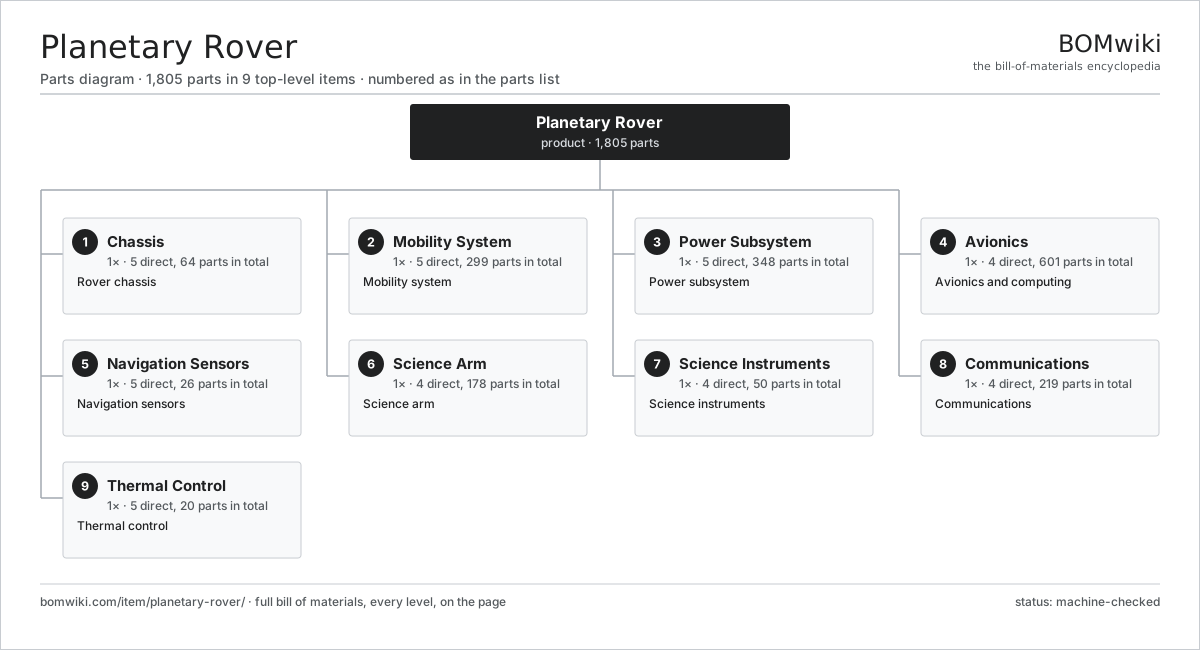
| # | Part | Qty | What it does |
|---|---|---|---|
| 1 | Chassis 5 parts | 1× | Rover chassis |
| 2 | Mobility System 5 parts | 1× | Mobility system |
| 3 | Power Subsystem 5 parts | 1× | Power subsystem |
| 4 | Avionics 4 parts | 1× | Avionics and computing |
| 5 | Navigation Sensors 5 parts | 1× | Navigation sensors |
| 6 | Science Arm 4 parts | 1× | Science arm |
| 7 | Science Instruments 4 parts | 1× | Science instruments |
| 8 | Communications 4 parts | 1× | Communications |
| 9 | Thermal Control 5 parts | 1× | Thermal control |
3D model
No 3D model yet. Have a CAD file of this? Add a 3D model. STL renders right on this page; STEP, FreeCAD, and OpenSCAD sources are welcome too (openly licensed, like all 3D models on BOMwiki).
Build & assembly graph
expand / collapse · shared sub-assemblies converge · links to related products · est. labourTap an assembly to expand/collapse · tap a part to open it · use “Open page” for any node · drag to pan, scroll to zoom.
Bill of materials for Planetary Rover
9 top-level lines · 121 rows shown · 1,805 parts total · indented to 3 levels| # | Item / sub-assembly | Part no. | Qty/assy | Ext. qty | Parts | Type |
|---|---|---|---|---|---|---|
| 1 | Chassis 5 parts | rov-chassis | 1× | 1 | 64 | assembly |
| 1.1 | Equipment Box | rov-equipment-box | 1× | 1 | · | part |
| 1.2 | Deck Plate | rov-deck-plate | 1× | 1 | · | part |
| 1.3 | Frame Strut | rov-frame-strut | 8× | 8 | · | part |
| 1.4 | Camera Mast 3 parts | rov-mast | 1× | 1 | 53 | assembly |
| 1.4.1 | Mast Tube | rov-mast-tube | 1× | 1 | · | part |
| 1.4.2 | Pan/Tilt Unit 3 parts + deeper › | rov-pan-tilt | 1× | 1 | 51 | assembly |
| 1.4.3 | Mast Deploy Hinge | rov-deploy-hinge | 1× | 1 | · | part |
| 1.5 | Fastener Set | fastener-set | 1× | 1 | · | part |
| 2 | Mobility System 5 parts | rov-mobility | 1× | 1 | 299 | assembly |
| 2.1 | Wheel Drive Module 6 parts | rov-wheel-drive | 6× | 6 | 31 | assembly |
| 2.1.1 | Drive Motor 4 parts + deeper › | rov-drive-motor | 1× | 6 | 24 | assembly |
| 2.1.2 | Gearbox Housing | gearbox-housing | 1× | 6 | · | part |
| 2.1.3 | Helical Gear Pair | gear-pair | 2× | 12 | · | part |
| 2.1.4 | Rover Wheel | rov-wheel | 1× | 6 | · | part |
| 2.1.5 | Ball Bearing | ball-bearing | 2× | 12 | · | part |
| 2.1.6 | Holding Brake | rov-brake | 1× | 6 | · | part |
| 2.2 | Steering Actuator 3 parts | rov-steering-actuator | 4× | 4 | 27 | assembly |
| 2.2.1 | Servo Motor 4 parts + deeper › | servo-motor | 1× | 4 | 24 | assembly |
| 2.2.2 | Helical Gear Pair | gear-pair | 1× | 4 | · | part |
| 2.2.3 | Ball Bearing | ball-bearing | 2× | 8 | · | part |
| 2.3 | Rocker Arm | rov-rocker | 2× | 2 | · | part |
| 2.4 | Bogie Arm | rov-bogie | 2× | 2 | · | part |
| 2.5 | Differential Bar | rov-differential-bar | 1× | 1 | · | part |
| 3 | Power Subsystem 5 parts | rov-power | 1× | 1 | 348 | assembly |
| 3.1 | Radioisotope Generator 3 parts | rov-rtg | 1× | 1 | 3 | assembly |
| 3.1.1 | Radioisotope Heat Source | rov-rtg-fuel | 1× | 1 | · | part |
| 3.1.2 | Thermocouple Bank | rov-thermocouple-bank | 1× | 1 | · | part |
| 3.1.3 | Generator Housing | rov-rtg-housing | 1× | 1 | · | part |
| 3.2 | Rover Battery 3 parts | rov-battery | 1× | 1 | 99 | assembly |
| 3.2.1 | Li-ion Cell | rov-battery-cell | 16× | 16 | · | part |
| 3.2.2 | Battery Electronics 3 parts + deeper › | rov-battery-bms | 1× | 1 | 82 | assembly |
| 3.2.3 | Battery Housing | rov-battery-housing | 1× | 1 | · | part |
| 3.3 | Power Controller 4 parts | rov-power-controller | 1× | 1 | 235 | assembly |
| 3.3.1 | Bare PCB | pcb-bare | 2× | 2 | · | part |
| 3.3.2 | Microcontroller | mcu | 1× | 1 | · | part |
| 3.3.3 | Relay | relay | 12× | 12 | · | part |
| 3.3.4 | SMD Passive (R/C/L) | smd-passives | 220× | 220 | · | part |
| 3.4 | Solar Array 2 parts | rov-solar-array | 2× | 2 | 5 | assembly |
| 3.4.1 | Solar Panel | rov-solar-panel | 3× | 6 | · | part |
| 3.4.2 | Array Hinge | rov-array-hinge | 2× | 4 | · | part |
| 3.5 | Wire Bundle | wire-bundle | 1× | 1 | · | part |
| 4 | Avionics 4 parts | rov-avionics | 1× | 1 | 601 | assembly |
| 4.1 | Main Computer 4 parts | rov-main-computer | 1× | 1 | 244 | assembly |
| 4.1.1 | Bare PCB | pcb-bare | 1× | 1 | · | part |
| 4.1.2 | Microcontroller | mcu | 2× | 2 | · | part |
| 4.1.3 | Radiation-Hardened CPU | rov-rad-cpu | 1× | 1 | · | part |
| 4.1.4 | SMD Passive (R/C/L) | smd-passives | 240× | 240 | · | part |
| 4.2 | Motor Controller 4 parts | rov-motor-controller | 1× | 1 | 172 | assembly |
| 4.2.1 | Bare PCB | pcb-bare | 1× | 1 | · | part |
| 4.2.2 | Microcontroller | mcu | 1× | 1 | · | part |
| 4.2.3 | Motor Driver | rov-motor-driver | 10× | 10 | · | part |
| 4.2.4 | SMD Passive (R/C/L) | smd-passives | 160× | 160 | · | part |
| 4.3 | I/O Board 3 parts | rov-io-board | 2× | 2 | 92 | assembly |
| 4.3.1 | Bare PCB | pcb-bare | 1× | 2 | · | part |
| 4.3.2 | Microcontroller | mcu | 1× | 2 | · | part |
| 4.3.3 | SMD Passive (R/C/L) | smd-passives | 90× | 180 | · | part |
| 4.4 | Data Storage | rov-data-storage | 1× | 1 | · | part |
| 5 | Navigation Sensors 5 parts | rov-navigation | 1× | 1 | 26 | assembly |
| 5.1 | Navigation Camera 3 parts | rov-nav-camera | 2× | 2 | 3 | assembly |
| 5.1.1 | Image Sensor | rov-image-sensor | 1× | 2 | · | part |
| 5.1.2 | Lens | rov-lens | 1× | 2 | · | part |
| 5.1.3 | Bare PCB | pcb-bare | 1× | 2 | · | part |
| 5.2 | Hazard Camera 3 parts | rov-hazard-camera | 4× | 4 | 3 | assembly |
| 5.2.1 | Image Sensor | rov-image-sensor | 1× | 4 | · | part |
| 5.2.2 | Lens | rov-lens | 1× | 4 | · | part |
| 5.2.3 | Bare PCB | pcb-bare | 1× | 4 | · | part |
| 5.3 | Inertial Measurement Unit | rov-imu | 1× | 1 | · | part |
| 5.4 | Sun Sensor | rov-sun-sensor | 1× | 1 | · | part |
| 5.5 | Wheel Odometer | rov-wheel-odometer | 6× | 6 | · | part |
| 6 | Science Arm 4 parts | rov-robotic-arm | 1× | 1 | 178 | assembly |
| 6.1 | Arm Joint 4 parts | rov-arm-joint | 5× | 5 | 29 | assembly |
| 6.1.1 | Servo Motor 4 parts + deeper › | servo-motor | 1× | 5 | 24 | assembly |
| 6.1.2 | Helical Gear Pair | gear-pair | 2× | 10 | · | part |
| 6.1.3 | Ball Bearing | ball-bearing | 2× | 10 | · | part |
| 6.1.4 | Joint Encoder | rov-joint-encoder | 1× | 5 | · | part |
| 6.2 | Arm Link | rov-arm-link | 3× | 3 | · | part |
| 6.3 | Instrument Turret 3 parts | rov-turret | 1× | 1 | 27 | assembly |
| 6.3.1 | Contact Instrument | rov-contact-instrument | 2× | 2 | · | part |
| 6.3.2 | Servo Motor 4 parts + deeper › | servo-motor | 1× | 1 | 24 | assembly |
| 6.3.3 | Dust Cover | rov-dust-cover | 1× | 1 | · | part |
| 6.4 | Coring Drill 3 parts | rov-drill | 1× | 1 | 3 | assembly |
| 6.4.1 | Drill Motor | rov-drill-motor | 1× | 1 | · | part |
| 6.4.2 | Drill Bit | rov-drill-bit | 1× | 1 | · | part |
| 6.4.3 | Percussion Mechanism | rov-percussion-mechanism | 1× | 1 | · | part |
| 7 | Science Instruments 4 parts | rov-science-payload | 1× | 1 | 50 | assembly |
| 7.1 | Mast Camera 4 parts | rov-mast-camera | 2× | 2 | 4 | assembly |
| 7.1.1 | Image Sensor | rov-image-sensor | 1× | 2 | · | part |
| 7.1.2 | Lens | rov-lens | 1× | 2 | · | part |
| 7.1.3 | Filter Wheel | rov-filter-wheel | 1× | 2 | · | part |
| 7.1.4 | Bare PCB | pcb-bare | 1× | 2 | · | part |
| 7.2 | Spectrometer | rov-spectrometer | 1× | 1 | · | part |
| 7.3 | Environment Station 3 parts | rov-environment-station | 1× | 1 | 4 | assembly |
| 7.3.1 | Pressure Sensor | pressure-sensor | 1× | 1 | · | part |
| 7.3.2 | Wind Sensor | rov-wind-sensor | 1× | 1 | · | part |
| 7.3.3 | Air Temperature Sensor | rov-temp-sensor | 2× | 2 | · | part |
| 7.4 | Sample Cache 3 parts | rov-sample-cache | 1× | 1 | 37 | assembly |
| 7.4.1 | Sample Tube | rov-sample-tube | 12× | 12 | · | part |
| 7.4.2 | Sealing Mechanism | rov-sealing-mechanism | 1× | 1 | · | part |
| 7.4.3 | Servo Motor 4 parts + deeper › | servo-motor | 1× | 1 | 24 | assembly |
| 8 | Communications 4 parts | rov-comms | 1× | 1 | 219 | assembly |
| 8.1 | UHF Radio 4 parts | rov-uhf-radio | 1× | 1 | 103 | assembly |
| 8.1.1 | Bare PCB | pcb-bare | 1× | 1 | · | part |
| 8.1.2 | Microcontroller | mcu | 1× | 1 | · | part |
| 8.1.3 | RF Module | rov-rf-module | 1× | 1 | · | part |
| 8.1.4 | SMD Passive (R/C/L) | smd-passives | 100× | 100 | · | part |
| 8.2 | X-Band Radio 4 parts | rov-xband-radio | 1× | 1 | 113 | assembly |
| 8.2.1 | Bare PCB | pcb-bare | 1× | 1 | · | part |
| 8.2.2 | Microcontroller | mcu | 1× | 1 | · | part |
| 8.2.3 | RF Module | rov-rf-module | 1× | 1 | · | part |
| 8.2.4 | SMD Passive (R/C/L) | smd-passives | 110× | 110 | · | part |
| 8.3 | High-Gain Antenna 2 parts | rov-hga | 1× | 1 | 2 | assembly |
| 8.3.1 | Antenna Dish | rov-antenna-dish | 1× | 1 | · | part |
| 8.3.2 | Antenna Gimbal | rov-antenna-gimbal | 1× | 1 | · | part |
| 8.4 | UHF Antenna | rov-uhf-antenna | 1× | 1 | · | part |
| 9 | Thermal Control 5 parts | rov-thermal | 1× | 1 | 20 | assembly |
| 9.1 | Insulation | rov-insulation | 1× | 1 | · | part |
| 9.2 | Heat-Transfer Loop | rov-heat-loop | 1× | 1 | · | part |
| 9.3 | Radiator | rov-radiator | 2× | 2 | · | part |
| 9.4 | Survival Heater | rov-heater | 8× | 8 | · | part |
| 9.5 | Thermostat | rov-thermostat | 8× | 8 | · | part |
Related products
same domain, ranked by shared parts Crewed Space Capsule
7,222 parts · shares 14 with this page
Crewed Space Capsule
7,222 parts · shares 14 with this page
 Mars Science Rover
1,624 parts · shares 11 with this page
Mars Science Rover
1,624 parts · shares 11 with this page
 GPS Navigation Satellite
2,640 parts · shares 13 with this page
GPS Navigation Satellite
2,640 parts · shares 13 with this page
 Ion Thruster
880 parts · shares 13 with this page
Ion Thruster
880 parts · shares 13 with this page
 Rocket Upper Stage
1,459 parts · shares 13 with this page
Rocket Upper Stage
1,459 parts · shares 13 with this page
 Weather Satellite
1,765 parts · shares 13 with this page
Weather Satellite
1,765 parts · shares 13 with this page
Sourcing: possible vendors
Browse the supplier directory → Prices, MOQ, and lead times are algorithmic estimates, not quotes, and not claims about these companies. Company mappings are curated by keyword; est. price band $50k–$500M. How estimates work| Vendor | HQ | Specialty | MOQ | Lead time |
|---|---|---|---|---|
|
🇺🇸SpaceX
spacex.com ↗
|
Hawthorne, US | Launch & spacecraft | made to order | 52–104 wks |
| northropgrumman.com ↗ | Falls Church, US | Space & defense | made to order | 52–104 wks |
|
🇫🇷Airbus
airbus.com ↗
|
Toulouse, FR | Aerospace OEM | made to order | 52–104 wks |
| rocketlabusa.com ↗ | Long Beach, US | Launch & spacecraft | made to order | 52–104 wks |
| thalesaleniaspace.com ↗ | Cannes, FR | Satellites | made to order | 52–104 wks |
951-word article