Reusable Launch Vehicle
ProductAlso known as: Falcon 9, SpaceX, reusable rocket, booster
Overview
For sixty years the Orbital Launch Vehicle was a machine for throwing away most of itself in the right order. The reusable launch vehicle keeps the expensive part. Its booster, nine engines and the tanks that feed them, roughly 60% of the vehicle's cost, separates near 2 km/s, flips around, flies back through the atmosphere and lands standing up, on legs, on a ship. The Falcon 9 flew this architecture from first landing in December 2015 to routine operations where individual boosters have each flown more than two dozen missions, and it is the reference vehicle for this BOM.
In parts terms, reuse is additive. Everything an expendable rocket carries is still here, the tanks, the feed system, the Turbopumps, the six-figure fastener populations. On top of that the Reusable Booster Stage carries roughly ten tonnes of hardware that exists only so it can come home: Titanium Grid Fins, Landing Legs, a Booster Cold-Gas RCS to flip the stage, a re-entry-rated Re-entry Base Heatshield, extra TEA-TEB Ampoules for the relights, and the propellant reserve to burn three more times. Recovery costs payload, about 17.5 t to LEO instead of 22.8 t, and buys back the booster.
An engine you can land on
The engine is where reusability starts. A landing burn presents an absurd control problem: a nearly empty stage weighs less than one engine's full thrust, so the vehicle cannot hover, it must hit zero velocity exactly at zero altitude. The Reusable Booster Engine answers with a Throttle Valve that lets the centre engine run deep below full power, and with a Pintle Injector in place of the hundreds of coaxial elements in a classic injector head. A single Pintle Post sheets LOX radially into a fuel curtain formed by the Pintle Fuel Sleeve; the design is inherently stable across a wide throttle range, which is exactly what an engine that must light at Mach 6 and again at 300 m needs.
Each booster engine starts four times per flight, liftoff, boostback, entry, landing, so the Multi-Start Ignition System system carries one sealed TEA-TEB Ampoule per relight. TEA-TEB ignites on contact with liquid oxygen; the green flash at every Falcon 9 start is triethylaluminum burning. Upstream of the injector, the engine shares its Turbopump, Thrust Chamber & Nozzle, Gas Generator and Engine Controller with its expendable cousin, the gas-generator kerolox cycle did not change, the duty cycle did. The Engine Plumbing & Hardware small-parts accounting carries over too: most of an engine's parts are still its brazed joints, B-nuts, seals and clips.
The ride home
The booster's return is flown by hardware that has no equivalent on an expendable stage. After separation the Booster Cold-Gas RCS, nitrogen thrusters fed from COPV Pressure Vessels, flips the 40-metre stage end-over-end so the engines face the airstream. Three engines relight for the entry burn, slowing the stage enough that re-entry heating stays survivable; the Re-entry Base Heatshield and its Engine Bay Thermal Blankets take the tail-first plasma that follows.
From there to the landing burn the only control is aerodynamic: four Titanium Grid Fins, cast in titanium as single-piece lattices after the original aluminium fins ablated during entry. The lattice geometry keeps control authority through the transonic regime where a planar fin stalls. Each fin's Grid Fin Actuator runs off the Fin Hydraulic Power Unit, a closed-loop circuit, because an early open-loop version ran the Hydraulic Reservoir dry seconds before touchdown on one of the first landing attempts.
Seconds before landing, helium from the Leg Deployment Pneumatics blows the four Landing Legs from stowed to locked. Each leg telescopes through three Leg Telescoping Piston stages onto a Landing Footpad, with a Crush Core Cartridge cartridge in the final stage, an aluminium-honeycomb fuse that crushes to absorb a hard landing and is swapped during refurbishment. The landing itself is flown blind by the avionics: a Radar Altimeter gives height-above-deck truth, GPS Receivers blended with the Inertial Measurement Units give metres-level navigation onto a barge-sized target, and the three voting Flight Computers close the loop. There is no pilot and no ground command; the Autonomous Flight Termination Unit even moves range safety on board.
What still gets thrown away, and what almost doesn't
The Second Stage remains expendable: one Vacuum Engine, the same pintle powerhead exhausting through a radiatively cooled Nozzle Extension, and a short Second-Stage Tank built on the same 3.7 m tooling as the booster tanks. That tooling decision is visible in this BOM: both stages share the same Tank Barrel Panels, Tank Domes and Slosh Baffles.
The Recoverable Payload Fairing, though, comes back. Each Recoverable Fairing Half is a small re-entry vehicle: its Fairing Recovery Kit packs cold-gas thrusters for the exoatmospheric coast, a Drogue Chute and GPS-steered Steerable Parafoil for the final kilometres, and a Flotation Collar for the wait at sea. A fairing is a few million dollars of autoclaved composite; flying it twice was worth giving each half its own Recovery Controller.
What reuse does to a BOM
An expendable rocket's bill of materials is a manifest of things built once and destroyed on schedule. This one is closer to an aircraft's: parts now have service lives, inspection intervals and replacement cadences. The Crush Core Cartridge is consumed by hard landings; the TEA-TEB Ampoules are consumed every flight; the titanium Grid Fin Lattice Body is designed never to be touched at all. Between flights the booster is inspected, engines borescoped, and the stage reflown, at the program's best, within weeks. The economics only close because the ~470,000 parts of a nine-engine cluster and its stage amortise across dozens of flights instead of one, which is the entire argument for every recovery part on this page.
Reusable Launch Vehicle parts and their functions
6 top-level parts · 2,046,169 parts in total · full bill of materials below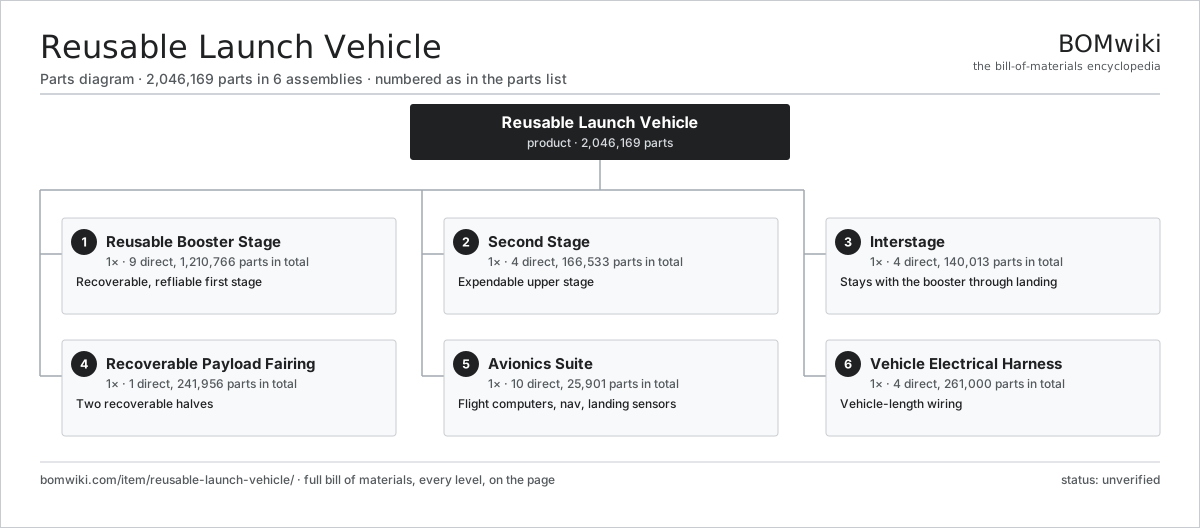
| # | Part | Qty | What it does |
|---|---|---|---|
| 1 | Reusable Booster Stage 9 parts | 1× | Recoverable, refliable first stage |
| 2 | Second Stage 4 parts | 1× | Expendable upper stage |
| 3 | Interstage 4 parts | 1× | Stays with the booster through landing |
| 4 | Recoverable Payload Fairing 1 parts | 1× | Two recoverable halves |
| 5 | Avionics Suite 10 parts | 1× | Flight computers, nav, landing sensors |
| 6 | Vehicle Electrical Harness 4 parts | 1× | Vehicle-length wiring |
Diagrams & photos
.jpg)
3D model
No 3D model yet. Have a CAD file of this? Add a 3D model — STL renders right on this page; STEP, FreeCAD, and OpenSCAD sources are welcome too (openly licensed, like all 3D models on BOMwiki).
Build & assembly graph
expand / collapse · shared sub-assemblies converge · links to related products · est. labourTap an assembly to expand/collapse · tap a part to open it · use “Open page” for any node · drag to pan, scroll to zoom.
Bill of materials for Reusable Launch Vehicle
6 top-level lines · 126 rows shown · 2,046,169 parts total · indented to 3 levels| # | Item / sub-assembly | Part no. | Qty/assy | Ext. qty | Parts | Type |
|---|---|---|---|---|---|---|
| 1 | Reusable Booster Stage 9 parts | reusable-launch-vehicle-booster | 1× | 1 | 1,210,766 | assembly |
| 1.1 | Reusable Booster Engine 9 parts | reusable-launch-vehicle-engine | 9× | 9 | 54,037 | assembly |
| 1.1.1 | Turbopump 6 parts + deeper › | orbital-launch-vehicle-turbopump | 1× | 9 | 55 | assembly |
| 1.1.2 | Thrust Chamber & Nozzle | orbital-launch-vehicle-thrust-chamber | 1× | 9 | · | part |
| 1.1.3 | Pintle Injector 5 parts + deeper › | reusable-launch-vehicle-pintle-injector | 1× | 9 | 31 | assembly |
| 1.1.4 | Gas Generator | orbital-launch-vehicle-gas-generator | 1× | 9 | · | part |
| 1.1.5 | Throttle Valve | reusable-launch-vehicle-throttle-valve | 1× | 9 | · | part |
| 1.1.6 | Engine Valve | orbital-launch-vehicle-engine-valve | 7× | 63 | · | part |
| 1.1.7 | Multi-Start Ignition System 4 parts + deeper › | reusable-launch-vehicle-multistart-ignition | 1× | 9 | 10 | assembly |
| 1.1.8 | Engine Controller 5 parts + deeper › | orbital-launch-vehicle-engine-controller | 1× | 9 | 1,846 | assembly |
| 1.1.9 | Engine Plumbing & Hardware 6 parts + deeper › | orbital-launch-vehicle-engine-plumbing | 1× | 9 | 52,085 | assembly |
| 1.2 | Booster LOX Tank (Subcooled) 5 parts | reusable-launch-vehicle-lox-tank | 1× | 1 | 180,026 | assembly |
| 1.2.1 | Tank Barrel Panel | orbital-launch-vehicle-tank-barrel-panel | 8× | 8 | · | part |
| 1.2.2 | Tank Dome | orbital-launch-vehicle-tank-dome | 2× | 2 | · | part |
| 1.2.3 | Slosh Baffle | orbital-launch-vehicle-slosh-baffle | 12× | 12 | · | part |
| 1.2.4 | Structural Fastener | orbital-launch-vehicle-structural-fastener | 180000× | 180,000 | · | part |
| 1.2.5 | Pressure Sensor | pressure-sensor | 4× | 4 | · | part |
| 1.3 | Booster RP-1 Tank (Chilled) 5 parts | reusable-launch-vehicle-rp1-tank | 1× | 1 | 150,021 | assembly |
| 1.3.1 | Tank Barrel Panel | orbital-launch-vehicle-tank-barrel-panel | 6× | 6 | · | part |
| 1.3.2 | Tank Dome | orbital-launch-vehicle-tank-dome | 2× | 2 | · | part |
| 1.3.3 | Slosh Baffle | orbital-launch-vehicle-slosh-baffle | 9× | 9 | · | part |
| 1.3.4 | Structural Fastener | orbital-launch-vehicle-structural-fastener | 150000× | 150,000 | · | part |
| 1.3.5 | Pressure Sensor | pressure-sensor | 4× | 4 | · | part |
| 1.4 | Octaweb Thrust Structure 4 parts | reusable-launch-vehicle-octaweb | 1× | 1 | 300,035 | assembly |
| 1.4.1 | Octaweb Web Member | orbital-launch-vehicle-octaweb-member | 8× | 8 | · | part |
| 1.4.2 | Engine Mount | orbital-launch-vehicle-engine-mount | 9× | 9 | · | part |
| 1.4.3 | TVC Actuator | orbital-launch-vehicle-tvc-actuator | 18× | 18 | · | part |
| 1.4.4 | Structural Fastener | orbital-launch-vehicle-structural-fastener | 300000× | 300,000 | · | part |
| 1.5 | Propellant Feed System 6 parts | orbital-launch-vehicle-feed-system | 1× | 1 | 2,461 | assembly |
| 1.5.1 | Propellant Feed Line | orbital-launch-vehicle-feed-line | 4× | 4 | · | part |
| 1.5.2 | Propellant Valve | orbital-launch-vehicle-propellant-valve | 14× | 14 | · | part |
| 1.5.3 | Pogo Accumulator | orbital-launch-vehicle-pogo-accumulator | 1× | 1 | · | part |
| 1.5.4 | Pressurization System 5 parts + deeper › | orbital-launch-vehicle-pressurization-system | 1× | 1 | 38 | assembly |
| 1.5.5 | Fill & Drain Valve | orbital-launch-vehicle-fill-drain-valve | 4× | 4 | · | part |
| 1.5.6 | Duct Flange Joint | orbital-launch-vehicle-flange-joint | 2400× | 2,400 | · | part |
| 1.6 | Landing Gear Set 3 parts | reusable-launch-vehicle-landing-gear | 1× | 1 | 30,496 | assembly |
| 1.6.1 | Landing Leg 5 parts + deeper › | reusable-launch-vehicle-landing-leg | 4× | 4 | 22 | assembly |
| 1.6.2 | Leg Deployment Pneumatics 3 parts + deeper › | reusable-launch-vehicle-leg-deploy-system | 1× | 1 | 408 | assembly |
| 1.6.3 | Structural Fastener | orbital-launch-vehicle-structural-fastener | 30000× | 30,000 | · | part |
| 1.7 | Grid Fin System 2 parts | reusable-launch-vehicle-grid-fin-system | 1× | 1 | 975 | assembly |
| 1.7.1 | Titanium Grid Fin 5 parts + deeper › | reusable-launch-vehicle-grid-fin | 4× | 4 | 17 | assembly |
| 1.7.2 | Fin Hydraulic Power Unit 5 parts + deeper › | reusable-launch-vehicle-fin-hydraulic-unit | 1× | 1 | 907 | assembly |
| 1.8 | Booster Cold-Gas RCS 3 parts | reusable-launch-vehicle-booster-rcs | 1× | 1 | 355 | assembly |
| 1.8.1 | Cold-Gas Thruster Pod 5 parts + deeper › | reusable-launch-vehicle-rcs-thruster-pod | 2× | 2 | 164 | assembly |
| 1.8.2 | COPV Pressure Vessel | orbital-launch-vehicle-copv | 4× | 4 | · | part |
| 1.8.3 | RCS Distribution Manifold 5 parts + deeper › | reusable-launch-vehicle-rcs-manifold | 1× | 1 | 23 | assembly |
| 1.9 | Re-entry Base Heatshield 3 parts | reusable-launch-vehicle-base-heatshield | 1× | 1 | 60,064 | assembly |
| 1.9.1 | Heatshield Panel | orbital-launch-vehicle-heatshield-panel | 24× | 24 | · | part |
| 1.9.2 | Engine Bay Thermal Blanket | reusable-launch-vehicle-engine-bay-blanket | 40× | 40 | · | part |
| 1.9.3 | Structural Fastener | orbital-launch-vehicle-structural-fastener | 60000× | 60,000 | · | part |
| 2 | Second Stage 4 parts | reusable-launch-vehicle-second-stage | 1× | 1 | 166,533 | assembly |
| 2.1 | Vacuum Engine 8 parts | reusable-launch-vehicle-vacuum-engine | 1× | 1 | 54,035 | assembly |
| 2.1.1 | Turbopump 6 parts + deeper › | orbital-launch-vehicle-turbopump | 1× | 1 | 55 | assembly |
| 2.1.2 | Thrust Chamber & Nozzle | orbital-launch-vehicle-thrust-chamber | 1× | 1 | · | part |
| 2.1.3 | Nozzle Extension | orbital-launch-vehicle-nozzle-extension | 1× | 1 | · | part |
| 2.1.4 | Pintle Injector 5 parts + deeper › | reusable-launch-vehicle-pintle-injector | 1× | 1 | 31 | assembly |
| 2.1.5 | Engine Valve | orbital-launch-vehicle-engine-valve | 6× | 6 | · | part |
| 2.1.6 | Multi-Start Ignition System 4 parts + deeper › | reusable-launch-vehicle-multistart-ignition | 1× | 1 | 10 | assembly |
| 2.1.7 | Engine Controller 5 parts + deeper › | orbital-launch-vehicle-engine-controller | 1× | 1 | 1,846 | assembly |
| 2.1.8 | Engine Plumbing & Hardware 6 parts + deeper › | orbital-launch-vehicle-engine-plumbing | 1× | 1 | 52,085 | assembly |
| 2.2 | Second-Stage Tank 5 parts | reusable-launch-vehicle-upper-tank | 1× | 1 | 110,017 | assembly |
| 2.2.1 | Tank Barrel Panel | orbital-launch-vehicle-tank-barrel-panel | 4× | 4 | · | part |
| 2.2.2 | Tank Dome | orbital-launch-vehicle-tank-dome | 3× | 3 | · | part |
| 2.2.3 | Slosh Baffle | orbital-launch-vehicle-slosh-baffle | 6× | 6 | · | part |
| 2.2.4 | Structural Fastener | orbital-launch-vehicle-structural-fastener | 110000× | 110,000 | · | part |
| 2.2.5 | Pressure Sensor | pressure-sensor | 4× | 4 | · | part |
| 2.3 | Propellant Feed System 6 parts | orbital-launch-vehicle-feed-system | 1× | 1 | 2,461 | assembly |
| 2.3.1 | Propellant Feed Line | orbital-launch-vehicle-feed-line | 4× | 4 | · | part |
| 2.3.2 | Propellant Valve | orbital-launch-vehicle-propellant-valve | 14× | 14 | · | part |
| 2.3.3 | Pogo Accumulator | orbital-launch-vehicle-pogo-accumulator | 1× | 1 | · | part |
| 2.3.4 | Pressurization System 5 parts + deeper › | orbital-launch-vehicle-pressurization-system | 1× | 1 | 38 | assembly |
| 2.3.5 | Fill & Drain Valve | orbital-launch-vehicle-fill-drain-valve | 4× | 4 | · | part |
| 2.3.6 | Duct Flange Joint | orbital-launch-vehicle-flange-joint | 2400× | 2,400 | · | part |
| 2.4 | Reaction Control System 3 parts | orbital-launch-vehicle-rcs | 1× | 1 | 20 | assembly |
| 2.4.1 | Cold-Gas Thruster | orbital-launch-vehicle-cold-gas-thruster | 8× | 8 | · | part |
| 2.4.2 | COPV Pressure Vessel | orbital-launch-vehicle-copv | 2× | 2 | · | part |
| 2.4.3 | Propellant Valve | orbital-launch-vehicle-propellant-valve | 10× | 10 | · | part |
| 3 | Interstage 4 parts | reusable-launch-vehicle-interstage | 1× | 1 | 140,013 | assembly |
| 3.1 | Composite Sandwich Panel | orbital-launch-vehicle-composite-panel | 8× | 8 | · | part |
| 3.2 | Pneumatic Pusher | orbital-launch-vehicle-pneumatic-pusher | 4× | 4 | · | part |
| 3.3 | Fin Mount Ring Frame | reusable-launch-vehicle-fin-mount-ring | 1× | 1 | · | part |
| 3.4 | Structural Fastener | orbital-launch-vehicle-structural-fastener | 140000× | 140,000 | · | part |
| 4 | Recoverable Payload Fairing 1 parts | reusable-launch-vehicle-payload-fairing | 1× | 1 | 241,956 | assembly |
| 4.1 | Recoverable Fairing Half 6 parts | reusable-launch-vehicle-fairing-half | 2× | 2 | 120,978 | assembly |
| 4.1.1 | Composite Sandwich Panel | orbital-launch-vehicle-composite-panel | 6× | 12 | · | part |
| 4.1.2 | Acoustic Blanket | orbital-launch-vehicle-acoustic-blanket | 30× | 60 | · | part |
| 4.1.3 | Fairing Separation Rail | orbital-launch-vehicle-separation-rail | 1× | 2 | · | part |
| 4.1.4 | Pneumatic Pusher | orbital-launch-vehicle-pneumatic-pusher | 4× | 8 | · | part |
| 4.1.5 | Fairing Recovery Kit 6 parts + deeper › | reusable-launch-vehicle-fairing-recovery-kit | 1× | 2 | 937 | assembly |
| 4.1.6 | Structural Fastener | orbital-launch-vehicle-structural-fastener | 120000× | 240,000 | · | part |
| 5 | Avionics Suite 10 parts | reusable-launch-vehicle-avionics | 1× | 1 | 25,901 | assembly |
| 5.1 | Flight Computer 4 parts | orbital-launch-vehicle-flight-computer | 3× | 3 | 5,246 | assembly |
| 5.1.1 | Bare PCB | pcb-bare | 4× | 12 | · | part |
| 5.1.2 | Compute SoC Module | soc-module | 2× | 6 | · | part |
| 5.1.3 | SMD Passive (R/C/L) | smd-passives | 5200× | 15,600 | · | part |
| 5.1.4 | Connector | connector | 40× | 120 | · | part |
| 5.2 | Inertial Measurement Unit | orbital-launch-vehicle-imu | 3× | 3 | · | part |
| 5.3 | GPS Receiver | reusable-launch-vehicle-gps-receiver | 3× | 3 | · | part |
| 5.4 | Radar Altimeter | reusable-launch-vehicle-radar-altimeter | 2× | 2 | · | part |
| 5.5 | Telemetry Transmitter | orbital-launch-vehicle-telemetry-transmitter | 2× | 2 | · | part |
| 5.6 | Autonomous Flight Termination Unit | reusable-launch-vehicle-afts-unit | 2× | 2 | · | part |
| 5.7 | Vehicle Battery 2 parts | orbital-launch-vehicle-battery | 4× | 4 | 170 | assembly |
| 5.7.1 | LiPo Cell | lipo-cell | 168× | 672 | · | part |
| 5.7.2 | BMS Board | bms-board | 2× | 8 | · | part |
| 5.8 | Power Distribution Unit 6 parts | reusable-launch-vehicle-power-distribution-unit | 2× | 2 | 2,487 | assembly |
| 5.8.1 | Bare PCB | pcb-bare | 4× | 8 | · | part |
| 5.8.2 | Microcontroller | mcu | 2× | 4 | · | part |
| 5.8.3 | Relay | relay | 32× | 64 | · | part |
| 5.8.4 | SMD Passive (R/C/L) | smd-passives | 2400× | 4,800 | · | part |
| 5.8.5 | Connector | connector | 48× | 96 | · | part |
| 5.8.6 | Wire Bundle | wire-bundle | 1× | 2 | · | part |
| 5.9 | Flight Data Network 3 parts | reusable-launch-vehicle-data-network | 1× | 1 | 1,977 | assembly |
| 5.9.1 | Network Switch Box 4 parts + deeper › | reusable-launch-vehicle-network-switch | 3× | 3 | 628 | assembly |
| 5.9.2 | Wire Bundle | wire-bundle | 3× | 3 | · | part |
| 5.9.3 | Connector | connector | 90× | 90 | · | part |
| 5.10 | Sensor Junction Box 5 parts | reusable-launch-vehicle-sensor-junction-box | 6× | 6 | 420 | assembly |
| 5.10.1 | Bare PCB | pcb-bare | 1× | 6 | · | part |
| 5.10.2 | Microcontroller | mcu | 1× | 6 | · | part |
| 5.10.3 | SMD Passive (R/C/L) | smd-passives | 400× | 2,400 | · | part |
| 5.10.4 | Connector | connector | 16× | 96 | · | part |
| 5.10.5 | Pressure Sensor | pressure-sensor | 2× | 12 | · | part |
| 6 | Vehicle Electrical Harness 4 parts | orbital-launch-vehicle-electrical-harness | 1× | 1 | 261,000 | assembly |
| 6.1 | Harness Wire | orbital-launch-vehicle-wire-segment | 48000× | 48,000 | · | part |
| 6.2 | Connector | connector | 15000× | 15,000 | · | part |
| 6.3 | Cable Clamp | orbital-launch-vehicle-cable-clamp | 38000× | 38,000 | · | part |
| 6.4 | Crimp Terminal | orbital-launch-vehicle-crimp-terminal | 160000× | 160,000 | · | part |
Related products
same domain, ranked by shared parts Orbital Launch Vehicle
2,510,534 parts · shares 54 with this page
Orbital Launch Vehicle
2,510,534 parts · shares 54 with this page
 Communications Satellite
725 parts · shares 4 with this page
Communications Satellite
725 parts · shares 4 with this page
 Crewed Space Capsule
7,222 parts · shares 4 with this page
Crewed Space Capsule
7,222 parts · shares 4 with this page
 GPS Navigation Satellite
2,640 parts · shares 4 with this page
GPS Navigation Satellite
2,640 parts · shares 4 with this page
 Lunar Lander
1,803 parts · shares 4 with this page
Lunar Lander
1,803 parts · shares 4 with this page
 Rocket Upper Stage
1,459 parts · shares 4 with this page
Rocket Upper Stage
1,459 parts · shares 4 with this page
Sourcing: possible vendors
Prices, MOQ, and lead times are algorithmic estimates, not quotes, and not claims about these companies. Company mappings are curated by keyword; est. price band $50k–$500M. How estimates work| Vendor | HQ | Specialty | MOQ | Lead time |
|---|---|---|---|---|
|
🇺🇸SpaceX
spacex.com ↗
|
Hawthorne, US | Launch & spacecraft | made to order | 52–104 wks |
| blueorigin.com ↗ | Kent, US | launch & spacecraft | made to order | 52–104 wks |
1,129-word article