Pipe Organ
ProductOverview
A pipe organ produces sound by blowing pressurized air through tuned pipes, one pipe per note per timbre. A modest church instrument of 36 ranks contains about 2,100 pipes ranging from a 4.9 m open wood bass to mixture trebles shorter than a finger. The player sits at the Console, selects timbres with Stop Knobs, and plays two 61-note Manual Keyboards and a 32-note Pedalboard. Keys open valves in the Slider Windchest; stops decide which ranks of pipes those valves feed.
The organ described here uses the classic combination found in most new instruments: mechanical Tracker Key Action for touch, electric Electric Stop Action for registration, and a fan-blown Wind System in place of hand-pumped bellows.
Pipes
There are two sound generators. A Flue Pipe Rank works like a recorder: wind entering the Pipe Foot is forced through the slit between the Languid and lower lip, and the resulting air sheet flips in and out of the Pipe Mouth, locking onto the resonance of the Flue Pipe Body. Pitch follows length, an open 8-foot C pipe is about 2.4 m, and scale (diameter relative to length) sets the tone, from broad flutes to keen strings. Each pipe is tuned at its Tuning Slide and stands in a Rack Board.
A Reed Pipe Rank generates tone with a curved brass Reed Tongue beating against the slotted face of a Shallot inside the Reed Boot. The Tuning Wire clamps the tongue's vibrating length and is tapped up or down to tune. The Reed Resonator above the Reed Block filters the buzzy source spectrum into trumpet, oboe, or clarinet color. Reeds drift with temperature faster than flues, which is why they are tuned last and often.
Pipe metal is a tin-lead alloy; high-tin "spotted metal" (around 50% Sn) is standard for principal ranks, and the polished Facade Pipes in the case front run 70–90% tin. Large basses are wood.
Wind and chests
The Blower Motor, a 1.5–3 kW centrifugal fan, feeds the Reservoir Bellows, a weighted double-rise bellows that regulates delivery to a steady 70–100 mm water column. A Curtain Valve throttles the blower intake as the reservoir fills, and Concussion Bellows on the Wind Trunks absorb the pressure dip when a full chord lands. Unsteady wind is audible as pitch wobble, so regulation quality matters more than blower size.
Each division sits on a slider chest. The Chest Grid is divided into one channel per key. Pressing a key opens that channel's leather-faced Pallet Valve via its Pull-Down Wire, flooding the channel with wind. Whether a given rank speaks depends on its Slider, a perforated strip between grid and Toe Board: holes aligned, the rank is on; offset by a few millimetres, it is silent. The slider chest thus implements the key-AND-stop logic mechanically, with Coil Springs returning each pallet.
Actions
In the tracker key action, motion travels from key to pallet through Trackers, thin strips loaded only in tension, turned through corners by Action Squares and shifted sideways by Rollers on the Roller Board, since the chest is far wider than the keyboard. Tracker Regulators take up slack. The appeal is control: the player feels the pallet open and can shade attacks, something electric key actions do not transmit.
The stop action is electric. Each Stop Knob signals an Microcontroller-based combination controller on the console Bare PCB, which drives Slider Solenoids through Relays from a 24 V Power Supply; a Wire Bundle with multi-pin Connectors links console to chests. Combination Pistons recall stored registrations, moving dozens of sliders in about 50 ms.
Enclosure and case
One manual division is built inside the Swell Box, a thick-walled chamber whose front is a set of Swell Shutter louvres worked by the Expression Shoe. Closing the shutters drops the division's level by 15–20 dB, the organ's only continuous dynamic control. The Case Frame carries the full eight-to-fifteen-tonne instrument and projects the sound; tuning stability depends mainly on the room, since pipe pitch moves about 1 cent per 0.6 °C.
Pipe Organ parts and their functions
8 top-level parts · 12,901 parts in total · full bill of materials below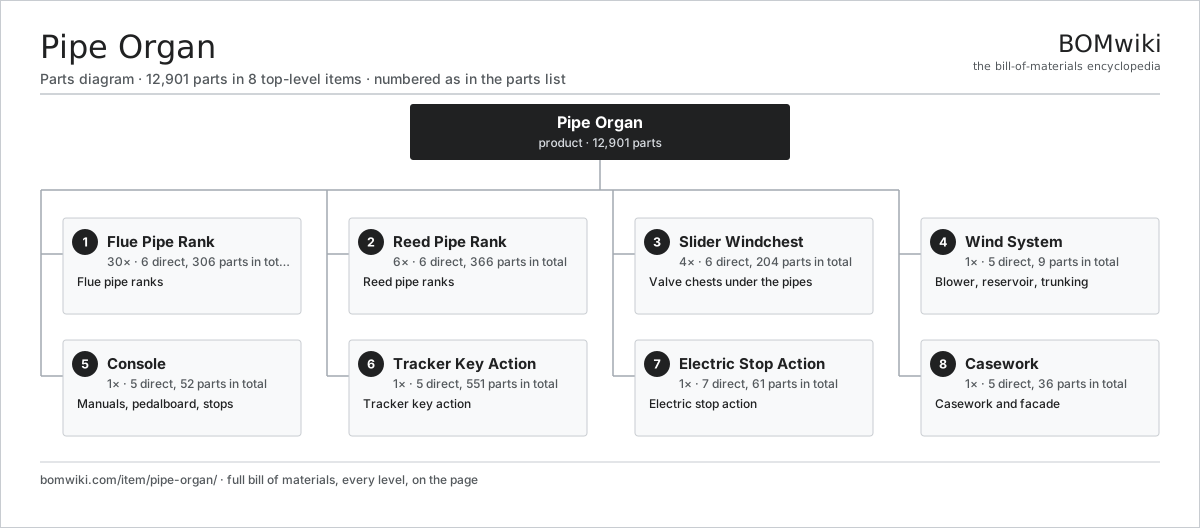
| # | Part | Qty | What it does |
|---|---|---|---|
| 1 | Flue Pipe Rank 6 parts | 30× | Flue pipe ranks |
| 2 | Reed Pipe Rank 6 parts | 6× | Reed pipe ranks |
| 3 | Slider Windchest 6 parts | 4× | Valve chests under the pipes |
| 4 | Wind System 5 parts | 1× | Blower, reservoir, trunking |
| 5 | Console 5 parts | 1× | Manuals, pedalboard, stops |
| 6 | Tracker Key Action 5 parts | 1× | Tracker key action |
| 7 | Electric Stop Action 7 parts | 1× | Electric stop action |
| 8 | Casework 5 parts | 1× | Casework and facade |
Diagrams & photos


3D model
No 3D model yet. Have a CAD file of this? Add a 3D model. STL renders right on this page; STEP, FreeCAD, and OpenSCAD sources are welcome too (openly licensed, like all 3D models on BOMwiki).
Build & assembly graph
expand / collapse · shared sub-assemblies converge · links to related products · est. labourTap an assembly to expand/collapse · tap a part to open it · use “Open page” for any node · drag to pan, scroll to zoom.
Bill of materials for Pipe Organ
8 top-level lines · 53 rows shown · 12,901 parts total · indented to 3 levels| # | Item / sub-assembly | Part no. | Qty/assy | Ext. qty | Parts | Type |
|---|---|---|---|---|---|---|
| 1 | Flue Pipe Rank 6 parts | pipe-organ-flue-rank | 30× | 30 | 306 | assembly |
| 1.1 | Flue Pipe Body | pipe-organ-flue-body | 61× | 1,830 | · | part |
| 1.2 | Pipe Foot | pipe-organ-pipe-foot | 61× | 1,830 | · | part |
| 1.3 | Languid | pipe-organ-languid | 61× | 1,830 | · | part |
| 1.4 | Pipe Mouth | pipe-organ-pipe-mouth | 61× | 1,830 | · | part |
| 1.5 | Tuning Slide | pipe-organ-tuning-slide | 61× | 1,830 | · | part |
| 1.6 | Rack Board | pipe-organ-rack-board | 1× | 30 | · | part |
| 2 | Reed Pipe Rank 6 parts | pipe-organ-reed-rank | 6× | 6 | 366 | assembly |
| 2.1 | Reed Resonator | pipe-organ-reed-resonator | 61× | 366 | · | part |
| 2.2 | Shallot | pipe-organ-shallot | 61× | 366 | · | part |
| 2.3 | Reed Tongue | pipe-organ-reed-tongue | 61× | 366 | · | part |
| 2.4 | Tuning Wire | pipe-organ-tuning-wire | 61× | 366 | · | part |
| 2.5 | Reed Boot | pipe-organ-reed-boot | 61× | 366 | · | part |
| 2.6 | Reed Block | pipe-organ-reed-block | 61× | 366 | · | part |
| 3 | Slider Windchest 6 parts | pipe-organ-windchest | 4× | 4 | 204 | assembly |
| 3.1 | Chest Grid | pipe-organ-chest-grid | 1× | 4 | · | part |
| 3.2 | Pallet Valve | pipe-organ-pallet | 61× | 244 | · | part |
| 3.3 | Slider | pipe-organ-slider | 10× | 40 | · | part |
| 3.4 | Toe Board | pipe-organ-toe-board | 10× | 40 | · | part |
| 3.5 | Coil Spring | coil-spring | 61× | 244 | · | part |
| 3.6 | Pull-Down Wire | pipe-organ-pull-down-wire | 61× | 244 | · | part |
| 4 | Wind System 5 parts | pipe-organ-wind-system | 1× | 1 | 9 | assembly |
| 4.1 | Blower Motor | blower-motor | 1× | 1 | · | part |
| 4.2 | Reservoir Bellows | pipe-organ-reservoir | 1× | 1 | · | part |
| 4.3 | Wind Trunk | pipe-organ-wind-trunk | 4× | 4 | · | part |
| 4.4 | Curtain Valve | pipe-organ-curtain-valve | 1× | 1 | · | part |
| 4.5 | Concussion Bellows | pipe-organ-concussion-bellows | 2× | 2 | · | part |
| 5 | Console 5 parts | pipe-organ-console | 1× | 1 | 52 | assembly |
| 5.1 | Manual Keyboard | pipe-organ-manual | 2× | 2 | · | part |
| 5.2 | Pedalboard | pipe-organ-pedalboard | 1× | 1 | · | part |
| 5.3 | Stop Knob | pipe-organ-stop-knob | 36× | 36 | · | part |
| 5.4 | Combination Piston | pipe-organ-piston | 12× | 12 | · | part |
| 5.5 | Expression Shoe | pipe-organ-expression-shoe | 1× | 1 | · | part |
| 6 | Tracker Key Action 5 parts | pipe-organ-key-action | 1× | 1 | 551 | assembly |
| 6.1 | Tracker | pipe-organ-tracker | 122× | 122 | · | part |
| 6.2 | Action Square | pipe-organ-square | 244× | 244 | · | part |
| 6.3 | Roller | pipe-organ-roller | 61× | 61 | · | part |
| 6.4 | Roller Board | pipe-organ-roller-board | 2× | 2 | · | part |
| 6.5 | Tracker Regulator | pipe-organ-tracker-regulator | 122× | 122 | · | part |
| 7 | Electric Stop Action 7 parts | pipe-organ-stop-action | 1× | 1 | 61 | assembly |
| 7.1 | Slider Solenoid | pipe-organ-slider-solenoid | 36× | 36 | · | part |
| 7.2 | Bare PCB | pcb-bare | 2× | 2 | · | part |
| 7.3 | Microcontroller | mcu | 1× | 1 | · | part |
| 7.4 | Relay | relay | 8× | 8 | · | part |
| 7.5 | Power Supply | power-supply | 1× | 1 | · | part |
| 7.6 | Wire Bundle | wire-bundle | 1× | 1 | · | part |
| 7.7 | Connector | connector | 12× | 12 | · | part |
| 8 | Casework 5 parts | pipe-organ-case | 1× | 1 | 36 | assembly |
| 8.1 | Case Frame | pipe-organ-case-frame | 1× | 1 | · | part |
| 8.2 | Facade Pipe | pipe-organ-facade-pipe | 21× | 21 | · | part |
| 8.3 | Swell Box | pipe-organ-swell-box | 1× | 1 | · | part |
| 8.4 | Swell Shutter | pipe-organ-swell-shutter | 12× | 12 | · | part |
| 8.5 | Fastener Set | fastener-set | 1× | 1 | · | part |
Something wrong in this list? Report a problem with this BOM.
Related products
same domain, ranked by shared parts Digital Piano
689 parts · shares 6 with this page
Digital Piano
689 parts · shares 6 with this page
 Electronic Drum Kit
336 parts · shares 6 with this page
Electronic Drum Kit
336 parts · shares 6 with this page
 Synthesizer
425 parts · shares 6 with this page
Synthesizer
425 parts · shares 6 with this page
 Guitar Amplifier
439 parts · shares 5 with this page
Guitar Amplifier
439 parts · shares 5 with this page
 Guitar Multi-Effects Processor
70 parts · shares 4 with this page
Guitar Multi-Effects Processor
70 parts · shares 4 with this page
 Theremin
47 parts · shares 4 with this page
Theremin
47 parts · shares 4 with this page
Sourcing: possible vendors
Browse the supplier directory → Prices, MOQ, and lead times are algorithmic estimates, not quotes, and not claims about these companies. Company mappings are curated by keyword; est. price band $50–$5k. How estimates work| Vendor | HQ | Specialty | MOQ | Lead time |
|---|---|---|---|---|
| yamaha.com ↗ | Hamamatsu, JP | Audio & instruments | 200 units | 8–14 wks |
|
🇺🇸Fender
fender.com ↗
|
Los Angeles, US | Guitars & amps | 200 units | 8–14 wks |
|
🇺🇸Gibson
gibson.com ↗
|
Nashville, US | Guitars | 200 units | 8–14 wks |
|
🇯🇵Roland
roland.com ↗
|
Hamamatsu, JP | Electronic instruments | 200 units | 8–14 wks |
| steinway.com ↗ | New York, US | Pianos | 200 units | 8–14 wks |
787-word article