Archimedes Screw Turbine
ProductOverview
The Archimedes screw turbine is a low-head hydroelectric converter based on the ancient screw pump principle, operated in reverse. Rather than lifting water upward, it harnesses gravitational flow through a helical rotor, converting the kinetic energy of river water into mechanical rotation. A gearbox steps this up to generator RPM.
Designed for heads of 1–8 m and flows of 0.5–5 m³/s, screw turbines fill the gap between conventional Pelton wheels (high-head, low-flow) and Kaplan turbines (low-head, high-flow). A typical 3 m diameter, 2.5 m head installation generates 50–100 kW and costs 2000–4000 USD/kW installed. The technology is particularly valuable in pastoral and mountainous regions with abundant water but limited elevation change.
Key advantages: (1) fish-friendly, blade speed and large passage minimize injury; (2) sediment-tolerant, can pass sand and small gravel; (3) modular, multiple screw units can be stacked; (4) silent operation. Disadvantages: (1) efficiency drops sharply off-design point; (2) corrosion in high-sediment or acidic water; (3) tailwater backpressure must be <0.5 m to maintain high efficiency.
How it works
Water enters the Intake Structure, where a Weir controls upstream water level. The Settling Basin allows silt to drop; a Trash Rack blocks logs and debris. Water flows into the top of the Trough, where the Screw Rotor rotates.
As water enters the upper flights of the Screw Rotor, it fills the screw chambers. Gravity pulls the water downward, creating a pressure difference across the rotor. Unlike reaction turbines (where water pressure acts on blades), the screw relies on the weight of the water column to drive rotation. Each chamber at the top is heavier than the corresponding chamber at the bottom, creating an imbalance that continuously drives the rotor.
The rotor typically operates at 50–300 RPM, depending on screw diameter and head:
- Small diameter (1 m), high head (5 m): 200–300 RPM
- Large diameter (3 m), low head (2 m): 50–150 RPM
Torque is high and continuous (no pulsation), ideal for direct mechanical load or soft-starter electrical generation.
The Gearbox steps the rotor speed (50–300 RPM) up to 1500 RPM for the Generator Unit, which produces electricity synchronized to the grid. A Control System regulates load by adjusting a Flow Control Valve at the tail race, shedding excess flow to maintain stable frequency and voltage.
The Tail Race channel returns water downstream with minimal backpressure. High tailwater (>0.5 m above screw outlet) severely reduces efficiency; proper channel slope (3% minimum) is critical.
Fish passage is excellent: water velocity inside the screw is slow (0.5–1.5 m/s), and the large rotor diameter (1–3 m) means fish pass through without pinching. Studies on European installations show <5% injury rate for passing fish, far better than conventional turbines.
Design Considerations
Head-Dependent Performance: Efficiency is maximum at design head (e.g., 3 m). At 2 m head, efficiency drops 5–10%. At 1 m, losses dominate and power output is marginal. At 5 m head, cavitation and seal leakage become concerns. Site survey must accurately measure available head over seasonal flow variations.
Flow Variation: Unlike Kaplan turbines (variable blade pitch), screw turbines tolerate wide flow ranges but with reduced efficiency. At 50% of design flow, efficiency typically drops from 75% to 55–60%. A site with highly variable discharge (2:1 winter-to-summer ratio) may benefit from multiple smaller screws in parallel for load-sharing.
Tailwater Backpressure: If downstream water level is too high, the screw outlet is submerged, creating backpressure. Efficiency falls dramatically, if screw outlet is submerged 1 m, available head drops from 3 m to 2 m, and power output halves. Channel design must ensure free discharge.
Sediment & Corrosion: River sand and gravel enter the intake despite the trash rack. Fine sand (<0.5 mm) is abrasive; stainless steel (316 grade) is standard to resist pitting. Coarser gravel (>20 mm) is mostly retained by the rack and cleared by the brush cleaner. High-sediment rivers (tropical monsoon zones) require more frequent maintenance.
Installation Depth: The screw must be submerged for structural support and cooling. Typically 2–4 m of water depth is needed. Very shallow sites (<1 m) require inlet channel excavation.
Economics & Lifecycle
- Capital: 2000–4000 USD/kW
- Maintenance: Annual bearing greasing, brush-rack cleaning, trash removal
- Lifespan: Stainless screw 25–30 years; gearbox bearings typically last 15–20 years (replaceable)
- Capacity factor: 30–50% (depends on flow regime and head stability)
In regions with stable seasonal flow (e.g., alpine streams, dam tailraces), capacity factors can reach 60–70%.
Applications Beyond Power
The reversible screw pump principle is also used for fish bypass (pumping fish over dams) and flood management (reverse-running to pump water upstream into retention basins).
Archimedes Screw Turbine parts and their functions
8 top-level parts · 56 parts in total · full bill of materials below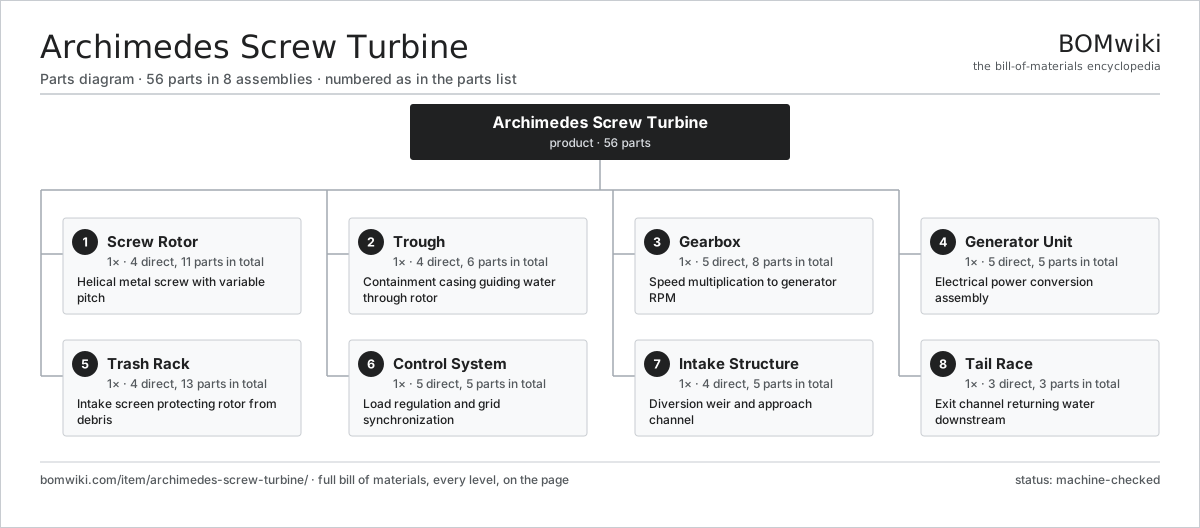
| # | Part | Qty | What it does |
|---|---|---|---|
| 1 | Screw Rotor 4 parts | 1× | Helical metal screw with variable pitch |
| 2 | Trough 4 parts | 1× | Containment casing guiding water through rotor |
| 3 | Gearbox 5 parts | 1× | Speed multiplication to generator RPM |
| 4 | Generator Unit 5 parts | 1× | Electrical power conversion assembly |
| 5 | Trash Rack 4 parts | 1× | Intake screen protecting rotor from debris |
| 6 | Control System 5 parts | 1× | Load regulation and grid synchronization |
| 7 | Intake Structure 4 parts | 1× | Diversion weir and approach channel |
| 8 | Tail Race 3 parts | 1× | Exit channel returning water downstream |
3D model
No 3D model yet. Have a CAD file of this? Add a 3D model — STL renders right on this page; STEP, FreeCAD, and OpenSCAD sources are welcome too (openly licensed, like all 3D models on BOMwiki).
Build & assembly graph
expand / collapse · shared sub-assemblies converge · links to related products · est. labourTap an assembly to expand/collapse · tap a part to open it · use “Open page” for any node · drag to pan, scroll to zoom.
Bill of materials for Archimedes Screw Turbine
8 top-level lines · 42 rows shown · 56 parts total · indented to 3 levels| # | Item / sub-assembly | Part no. | Qty/assy | Ext. qty | Parts | Type |
|---|---|---|---|---|---|---|
| 1 | Screw Rotor 4 parts | archimedes-screw-turbine-screw-rotor | 1× | 1 | 11 | assembly |
| 1.1 | Screw Shaft | archimedes-screw-turbine-screw-shaft | 1× | 1 | · | part |
| 1.2 | Screw Flight | archimedes-screw-turbine-screw-flight | 3× | 3 | · | part |
| 1.3 | Flight Connector | archimedes-screw-turbine-flight-connector | 6× | 6 | · | part |
| 1.4 | Fastener Set | fastener-set | 1× | 1 | · | part |
| 2 | Trough 4 parts | archimedes-screw-turbine-trough | 1× | 1 | 6 | assembly |
| 2.1 | Trough Shell | archimedes-screw-turbine-trough-shell | 1× | 1 | · | part |
| 2.2 | Trough End Seal | archimedes-screw-turbine-trough-end-seal | 2× | 2 | · | part |
| 2.3 | Trough Bearing | archimedes-screw-turbine-trough-bearing | 2× | 2 | · | part |
| 2.4 | Fastener Set | fastener-set | 1× | 1 | · | part |
| 3 | Gearbox 5 parts | archimedes-screw-turbine-gearbox | 1× | 1 | 8 | assembly |
| 3.1 | Input Pinion | archimedes-screw-turbine-input-pinion | 1× | 1 | · | part |
| 3.2 | Output Gear | archimedes-screw-turbine-output-gear | 1× | 1 | · | part |
| 3.3 | Gearbox Housing | archimedes-screw-turbine-gearbox-housing | 1× | 1 | · | part |
| 3.4 | Bearings | archimedes-screw-turbine-bearings | 4× | 4 | · | part |
| 3.5 | Power Supply | power-supply | 1× | 1 | · | part |
| 4 | Generator Unit 5 parts | archimedes-screw-turbine-generator-unit | 1× | 1 | 5 | assembly |
| 4.1 | Generator | archimedes-screw-turbine-generator | 1× | 1 | · | part |
| 4.2 | Coupling | archimedes-screw-turbine-coupling | 1× | 1 | · | part |
| 4.3 | Soft Starter | archimedes-screw-turbine-soft-starter | 1× | 1 | · | part |
| 4.4 | Protection Relay | archimedes-screw-turbine-protection-relay | 1× | 1 | · | part |
| 4.5 | Power Supply | power-supply | 1× | 1 | · | part |
| 5 | Trash Rack 4 parts | archimedes-screw-turbine-trash-rack | 1× | 1 | 13 | assembly |
| 5.1 | Rack Bars | archimedes-screw-turbine-rack-bars | 10× | 10 | · | part |
| 5.2 | Rack Frame | archimedes-screw-turbine-rack-frame | 1× | 1 | · | part |
| 5.3 | Brush Cleaner | archimedes-screw-turbine-brush-cleaner | 1× | 1 | · | part |
| 5.4 | Fastener Set | fastener-set | 1× | 1 | · | part |
| 6 | Control System 5 parts | archimedes-screw-turbine-control-system | 1× | 1 | 5 | assembly |
| 6.1 | PLC | archimedes-screw-turbine-plc | 1× | 1 | · | part |
| 6.2 | Flow Control Valve | archimedes-screw-turbine-flow-control-valve | 1× | 1 | · | part |
| 6.3 | Grid Relay | archimedes-screw-turbine-grid-relay | 1× | 1 | · | part |
| 6.4 | Speed Sensor | archimedes-screw-turbine-speed-sensor | 1× | 1 | · | part |
| 6.5 | Voltage Regulator | archimedes-screw-turbine-voltage-regulator | 1× | 1 | · | part |
| 7 | Intake Structure 4 parts | archimedes-screw-turbine-intake-structure | 1× | 1 | 5 | assembly |
| 7.1 | Weir | archimedes-screw-turbine-weir | 1× | 1 | · | part |
| 7.2 | Settling Basin | archimedes-screw-turbine-settling-basin | 1× | 1 | · | part |
| 7.3 | Guide Wall | archimedes-screw-turbine-guide-wall | 2× | 2 | · | part |
| 7.4 | Fastener Set | fastener-set | 1× | 1 | · | part |
| 8 | Tail Race 3 parts | archimedes-screw-turbine-tail-race | 1× | 1 | 3 | assembly |
| 8.1 | Draft Tube | archimedes-screw-turbine-draft-tube | 1× | 1 | · | part |
| 8.2 | Stilling Basin | archimedes-screw-turbine-stilling-basin | 1× | 1 | · | part |
| 8.3 | Fastener Set | fastener-set | 1× | 1 | · | part |
Related products
same domain, ranked by shared parts Battery Energy Storage System
17,429 parts · shares 1 with this page
Biogas Upgrading Unit
110 parts · shares 1 with this page
Battery Energy Storage System
17,429 parts · shares 1 with this page
Biogas Upgrading Unit
110 parts · shares 1 with this page
 Biomass Pellet Plant
404 parts · shares 1 with this page
Biomass Pellet Plant
404 parts · shares 1 with this page
 Concentrated Solar Power Receiver
855 parts · shares 1 with this page
Concentrated Solar Power Receiver
855 parts · shares 1 with this page
 Floating Offshore Wind Turbine
608 parts · shares 1 with this page
Floating Offshore Wind Turbine
608 parts · shares 1 with this page
 Floating Solar Platform
108 parts · shares 1 with this page
Floating Solar Platform
108 parts · shares 1 with this page
Sourcing: possible vendors
Prices, MOQ, and lead times are algorithmic estimates, not quotes, and not claims about these companies. Company mappings are curated by keyword; est. price band $100–$20M. How estimates work| Vendor | HQ | Specialty | MOQ | Lead time |
|---|---|---|---|---|
|
🇩🇰Vestas
vestas.com ↗
|
Aarhus, DK | Wind turbines | 500 units | 12–24 wks |
| firstsolar.com ↗ | Tempe, US | PV modules | 500 units | 12–24 wks |
|
🇨🇳LONGi
longi.com ↗
|
Xi'an, CN | Solar wafers & modules | 500 units | 12–24 wks |
| enphase.com ↗ | Fremont, US | Microinverters & storage | 500 units | 12–24 wks |
|
🇨🇳Sungrow
sungrowpower.com ↗
|
Hefei, CN | Solar inverters & storage | 500 units | 12–24 wks |
837-word article