Anaerobic Digester
ProductOverview
An anaerobic digester is a sealed fermentation vessel that stabilizes organic waste and wastewater biosolids via anaerobic bacterial consortium, producing biogas (primarily methane and carbon dioxide) and nutrient-rich digestate suitable for soil amendment. Unlike aerobic composting, which requires continuous aeration and produces heat, anaerobic digestion operates in oxygen-free conditions, converting complex organic polymers into simpler organic acids, then into methane via methanogenic archaea.
The Reactor Vessel is the core unit; all ancillary systems (feeding, heating, gas handling, discharge) exist to maintain optimal conditions for the microbial ecosystem: stable temperature (35–40 °C mesophilic, or 50–58 °C thermophilic), pH 6.8–7.5, and uniform substrate distribution.
How it works
Four-Stage Anaerobic Digestion
Hydrolysis: Large polymers (cellulose, proteins, fats) are enzymatically broken down into monomers and dimers by extracellular hydrolytic bacteria. This stage is rate-limiting for fibrous, slow-biodegrading wastes (agricultural residues, wood chips).
Acidogenesis: Monomers (glucose, amino acids, fatty acids) are fermented by acid-forming bacteria into volatile fatty acids (VFAs: acetate, propionate, butyrate), alcohols, hydrogen, and carbon dioxide.
Acetogenesis: Propionate and butyrate are oxidized to acetate and hydrogen by syntrophic bacteria. This stage is energetically marginal; it only proceeds if hydrogen partial pressure remains low (maintained by methanogens consuming the H₂).
Methanogenesis: Methanogenic archaea convert acetate (70% of final methane) and hydrogen (30% of final methane) into CH₄ and CO₂. This is the slowest step and determines overall retention time.
Mechanical Mixing and Retention
The Mixing System serves two purposes: (1) preventing stratification and settling, which can create anaerobic dead zones and reduce effective volume, and (2) maintaining uniform temperature distribution supplied by the Heating Coils. Slow-speed mechanical mixers (0.5–2 RPM, driven by a Motor Gearbox) or biogas recirculation via a Gas Recirculation Pump are typical.
The Reactor Vessel is sized by hydraulic retention time (HRT): the average time organic matter spends inside. Longer HRT (20–40 days) is needed for low-solids feedstock (wastewater sludge) and cold climates; shorter HRT (15–20 days) suits readily degradable materials (food waste, manure slurries) in warm regions.
Temperature Control for Metabolic Rates
Anaerobic digestion rate doubles approximately every 10 °C rise (Q₁₀ ≈ 2). The Heating Coils circulate hot water maintained by an External Heater (biogas-fired boiler, heat pump, or electric resistance) to maintain set temperature. In mesophilic mode (35–40 °C), microbial growth is slower but process is stable and robust. In thermophilic mode (50–58 °C), hydrolysis accelerates and gas production rate increases 30–50%, but process stability is more sensitive to feedstock shocks and temperature fluctuations.
Biogas Collection and Management
The Gas Dome floats atop the digester, rising as biogas is produced and sinking as gas is withdrawn. The dome maintains ~10–20 mbar overpressure, sufficient to drive biogas through the Gas Outlet Pipe to a Flame Arrestor (safety) and downstream treatment (Biogas Upgrader for CO₂ removal, or direct combustion boiler).
The Pressure Relief Valve vents excess biogas if production temporarily exceeds demand. Biogas composition (50–70% CH₄, 25–40% CO₂, trace H₂S) is monitored by the Biogas Analyzer.
Feedstock Introduction and Discharge
The Feed System consists of a Feed Hopper (batch collection), optional Pulper Shredder (particle size reduction), and a Feed Pump that injects substrate into the digester against hydrostatic pressure and biogas overpressure. Feeding can be batch (daily) or continuous (multiple times daily).
As new feedstock enters at one location, stabilized Discharge System effluent is withdrawn from the opposite side via a Outlet Pump. The Digestate Separator (screw press or decanter) dewater the effluent into:
- Liquid phase: Ammonium-rich (0.3–0.5% N), suitable for irrigation or liquid fertilizer concentrate.
- Solid phase: Fibrous cake (0.15–0.25% N, slow-release), suitable for land application or compost blending.
Process Monitoring and Control
The Instrumentation continuously logs Temperature Sensor (bulk slurry), Pressure Sensor (dome and feed), and Biogas Analyzer (CH₄/CO₂/H₂S). These feeds inform the Control Box PLC, which modulates:
- Heating Coils circulator and heater (maintaining ±1 °C setpoint).
- Mixing System on/off schedule (e.g., 15 min every 2 hours, to save electrical energy while maintaining uniformity).
- Feed Pump frequency (adjusting organic loading rate based on biogas CO₂ concentration, rising CO₂ signals acidification risk).
Key Performance Drivers
Feedstock type: Readily degradable substrates (food waste, manure slurries, wastewater primary sludge) have high methane yields (0.2–0.25 m³/kg VS). Slow-degrading feedstock (agricultural straw, paper, wood) has lower yields (0.1–0.15 m³/kg VS) and require longer HRT.
Organic loading rate (OLR): Measured in kg volatile solids per m³ per day. Too-high OLR causes VFA accumulation, pH drop, and process failure. Typical safe OLR: 1–3 kg VS/m³/day for municipal sludge, up to 5 kg VS/m³/day for co-digestion of food waste + manure.
Carbon/nitrogen ratio: Optimal is ~25:1. Nitrogen-poor feedstock (woody residue) dilutes biogas yield; nitrogen-rich feedstock (slaughterhouse waste) risks ammonia inhibition and requires longer HRT.
Hydrogen partial pressure: Kept low by methanogens; if H₂ partial pressure rises (indicator: biogas CH₄ % falls, CO₂ % rises), acetogenic bacteria struggle and acidification begins.
Integration with Hydrogen Dispenser
Biogas from the digester can be upgraded via Biogas Upgrader (membrane separation) or PSA to >95% CH₄, then fed to a Solid Oxide Fuel Cell Module for electrical generation, or to Hydrogen Dispenser via on-site Reformer Unit reforming, closing the circular nutrient and energy loop in agricultural or wastewater treatment operations.
Anaerobic Digester parts and their functions
8 top-level parts · 36 parts in total · full bill of materials below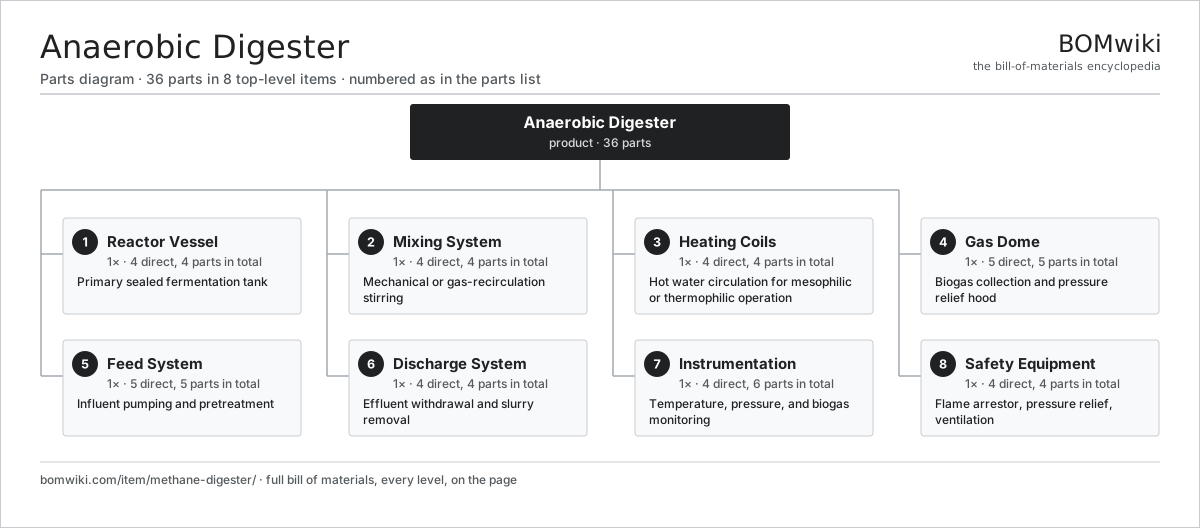
| # | Part | Qty | What it does |
|---|---|---|---|
| 1 | Reactor Vessel 4 parts | 1× | Primary sealed fermentation tank |
| 2 | Mixing System 4 parts | 1× | Mechanical or gas-recirculation stirring |
| 3 | Heating Coils 4 parts | 1× | Hot water circulation for mesophilic or thermophilic operation |
| 4 | Gas Dome 5 parts | 1× | Biogas collection and pressure relief hood |
| 5 | Feed System 5 parts | 1× | Influent pumping and pretreatment |
| 6 | Discharge System 4 parts | 1× | Effluent withdrawal and slurry removal |
| 7 | Instrumentation 4 parts | 1× | Temperature, pressure, and biogas monitoring |
| 8 | Safety Equipment 4 parts | 1× | Flame arrestor, pressure relief, ventilation |
3D model
No 3D model yet. Have a CAD file of this? Add a 3D model. STL renders right on this page; STEP, FreeCAD, and OpenSCAD sources are welcome too (openly licensed, like all 3D models on BOMwiki).
Build & assembly graph
expand / collapse · shared sub-assemblies converge · links to related products · est. labourTap an assembly to expand/collapse · tap a part to open it · use “Open page” for any node · drag to pan, scroll to zoom.
Bill of materials for Anaerobic Digester
8 top-level lines · 42 rows shown · 36 parts total · indented to 3 levels| # | Item / sub-assembly | Part no. | Qty/assy | Ext. qty | Parts | Type |
|---|---|---|---|---|---|---|
| 1 | Reactor Vessel 4 parts | methane-digester-reactor-vessel | 1× | 1 | 4 | assembly |
| 1.1 | Tank Body | methane-digester-tank-body | 1× | 1 | · | part |
| 1.2 | Foundation Ring | methane-digester-foundation-ring | 1× | 1 | · | part |
| 1.3 | Access Hatch | methane-digester-access-hatch | 1× | 1 | · | part |
| 1.4 | External Insulation | methane-digester-external-insulation | 1× | 1 | · | part |
| 2 | Mixing System 4 parts | methane-digester-mixing-system | 1× | 1 | 4 | assembly |
| 2.1 | Impeller Assembly | methane-digester-impeller-assembly | 1× | 1 | · | part |
| 2.2 | Motor Gearbox | methane-digester-motor-gearbox | 1× | 1 | · | part |
| 2.3 | Shaft Seal | methane-digester-shaft-seal | 1× | 1 | · | part |
| 2.4 | Gas Recirculation Pump | methane-digester-gas-recirculation-pump | 1× | 1 | · | part |
| 3 | Heating Coils 4 parts | methane-digester-heating-coils | 1× | 1 | 4 | assembly |
| 3.1 | Heat Exchanger Coil | methane-digester-heat-exchanger-coil | 1× | 1 | · | part |
| 3.2 | Circulation Pump | methane-digester-circulation-pump | 1× | 1 | · | part |
| 3.3 | External Heater | methane-digester-external-heater | 1× | 1 | · | part |
| 3.4 | Temperature Thermostat | methane-digester-temperature-thermostat | 1× | 1 | · | part |
| 4 | Gas Dome 5 parts | methane-digester-gas-dome | 1× | 1 | 5 | assembly |
| 4.1 | Dome Bell | methane-digester-dome-bell | 1× | 1 | · | part |
| 4.2 | Dome Guide Rods | methane-digester-dome-guide-rods | 1× | 1 | · | part |
| 4.3 | Gas Outlet Pipe | methane-digester-gas-outlet-pipe | 1× | 1 | · | part |
| 4.4 | Pressure Relief Valve | methane-digester-pressure-relief-valve | 1× | 1 | · | part |
| 4.5 | Flame Arrestor | methane-digester-flame-arrestor | 1× | 1 | · | part |
| 5 | Feed System 5 parts | methane-digester-feed-system | 1× | 1 | 5 | assembly |
| 5.1 | Feed Hopper | methane-digester-feed-hopper | 1× | 1 | · | part |
| 5.2 | Pulper Shredder | methane-digester-pulper-shredder | 1× | 1 | · | part |
| 5.3 | Feed Pump | methane-digester-feed-pump | 1× | 1 | · | part |
| 5.4 | Inlet Preheater | methane-digester-inlet-preheater | 1× | 1 | · | part |
| 5.5 | Pressure Sensor | pressure-sensor | 1× | 1 | · | part |
| 6 | Discharge System 4 parts | methane-digester-discharge-system | 1× | 1 | 4 | assembly |
| 6.1 | Outlet Pump | methane-digester-outlet-pump | 1× | 1 | · | part |
| 6.2 | Digestate Separator | methane-digester-digestate-separator | 1× | 1 | · | part |
| 6.3 | Discharge Valve | methane-digester-discharge-valve | 1× | 1 | · | part |
| 6.4 | Pressure Sensor | pressure-sensor | 1× | 1 | · | part |
| 7 | Instrumentation 4 parts | methane-digester-instrumentation | 1× | 1 | 6 | assembly |
| 7.1 | Temperature Sensor | methane-digester-temperature-sensor | 2× | 2 | · | part |
| 7.2 | Pressure Sensor | pressure-sensor | 2× | 2 | · | part |
| 7.3 | Biogas Analyzer | methane-digester-biogas-analyzer | 1× | 1 | · | part |
| 7.4 | Control Box | methane-digester-control-box | 1× | 1 | · | part |
| 8 | Safety Equipment 4 parts | methane-digester-safety-equipment | 1× | 1 | 4 | assembly |
| 8.1 | Flame Arrestor | methane-digester-flame-arrestor | 1× | 1 | · | part |
| 8.2 | Overflow Vent | methane-digester-overflow-vent | 1× | 1 | · | part |
| 8.3 | Emergency Bleed | methane-digester-emergency-bleed | 1× | 1 | · | part |
| 8.4 | Ventilation Hood | methane-digester-ventilation-hood | 1× | 1 | · | part |
Something wrong in this list? Report a problem with this BOM.
Related products
same domain, ranked by shared parts Battery Energy Storage System
17,429 parts · shares 1 with this page
Biogas Upgrading Unit
110 parts · shares 1 with this page
Battery Energy Storage System
17,429 parts · shares 1 with this page
Biogas Upgrading Unit
110 parts · shares 1 with this page
 Biomass Gasifier
32 parts · shares 1 with this page
Biomass Gasifier
32 parts · shares 1 with this page
 Biomass Pellet Plant
404 parts · shares 1 with this page
Biomass Pellet Plant
404 parts · shares 1 with this page
 Concentrated Solar Power Receiver
855 parts · shares 1 with this page
Concentrated Solar Power Receiver
855 parts · shares 1 with this page
 Floating Offshore Wind Turbine
608 parts · shares 1 with this page
Floating Offshore Wind Turbine
608 parts · shares 1 with this page
Sourcing: possible vendors
Browse the supplier directory → Prices, MOQ, and lead times are algorithmic estimates, not quotes, and not claims about these companies. Company mappings are curated by keyword; est. price band $100–$20M. How estimates work| Vendor | HQ | Specialty | MOQ | Lead time |
|---|---|---|---|---|
|
🇩🇰Vestas
vestas.com ↗
|
Aarhus, DK | Wind turbines | 500 units | 12–24 wks |
| firstsolar.com ↗ | Tempe, US | PV modules | 500 units | 12–24 wks |
|
🇨🇳LONGi
longi.com ↗
|
Xi'an, CN | Solar wafers & modules | 500 units | 12–24 wks |
| enphase.com ↗ | Fremont, US | Microinverters & storage | 500 units | 12–24 wks |
|
🇨🇳Sungrow
sungrowpower.com ↗
|
Hefei, CN | Solar inverters & storage | 500 units | 12–24 wks |
964-word article