PEM Hydrogen Electrolyzer
ProductOverview
A PEM electrolyzer splits deionized water into hydrogen and oxygen by passing DC current through a stack of cells, each built around a proton-exchange membrane. Water is oxidized at the anode (2H₂O → O₂ + 4H⁺ + 4e⁻); protons migrate through the membrane and recombine with electrons at the cathode to form hydrogen gas. Because the only feedstock is water and electricity, an electrolyzer fed from wind or solar produces hydrogen with no direct emissions, and PEM's fast response, full-range load changes in seconds, makes it the favored chemistry for following a fluctuating renewable supply.
The unit described here is a containerized small-industrial machine: 5–50 kW of stack power producing 1–10 Nm³/h of hydrogen at up to 30 bar, with everything mounted on a single Skid Frame.
The cell stack
The PEM Cell Stack is a filter press of repeating cells clamped between two End Plate castings by spring-loaded Tie Rod Set. Each cell centers on a Membrane-Electrode Assembly: a perfluorosulfonic-acid membrane roughly 100 µm thick, coated on the anode face with iridium-oxide catalyst and on the cathode face with platinum on carbon. The membrane conducts hydrated protons but blocks gas crossover, which is what lets the cathode side run at 30 bar while the anode stays near ambient.
On each side of the MEA, a Porous Transport Layer, sintered titanium fiber on the anode, where carbon would corrode at the oxygen potential, performs the awkward dual job of delivering liquid water to the catalyst while evacuating gas bubbles in the opposite direction. Bipolar Plate elements separate adjacent cells, carry the full stack current through their faces, and channel the fluid flows; they are titanium with a platinum or gold coating, because untreated titanium grows a resistive oxide. Cell Gasket frames seal each perimeter, and copper Current Collector plates at the ends take the rectifier cables.
At a typical 1.5 A/cm² and 2.0 V per cell, a 40-cell stack draws about 80 V at several hundred amps. The thermodynamic minimum is 1.23 V; everything above that becomes heat, which sets the cooling duty.
Water loop
Only the anode side is fed with water. The Circulation Pump drives several litres per minute through the stack, far more than electrolysis consumes, because the flow also removes heat and sweeps oxygen bubbles out of the cells. The return enters the Water Tank, where gas disengages, and a slipstream passes through the DI Polishing Cartridge to hold resistivity above 1 MΩ·cm. Purity is not optional: metal ions exchange into the membrane's sulfonic sites and permanently raise cell voltage, so the Conductivity Sensor alarms above about 1 µS/cm. A Makeup Valve replaces the roughly one litre consumed per normal cubic metre of hydrogen, and a Particle Filter guards the flow channels.
Gas handling
Cathode gas leaves the stack as hydrogen saturated with water. It enters the Hydrogen Separator, drops its liquid, passes a Demister Element, and reaches the purification train: the Deoxo Reactor, a palladium bed that recombines the few hundred ppm of crossed-over oxygen back into water, then the Hydrogen Dryer, a twin-tower desiccant unit cycling between adsorption and regeneration to push the dew point below −60 °C. The result is 99.999% hydrogen. The Back-Pressure Valve holds the cathode train at delivery pressure, a key PEM advantage, since electrochemical compression to 30 bar costs far less energy than mechanical compression of the product gas.
The anode side is simpler: the Oxygen Separator splits oxygen from the circulating water and vents it through the Vent Stack, in small plants usually unrecovered.
Power and control
The Power Supply is an active rectifier built on IGBT Power Module legs behind a Rectifier Transformer, delivering smooth DC into the stack; the DC Bus Capacitors keep ripple low because ripple current ages the catalyst layers. Production rate is simply proportional to current, read at the Current Shunt, 1 A through one cell makes 0.42 Nml/min of H₂ by Faraday's law.
The Control & Safety System PLC sequences startup (circulate, heat, pressurize, ramp current) and supervises two protection layers. The Cell Voltage Monitor watches every cell; a cell drifting high signals membrane thinning or contamination long before failure. The hardwired chain, H2 Leak Sensor detectors at 10% LEL, pressure switches, and the ventilation interlock on the Ventilation Fan, dumps the stack current and vents the system independently of software.
Thermal management
Roughly a third of input power leaves as heat in the anode water. The Thermal Management circuit rejects it through a Radiator with a Blower Motor fan; the Thermal Bypass Valve short-circuits the radiator during cold starts so the stack reaches its 60 °C operating point quickly, where membrane conductivity is highest and cell voltage lowest. Temperature Probe RTDs at stack inlet and outlet close the loop.
Efficiency and life
System specific energy runs 4.8–5.5 kWh per normal cubic metre, about 60–70% efficiency against hydrogen's higher heating value. Stacks degrade a few microvolts per cell-hour; at 40,000–80,000 hours the voltage penalty justifies a stack swap, while the balance of plant outlives several stacks.
PEM Hydrogen Electrolyzer parts and their functions
7 top-level parts · 305 parts in total · full bill of materials below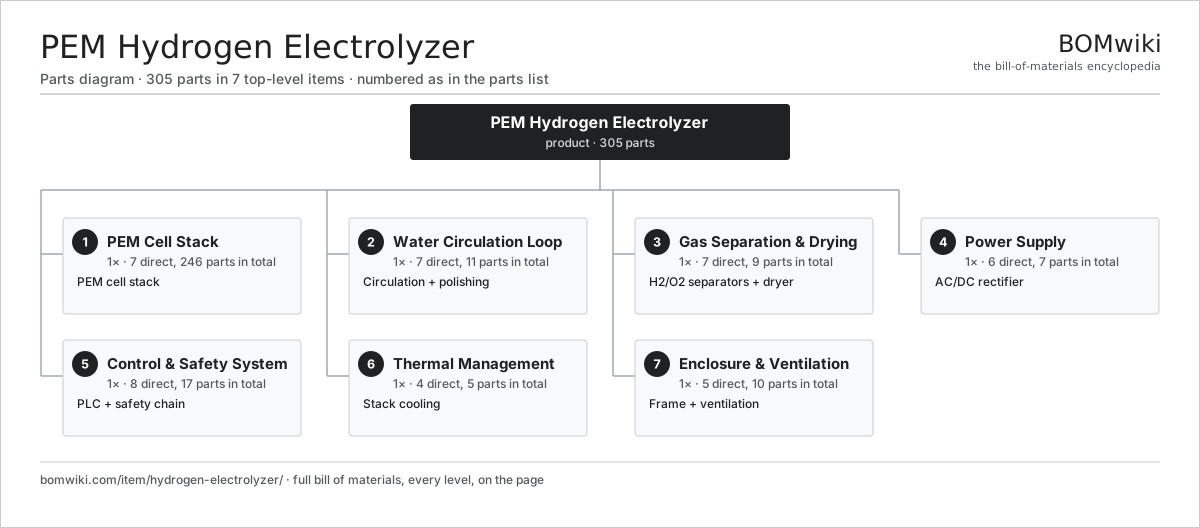
| # | Part | Qty | What it does |
|---|---|---|---|
| 1 | PEM Cell Stack 7 parts | 1× | PEM cell stack |
| 2 | Water Circulation Loop 7 parts | 1× | Circulation + polishing |
| 3 | Gas Separation & Drying 7 parts | 1× | H2/O2 separators + dryer |
| 4 | Power Supply 6 parts | 1× | AC/DC rectifier |
| 5 | Control & Safety System 8 parts | 1× | PLC + safety chain |
| 6 | Thermal Management 4 parts | 1× | Stack cooling |
| 7 | Enclosure & Ventilation 5 parts | 1× | Frame + ventilation |
3D model
No 3D model yet. Have a CAD file of this? Add a 3D model. STL renders right on this page; STEP, FreeCAD, and OpenSCAD sources are welcome too (openly licensed, like all 3D models on BOMwiki).
Build & assembly graph
expand / collapse · shared sub-assemblies converge · links to related products · est. labourTap an assembly to expand/collapse · tap a part to open it · use “Open page” for any node · drag to pan, scroll to zoom.
Bill of materials for PEM Hydrogen Electrolyzer
7 top-level lines · 55 rows shown · 305 parts total · indented to 3 levels| # | Item / sub-assembly | Part no. | Qty/assy | Ext. qty | Parts | Type |
|---|---|---|---|---|---|---|
| 1 | PEM Cell Stack 7 parts | hydrogen-electrolyzer-stack | 1× | 1 | 246 | assembly |
| 1.1 | Membrane-Electrode Assembly | hydrogen-electrolyzer-mea | 40× | 40 | · | part |
| 1.2 | Bipolar Plate | hydrogen-electrolyzer-bipolar-plate | 41× | 41 | · | part |
| 1.3 | Porous Transport Layer | hydrogen-electrolyzer-ptl | 80× | 80 | · | part |
| 1.4 | Cell Gasket | hydrogen-electrolyzer-cell-gasket | 80× | 80 | · | part |
| 1.5 | End Plate | hydrogen-electrolyzer-end-plate | 2× | 2 | · | part |
| 1.6 | Tie Rod Set | hydrogen-electrolyzer-tie-rods | 1× | 1 | · | part |
| 1.7 | Current Collector | hydrogen-electrolyzer-current-collector | 2× | 2 | · | part |
| 2 | Water Circulation Loop 7 parts | hydrogen-electrolyzer-water-loop | 1× | 1 | 11 | assembly |
| 2.1 | Circulation Pump 4 parts | hydrogen-electrolyzer-circulation-pump | 1× | 1 | 5 | assembly |
| 2.1.1 | Motor Housing | motor-housing | 1× | 1 | · | part |
| 2.1.2 | Copper Winding | copper-winding | 1× | 1 | · | part |
| 2.1.3 | Ball Bearing | ball-bearing | 2× | 2 | · | part |
| 2.1.4 | O-Ring Set | oring-set | 1× | 1 | · | part |
| 2.2 | DI Polishing Cartridge | hydrogen-electrolyzer-di-cartridge | 1× | 1 | · | part |
| 2.3 | Water Tank | hydrogen-electrolyzer-water-tank | 1× | 1 | · | part |
| 2.4 | Conductivity Sensor | hydrogen-electrolyzer-conductivity-sensor | 1× | 1 | · | part |
| 2.5 | Particle Filter | hydrogen-electrolyzer-particle-filter | 1× | 1 | · | part |
| 2.6 | Makeup Valve | hydrogen-electrolyzer-makeup-valve | 1× | 1 | · | part |
| 2.7 | O-Ring Set | oring-set | 1× | 1 | · | part |
| 3 | Gas Separation & Drying 7 parts | hydrogen-electrolyzer-gas-separation | 1× | 1 | 9 | assembly |
| 3.1 | Hydrogen Separator | hydrogen-electrolyzer-h2-separator | 1× | 1 | · | part |
| 3.2 | Oxygen Separator | hydrogen-electrolyzer-o2-separator | 1× | 1 | · | part |
| 3.3 | Demister Element | hydrogen-electrolyzer-demister | 2× | 2 | · | part |
| 3.4 | Hydrogen Dryer | hydrogen-electrolyzer-h2-dryer | 1× | 1 | · | part |
| 3.5 | Back-Pressure Valve | hydrogen-electrolyzer-backpressure-valve | 1× | 1 | · | part |
| 3.6 | Deoxo Reactor | hydrogen-electrolyzer-deoxo-reactor | 1× | 1 | · | part |
| 3.7 | Pressure Sensor | pressure-sensor | 2× | 2 | · | part |
| 4 | Power Supply 6 parts | hydrogen-electrolyzer-power-supply | 1× | 1 | 7 | assembly |
| 4.1 | IGBT Power Module | igbt-module | 2× | 2 | · | part |
| 4.2 | Rectifier Transformer | hydrogen-electrolyzer-rectifier-transformer | 1× | 1 | · | part |
| 4.3 | DC Bus Capacitors | hydrogen-electrolyzer-dc-bus-caps | 1× | 1 | · | part |
| 4.4 | Current Shunt | hydrogen-electrolyzer-current-shunt | 1× | 1 | · | part |
| 4.5 | Power Supply | power-supply | 1× | 1 | · | part |
| 4.6 | EMI Filter | hydrogen-electrolyzer-emi-filter | 1× | 1 | · | part |
| 5 | Control & Safety System 8 parts | hydrogen-electrolyzer-controls | 1× | 1 | 17 | assembly |
| 5.1 | Bare PCB | pcb-bare | 1× | 1 | · | part |
| 5.2 | Microcontroller | mcu | 1× | 1 | · | part |
| 5.3 | SMD Passive (R/C/L) | smd-passives | 1× | 1 | · | part |
| 5.4 | H2 Leak Sensor | hydrogen-electrolyzer-h2-leak-sensor | 2× | 2 | · | part |
| 5.5 | Cell Voltage Monitor | hydrogen-electrolyzer-cell-voltage-monitor | 1× | 1 | · | part |
| 5.6 | Relay | relay | 4× | 4 | · | part |
| 5.7 | LCD Panel | lcd-panel | 1× | 1 | · | part |
| 5.8 | Connector | connector | 6× | 6 | · | part |
| 6 | Thermal Management 4 parts | hydrogen-electrolyzer-thermal | 1× | 1 | 5 | assembly |
| 6.1 | Radiator | radiator | 1× | 1 | · | part |
| 6.2 | Blower Motor | blower-motor | 1× | 1 | · | part |
| 6.3 | Temperature Probe | hydrogen-electrolyzer-temp-probe | 2× | 2 | · | part |
| 6.4 | Thermal Bypass Valve | hydrogen-electrolyzer-bypass-valve | 1× | 1 | · | part |
| 7 | Enclosure & Ventilation 5 parts | hydrogen-electrolyzer-enclosure | 1× | 1 | 10 | assembly |
| 7.1 | Skid Frame | hydrogen-electrolyzer-frame | 1× | 1 | · | part |
| 7.2 | Sheet Metal Panel | sheet-panel | 6× | 6 | · | part |
| 7.3 | Ventilation Fan | hydrogen-electrolyzer-vent-fan | 1× | 1 | · | part |
| 7.4 | Vent Stack | hydrogen-electrolyzer-vent-stack | 1× | 1 | · | part |
| 7.5 | Fastener Set | fastener-set | 1× | 1 | · | part |
Something wrong in this list? Report a problem with this BOM.
Related products
same domain, ranked by shared parts Wave Energy Converter
111 parts · shares 7 with this page
Wave Energy Converter
111 parts · shares 7 with this page
 Grid Battery Storage Container
1,438 parts · shares 5 with this page
Grid Battery Storage Container
1,438 parts · shares 5 with this page
 Tidal Stream Turbine
348 parts · shares 6 with this page
Biomass Pellet Boiler
139 parts · shares 6 with this page
Green Hydrogen Electrolyzer Plant
2,171 parts · shares 8 with this page
Utility-Scale Solar Inverter
204 parts · shares 8 with this page
Tidal Stream Turbine
348 parts · shares 6 with this page
Biomass Pellet Boiler
139 parts · shares 6 with this page
Green Hydrogen Electrolyzer Plant
2,171 parts · shares 8 with this page
Utility-Scale Solar Inverter
204 parts · shares 8 with this page
Sourcing: possible vendors
Browse the supplier directory → Prices, MOQ, and lead times are algorithmic estimates, not quotes, and not claims about these companies. Company mappings are curated by keyword; est. price band $100–$20M. How estimates work| Vendor | HQ | Specialty | MOQ | Lead time |
|---|---|---|---|---|
|
🇩🇰Vestas
vestas.com ↗
|
Aarhus, DK | Wind turbines | 500 units | 12–24 wks |
| firstsolar.com ↗ | Tempe, US | PV modules | 500 units | 12–24 wks |
|
🇨🇳LONGi
longi.com ↗
|
Xi'an, CN | Solar wafers & modules | 500 units | 12–24 wks |
| enphase.com ↗ | Fremont, US | Microinverters & storage | 500 units | 12–24 wks |
|
🇨🇳Sungrow
sungrowpower.com ↗
|
Hefei, CN | Solar inverters & storage | 500 units | 12–24 wks |
918-word article