Geothermal ORC Module
ProductOverview
An organic Rankine cycle (ORC) module is a thermodynamic machine converting low-temperature geothermal heat (60–150°C) into electricity and usable heat. Unlike steam turbines, which require >150°C, ORC turbines use fluids with low boiling points (cyclopentane, isopentane, hydrofluorocarbons) to maximize power extraction from sub-boiling reservoirs.
Typical application: a 80°C geothermal well produces 20–30 kWe and 40–60 kWth (heat) from a 50–100 kW ORC module. Gross thermal-to-electric efficiency is 8–15%, and combined heat and power (CHP) improves overall resource utilization to 60–80%, suitable for district heating, greenhouse operation, or process industries.
ORC modules are shipped as factory-packaged skids, field-assembled in 2–4 weeks at remote sites lacking grid infrastructure. The technology is mature, with 2000+ units operational worldwide (Iceland, New Zealand, Turkey, US western states). Capital cost is 3000–8000 USD/kW installed; payback through heat sales is 5–8 years in high-insolation or good geothermal resource regions.
How it works
Geothermal brine at 80–150°C flows through the Thermal Tank buffer, which smooths transient fluctuations, then enters the Evaporator, a plate-fin heat exchanger. Inside the evaporator, low-boiling working fluid (cyclopentane at atmospheric boiling point ~49°C, but superheated to 80°C at 10 bar) absorbs heat from the brine, vaporizing into superheated vapor at ~80°C and 20–30 bar.
The Working Fluid Pump circulates fluid at 10–50 bar, maintaining subcooled liquid at the inlet. The Control Package modulates a proportional valve on the evaporator inlet, regulating evaporator pressure and turbine inlet temperature to track changing brine supply.
Hot vapor expands through the Turbine Assembly, a radial or axial turbine with 10–20 blades, driving a rotor at 3000–15000 RPM. The turbine extracts enthalpy from the vapor, dropping pressure and temperature. Isentropic efficiency is typically 75–85%, meaning actual work output is 75–85% of the theoretical maximum (isentropic) expansion. A well-designed ORC achieves 8–15% net efficiency (electrical output / geothermal heat input).
The turbine exhaust vapor (at ~40°C, 2 bar) flows to the Condenser, where it is condensed back to liquid. The condenser may be air-cooled (with a fan rejecting waste heat to atmosphere) or water-cooled (using cooling-water tower or closed-loop loop to a lake/river). Condensation requires rejecting 60–90% of the input heat; this "waste heat" is often recovered for space heating, greenhouse operation, or drying processes.
The Generator is directly coupled to the turbine shaft via a Gen Coupling, rotating at turbine speed. A gearbox steps RPM to 1500 or 3000 for a standard AC generator. Alternatively, a variable-speed generator with power electronics provides better part-load efficiency (ORC efficiency drops significantly below design point if not matched to brine conditions).
The Control Package continuously monitors Control Temp Sensor and Control Pressure Sensor, adjusting the modulating valve to maintain stable cycle conditions. If brine temperature drops (e.g., cooler deep zone tapped), the controller reduces evaporator pressure, shifting the cycle to match new heat source. If brine temperature spikes, the controller increases pressure to extract more work.
The Skid Frame integrates all components, evaporator, turbine, generator, condenser, pump, controls, into a single transportable unit. Flexible hose connections allow on-site tie-in to geothermal wells, heat exchanger piping, and grid electrical infrastructure.
Working Fluid Selection
Common organic fluids:
- Cyclopentane: Low boiling point (49°C), high latent heat, safe, non-toxic. Most common for small geothermal ORCs.
- Isopentane: Similar to cyclopentane, slightly higher boiling point, better for 100–150°C sources.
- Alkane blends: Custom mixtures optimizing critical point to match heat-source temperature, improving efficiency 2–5% vs. pure fluids.
- HFCs (hydrofluorocarbons): Lower toxicity and flammability than hydrocarbons, but higher cost and GWP concerns (being phased out).
The choice affects turbine design, material compatibility, and cycle thermodynamics. A 80°C source favors cyclopentane (low superheat needed); a 150°C source favors isopentane or alkane blends.
Thermal-Electric Trade-Off
An ORC can prioritize electricity (higher turbine inlet pressure, lower turbine exhaust pressure) or heat recovery (moderate pressure ratio, warm condenser). A typical split: 30% electrical, 70% thermal. For off-grid rural sites, the thermal output often exceeds electrical value, so oversizing the condenser and heat recovery loop justifies cost.
Geothermal Resource Matching
High-enthalpy (>150°C): Flash steam or back-pressure steam turbines more efficient than ORC. Medium-enthalpy (80–150°C): ORC optimal; binary cycles (two ORCs in cascade) can extract more energy from high-temperature difference. Low-enthalpy (50–80°C): ORC efficiency drops below 5%; direct-use heating only, unless coupled to heat pumps for temperature lift.
Maintenance & Longevity
- Working fluid: Replace every 5–7 years (oxidation, moisture absorption).
- Turbine bearings: Last 20,000+ hours (7–10 years at continuous operation); replacement labor ~1000 USD.
- Heat exchanger scaling: Mineral fouling in high-salinity geothermal brines requires annual chemical cleaning or bypass heat exchanger.
- Overall system: 25+ year lifespan with component maintenance.
Economics
- Capital: 3,000–8,000 USD/kW (10 kW module ~50,000 USD; 100 kW ~500,000 USD)
- Operating: 0.03–0.08 USD/kWh (working fluid top-ups, maintenance, heat loss)
- Payback: 5–8 years in regions with:
- Abundant low-enthalpy geothermal (>3 MW thermal available)
- High electricity prices (>0.15 USD/kWh)
- Significant thermal load (greenhouse, district heating)
Applications Beyond Geothermal
ORCs are increasingly deployed on industrial waste-heat sources (cement kilns, steel furnaces, refineries, data centers), recovering 5–20% of waste exergy. This "waste-heat recovery" market is larger than dedicated geothermal and growing at 15–20% annually.
Grid Synchronization & Control
A soft-start reduces inrush current on grid connection. Variable-speed generators (with IGBT inverters) improve part-load efficiency but add cost (~30% premium). Most small ORC modules use fixed-speed induction generators (simpler, cheaper) optimized at design-point brine temperature; part-load efficiency is acceptable (70–90% of full-load) if brine temperature variability is limited to ±10°C.
Geothermal ORC Module parts and their functions
8 top-level parts · 57 parts in total · full bill of materials below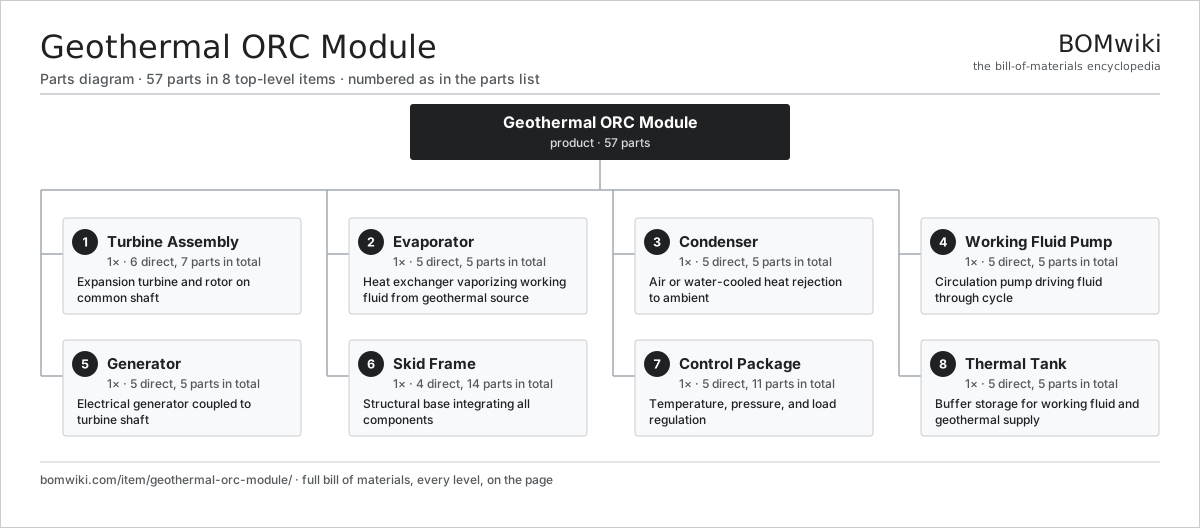
| # | Part | Qty | What it does |
|---|---|---|---|
| 1 | Turbine Assembly 6 parts | 1× | Expansion turbine and rotor on common shaft |
| 2 | Evaporator 5 parts | 1× | Heat exchanger vaporizing working fluid from geothermal source |
| 3 | Condenser 5 parts | 1× | Air or water-cooled heat rejection to ambient |
| 4 | Working Fluid Pump 5 parts | 1× | Circulation pump driving fluid through cycle |
| 5 | Generator 5 parts | 1× | Electrical generator coupled to turbine shaft |
| 6 | Skid Frame 4 parts | 1× | Structural base integrating all components |
| 7 | Control Package 5 parts | 1× | Temperature, pressure, and load regulation |
| 8 | Thermal Tank 5 parts | 1× | Buffer storage for working fluid and geothermal supply |
3D model
No 3D model yet. Have a CAD file of this? Add a 3D model. STL renders right on this page; STEP, FreeCAD, and OpenSCAD sources are welcome too (openly licensed, like all 3D models on BOMwiki).
Build & assembly graph
expand / collapse · shared sub-assemblies converge · links to related products · est. labourTap an assembly to expand/collapse · tap a part to open it · use “Open page” for any node · drag to pan, scroll to zoom.
Bill of materials for Geothermal ORC Module
8 top-level lines · 48 rows shown · 57 parts total · indented to 3 levels| # | Item / sub-assembly | Part no. | Qty/assy | Ext. qty | Parts | Type |
|---|---|---|---|---|---|---|
| 1 | Turbine Assembly 6 parts | geothermal-orc-module-turbine-assembly | 1× | 1 | 7 | assembly |
| 1.1 | Turbine Wheel | geothermal-orc-module-turbine-wheel | 1× | 1 | · | part |
| 1.2 | Turbine Shaft | geothermal-orc-module-turbine-shaft | 1× | 1 | · | part |
| 1.3 | Nozzle Ring | geothermal-orc-module-nozzle-ring | 1× | 1 | · | part |
| 1.4 | Turbine Bearing | geothermal-orc-module-turbine-bearing | 2× | 2 | · | part |
| 1.5 | Thrust Bearing | geothermal-orc-module-thrust-bearing | 1× | 1 | · | part |
| 1.6 | Fastener Set | fastener-set | 1× | 1 | · | part |
| 2 | Evaporator 5 parts | geothermal-orc-module-evaporator | 1× | 1 | 5 | assembly |
| 2.1 | Evap Core | geothermal-orc-module-evap-core | 1× | 1 | · | part |
| 2.2 | Evap Inlet Header | geothermal-orc-module-evap-inlet-header | 1× | 1 | · | part |
| 2.3 | Evap Outlet Header | geothermal-orc-module-evap-outlet-header | 1× | 1 | · | part |
| 2.4 | Evap Shell | geothermal-orc-module-evap-shell | 1× | 1 | · | part |
| 2.5 | Fastener Set | fastener-set | 1× | 1 | · | part |
| 3 | Condenser 5 parts | geothermal-orc-module-condenser | 1× | 1 | 5 | assembly |
| 3.1 | Condenser Core | geothermal-orc-module-condenser-core | 1× | 1 | · | part |
| 3.2 | Condenser Fan | geothermal-orc-module-condenser-fan | 1× | 1 | · | part |
| 3.3 | Condenser Pump | geothermal-orc-module-condenser-pump | 1× | 1 | · | part |
| 3.4 | Condenser Tank | geothermal-orc-module-condenser-tank | 1× | 1 | · | part |
| 3.5 | Fastener Set | fastener-set | 1× | 1 | · | part |
| 4 | Working Fluid Pump 5 parts | geothermal-orc-module-working-fluid-pump | 1× | 1 | 5 | assembly |
| 4.1 | Pump Unit | geothermal-orc-module-pump-unit | 1× | 1 | · | part |
| 4.2 | Pump Motor | geothermal-orc-module-pump-motor | 1× | 1 | · | part |
| 4.3 | Pump Suction Filter | geothermal-orc-module-pump-suction-filter | 1× | 1 | · | part |
| 4.4 | Pump Discharge Valve | geothermal-orc-module-pump-discharge-valve | 1× | 1 | · | part |
| 4.5 | Fastener Set | fastener-set | 1× | 1 | · | part |
| 5 | Generator 5 parts | geothermal-orc-module-generator | 1× | 1 | 5 | assembly |
| 5.1 | Gen Unit | geothermal-orc-module-gen-unit | 1× | 1 | · | part |
| 5.2 | Gen Coupling | geothermal-orc-module-gen-coupling | 1× | 1 | · | part |
| 5.3 | Gen Soft Starter | geothermal-orc-module-gen-soft-starter | 1× | 1 | · | part |
| 5.4 | Gen Transformer | geothermal-orc-module-gen-transformer | 1× | 1 | · | part |
| 5.5 | Gen Panel | geothermal-orc-module-gen-panel | 1× | 1 | · | part |
| 6 | Skid Frame 4 parts | geothermal-orc-module-skid-frame | 1× | 1 | 14 | assembly |
| 6.1 | Frame Main | geothermal-orc-module-frame-main | 1× | 1 | · | part |
| 6.2 | Frame Vibration Isolators | geothermal-orc-module-frame-vibration-isolators | 8× | 8 | · | part |
| 6.3 | Frame Tie-Downs | geothermal-orc-module-frame-tie-downs | 4× | 4 | · | part |
| 6.4 | Fastener Set | fastener-set | 1× | 1 | · | part |
| 7 | Control Package 5 parts | geothermal-orc-module-control-package | 1× | 1 | 11 | assembly |
| 7.1 | Control PLC | geothermal-orc-module-control-plc | 1× | 1 | · | part |
| 7.2 | Control Temp Sensor | geothermal-orc-module-control-temp-sensor | 3× | 3 | · | part |
| 7.3 | Control Pressure Sensor | geothermal-orc-module-control-pressure-sensor | 4× | 4 | · | part |
| 7.4 | Control Flow Meter | geothermal-orc-module-control-flow-meter | 2× | 2 | · | part |
| 7.5 | Control Modulating Valve | geothermal-orc-module-control-modulating-valve | 1× | 1 | · | part |
| 8 | Thermal Tank 5 parts | geothermal-orc-module-thermal-tank | 1× | 1 | 5 | assembly |
| 8.1 | Tank Shell | geothermal-orc-module-tank-shell | 1× | 1 | · | part |
| 8.2 | Tank Insulation | geothermal-orc-module-tank-insulation | 1× | 1 | · | part |
| 8.3 | Tank Diffuser | geothermal-orc-module-tank-diffuser | 1× | 1 | · | part |
| 8.4 | Tank Baffle | geothermal-orc-module-tank-baffle | 1× | 1 | · | part |
| 8.5 | Fastener Set | fastener-set | 1× | 1 | · | part |
Something wrong in this list? Report a problem with this BOM.
Sourcing: possible vendors
Browse the supplier directory → Prices, MOQ, and lead times are algorithmic estimates, not quotes, and not claims about these companies. Company mappings are curated by keyword; est. price band $100–$20M. How estimates work| Vendor | HQ | Specialty | MOQ | Lead time |
|---|---|---|---|---|
|
🇩🇰Vestas
vestas.com ↗
|
Aarhus, DK | Wind turbines | 500 units | 12–24 wks |
| firstsolar.com ↗ | Tempe, US | PV modules | 500 units | 12–24 wks |
|
🇨🇳LONGi
longi.com ↗
|
Xi'an, CN | Solar wafers & modules | 500 units | 12–24 wks |
| enphase.com ↗ | Fremont, US | Microinverters & storage | 500 units | 12–24 wks |
|
🇨🇳Sungrow
sungrowpower.com ↗
|
Hefei, CN | Solar inverters & storage | 500 units | 12–24 wks |
1,026-word article