Flotation Reagent Dosing Skid
ProductOverview
A flotation reagent dosing skid prepares and meters the chemicals that make froth flotation work. Flotation separates valuable minerals from waste rock by exploiting surface chemistry: ground ore is mixed with water into a slurry, air is blown through it, and the wanted mineral grains stick to the bubbles and float to a froth that overflows as concentrate, while the worthless gangue sinks. The reagents are what make the right grains float. A collector coats the target mineral so it grabs bubbles, a frother stabilises the bubbles into a lasting froth, a depressant keeps unwanted minerals down, and an activator wakes up minerals that would otherwise stay inert. Each must be added at the right place and the right rate; too little and recovery falls, too much and selectivity collapses or the froth floods. The skid stores these reagents, makes them up to strength, and doses each one precisely into the circuit.
The whole system is built on one bunded frame so it can be trucked in and set beside the flotation cells. From bulk tanks the reagents pass through make-up, metering and distribution, watched by instruments that prove the dose, and run by a PLC that ties dose rate to how much ore the plant is treating.
Frame and containment
The Skid Frame carries everything and contains spills. A welded Base Frame mounts the tanks, pumps and panel as one unit, sitting in a Spill Bund tray sized to hold a full tank if it ruptures, since xanthate collectors and frothers are hazardous to ground and water. Operators reach the tank tops on Walkway Grating walkways, and a Eyewash Station station sits within reach for handling the chemicals.
Storage and make-up
Reagents arrive in bulk and are diluted before use. The Reagent Storage section holds a Bulk Tank for each major reagent and a set of Day Tank tanks of ready-diluted reagent for a shift, each watched by a Level Sensor and vented through a Vent Filter that catches the odour of volatile frothers. Many reagents cannot be dosed neat: xanthate comes as a solid that must be dissolved, lime as a powder. The Make-up and Mixing section dilutes and dissolves them, running a Make-up Tank stirred by a Tank Mixer on a Servo Motor, fed dilution water through a Water Valve and solids through a Powder Feeder. Xanthate solutions are made fresh because they degrade in water within a day.
Metering
Accurate dosing is the core job, and it falls to the Metering Pump Bank bank. Each reagent has its own Metering Pump, a diaphragm pump whose Pump Diaphragm displaces a fixed volume per stroke through a Pump Head gated by two Check Valve units so each stroke meters cleanly. A Pump Motor stepper drive sets the stroke rate and so the dose, a Pulsation Damper smooths the pulses into steady flow, a Relief Valve protects the pump against a blocked line, and a Suction Strainer keeps debris out. Diaphragm metering pumps are used because they hold dose accuracy within about one percent across a wide turndown, which is what a flotation circuit needs as ore grade and tonnage shift.
Distribution and verification
Metered reagent goes where it is needed through the Distribution Manifold section. A Distribution Manifold splits each pump output and routes it through chemical-resistant Dosing Line tubing to a Addition Point at a conditioning tank or a particular flotation cell, each line able to be shut by an Isolation Valve. Reagents go in at staged points down the bank, not all at once, because rougher, scavenger and cleaner stages want different doses. The Instruments section proves the dose: a Flow Meter reads each line, a Calibration Column lets an operator draw-down test a pump against a stopwatch, a Density Meter checks make-up strength, and a Pressure Sensor flags a blocked line.
Control and operation
The Control Panel panel ratios reagent to ore. Its PLC Controller takes the plant feed tonnage and the target grams per tonne for each reagent, sets each pump stroke rate to match, and trims the doses from on-stream assay so the circuit holds grade and recovery as the ore changes. It alarms on low tank level, lost flow and pump fault through a Relay bank, shows the dosing schematic on an LCD Panel, and runs off a Power Supply. Reagent cost is one of the largest consumables in a concentrator, so dosing to actual need rather than a fixed rate saves real money and steadies the concentrate. Skids are sized to the number of reagents and addition points a circuit needs, from a few pumps on a small plant to a dozen on a large polymetallic concentrator running separate collector and depressant schemes for each mineral it recovers.
Flotation Reagent Dosing Skid parts and their functions
7 top-level parts · 198 parts in total · full bill of materials below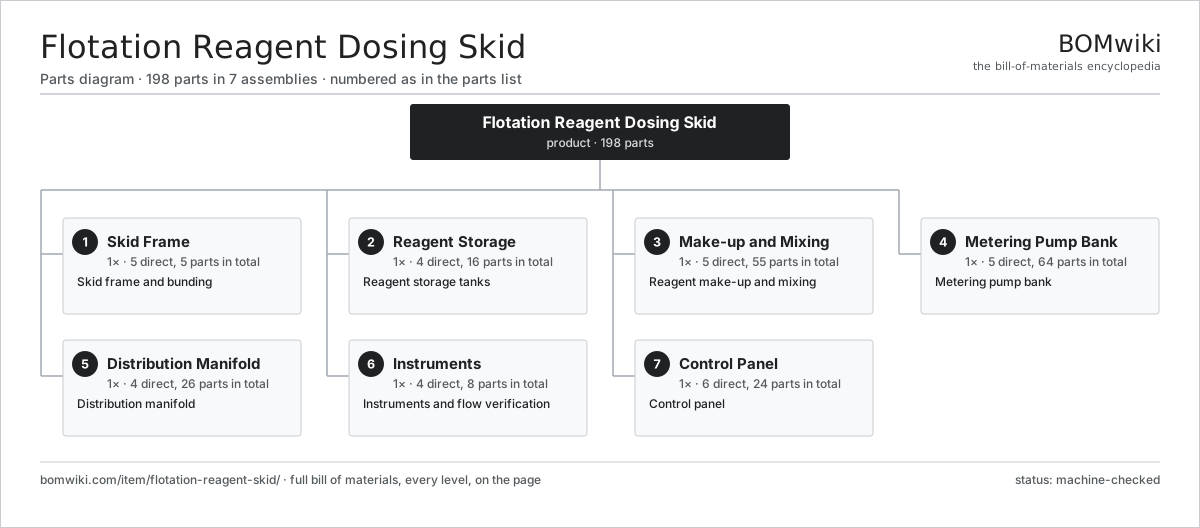
| # | Part | Qty | What it does |
|---|---|---|---|
| 1 | Skid Frame 5 parts | 1× | Skid frame and bunding |
| 2 | Reagent Storage 4 parts | 1× | Reagent storage tanks |
| 3 | Make-up and Mixing 5 parts | 1× | Reagent make-up and mixing |
| 4 | Metering Pump Bank 5 parts | 1× | Metering pump bank |
| 5 | Distribution Manifold 4 parts | 1× | Distribution manifold |
| 6 | Instruments 4 parts | 1× | Instruments and flow verification |
| 7 | Control Panel 6 parts | 1× | Control panel |
3D model
No 3D model yet. Have a CAD file of this? Add a 3D model — STL renders right on this page; STEP, FreeCAD, and OpenSCAD sources are welcome too (openly licensed, like all 3D models on BOMwiki).
Build & assembly graph
expand / collapse · shared sub-assemblies converge · links to related products · est. labourTap an assembly to expand/collapse · tap a part to open it · use “Open page” for any node · drag to pan, scroll to zoom.
Bill of materials for Flotation Reagent Dosing Skid
7 top-level lines · 51 rows shown · 198 parts total · indented to 3 levels| # | Item / sub-assembly | Part no. | Qty/assy | Ext. qty | Parts | Type |
|---|---|---|---|---|---|---|
| 1 | Skid Frame 5 parts | flotation-reagent-skid-frame | 1× | 1 | 5 | assembly |
| 1.1 | Base Frame | flotation-reagent-skid-base-frame | 1× | 1 | · | part |
| 1.2 | Spill Bund | flotation-reagent-skid-bund | 1× | 1 | · | part |
| 1.3 | Walkway Grating | flotation-reagent-skid-grating | 1× | 1 | · | part |
| 1.4 | Eyewash Station | flotation-reagent-skid-eyewash | 1× | 1 | · | part |
| 1.5 | Fastener Set | fastener-set | 1× | 1 | · | part |
| 2 | Reagent Storage 4 parts | flotation-reagent-skid-storage | 1× | 1 | 16 | assembly |
| 2.1 | Bulk Tank | flotation-reagent-skid-bulk-tank | 2× | 2 | · | part |
| 2.2 | Day Tank | flotation-reagent-skid-day-tank | 4× | 4 | · | part |
| 2.3 | Level Sensor | flotation-reagent-skid-level-sensor | 6× | 6 | · | part |
| 2.4 | Vent Filter | flotation-reagent-skid-vent-filter | 4× | 4 | · | part |
| 3 | Make-up and Mixing 5 parts | flotation-reagent-skid-mixing | 1× | 1 | 55 | assembly |
| 3.1 | Make-up Tank | flotation-reagent-skid-mix-tank | 2× | 2 | · | part |
| 3.2 | Tank Mixer | flotation-reagent-skid-mixer | 2× | 2 | · | part |
| 3.3 | Water Valve | flotation-reagent-skid-water-valve | 2× | 2 | · | part |
| 3.4 | Powder Feeder | flotation-reagent-skid-powder-feeder | 1× | 1 | · | part |
| 3.5 | Servo Motor 4 parts | servo-motor | 2× | 2 | 24 | assembly |
| 3.5.1 | Stator Assembly 3 parts + deeper › | stator-assembly | 1× | 2 | 3 | assembly |
| 3.5.2 | Rotor Assembly 4 parts + deeper › | rotor-assembly | 1× | 2 | 19 | assembly |
| 3.5.3 | Encoder | encoder | 1× | 2 | · | part |
| 3.5.4 | Motor Housing | motor-housing | 1× | 2 | · | part |
| 4 | Metering Pump Bank 5 parts | flotation-reagent-skid-metering | 1× | 1 | 64 | assembly |
| 4.1 | Metering Pump 3 parts | flotation-reagent-skid-metering-pump | 8× | 8 | 4 | assembly |
| 4.1.1 | Pump Diaphragm | flotation-reagent-skid-pump-diaphragm | 1× | 8 | · | part |
| 4.1.2 | Pump Head | flotation-reagent-skid-pump-head | 1× | 8 | · | part |
| 4.1.3 | Check Valve | flotation-reagent-skid-check-valve | 2× | 16 | · | part |
| 4.2 | Pump Motor | flotation-reagent-skid-pump-motor | 8× | 8 | · | part |
| 4.3 | Pulsation Damper | flotation-reagent-skid-pulsation-damper | 8× | 8 | · | part |
| 4.4 | Relief Valve | flotation-reagent-skid-relief-valve | 8× | 8 | · | part |
| 4.5 | Suction Strainer | flotation-reagent-skid-suction-strainer | 8× | 8 | · | part |
| 5 | Distribution Manifold 4 parts | flotation-reagent-skid-distribution | 1× | 1 | 26 | assembly |
| 5.1 | Distribution Manifold | flotation-reagent-skid-manifold | 1× | 1 | · | part |
| 5.2 | Addition Point | flotation-reagent-skid-addition-point | 12× | 12 | · | part |
| 5.3 | Isolation Valve | flotation-reagent-skid-isolation-valve | 12× | 12 | · | part |
| 5.4 | Dosing Line | flotation-reagent-skid-dose-line | 1× | 1 | · | part |
| 6 | Instruments 4 parts | flotation-reagent-skid-instrument | 1× | 1 | 8 | assembly |
| 6.1 | Flow Meter | flotation-reagent-skid-flow-meter | 4× | 4 | · | part |
| 6.2 | Calibration Column | flotation-reagent-skid-cal-column | 1× | 1 | · | part |
| 6.3 | Density Meter | flotation-reagent-skid-density-meter | 1× | 1 | · | part |
| 6.4 | Pressure Sensor | pressure-sensor | 2× | 2 | · | part |
| 7 | Control Panel 6 parts | flotation-reagent-skid-control | 1× | 1 | 24 | assembly |
| 7.1 | PLC Controller 4 parts | flotation-reagent-skid-plc | 1× | 1 | 7 | assembly |
| 7.1.1 | Bare PCB | pcb-bare | 1× | 1 | · | part |
| 7.1.2 | Microcontroller | mcu | 1× | 1 | · | part |
| 7.1.3 | SMD Passive (R/C/L) | smd-passives | 1× | 1 | · | part |
| 7.1.4 | Connector | connector | 4× | 4 | · | part |
| 7.2 | LCD Panel | lcd-panel | 1× | 1 | · | part |
| 7.3 | Power Supply | power-supply | 1× | 1 | · | part |
| 7.4 | Relay | relay | 6× | 6 | · | part |
| 7.5 | Wire Bundle | wire-bundle | 1× | 1 | · | part |
| 7.6 | Connector | connector | 8× | 8 | · | part |
Related products
same domain, ranked by shared parts Carbon Regeneration Kiln
141 parts · shares 13 with this page
Carbon Regeneration Kiln
141 parts · shares 13 with this page
 Electrowinning Cell
347 parts · shares 13 with this page
Electrowinning Cell
347 parts · shares 13 with this page
 Gold Elution Column
128 parts · shares 13 with this page
Gold Elution Column
128 parts · shares 13 with this page
 Heap Leach Irrigation System
121 parts · shares 13 with this page
Heap Leach Irrigation System
121 parts · shares 13 with this page
 Laboratory Ring Pulverizer
73 parts · shares 13 with this page
Laboratory Ring Pulverizer
73 parts · shares 13 with this page
 Reverse Circulation Drill Rig
154 parts · shares 11 with this page
Reverse Circulation Drill Rig
154 parts · shares 11 with this page
Sourcing: possible vendors
Prices, MOQ, and lead times are algorithmic estimates, not quotes, and not claims about these companies. Company mappings are curated by keyword; est. price band $200k–$5M. How estimates work| Vendor | HQ | Specialty | MOQ | Lead time |
|---|---|---|---|---|
| caterpillar.com ↗ | Irving, US | Construction & mining equipment | made to order | 20–36 wks |
|
🇯🇵Komatsu
komatsu.com ↗
|
Tokyo, JP | Construction & mining equipment | made to order | 20–36 wks |
|
🇸🇪Sandvik
rocktechnology.sandvik ↗
|
Stockholm, SE | Mining & rock technology | made to order | 20–36 wks |
|
🇸🇪Epiroc
epiroc.com ↗
|
Stockholm, SE | Mining & drilling equipment | made to order | 20–36 wks |
|
🇫🇮Metso
metso.com ↗
|
Helsinki, FI | Crushing & minerals processing | made to order | 20–36 wks |
886-word article