Laboratory Ring Pulverizer
ProductOverview
A laboratory ring pulverizer grinds a crushed rock sample down to a fine powder so it can be assayed. Before an ore can be analysed for its gold, copper or other metal content, a representative sample must be reduced to a uniform powder fine enough that a small assay portion truly represents the whole. This machine does the final size reduction in that chain. It works by sliding wear rather than hammering: a sample sits in a heavy bowl with one or two free rings and a centre puck, the bowl is swirled rapidly in a small horizontal orbit, and the rings and puck slide and grind the rock against the bowl wall and each other. In a half a minute to a few minutes the sample is reduced to assay fineness, typically 85-95 percent passing 75 micron.
The mill is built around a swirling grinding head, an eccentric drive that creates the orbit, a clamp that holds the bowl down against the violent motion, and an enclosure with dust extraction that protects the operator from silica. Sample preparation labs at mines and assay houses run these constantly, so the design is about fast cycles, easy bowl changes, and keeping every sample free of cross-contamination from the one before.
The grinding head
The Grinding Head does the grinding. The sample goes into a Grinding Bowl of hardened steel, chrome steel or tungsten carbide, the choice driven by what the sample will be assayed for: a carbide bowl avoids the iron contamination a steel bowl would add. Inside the bowl, one or two free Grinding Ring rings and a central Centre Puck slide over the sample as the bowl swirls, crushing it by the sliding pressure between the heavy parts and the bowl wall. A Bowl Lid closes the bowl with a Lid Seal so nothing escapes. Because the rings are free and the bowl moves, the grinding media are never bolted to anything; the orbit alone drives the action.
Eccentric drive
The orbit comes from the Eccentric Drive. A Servo Motor turns a Drive Belt that spins a Drive Spindle carrying a Eccentric Weight weight on Ball Bearing supports. The eccentric drives the bowl table in a fast, small circular swirl rather than a spin, so the rings inside slide and grind instead of just centrifuging to the wall. Because a heavy offset mass spinning at speed would shake the machine off the bench, a Counterweight balances the eccentric. The swirl frequency and the bowl mass set how hard the sample is worked, which is why grind time is the main process variable.
Clamping and safety
The bowl is held down by the Bowl Clamp. A Clamp Arm swings over the bowl and a Clamp Cylinder presses it onto the table through a Clamp Pad, because an unclamped bowl would walk off the table under the swirl. A Clamp Switch stops the drive starting unless the bowl is clamped. Operating safely matters, since a bowl breaking loose at speed is dangerous, so the Enclosure adds an interlocked Acoustic Cabinet with an Acoustic Lining lining to cut noise, an Enclosure Door for loading, and a Door Interlock that stops the mill the moment the door opens.
Dust extraction
Grinding rock to a fine powder releases respirable silica, a serious health hazard, so the Dust Extraction system runs whenever the mill does. A Extraction Fan pulls air off the bowl area through a Extraction Duct and a HEPA Filter that captures the fine dust before air returns to the room, while settled dust collects in a Dust Drawer for safe disposal. Good extraction also keeps the lab clean, which matters because stray dust between samples is a source of cross-contamination that skews assays.
Control, frame and operation
The Control Panel panel runs a fixed cycle. Its Timer Controller times a set grind, enforces the door and clamp interlocks through a Relay bank, and stops at once on the Emergency Stop, with an LCD Panel for the operator and a Power Supply feeding the loop. The whole head sits on the Base Frame: a heavy Base Casting gives the mass to absorb the swirl, Vibration Isolator mounts keep vibration off the bench, and Levelling Foot feet level it. In use, an operator loads a weighed sub-sample and the rings into a clean bowl, clamps it, runs the timed grind, then empties the bowl, splits out the assay portion, and cleans the bowl with quartz wash or compressed air before the next sample. The grind time is set once for a given ore hardness and target fineness, then repeated sample after sample, with carbide bowls reserved for samples where iron or chromium pickup would ruin the analysis.
Laboratory Ring Pulverizer parts and their functions
7 top-level parts · 73 parts in total · full bill of materials below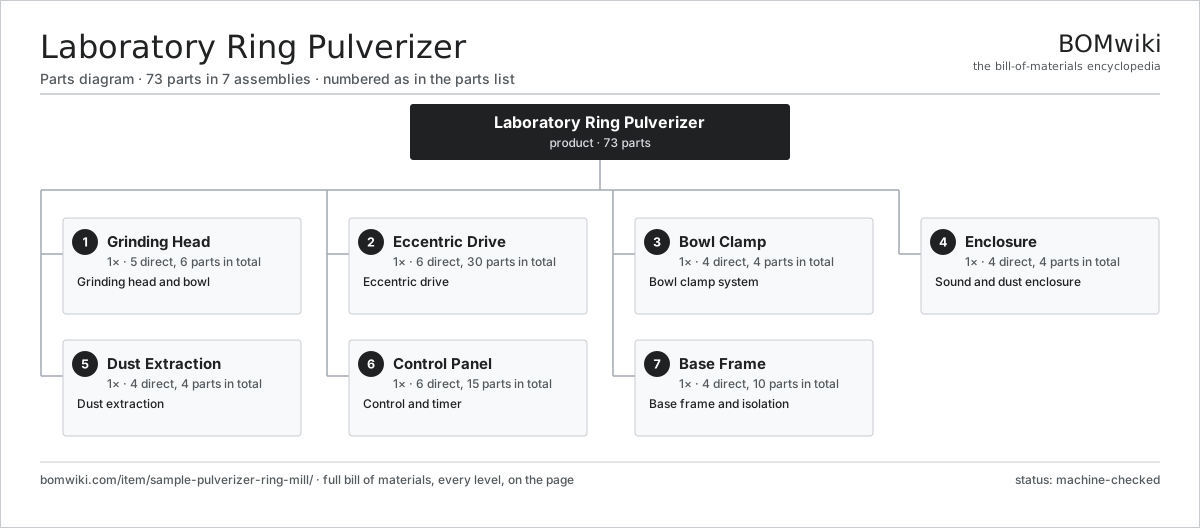
| # | Part | Qty | What it does |
|---|---|---|---|
| 1 | Grinding Head 5 parts | 1× | Grinding head and bowl |
| 2 | Eccentric Drive 6 parts | 1× | Eccentric drive |
| 3 | Bowl Clamp 4 parts | 1× | Bowl clamp system |
| 4 | Enclosure 4 parts | 1× | Sound and dust enclosure |
| 5 | Dust Extraction 4 parts | 1× | Dust extraction |
| 6 | Control Panel 6 parts | 1× | Control and timer |
| 7 | Base Frame 4 parts | 1× | Base frame and isolation |
3D model
No 3D model yet. Have a CAD file of this? Add a 3D model — STL renders right on this page; STEP, FreeCAD, and OpenSCAD sources are welcome too (openly licensed, like all 3D models on BOMwiki).
Build & assembly graph
expand / collapse · shared sub-assemblies converge · links to related products · est. labourTap an assembly to expand/collapse · tap a part to open it · use “Open page” for any node · drag to pan, scroll to zoom.
Bill of materials for Laboratory Ring Pulverizer
7 top-level lines · 48 rows shown · 73 parts total · indented to 3 levels| # | Item / sub-assembly | Part no. | Qty/assy | Ext. qty | Parts | Type |
|---|---|---|---|---|---|---|
| 1 | Grinding Head 5 parts | sample-pulverizer-ring-mill-grinding-head | 1× | 1 | 6 | assembly |
| 1.1 | Grinding Bowl | sample-pulverizer-ring-mill-bowl | 1× | 1 | · | part |
| 1.2 | Grinding Ring | sample-pulverizer-ring-mill-ring | 2× | 2 | · | part |
| 1.3 | Centre Puck | sample-pulverizer-ring-mill-puck | 1× | 1 | · | part |
| 1.4 | Bowl Lid | sample-pulverizer-ring-mill-lid | 1× | 1 | · | part |
| 1.5 | Lid Seal | sample-pulverizer-ring-mill-lid-seal | 1× | 1 | · | part |
| 2 | Eccentric Drive 6 parts | sample-pulverizer-ring-mill-drive | 1× | 1 | 30 | assembly |
| 2.1 | Servo Motor 4 parts | servo-motor | 1× | 1 | 24 | assembly |
| 2.1.1 | Stator Assembly 3 parts + deeper › | stator-assembly | 1× | 1 | 3 | assembly |
| 2.1.2 | Rotor Assembly 4 parts + deeper › | rotor-assembly | 1× | 1 | 19 | assembly |
| 2.1.3 | Encoder | encoder | 1× | 1 | · | part |
| 2.1.4 | Motor Housing | motor-housing | 1× | 1 | · | part |
| 2.2 | Drive Belt | drive-belt | 1× | 1 | · | part |
| 2.3 | Eccentric Weight | sample-pulverizer-ring-mill-eccentric | 1× | 1 | · | part |
| 2.4 | Drive Spindle | sample-pulverizer-ring-mill-spindle | 1× | 1 | · | part |
| 2.5 | Ball Bearing | ball-bearing | 2× | 2 | · | part |
| 2.6 | Counterweight | sample-pulverizer-ring-mill-counterweight | 1× | 1 | · | part |
| 3 | Bowl Clamp 4 parts | sample-pulverizer-ring-mill-clamp | 1× | 1 | 4 | assembly |
| 3.1 | Clamp Arm | sample-pulverizer-ring-mill-clamp-arm | 1× | 1 | · | part |
| 3.2 | Clamp Cylinder | sample-pulverizer-ring-mill-clamp-cylinder | 1× | 1 | · | part |
| 3.3 | Clamp Pad | sample-pulverizer-ring-mill-clamp-pad | 1× | 1 | · | part |
| 3.4 | Clamp Switch | sample-pulverizer-ring-mill-clamp-switch | 1× | 1 | · | part |
| 4 | Enclosure 4 parts | sample-pulverizer-ring-mill-enclosure | 1× | 1 | 4 | assembly |
| 4.1 | Acoustic Cabinet | sample-pulverizer-ring-mill-cabinet | 1× | 1 | · | part |
| 4.2 | Enclosure Door | sample-pulverizer-ring-mill-door | 1× | 1 | · | part |
| 4.3 | Acoustic Lining | sample-pulverizer-ring-mill-acoustic-foam | 1× | 1 | · | part |
| 4.4 | Door Interlock | sample-pulverizer-ring-mill-door-interlock | 1× | 1 | · | part |
| 5 | Dust Extraction 4 parts | sample-pulverizer-ring-mill-dust | 1× | 1 | 4 | assembly |
| 5.1 | Extraction Fan | sample-pulverizer-ring-mill-extraction-fan | 1× | 1 | · | part |
| 5.2 | HEPA Filter | sample-pulverizer-ring-mill-hepa-filter | 1× | 1 | · | part |
| 5.3 | Extraction Duct | sample-pulverizer-ring-mill-duct | 1× | 1 | · | part |
| 5.4 | Dust Drawer | sample-pulverizer-ring-mill-dust-drawer | 1× | 1 | · | part |
| 6 | Control Panel 6 parts | sample-pulverizer-ring-mill-control | 1× | 1 | 15 | assembly |
| 6.1 | Timer Controller 4 parts | sample-pulverizer-ring-mill-controller | 1× | 1 | 7 | assembly |
| 6.1.1 | Bare PCB | pcb-bare | 1× | 1 | · | part |
| 6.1.2 | Microcontroller | mcu | 1× | 1 | · | part |
| 6.1.3 | SMD Passive (R/C/L) | smd-passives | 1× | 1 | · | part |
| 6.1.4 | Connector | connector | 4× | 4 | · | part |
| 6.2 | LCD Panel | lcd-panel | 1× | 1 | · | part |
| 6.3 | Power Supply | power-supply | 1× | 1 | · | part |
| 6.4 | Relay | relay | 4× | 4 | · | part |
| 6.5 | Emergency Stop | sample-pulverizer-ring-mill-estop | 1× | 1 | · | part |
| 6.6 | Wire Bundle | wire-bundle | 1× | 1 | · | part |
| 7 | Base Frame 4 parts | sample-pulverizer-ring-mill-frame | 1× | 1 | 10 | assembly |
| 7.1 | Base Casting | sample-pulverizer-ring-mill-base-casting | 1× | 1 | · | part |
| 7.2 | Vibration Isolator | sample-pulverizer-ring-mill-isolator | 4× | 4 | · | part |
| 7.3 | Levelling Foot | sample-pulverizer-ring-mill-foot | 4× | 4 | · | part |
| 7.4 | Fastener Set | fastener-set | 1× | 1 | · | part |
Related products
same domain, ranked by shared parts Carbon Regeneration Kiln
141 parts · shares 13 with this page
Carbon Regeneration Kiln
141 parts · shares 13 with this page
 Electrowinning Cell
347 parts · shares 13 with this page
Flotation Reagent Dosing Skid
198 parts · shares 13 with this page
Electrowinning Cell
347 parts · shares 13 with this page
Flotation Reagent Dosing Skid
198 parts · shares 13 with this page
 Gold Elution Column
128 parts · shares 13 with this page
Gold Elution Column
128 parts · shares 13 with this page
 Heap Leach Irrigation System
121 parts · shares 13 with this page
Heap Leach Irrigation System
121 parts · shares 13 with this page
 Reverse Circulation Drill Rig
154 parts · shares 11 with this page
Reverse Circulation Drill Rig
154 parts · shares 11 with this page
Sourcing: possible vendors
Prices, MOQ, and lead times are algorithmic estimates, not quotes, and not claims about these companies. Company mappings are curated by keyword; est. price band $200k–$5M. How estimates work| Vendor | HQ | Specialty | MOQ | Lead time |
|---|---|---|---|---|
| caterpillar.com ↗ | Irving, US | Construction & mining equipment | made to order | 20–36 wks |
|
🇯🇵Komatsu
komatsu.com ↗
|
Tokyo, JP | Construction & mining equipment | made to order | 20–36 wks |
|
🇸🇪Sandvik
rocktechnology.sandvik ↗
|
Stockholm, SE | Mining & rock technology | made to order | 20–36 wks |
|
🇸🇪Epiroc
epiroc.com ↗
|
Stockholm, SE | Mining & drilling equipment | made to order | 20–36 wks |
|
🇫🇮Metso
metso.com ↗
|
Helsinki, FI | Crushing & minerals processing | made to order | 20–36 wks |
898-word article