Mineral Jig Concentrator
ProductOverview
A mineral jig is a gravity concentrator that sorts a feed of mixed particles by density. It pulses water up and down through a bed of mineral resting on a screen. Heavy particles settle through the bed and report to the concentrate under the screen, while the lighter gangue stays near the top and overflows as tailings. The jig works on density alone, so it suits minerals that are much heavier than the rock around them: gold, cassiterite (tin), tungsten, tantalite, chromite, garnet, and the heavy fraction in iron and coal washing. It uses no reagents, only water, which is part of why it stays in use long after froth flotation took over much of mineral processing.
The machine is built from a few subsystems on one frame. The Jig Tank and Hutch holds the water and the cells, the Jig Bed and Screen Deck is the screen and the heavy media that sit on it, the Diaphragm Pulsion Mechanism makes the water pulse, the Hutch Water System adds makeup water under the screen, the Concentrate Discharge draws the concentrate off, and the Drive Unit turns the pulsion mechanism. The Control and Instrumentation holds the pulse, water and draw at steady settings.
The jigging principle
Feed slurry runs in over the Feed Launder and spreads across the Punched Screen Plate. Under each screen is a Hutch Chamber, a chamber full of water. The pulsion mechanism drives that water up through the screen and then lets it fall back. On the up stroke the whole bed lifts and opens up, so the particles are briefly suspended and free to move. As the water slows and reverses, the particles fall back at a rate set by their size and density. Heavy particles fall faster and reach the screen first; light ones settle on top. After many cycles the bed is stratified, heavy at the bottom and light at the top. The light layer is washed off the Tailings Overflow Weir as tailings, and the heavy layer at the screen is drawn off as concentrate. The down stroke matters as much as the up stroke. As the water drops back through the bed it sucks fine heavy grains down through the gaps, an action called consolidation trickling, which is how a jig recovers particles smaller than the screen holes.
The bed and ragging
A jig does not run on bare screen. A layer of Ragging Media sits on the Punched Screen Plate, a charge of dense coarse media such as steel shot or hematite, held in place by a Ragging Retainer. The ragging is the working part of the bed. The pulse dilates it on the up stroke, and the size and density of the ragging set how easily mineral passes through to the hutch. Coarse, heavy ragging passes only the densest mineral and gives a clean, high-grade concentrate at lower recovery; finer, lighter ragging passes more and lifts recovery at the cost of grade. The holes in the screen are sized to retain the ragging while letting the fine concentrate fall into the Hutch Chamber below. The Screen Frame holds the deck over the hutch and is bolted down so the pulse does not lift it.
The pulsion mechanism
The pulse is made by the Diaphragm Pulsion Mechanism, a diaphragm drive. The Drive Unit turns the Eccentric Shaft, whose offset throw works the Connecting Rod up and down. The rod flexes the Rubber Diaphragm, a reinforced rubber membrane sealing the bottom of the pulse chamber, through the Diaphragm Backing Plate. As the diaphragm rises it pushes water up through the bed; as it falls it draws water back. The Flywheel on the shaft smooths the load so the motor turns at a steady speed through the stroke. Two settings govern the separation. The Stroke Adjustment sets the stroke length, how far the diaphragm moves and so how far the bed lifts, in the range 5-50 mm. The drive speed sets the pulse frequency, 100-300 cycles per minute. Coarse feed wants a long, slow stroke; fine feed wants a short, fast one. The diaphragm is the main wear item of the drive and is changed on a schedule, since a split diaphragm stops the pulse.
Water and discharge
The pulse alone does not move enough water in one direction. The Hutch Water System adds makeup water under the screen through the Water Manifold and a Hutch Water Valve on each hutch, fed by the Makeup Water Pump. This hutch water lengthens and strengthens the up pulse and gives a net upward flow that keeps the bed open and carries the tailings across to the weir. The Flow Meter lets the operator balance the water cell to cell. Concentrate is drawn off through the Concentrate Discharge. Each Hutch Chamber feeds a Spigot Discharge Valve whose Pinch Sleeve meters the draw without losing the water seal. On a controlled machine a Density-Controlled Spigot reads the bed with a Density Float and a Pressure Sensor and opens the Modulating Valve as heavy mineral builds up, so the grade holds steady when the feed changes. The drawn-off concentrate runs down the Concentrate Launder to the Concentrate Collection Box.
Drive and frame
The Drive Unit is a Drive Motor through a Gear Reducer and a set of Drive Belt vee belts. The reducer brings the motor speed down to the slow turn the eccentric needs for the pulse frequency. A Variable Frequency Drive on the motor sets that speed, which is how the operator trims the pulse frequency without changing pulleys. Everything sits on the Base Frame, carried on a Support Leg at each corner. A Anti-Vibration Mount and a Coil Spring under each foot keep the pulse reaction out of the floor, which matters because the jig shakes a heavy water mass twice a second.
Control, variants and use
The Control and Instrumentation ties the parts together. The PLC Controller times the pulse, sequences the hutch water and steps the spigot valves from the Bed Density Sensor signal, with water pressure, bed level and stroke read by the Process Sensor Set. Jigs vary by how the pulse is made. The diaphragm jig here is the common modern type. A plunger jig uses a piston instead of a diaphragm; an air-pulsed (Baum or Batac) jig uses compressed air on the water and is standard for washing coal at high tonnage. By bed type, a fixed-sieve jig keeps the screen still and pulses the water, as here, while a moving-sieve jig shakes the screen itself. Jigs are used to recover heavy minerals from alluvial and hard-rock ores, to wash coal, to clean scrap metal, and to pre-concentrate ahead of finer processing. The appeal is a simple machine that separates by density with water and no chemicals, at a low cost per tonne.
Mineral Jig Concentrator parts and their functions
8 top-level parts · 145 parts in total · full bill of materials below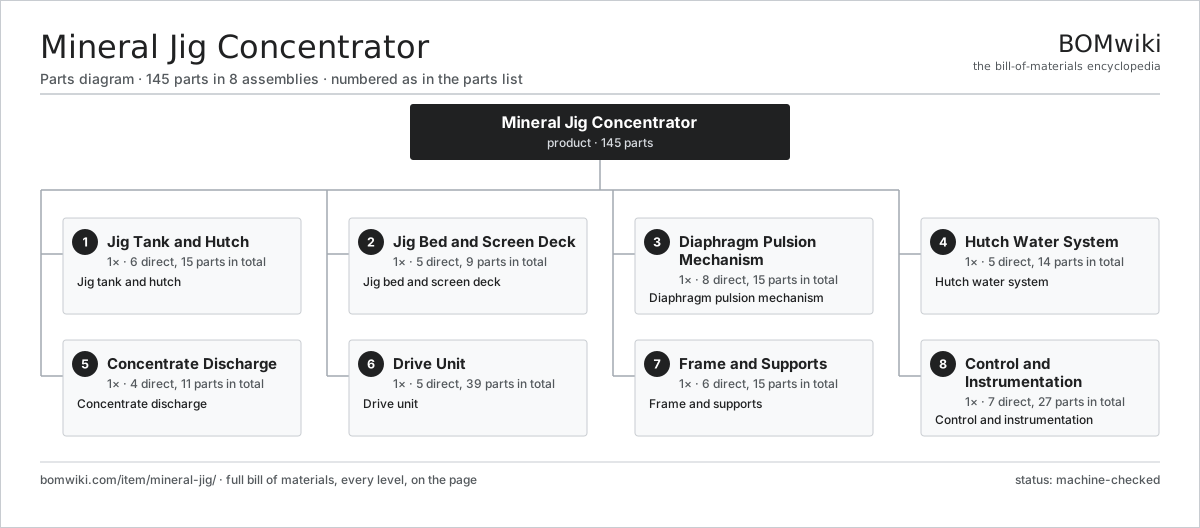
| # | Part | Qty | What it does |
|---|---|---|---|
| 1 | Jig Tank and Hutch 6 parts | 1× | Jig tank and hutch |
| 2 | Jig Bed and Screen Deck 5 parts | 1× | Jig bed and screen deck |
| 3 | Diaphragm Pulsion Mechanism 8 parts | 1× | Diaphragm pulsion mechanism |
| 4 | Hutch Water System 5 parts | 1× | Hutch water system |
| 5 | Concentrate Discharge 4 parts | 1× | Concentrate discharge |
| 6 | Drive Unit 5 parts | 1× | Drive unit |
| 7 | Frame and Supports 6 parts | 1× | Frame and supports |
| 8 | Control and Instrumentation 7 parts | 1× | Control and instrumentation |
3D model
No 3D model yet. Have a CAD file of this? Add a 3D model — STL renders right on this page; STEP, FreeCAD, and OpenSCAD sources are welcome too (openly licensed, like all 3D models on BOMwiki).
Build & assembly graph
expand / collapse · shared sub-assemblies converge · links to related products · est. labourTap an assembly to expand/collapse · tap a part to open it · use “Open page” for any node · drag to pan, scroll to zoom.
Bill of materials for Mineral Jig Concentrator
8 top-level lines · 92 rows shown · 145 parts total · indented to 3 levels| # | Item / sub-assembly | Part no. | Qty/assy | Ext. qty | Parts | Type |
|---|---|---|---|---|---|---|
| 1 | Jig Tank and Hutch 6 parts | mineral-jig-tank | 1× | 1 | 15 | assembly |
| 1.1 | Tank Shell | mineral-jig-tank-shell | 1× | 1 | · | part |
| 1.2 | Cell Divider | mineral-jig-cell-divider | 2× | 2 | · | part |
| 1.3 | Hutch Chamber 3 parts | mineral-jig-hutch | 2× | 2 | 3 | assembly |
| 1.3.1 | Hutch Body | mineral-jig-hutch-body | 1× | 2 | · | part |
| 1.3.2 | Hutch Spigot | mineral-jig-hutch-spigot | 1× | 2 | · | part |
| 1.3.3 | Hutch Liner | mineral-jig-hutch-liner | 1× | 2 | · | part |
| 1.4 | Feed Launder | mineral-jig-feed-launder | 1× | 1 | · | part |
| 1.5 | Tailings Overflow Weir | mineral-jig-tailings-weir | 1× | 1 | · | part |
| 1.6 | Tank Wear Liner | mineral-jig-tank-liner | 4× | 4 | · | part |
| 2 | Jig Bed and Screen Deck 5 parts | mineral-jig-bed | 1× | 1 | 9 | assembly |
| 2.1 | Screen Frame | mineral-jig-screen-frame | 2× | 2 | · | part |
| 2.2 | Punched Screen Plate | mineral-jig-screen-plate | 2× | 2 | · | part |
| 2.3 | Ragging Media | mineral-jig-ragging | 2× | 2 | · | part |
| 2.4 | Ragging Retainer | mineral-jig-ragging-retainer | 2× | 2 | · | part |
| 2.5 | Fastener Set | fastener-set | 1× | 1 | · | part |
| 3 | Diaphragm Pulsion Mechanism 8 parts | mineral-jig-pulsion | 1× | 1 | 15 | assembly |
| 3.1 | Eccentric Shaft 4 parts | mineral-jig-eccentric-shaft | 1× | 1 | 5 | assembly |
| 3.1.1 | Eccentric Shaft Body | mineral-jig-eccentric-body | 1× | 1 | · | part |
| 3.1.2 | Eccentric Bush | mineral-jig-eccentric-bush | 1× | 1 | · | part |
| 3.1.3 | Ball Bearing | ball-bearing | 2× | 2 | · | part |
| 3.1.4 | O-Ring Set | oring-set | 1× | 1 | · | part |
| 3.2 | Connecting Rod | mineral-jig-connecting-rod | 1× | 1 | · | part |
| 3.3 | Rubber Diaphragm | mineral-jig-diaphragm | 1× | 1 | · | part |
| 3.4 | Diaphragm Backing Plate | mineral-jig-diaphragm-plate | 1× | 1 | · | part |
| 3.5 | Flywheel 2 parts | mineral-jig-flywheel | 1× | 1 | 2 | assembly |
| 3.5.1 | Flywheel Rim | mineral-jig-flywheel-rim | 1× | 1 | · | part |
| 3.5.2 | Flywheel Hub | mineral-jig-flywheel-hub | 1× | 1 | · | part |
| 3.6 | Stroke Adjustment | mineral-jig-stroke-adjuster | 1× | 1 | · | part |
| 3.7 | Ball Bearing | ball-bearing | 2× | 2 | · | part |
| 3.8 | Oil Seal | oil-seal | 2× | 2 | · | part |
| 4 | Hutch Water System 5 parts | mineral-jig-water | 1× | 1 | 14 | assembly |
| 4.1 | Water Manifold | mineral-jig-water-manifold | 1× | 1 | · | part |
| 4.2 | Hutch Water Valve | mineral-jig-water-valve | 2× | 2 | · | part |
| 4.3 | Flow Meter | mineral-jig-water-rotameter | 2× | 2 | · | part |
| 4.4 | Makeup Water Pump 4 parts | mineral-jig-water-pump | 1× | 1 | 5 | assembly |
| 4.4.1 | Pump Casing | mineral-jig-pump-casing | 1× | 1 | · | part |
| 4.4.2 | Pump Impeller | mineral-jig-pump-impeller | 1× | 1 | · | part |
| 4.4.3 | Ball Bearing | ball-bearing | 2× | 2 | · | part |
| 4.4.4 | Oil Seal | oil-seal | 1× | 1 | · | part |
| 4.5 | Supply Hose | mineral-jig-water-hose | 4× | 4 | · | part |
| 5 | Concentrate Discharge 4 parts | mineral-jig-discharge | 1× | 1 | 11 | assembly |
| 5.1 | Spigot Discharge Valve 3 parts | mineral-jig-spigot-valve | 2× | 2 | 3 | assembly |
| 5.1.1 | Valve Body | mineral-jig-valve-body | 1× | 2 | · | part |
| 5.1.2 | Pinch Sleeve | mineral-jig-pinch-sleeve | 1× | 2 | · | part |
| 5.1.3 | Valve Actuator | mineral-jig-valve-actuator | 1× | 2 | · | part |
| 5.2 | Density-Controlled Spigot 3 parts | mineral-jig-density-spigot | 1× | 1 | 3 | assembly |
| 5.2.1 | Density Float | mineral-jig-density-float | 1× | 1 | · | part |
| 5.2.2 | Modulating Valve | mineral-jig-density-valve | 1× | 1 | · | part |
| 5.2.3 | Pressure Sensor | pressure-sensor | 1× | 1 | · | part |
| 5.3 | Concentrate Launder | mineral-jig-conc-launder | 1× | 1 | · | part |
| 5.4 | Concentrate Collection Box | mineral-jig-conc-box | 1× | 1 | · | part |
| 6 | Drive Unit 5 parts | mineral-jig-drive | 1× | 1 | 39 | assembly |
| 6.1 | Drive Motor 4 parts | mineral-jig-motor | 1× | 1 | 25 | assembly |
| 6.1.1 | Stator Assembly 3 parts + deeper › | stator-assembly | 1× | 1 | 3 | assembly |
| 6.1.2 | Rotor Assembly 4 parts + deeper › | rotor-assembly | 1× | 1 | 19 | assembly |
| 6.1.3 | Ball Bearing | ball-bearing | 2× | 2 | · | part |
| 6.1.4 | Motor Frame | mineral-jig-motor-frame | 1× | 1 | · | part |
| 6.2 | Gear Reducer 4 parts | mineral-jig-reducer | 1× | 1 | 9 | assembly |
| 6.2.1 | Gearbox Housing | gearbox-housing | 1× | 1 | · | part |
| 6.2.2 | Helical Gear Pair | gear-pair | 2× | 2 | · | part |
| 6.2.3 | Ball Bearing | ball-bearing | 4× | 4 | · | part |
| 6.2.4 | Oil Seal | oil-seal | 2× | 2 | · | part |
| 6.3 | Belt Guard | mineral-jig-belt-guard | 1× | 1 | · | part |
| 6.4 | Motor Pulley | mineral-jig-motor-pulley | 1× | 1 | · | part |
| 6.5 | Drive Belt | drive-belt | 3× | 3 | · | part |
| 7 | Frame and Supports 6 parts | mineral-jig-frame | 1× | 1 | 15 | assembly |
| 7.1 | Base Frame | mineral-jig-base-frame | 1× | 1 | · | part |
| 7.2 | Support Leg | mineral-jig-support-leg | 4× | 4 | · | part |
| 7.3 | Anti-Vibration Mount | mineral-jig-anti-vib-mount | 4× | 4 | · | part |
| 7.4 | Coil Spring | coil-spring | 4× | 4 | · | part |
| 7.5 | Access Platform | mineral-jig-walkway | 1× | 1 | · | part |
| 7.6 | Fastener Set | fastener-set | 1× | 1 | · | part |
| 8 | Control and Instrumentation 7 parts | mineral-jig-control | 1× | 1 | 27 | assembly |
| 8.1 | PLC Controller 5 parts | mineral-jig-plc | 1× | 1 | 8 | assembly |
| 8.1.1 | Bare PCB | pcb-bare | 1× | 1 | · | part |
| 8.1.2 | Microcontroller | mcu | 1× | 1 | · | part |
| 8.1.3 | SMD Passive (R/C/L) | smd-passives | 1× | 1 | · | part |
| 8.1.4 | Relay | relay | 4× | 4 | · | part |
| 8.1.5 | LCD Panel | lcd-panel | 1× | 1 | · | part |
| 8.2 | Variable Frequency Drive | mineral-jig-vfd | 1× | 1 | · | part |
| 8.3 | Bed Density Sensor | mineral-jig-density-sensor | 1× | 1 | · | part |
| 8.4 | Process Sensor Set 3 parts | mineral-jig-sensor-set | 1× | 1 | 4 | assembly |
| 8.4.1 | Pressure Sensor | pressure-sensor | 2× | 2 | · | part |
| 8.4.2 | Bed Level Sensor | mineral-jig-level-sensor | 1× | 1 | · | part |
| 8.4.3 | Stroke Sensor | mineral-jig-stroke-sensor | 1× | 1 | · | part |
| 8.5 | Control Panel 3 parts | mineral-jig-control-panel | 1× | 1 | 6 | assembly |
| 8.5.1 | Panel Enclosure | mineral-jig-panel-box | 1× | 1 | · | part |
| 8.5.2 | Power Supply | power-supply | 1× | 1 | · | part |
| 8.5.3 | Relay | relay | 4× | 4 | · | part |
| 8.6 | Wire Bundle | wire-bundle | 1× | 1 | · | part |
| 8.7 | Connector | connector | 6× | 6 | · | part |
Related products
same domain, ranked by shared parts Gravity Concentrating Table
184 parts · shares 14 with this page
Double Roll Crusher
214 parts · shares 12 with this page
Raise Climber Platform
447 parts · shares 13 with this page
Gravity Concentrating Table
184 parts · shares 14 with this page
Double Roll Crusher
214 parts · shares 12 with this page
Raise Climber Platform
447 parts · shares 13 with this page
 Jaw Crusher
92 parts · shares 11 with this page
Jaw Crusher
92 parts · shares 11 with this page
 Vertical Shaft Impact Crusher
176 parts · shares 12 with this page
Vertical Shaft Impact Crusher
176 parts · shares 12 with this page
Sourcing: possible vendors
Prices, MOQ, and lead times are algorithmic estimates, not quotes, and not claims about these companies. Company mappings are curated by keyword; est. price band $200k–$5M. How estimates work| Vendor | HQ | Specialty | MOQ | Lead time |
|---|---|---|---|---|
| caterpillar.com ↗ | Irving, US | Construction & mining equipment | made to order | 20–36 wks |
|
🇯🇵Komatsu
komatsu.com ↗
|
Tokyo, JP | Construction & mining equipment | made to order | 20–36 wks |
|
🇸🇪Sandvik
rocktechnology.sandvik ↗
|
Stockholm, SE | Mining & rock technology | made to order | 20–36 wks |
|
🇸🇪Epiroc
epiroc.com ↗
|
Stockholm, SE | Mining & drilling equipment | made to order | 20–36 wks |
|
🇫🇮Metso
metso.com ↗
|
Helsinki, FI | Crushing & minerals processing | made to order | 20–36 wks |
1,198-word article