Mine Hoisting Skip
ProductOverview
A mine hoisting skip is the bucket that lifts broken ore up the production shaft. It is the tonnage machine of a deep mine, designed to do one job at maximum rate: take a measured charge of rock at the loading pocket near the shaft bottom, hoist it to the headframe at the surface, dump it into the storage bin, and return empty for the next load. Where a Mine Shaft Cage is built around carrying people safely and stopping level at each landing, the skip is built around throughput and abrasion resistance, and it discharges automatically without ever stopping at an intermediate landing.
A modern skip handles 5 to 30 tonnes per hoist and runs faster than a cage, often 12 to 18 m/s, because it carries no occupants and is not subject to the speed limits that protect riders. Two skips are usually run in balance, one rising loaded while the other descends empty, so the winder only lifts the net difference plus the rope weight. This balanced arrangement is what makes hoisting hundreds of tonnes an hour from two kilometres down economically possible.
Skip Body and Bail
The Skip Body & Bail is a welded plate ore box carried in a forged Bail Yoke yoke. The Ore Box Shell is fabricated from 10-16 mm S355 plate and sized to the payload, but the working surfaces never touch raw ore directly. Bolt-in Wear Liner plates in 400-500 HB abrasion-resistant steel cover the floor and walls and are replaced on a schedule as they wear, which keeps the structural shell intact for the life of the skip. The box hangs from the bail on two Trunnion Pin trunnions, and a reinforced Discharge Lip directs the ore stream cleanly during discharge while taking the brunt of impact wear at the front edge.
Discharge Mechanism
Automatic discharge is the feature that separates a skip from a simple bucket. The box floor is formed by a Bottom Dump Door, a curved arc door held shut by a Door Latch throughout loading and hoisting. As the skip approaches the tip point in the headframe, Door Roller rollers on the door arms run onto fixed Dump Scroll Track scroll tracks. The scrolls force the door open at exactly the right height, the ore falls by gravity into the storage bin, and as the skip descends out of the tip the Door Hinge hinges and a pair of Discharge Mechanism return springs reseat the door. A Latch Spring holds the latch engaged so that nothing but the dump scrolls can release the load, an important safeguard against the door opening early under vibration during a high-speed wind.
Suspension and Attachment
The Suspension & Attachment gear connects the winding rope to the bail. The rope ends in a Rope Socket, a resin or white-metal termination that develops the full rope breaking load, and a Rope Swivel decouples skip rotation from the lay torque of the rope so the loaded skip does not slowly spin in the shaft. Forged Suspension Shackle shackles link the socket, swivel, and bail. As with the cage, a Detaching Hook guards against an overwind: if the winder fails to stop and the skip is wound up past the tip point, the hook catches on the headgear plate and holds it, preventing the skip from being torn off and dropped back down the shaft.
Guides and Dump Followers
The skip rides the shaft on four Guide Shoe assemblies. A Shoe Wear Liner of UHMWPE slides on the guide at low speed while rubber-tyred Guide Roller units take the lateral loads at full hoisting speed, and a Shoe Spring Pack pack lets each shoe ride over guide joints without snatching. Steering the skip into its discharge curve is the job of the Dump Cam & Track Followers set. A profiled Dump Cam on the skip engages the fixed headframe curve, Cam Follower rollers track that curve to begin the tipping motion, and Back Roller rollers react the tipping load against the back of the headframe. A Tip Position Sensor confirms the skip has reached the full tip position, and a Pressure Sensor monitors the door actuation load so an obstruction or a jammed door is detected before it becomes a failure.
Loading
At the bottom of the shaft the skip is filled by the Loading Flask Gate flask gate. Ore is first measured into a loading flask, then a Flask Gate sliding gate, driven by a Gate Cylinder hydraulic cylinder, releases the metered charge into the waiting skip. The chute is protected by Gate Chute Liner wear liners against the abrasive flow, and a pair of Gate Position Switch limit switches confirm the gate is fully open and fully closed at each step of the cycle. Loading a measured charge rather than free-flowing ore keeps every hoist within the rated payload and protects the winder from overload.
Variants and Use
Skips range from small bottom-dump units in narrow exploration shafts to large multi-rope skips moving 30 tonnes a lift in deep gold and platinum mines. Some designs use an arc door as described here, others use a swing-back front door or a complete bottom-dump body that tips on its trunnions. Skip and cage usually share the same shaft, headgear, and winder, so the skip cycle is timed around the cage's shift-change runs, and both conveyances are governed by the same winding installation and its safety regime.
Mine Hoisting Skip parts and their functions
6 top-level parts · 104 parts in total · full bill of materials below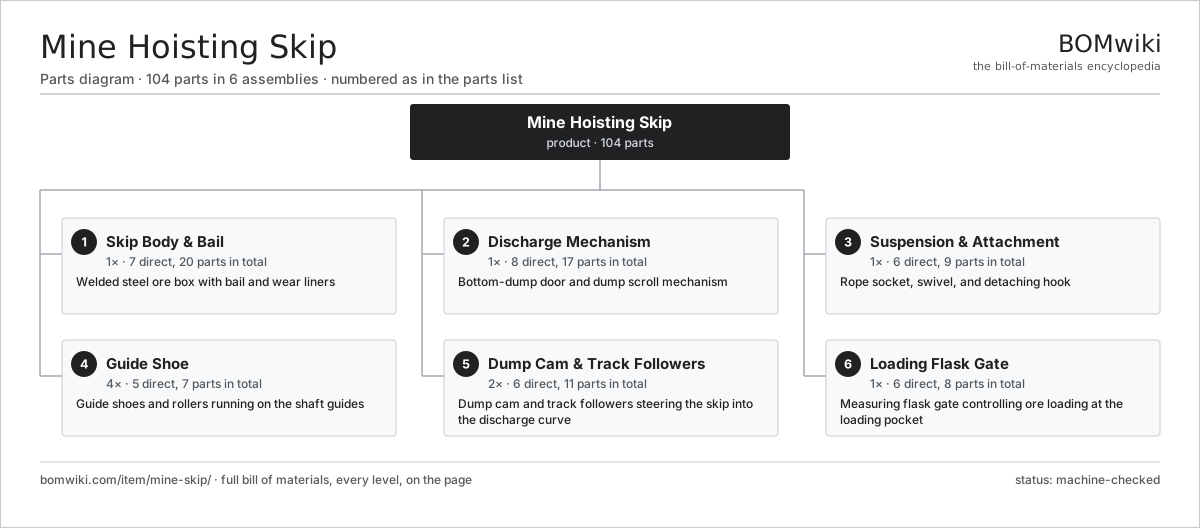
| # | Part | Qty | What it does |
|---|---|---|---|
| 1 | Skip Body & Bail 7 parts | 1× | Welded steel ore box with bail and wear liners |
| 2 | Discharge Mechanism 8 parts | 1× | Bottom-dump door and dump scroll mechanism |
| 3 | Suspension & Attachment 6 parts | 1× | Rope socket, swivel, and detaching hook |
| 4 | Guide Shoe 5 parts | 4× | Guide shoes and rollers running on the shaft guides |
| 5 | Dump Cam & Track Followers 6 parts | 2× | Dump cam and track followers steering the skip into the discharge curve |
| 6 | Loading Flask Gate 6 parts | 1× | Measuring flask gate controlling ore loading at the loading pocket |
3D model
No 3D model yet. Have a CAD file of this? Add a 3D model — STL renders right on this page; STEP, FreeCAD, and OpenSCAD sources are welcome too (openly licensed, like all 3D models on BOMwiki).
Build & assembly graph
expand / collapse · shared sub-assemblies converge · links to related products · est. labourTap an assembly to expand/collapse · tap a part to open it · use “Open page” for any node · drag to pan, scroll to zoom.
Bill of materials for Mine Hoisting Skip
6 top-level lines · 44 rows shown · 104 parts total · indented to 3 levels| # | Item / sub-assembly | Part no. | Qty/assy | Ext. qty | Parts | Type |
|---|---|---|---|---|---|---|
| 1 | Skip Body & Bail 7 parts | mine-skip-body | 1× | 1 | 20 | assembly |
| 1.1 | Ore Box Shell | mine-skip-box-shell | 1× | 1 | · | part |
| 1.2 | Bail Yoke | mine-skip-bail | 1× | 1 | · | part |
| 1.3 | Wear Liner | mine-skip-wear-liner | 6× | 6 | · | part |
| 1.4 | Trunnion Pin | mine-skip-pivot-pin | 2× | 2 | · | part |
| 1.5 | Discharge Lip | mine-skip-front-lip | 1× | 1 | · | part |
| 1.6 | Sheet Metal Panel | sheet-panel | 8× | 8 | · | part |
| 1.7 | Fastener Set | fastener-set | 1× | 1 | · | part |
| 2 | Discharge Mechanism 8 parts | mine-skip-discharge | 1× | 1 | 17 | assembly |
| 2.1 | Bottom Dump Door | mine-skip-dump-door | 1× | 1 | · | part |
| 2.2 | Dump Scroll Track | mine-skip-dump-scroll | 2× | 2 | · | part |
| 2.3 | Door Roller | mine-skip-door-roller | 4× | 4 | · | part |
| 2.4 | Door Latch | mine-skip-door-latch | 1× | 1 | · | part |
| 2.5 | Door Hinge | mine-skip-door-hinge | 2× | 2 | · | part |
| 2.6 | Latch Spring | mine-skip-latch-spring | 1× | 1 | · | part |
| 2.7 | Coil Spring | coil-spring | 2× | 2 | · | part |
| 2.8 | Ball Bearing | ball-bearing | 4× | 4 | · | part |
| 3 | Suspension & Attachment 6 parts | mine-skip-suspension | 1× | 1 | 9 | assembly |
| 3.1 | Rope Socket | mine-skip-rope-socket | 1× | 1 | · | part |
| 3.2 | Rope Swivel | mine-skip-swivel | 1× | 1 | · | part |
| 3.3 | Detaching Hook | mine-skip-detaching-hook | 1× | 1 | · | part |
| 3.4 | Suspension Shackle | mine-skip-shackle | 2× | 2 | · | part |
| 3.5 | Oil Seal | oil-seal | 2× | 2 | · | part |
| 3.6 | Ball Bearing | ball-bearing | 2× | 2 | · | part |
| 4 | Guide Shoe 5 parts | mine-skip-guide-shoes | 4× | 4 | 7 | assembly |
| 4.1 | Shoe Wear Liner | mine-skip-shoe-liner | 1× | 4 | · | part |
| 4.2 | Guide Roller | mine-skip-guide-roller | 2× | 8 | · | part |
| 4.3 | Shoe Spring Pack | mine-skip-shoe-spring | 1× | 4 | · | part |
| 4.4 | Ball Bearing | ball-bearing | 2× | 8 | · | part |
| 4.5 | Coil Spring | coil-spring | 1× | 4 | · | part |
| 5 | Dump Cam & Track Followers 6 parts | mine-skip-dump-followers | 2× | 2 | 11 | assembly |
| 5.1 | Dump Cam | mine-skip-dump-cam | 1× | 2 | · | part |
| 5.2 | Cam Follower | mine-skip-cam-follower | 2× | 4 | · | part |
| 5.3 | Back Roller | mine-skip-back-roller | 2× | 4 | · | part |
| 5.4 | Tip Position Sensor | mine-skip-tip-sensor | 1× | 2 | · | part |
| 5.5 | Pressure Sensor | pressure-sensor | 1× | 2 | · | part |
| 5.6 | Ball Bearing | ball-bearing | 4× | 8 | · | part |
| 6 | Loading Flask Gate 6 parts | mine-skip-loading-gate | 1× | 1 | 8 | assembly |
| 6.1 | Flask Gate | mine-skip-flask-gate | 1× | 1 | · | part |
| 6.2 | Gate Cylinder | mine-skip-gate-cylinder | 1× | 1 | · | part |
| 6.3 | Gate Chute Liner | mine-skip-gate-liner | 2× | 2 | · | part |
| 6.4 | Gate Position Switch | mine-skip-position-switch | 2× | 2 | · | part |
| 6.5 | O-Ring Set | oring-set | 1× | 1 | · | part |
| 6.6 | Fastener Set | fastener-set | 1× | 1 | · | part |
Related products
same domain, ranked by shared parts Quarry Drill Rig
94 parts · shares 3 with this page
Raise Climber Platform
447 parts · shares 3 with this page
Double Roll Crusher
214 parts · shares 2 with this page
Quarry Drill Rig
94 parts · shares 3 with this page
Raise Climber Platform
447 parts · shares 3 with this page
Double Roll Crusher
214 parts · shares 2 with this page
 Mine Ventilation Fan
148 parts · shares 2 with this page
Mine Ventilation Fan
148 parts · shares 2 with this page
Sourcing: possible vendors
Prices, MOQ, and lead times are algorithmic estimates, not quotes, and not claims about these companies. Company mappings are curated by keyword; est. price band $200k–$5M. How estimates work| Vendor | HQ | Specialty | MOQ | Lead time |
|---|---|---|---|---|
| caterpillar.com ↗ | Irving, US | Construction & mining equipment | made to order | 20–36 wks |
|
🇯🇵Komatsu
komatsu.com ↗
|
Tokyo, JP | Construction & mining equipment | made to order | 20–36 wks |
|
🇸🇪Sandvik
rocktechnology.sandvik ↗
|
Stockholm, SE | Mining & rock technology | made to order | 20–36 wks |
|
🇸🇪Epiroc
epiroc.com ↗
|
Stockholm, SE | Mining & drilling equipment | made to order | 20–36 wks |
|
🇫🇮Metso
metso.com ↗
|
Helsinki, FI | Crushing & minerals processing | made to order | 20–36 wks |
961-word article