Electrowinning Cell
ProductOverview
An electrowinning cell uses electric current to plate dissolved metal out of solution as solid sheets. It is the last step in a solvent extraction and electrowinning, or SX-EW, plant. Leaching dissolves copper from ore into a pregnant solution, solvent extraction concentrates and purifies that copper into a clean strong electrolyte, and electrowinning passes direct current through the electrolyte so copper deposits on cathodes while oxygen evolves at anodes. The result is cathode copper of 99.99 percent purity, ready to sell, won directly from ore without smelting. The same cell design wins zinc, nickel and cobalt with changed chemistry and operating points.
A cell is a long lined tank holding rows of alternating cathodes and anodes hanging in acidic electrolyte. Current enters each anode, drives the electrode reactions, and leaves through each cathode where metal grows. Cells are wired in series into a tankhouse with hundreds of cells, all fed from one transformer-rectifier. Over a six to seven day cycle copper builds to a thick sheet on each cathode, then the cathodes are pulled and the copper stripped off, and the cycle repeats.
The cell tank
The Cell Tank holds everything. Its Tank Body is polymer concrete, which takes hot sulfuric electrolyte without the corrosion plain concrete would suffer, protected further by an Acid Liner. Along each top edge an insulating Capping Board carries and spaces the electrode hanger bars and isolates them from the tank, while an Overflow Weir weir sets the electrolyte level and spills spent solution back to recycle. The geometry fixes the gap between every electrode, because uneven gaps make uneven deposits and short circuits.
Cathodes and anodes
Metal grows on the Cathode Set. Modern cells use a permanent Cathode Blank of 316L stainless that copper plates onto and is later mechanically peeled from as a sheet, replacing the old practice of starter sheets. Each blank hangs from a copper-cored Hanger Bar that also carries its current, with an Edge Strip down each side and an Bottom Strip that stop the deposit wrapping the edges so it peels cleanly. Facing them are the Anode Set, rolled Anode Plate sheets of lead-calcium-tin alloy where oxygen evolves; the alloy resists corroding into the copper, helped by a Cobalt Feeder that doses cobalt to slow lead attack. Each anode hangs on a Anode Hanger and is held parallel by Anode Guide spacers.
Power and busbars
The cell runs on low-voltage high-current DC from the DC Rectifier. A Step-down Transformer drops line voltage to a few volts per cell, a Thyristor Stack rectifies and regulates the current, and the output runs through a DC Busbar measured by a Current Shunt, with Rectifier Cooling carrying off the rectifier losses. Inside the tankhouse the Busbar System system distributes that current: an Intercell Busbar links the cathodes of one cell to the anodes of the next, hanger bars seat on a triangular Contact Rail rail for low resistance, an Busbar Insulator keeps the busbar off the structure, and an Current Equalizer evens current sharing across electrodes. At 10-30 kA per cell, even a poor contact wastes power and heats up.
Electrolyte and acid mist
A Electrolyte Circulation system keeps the cell fed and warm. A Feed Pump driven by a Servo Motor on Ball Bearing supports pushes rich electrolyte through a Distribution Header along the cell bottom, metered by a Flow Meter, with a Heating Element holding the bath at 40-50 C where deposition runs well. Oxygen evolving at the anodes lifts a fine sulfuric mist off the surface, so the Acid Mist Control system caps the cell with a floating Bead Blanket that breaks rising bubbles, doses a surfactant from a Suppressant Doser, and draws any escaping mist into an Extraction Hood through a Mist Fan to a scrubber. Acid mist control protects both workers and the tankhouse steel.
Control and operation
The Control Panel panel runs the deposition. Its PLC Controller sets rectifier current to hold the target current density, and a Cell Voltage Scanner reads each cell voltage so a short circuit, where a nodular deposit bridges to an anode, shows up at once as a low cell voltage and is cleared before it ruins the sheet. An LCD Panel shows the tankhouse, Relay interlocks guard the rectifier, and a Power Supply feeds the loop. Current density sets the trade between speed and quality: push it too hard and the deposit grows rough and nodular and traps electrolyte, lowering purity. A typical copper cell runs six to seven days, after which a crane lifts the cathodes, a stripping machine peels two copper sheets off each blank, and the blanks go straight back into the cell for the next harvest.
Electrowinning Cell parts and their functions
8 top-level parts · 347 parts in total · full bill of materials below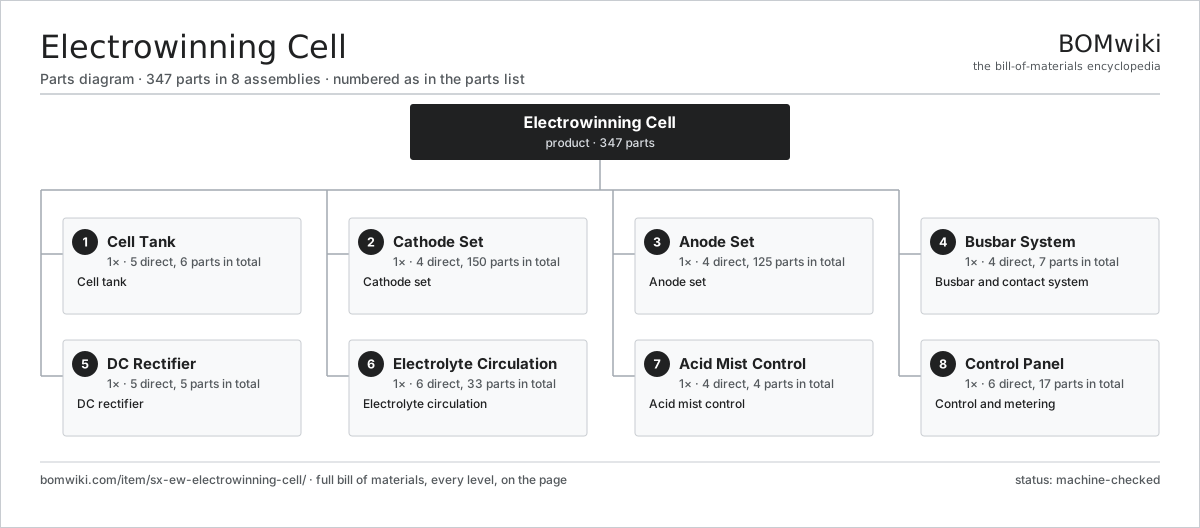
| # | Part | Qty | What it does |
|---|---|---|---|
| 1 | Cell Tank 5 parts | 1× | Cell tank |
| 2 | Cathode Set 4 parts | 1× | Cathode set |
| 3 | Anode Set 4 parts | 1× | Anode set |
| 4 | Busbar System 4 parts | 1× | Busbar and contact system |
| 5 | DC Rectifier 5 parts | 1× | DC rectifier |
| 6 | Electrolyte Circulation 6 parts | 1× | Electrolyte circulation |
| 7 | Acid Mist Control 4 parts | 1× | Acid mist control |
| 8 | Control Panel 6 parts | 1× | Control and metering |
3D model
No 3D model yet. Have a CAD file of this? Add a 3D model — STL renders right on this page; STEP, FreeCAD, and OpenSCAD sources are welcome too (openly licensed, like all 3D models on BOMwiki).
Build & assembly graph
expand / collapse · shared sub-assemblies converge · links to related products · est. labourTap an assembly to expand/collapse · tap a part to open it · use “Open page” for any node · drag to pan, scroll to zoom.
Bill of materials for Electrowinning Cell
8 top-level lines · 54 rows shown · 347 parts total · indented to 3 levels| # | Item / sub-assembly | Part no. | Qty/assy | Ext. qty | Parts | Type |
|---|---|---|---|---|---|---|
| 1 | Cell Tank 5 parts | sx-ew-electrowinning-cell-tank | 1× | 1 | 6 | assembly |
| 1.1 | Tank Body | sx-ew-electrowinning-cell-tank-body | 1× | 1 | · | part |
| 1.2 | Acid Liner | sx-ew-electrowinning-cell-liner | 1× | 1 | · | part |
| 1.3 | Capping Board | sx-ew-electrowinning-cell-capping-board | 2× | 2 | · | part |
| 1.4 | Overflow Weir | sx-ew-electrowinning-cell-overflow | 1× | 1 | · | part |
| 1.5 | O-Ring Set | oring-set | 1× | 1 | · | part |
| 2 | Cathode Set 4 parts | sx-ew-electrowinning-cell-cathodes | 1× | 1 | 150 | assembly |
| 2.1 | Cathode Blank | sx-ew-electrowinning-cell-cathode-blank | 30× | 30 | · | part |
| 2.2 | Hanger Bar | sx-ew-electrowinning-cell-hanger-bar | 30× | 30 | · | part |
| 2.3 | Edge Strip | sx-ew-electrowinning-cell-edge-strip | 60× | 60 | · | part |
| 2.4 | Bottom Strip | sx-ew-electrowinning-cell-bottom-strip | 30× | 30 | · | part |
| 3 | Anode Set 4 parts | sx-ew-electrowinning-cell-anodes | 1× | 1 | 125 | assembly |
| 3.1 | Anode Plate | sx-ew-electrowinning-cell-anode-plate | 31× | 31 | · | part |
| 3.2 | Anode Hanger | sx-ew-electrowinning-cell-anode-hanger | 31× | 31 | · | part |
| 3.3 | Anode Guide | sx-ew-electrowinning-cell-anode-guide | 62× | 62 | · | part |
| 3.4 | Cobalt Feeder | sx-ew-electrowinning-cell-cobalt-feeder | 1× | 1 | · | part |
| 4 | Busbar System 4 parts | sx-ew-electrowinning-cell-busbar | 1× | 1 | 7 | assembly |
| 4.1 | Intercell Busbar | sx-ew-electrowinning-cell-intercell-bar | 1× | 1 | · | part |
| 4.2 | Contact Rail | sx-ew-electrowinning-cell-contact | 1× | 1 | · | part |
| 4.3 | Busbar Insulator | sx-ew-electrowinning-cell-insulator | 4× | 4 | · | part |
| 4.4 | Current Equalizer | sx-ew-electrowinning-cell-equalizer | 1× | 1 | · | part |
| 5 | DC Rectifier 5 parts | sx-ew-electrowinning-cell-rectifier | 1× | 1 | 5 | assembly |
| 5.1 | Step-down Transformer | sx-ew-electrowinning-cell-transformer | 1× | 1 | · | part |
| 5.2 | Thyristor Stack | sx-ew-electrowinning-cell-thyristor-stack | 1× | 1 | · | part |
| 5.3 | DC Busbar | sx-ew-electrowinning-cell-dc-busbar | 1× | 1 | · | part |
| 5.4 | Rectifier Cooling | sx-ew-electrowinning-cell-cooling | 1× | 1 | · | part |
| 5.5 | Current Shunt | sx-ew-electrowinning-cell-current-shunt | 1× | 1 | · | part |
| 6 | Electrolyte Circulation 6 parts | sx-ew-electrowinning-cell-circulation | 1× | 1 | 33 | assembly |
| 6.1 | Feed Pump | sx-ew-electrowinning-cell-feed-pump | 1× | 1 | · | part |
| 6.2 | Servo Motor 4 parts | servo-motor | 1× | 1 | 24 | assembly |
| 6.2.1 | Stator Assembly 3 parts + deeper › | stator-assembly | 1× | 1 | 3 | assembly |
| 6.2.2 | Rotor Assembly 4 parts + deeper › | rotor-assembly | 1× | 1 | 19 | assembly |
| 6.2.3 | Encoder | encoder | 1× | 1 | · | part |
| 6.2.4 | Motor Housing | motor-housing | 1× | 1 | · | part |
| 6.3 | Heating Element | heating-element | 4× | 4 | · | part |
| 6.4 | Distribution Header | sx-ew-electrowinning-cell-distribution-header | 1× | 1 | · | part |
| 6.5 | Flow Meter | sx-ew-electrowinning-cell-flow-meter | 1× | 1 | · | part |
| 6.6 | Ball Bearing | ball-bearing | 2× | 2 | · | part |
| 7 | Acid Mist Control 4 parts | sx-ew-electrowinning-cell-mist | 1× | 1 | 4 | assembly |
| 7.1 | Bead Blanket | sx-ew-electrowinning-cell-bead-blanket | 1× | 1 | · | part |
| 7.2 | Suppressant Doser | sx-ew-electrowinning-cell-suppressant-doser | 1× | 1 | · | part |
| 7.3 | Extraction Hood | sx-ew-electrowinning-cell-extraction-hood | 1× | 1 | · | part |
| 7.4 | Mist Fan | sx-ew-electrowinning-cell-mist-fan | 1× | 1 | · | part |
| 8 | Control Panel 6 parts | sx-ew-electrowinning-cell-control | 1× | 1 | 17 | assembly |
| 8.1 | PLC Controller 4 parts | sx-ew-electrowinning-cell-plc | 1× | 1 | 7 | assembly |
| 8.1.1 | Bare PCB | pcb-bare | 1× | 1 | · | part |
| 8.1.2 | Microcontroller | mcu | 1× | 1 | · | part |
| 8.1.3 | SMD Passive (R/C/L) | smd-passives | 1× | 1 | · | part |
| 8.1.4 | Connector | connector | 4× | 4 | · | part |
| 8.2 | LCD Panel | lcd-panel | 1× | 1 | · | part |
| 8.3 | Power Supply | power-supply | 1× | 1 | · | part |
| 8.4 | Cell Voltage Scanner | sx-ew-electrowinning-cell-cell-voltage-scanner | 1× | 1 | · | part |
| 8.5 | Relay | relay | 6× | 6 | · | part |
| 8.6 | Wire Bundle | wire-bundle | 1× | 1 | · | part |
Related products
same domain, ranked by shared parts Gold Elution Column
128 parts · shares 15 with this page
Gold Elution Column
128 parts · shares 15 with this page
 Carbon Regeneration Kiln
141 parts · shares 14 with this page
Flotation Reagent Dosing Skid
198 parts · shares 13 with this page
Carbon Regeneration Kiln
141 parts · shares 14 with this page
Flotation Reagent Dosing Skid
198 parts · shares 13 with this page
 Heap Leach Irrigation System
121 parts · shares 13 with this page
Heap Leach Irrigation System
121 parts · shares 13 with this page
 Laboratory Ring Pulverizer
73 parts · shares 13 with this page
Laboratory Ring Pulverizer
73 parts · shares 13 with this page
 Reverse Circulation Drill Rig
154 parts · shares 11 with this page
Reverse Circulation Drill Rig
154 parts · shares 11 with this page
Sourcing: possible vendors
Prices, MOQ, and lead times are algorithmic estimates, not quotes, and not claims about these companies. Company mappings are curated by keyword; est. price band $200k–$5M. How estimates work| Vendor | HQ | Specialty | MOQ | Lead time |
|---|---|---|---|---|
| caterpillar.com ↗ | Irving, US | Construction & mining equipment | made to order | 20–36 wks |
|
🇯🇵Komatsu
komatsu.com ↗
|
Tokyo, JP | Construction & mining equipment | made to order | 20–36 wks |
|
🇸🇪Sandvik
rocktechnology.sandvik ↗
|
Stockholm, SE | Mining & rock technology | made to order | 20–36 wks |
|
🇸🇪Epiroc
epiroc.com ↗
|
Stockholm, SE | Mining & drilling equipment | made to order | 20–36 wks |
|
🇫🇮Metso
metso.com ↗
|
Helsinki, FI | Crushing & minerals processing | made to order | 20–36 wks |
925-word article