Water Distiller
ProductOverview
A water distiller purifies water by mimicking the natural water cycle: boiling raw water into steam, condensing the vapor through a cooled coil, and collecting the resulting liquid, free of dissolved minerals, salts, bacteria, viruses, and most chemical contaminants. Unlike filters (which require replacement cartridges), distillation is a phase-change process that leaves behind all non-volatile impurities.
Home distillers serve multiple uses: softening hard water, purifying well water or uncertain sources, preparing water for aquariums or medical equipment, and producing water for cosmetics or laboratory use. A benchtop model typically yields 1–4 L per 3–5 hour cycle, suitable for household and small commercial scales.
How It Works
Boiling and Vaporization
Raw water (tap, well, or collected rainwater) is fed into the Boiling Chamber & Heater via the Inlet Solenoid Valve, a solenoid valve controlled by the Control & Safety Module MCU. The Heating Element, a 2–3 kW immersion heater, brings the chamber to 100°C (212°F) in ≈30–45 minutes.
At 100°C, water molecules escape as vapor (steam). Dissolved minerals, salts, and particulates remain behind in the boiling chamber as a concentrated residue, they have melting points above 100°C and cannot vaporize. Microorganisms (bacteria, viruses) are also eliminated by heat.
The boiling continues at a steady rate (not a rolling boil, which would carry droplets of liquid with the vapor). The Pressure Sensor monitors chamber fill; once water drops to a setpoint, the MCU halts heating to prevent overheating of the empty chamber.
Condenser Coil and Cooling
The steam exits the boiling chamber and enters the Condenser Coil Assembly, a ≈10-meter coil of 10 mm tubing. This coil is cooled to ≤10°C by circulating cool water pumped through its exterior.
The Circulation Pump, a small brushless DC pump, draws cool water from the Expansion Reservoir and pushes it through the Heat Radiator, an aluminum bar-plate heat exchanger with fins. The Radiator Fan, a low-speed AC fan, blows ambient air across the radiator fins, rejecting heat to the environment. The cooled water (now ≤10°C) returns to the condenser coil inlet.
As steam passes through the cold condenser coil, it condenses back into liquid water droplets. This condensed water (distillate) is now pure, lacking the minerals and contaminants left behind in the boiling chamber.
Collection and Auto-Shutoff
The condensed distilled water drips from the condenser coil outlet into the Distilled Water Collection Vessel, a 4–6 L borosilicate glass pitcher. A Full-Level Sensor inside the pitcher detects when the water level reaches ≈80% capacity. At this point, the MCU closes the Dispenser Solenoid (dispenser valve), halting water flow. The heater shuts off shortly after, and the Control & Safety Module sounds an alert on the Alert Buzzer, notifying the operator that the cycle is complete.
The operator removes the full pitcher and replaces it with an empty one (or runs the cycle again). The Bottom Drain Valve, a manual ball valve at the boiling chamber bottom, is periodically opened to drain the mineral residue accumulated during boiling. This sediment layer (calcium, magnesium, silica salts) can build up to several millimeters after 5–10 cycles, reducing heating efficiency. Regular flushing maintains performance.
Water Quality and Mineral Removal
Distillation removes ≥99.5% of dissolved solids. Common impurities and their behavior:
- Hardness minerals (calcium, magnesium): Non-volatile, remain in boiling chamber.
- Salts (sodium chloride, nitrates): Non-volatile, remain in chamber.
- Bacteria and viruses: Killed by heat, don't vaporize.
- Chlorine gas: Partially evaporates with steam but mostly condenses with water; residual chlorine is typically <0.1 mg/L (drinking water standard is 0.2–1 mg/L, so distilled water can be chlorine-free or very low).
- Volatile organic compounds (some pesticides, some solvents): Can evaporate with steam, but most condense at 10°C. Heavy VOCs remain in the chamber.
The result is exceptionally pure water, softer than any filter and suitable for sensitive applications like humidifiers, medical equipment, or aquariums.
Cooling System Design
The cooling loop is critical. A poorly cooled condenser results in:
- Incomplete condensation: Some steam exits as vapor, carrying away heat energy and reducing distillate output.
- Liquid water entrained with vapor: Droplets of impure boiling-chamber water carried along with steam, contaminating the distillate.
- Thermal runaway: Heat accumulates; the condenser coil temperature rises, further reducing condensation efficiency.
The Heat Radiator is sized to reject ≥5 kW continuously. The Circulation Pump circulates ≥3 L/min, ensuring water residence time in the condenser is sufficient for complete vapor condensation. The Radiator Fan is thermostat-controlled; if radiator water temperature exceeds ≈25°C, the fan increases speed to boost cooling.
Cycle Timing and Efficiency
A typical cycle:
- 0–45 min: Heating raw water from 20°C to 100°C (≈130 kWh thermal energy for 5 L)
- 45–180 min: Boiling, condensing, and collecting ≈3 L distilled water
- 180 min: Operator drains residue, reloads chamber
Total elapsed time: ≈3–5 hours per batch.
Efficiency: A 2.5 kW heater running for 120 minutes (middle of boil phase) uses ≈5 kWh electrical energy to produce ≈3 L distilled water. The radiator fan adds ≈0.3 kWh. Total ≈5.3 kWh per 3 L = 1.8 kWh/L, typical for benchtop distillers. Commercial units with better heat recovery are more efficient; home units can improve efficiency with:
- Taller/longer condenser coils for greater surface area.
- Fan-assisted radiators (already included here).
- Heat exchanger warm-water pre-heater: use warm outflow from the radiator to pre-heat incoming raw water before it reaches the boiling chamber.
Mineral Residue and Maintenance
Each cycle leaves behind mineral scale in the Boiling Chamber & Heater. Hard tap water (≥200 mg/L dissolved solids) accumulates ≈20–40 g residue per 5 L cycle. This scale eventually reduces heat transfer and heating efficiency.
Descaling: Every 5–10 cycles, the operator opens the Bottom Drain Valve, drains the chamber, and either:
- Manual scrubbing: Empty and refill the chamber with white vinegar (5% acetic acid), allow to soak 1–2 hours, scrub, rinse.
- Automated descale cycle: Some advanced models include a descaling program that circulates citric acid or commercial descaler through the chamber.
Regular maintenance extends the heater and chamber lifespan to 5–10 years before replacement.
Design Variants
Slow-drip models: Low-power (≤1 kW) distillers boil slowly over 8–12 hours, producing gentler condensation and more thorough contaminant removal. Popular for laboratories.
Double-condenser models: Two coils in series for redundancy and maximum purity; if the first condenser outlet is >5°C, it's recycled through the second coil.
Pre-heater variants: Outflow warm water from the radiator is routed through a heat exchanger submerged in the boiling chamber, pre-warming incoming raw water and reducing total heating energy by ≈20–30%.
Water Distiller parts and their functions
8 top-level parts · 38 parts in total · full bill of materials below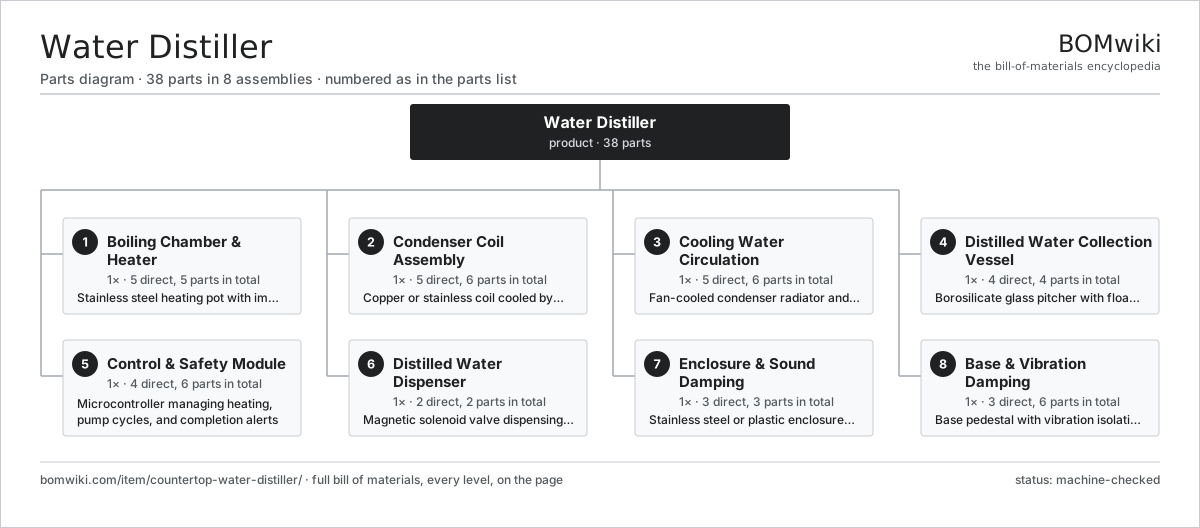
| # | Part | Qty | What it does |
|---|---|---|---|
| 1 | Boiling Chamber & Heater 5 parts | 1× | Stainless steel heating pot with immersion element and water inlet valve |
| 2 | Condenser Coil Assembly 5 parts | 1× | Copper or stainless coil cooled by circulating cold water, condensing steam |
| 3 | Cooling Water Circulation 5 parts | 1× | Fan-cooled condenser radiator and circulation pump recirculating cool water |
| 4 | Distilled Water Collection Vessel 4 parts | 1× | Borosilicate glass pitcher with float sensor triggering auto-shutoff |
| 5 | Control & Safety Module 4 parts | 1× | Microcontroller managing heating, pump cycles, and completion alerts |
| 6 | Distilled Water Dispenser 2 parts | 1× | Magnetic solenoid valve dispensing collected distilled water into pitcher |
| 7 | Enclosure & Sound Damping 3 parts | 1× | Stainless steel or plastic enclosure containing heating and cooling systems |
| 8 | Base & Vibration Damping 3 parts | 1× | Base pedestal with vibration isolation feet |
3D model
No 3D model yet. Have a CAD file of this? Add a 3D model — STL renders right on this page; STEP, FreeCAD, and OpenSCAD sources are welcome too (openly licensed, like all 3D models on BOMwiki).
Build & assembly graph
expand / collapse · shared sub-assemblies converge · links to related products · est. labourTap an assembly to expand/collapse · tap a part to open it · use “Open page” for any node · drag to pan, scroll to zoom.
Bill of materials for Water Distiller
8 top-level lines · 39 rows shown · 38 parts total · indented to 3 levels| # | Item / sub-assembly | Part no. | Qty/assy | Ext. qty | Parts | Type |
|---|---|---|---|---|---|---|
| 1 | Boiling Chamber & Heater 5 parts | countertop-water-distiller-boiling-chamber | 1× | 1 | 5 | assembly |
| 1.1 | Boiling Pot | countertop-water-distiller-pot-body | 1× | 1 | · | part |
| 1.2 | Heating Element | heating-element | 1× | 1 | · | part |
| 1.3 | Inlet Solenoid Valve | countertop-water-distiller-water-inlet-valve | 1× | 1 | · | part |
| 1.4 | Pressure Sensor | pressure-sensor | 1× | 1 | · | part |
| 1.5 | Bottom Drain Valve | countertop-water-distiller-drain-valve | 1× | 1 | · | part |
| 2 | Condenser Coil Assembly 5 parts | countertop-water-distiller-condenser-coil | 1× | 1 | 6 | assembly |
| 2.1 | Condenser Tubing | countertop-water-distiller-condenser-tube | 1× | 1 | · | part |
| 2.2 | Condenser Frame | countertop-water-distiller-condenser-support | 1× | 1 | · | part |
| 2.3 | Cooling Water Inlet | countertop-water-distiller-inlet-manifold | 1× | 1 | · | part |
| 2.4 | Condenser Outlet | countertop-water-distiller-outlet-manifold | 1× | 1 | · | part |
| 2.5 | Connector | connector | 2× | 2 | · | part |
| 3 | Cooling Water Circulation 5 parts | countertop-water-distiller-cooling-water-loop | 1× | 1 | 6 | assembly |
| 3.1 | Circulation Pump | countertop-water-distiller-circulation-pump | 1× | 1 | · | part |
| 3.2 | Heat Radiator | countertop-water-distiller-radiator | 1× | 1 | · | part |
| 3.3 | Radiator Fan | countertop-water-distiller-radiator-fan | 1× | 1 | · | part |
| 3.4 | Cooling Tubing | countertop-water-distiller-water-tubing | 2× | 2 | · | part |
| 3.5 | Expansion Reservoir | countertop-water-distiller-expansion-tank | 1× | 1 | · | part |
| 4 | Distilled Water Collection Vessel 4 parts | countertop-water-distiller-collection-pitcher | 1× | 1 | 4 | assembly |
| 4.1 | Glass Pitcher | countertop-water-distiller-pitcher-body | 1× | 1 | · | part |
| 4.2 | Full-Level Sensor | countertop-water-distiller-float-switch | 1× | 1 | · | part |
| 4.3 | Pitcher Spigot | countertop-water-distiller-outlet-spigot | 1× | 1 | · | part |
| 4.4 | Connector | connector | 1× | 1 | · | part |
| 5 | Control & Safety Module 4 parts | countertop-water-distiller-controller | 1× | 1 | 6 | assembly |
| 5.1 | Microcontroller | mcu | 1× | 1 | · | part |
| 5.2 | Relay | relay | 3× | 3 | · | part |
| 5.3 | Bare PCB | pcb-bare | 1× | 1 | · | part |
| 5.4 | SMD Passive (R/C/L) | smd-passives | 1× | 1 | · | part |
| 6 | Distilled Water Dispenser 2 parts | countertop-water-distiller-dispenser-valve | 1× | 1 | 2 | assembly |
| 6.1 | Dispenser Solenoid | countertop-water-distiller-solenoid-body | 1× | 1 | · | part |
| 6.2 | Drip Tray | countertop-water-distiller-drip-tray | 1× | 1 | · | part |
| 7 | Enclosure & Sound Damping 3 parts | countertop-water-distiller-housing | 1× | 1 | 3 | assembly |
| 7.1 | Housing Shell | countertop-water-distiller-housing-shell | 1× | 1 | · | part |
| 7.2 | Acoustic Liner | countertop-water-distiller-sound-liner | 1× | 1 | · | part |
| 7.3 | Ventilation Grilles | countertop-water-distiller-ventilation-openings | 1× | 1 | · | part |
| 8 | Base & Vibration Damping 3 parts | countertop-water-distiller-frame | 1× | 1 | 6 | assembly |
| 8.1 | Frame Legs | countertop-water-distiller-frame-legs | 1× | 1 | · | part |
| 8.2 | Isolation Feet | countertop-water-distiller-isolation-feet | 4× | 4 | · | part |
| 8.3 | Fastener Set | fastener-set | 1× | 1 | · | part |
Related products
same domain, ranked by shared parts Electric Multicooker
151 parts · shares 2 with this page
Herbal Infusion Machine
34 parts · shares 2 with this page
Electric Multicooker
151 parts · shares 2 with this page
Herbal Infusion Machine
34 parts · shares 2 with this page
 Sous Vide Immersion Circulator
294 parts · shares 2 with this page
Super-Automatic Espresso Machine
293 parts · shares 2 with this page
Tofu Maker
40 parts · shares 2 with this page
Sous Vide Immersion Circulator
294 parts · shares 2 with this page
Super-Automatic Espresso Machine
293 parts · shares 2 with this page
Tofu Maker
40 parts · shares 2 with this page
Sourcing: possible vendors
Prices, MOQ, and lead times are algorithmic estimates, not quotes, and not claims about these companies. Company mappings are curated by keyword; est. price band $20–$600. How estimates work| Vendor | HQ | Specialty | MOQ | Lead time |
|---|---|---|---|---|
|
🇦🇺Breville
breville.com ↗
|
Sydney, AU | Kitchen appliances | 2,000 units | 6–10 wks |
| groupeseb.com ↗ | Écully, FR | Cookware & small appliances | 2,000 units | 6–10 wks |
| hamiltonbeach.com ↗ | Glen Allen, US | Small appliances | 2,000 units | 6–10 wks |
| panasonic.com ↗ | Osaka, JP | Electronics & appliances | 2,000 units | 6–10 wks |
|
🇨🇳Midea
midea.com ↗
|
Foshan, CN | Home appliances | 2,000 units | 6–10 wks |
1,167-word article