French Press
ProductOverview
A French press, also called a cafetiere or press pot, brews coffee by full immersion: ground coffee and hot water sit together in a carafe for a few minutes, then a fine mesh plunger is pushed down to trap the grounds at the bottom while the liquid stays above. Because the brew uses a metal screen rather than paper, it lets the coffee's oils and a little fine sediment through, giving a heavier, rounder body than a paper-filtered drip. It needs no power, no paper filter, and no special skill, which makes it one of the most common manual brewers. Its appeal is that it forgives the user: there is no pour technique to master and no filter to fold, so the same coarse grind and roughly four-minute steep produce a repeatable cup with little practice. The trade is a heavier body and a fine sediment in the cup that some drinkers prize and others choose to avoid.
The device is simple. A Glass Carafe holds the brew, a Holder Frame cradles and protects the glass, a Plunger Assembly does the filtering, a Lid caps and guides the plunger, and a Handle and Pour Spout make it pourable.
How it brews
Brewing is immersion rather than percolation. Coarse coffee goes into the Borosilicate Beaker, hot water is poured over it, and the whole bed steeps for around four minutes. During that time every particle is in contact with water the entire time, which is why the grind is coarse: fine grounds would over-extract and slip through the mesh. When the steep is done the Plunger Assembly is pushed slowly down. Its Mesh Screen presses the grounds into the bottom of the carafe and holds them there, leaving brewed coffee above the screen ready to pour. The plunge is slow on purpose, because forcing it stirs up sediment and can pop the seal at the glass wall.
The carafe and frame
The Glass Carafe is the brewing vessel. Its Borosilicate Beaker is borosilicate, chosen because it shrugs off the thermal shock of boiling water hitting cool glass. Borosilicate is also fragile to impact, so the Holder Frame exists to protect it. The Frame Body is a chromed steel or plastic cage that surrounds the beaker, sits it on a Base Ring, and carries the Handle and Frame Foot set. The frame means a hot, full carafe can be handled by the cool metal rather than the hot glass, and a dropped press is far more likely to survive.
The plunger and filter
The Plunger Assembly is where the design earns its name. A Plunger Rod tipped with a Plunger Knob runs down the centre, and at its base a filter stack clamps a Mesh Screen between a Cross Plate above and a Base Plate below. A Edge Spring wraps the edge of the screen and presses it outward against the inside wall of the glass, so grounds cannot escape around the rim as the plunger descends. The mesh is the entire filtration system; there is no paper, which is why the coffee keeps its oils and a fine layer of sediment settles at the bottom of the cup.
Lid, handle, and pouring
The Lid caps the carafe before the plunge and keeps heat in during the steep. Its Plunger Guide centres the Plunger Rod so the screen stays level as it travels, and a Lid Seal closes the gap at the rim. Many lids can be rotated to align an opening with the Pour Spout for pouring and away from it to hold heat. The Handle is insulated so the press can be carried and poured by hand, and the Pour Spout is shaped to pour cleanly without dribbling down the side.
Variants and use
Most French presses are the glass-and-frame type described here, but insulated double-wall stainless versions trade the view of the brew for better heat retention and durability, which suits travel and offices. Sizes are quoted in cups, from a small three-cup up to a twelve-cup carafe near a litre. In use the brewer adds coarse grounds, pours hot water just off the boil, stirs once, fits the Lid, and waits about four minutes before pressing the Plunger Assembly down. Coffee is best poured out promptly, because leaving it sitting on the grounds continues extraction and turns the brew bitter; for the same reason, brewers who want to hold a batch warm often decant it into a separate carafe rather than leaving it in the press. Cleaning means lifting out the plunger, unscrewing the Base Plate to free the Mesh Screen, and rinsing the grounds and oils from each part so the next brew tastes clean.
French Press parts and their functions
6 top-level parts · 20 parts in total · full bill of materials below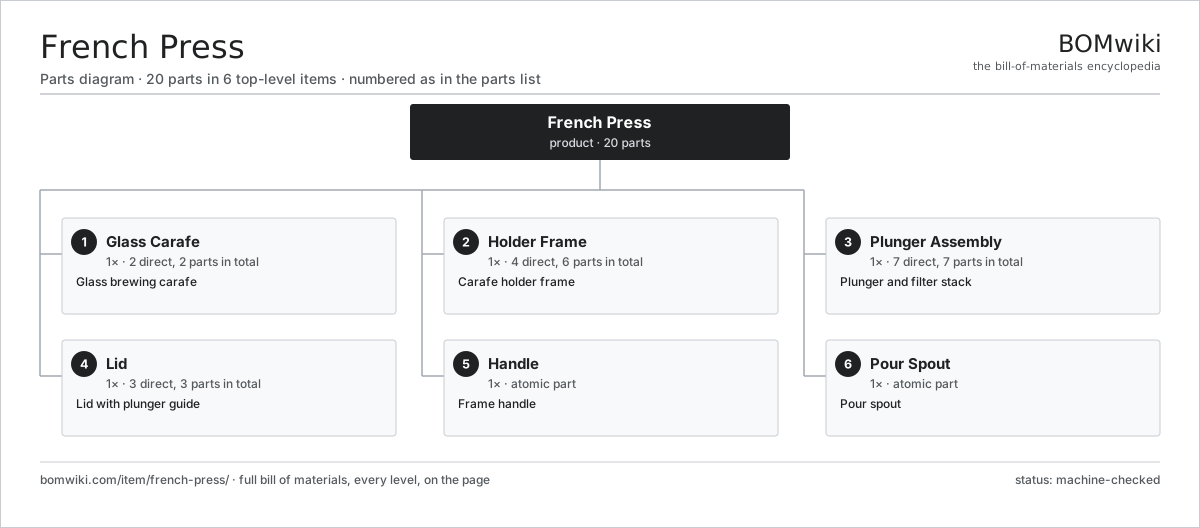
| # | Part | Qty | What it does |
|---|---|---|---|
| 1 | Glass Carafe 2 parts | 1× | Glass brewing carafe |
| 2 | Holder Frame 4 parts | 1× | Carafe holder frame |
| 3 | Plunger Assembly 7 parts | 1× | Plunger and filter stack |
| 4 | Lid 3 parts | 1× | Lid with plunger guide |
| 5 | Handle | 1× | Frame handle |
| 6 | Pour Spout | 1× | Pour spout |
3D model
No 3D model yet. Have a CAD file of this? Add a 3D model. STL renders right on this page; STEP, FreeCAD, and OpenSCAD sources are welcome too (openly licensed, like all 3D models on BOMwiki).
Build & assembly graph
expand / collapse · shared sub-assemblies converge · links to related products · est. labourTap an assembly to expand/collapse · tap a part to open it · use “Open page” for any node · drag to pan, scroll to zoom.
Bill of materials for French Press
6 top-level lines · 22 rows shown · 20 parts total · indented to 3 levels| # | Item / sub-assembly | Part no. | Qty/assy | Ext. qty | Parts | Type |
|---|---|---|---|---|---|---|
| 1 | Glass Carafe 2 parts | french-press-carafe | 1× | 1 | 2 | assembly |
| 1.1 | Borosilicate Beaker | french-press-carafe-glass | 1× | 1 | · | part |
| 1.2 | Glass Foot | french-press-carafe-foot | 1× | 1 | · | part |
| 2 | Holder Frame 4 parts | french-press-frame | 1× | 1 | 6 | assembly |
| 2.1 | Frame Body | french-press-frame-body | 1× | 1 | · | part |
| 2.2 | Base Ring | french-press-frame-base-ring | 1× | 1 | · | part |
| 2.3 | Frame Foot | french-press-foot | 3× | 3 | · | part |
| 2.4 | Fastener Set | fastener-set | 1× | 1 | · | part |
| 3 | Plunger Assembly 7 parts | french-press-plunger | 1× | 1 | 7 | assembly |
| 3.1 | Plunger Rod | french-press-rod | 1× | 1 | · | part |
| 3.2 | Plunger Knob | french-press-knob | 1× | 1 | · | part |
| 3.3 | Mesh Screen | french-press-mesh-screen | 1× | 1 | · | part |
| 3.4 | Cross Plate | french-press-cross-plate | 1× | 1 | · | part |
| 3.5 | Base Plate | french-press-base-plate | 1× | 1 | · | part |
| 3.6 | Edge Spring | french-press-spiral-spring | 1× | 1 | · | part |
| 3.7 | Fastener Set | fastener-set | 1× | 1 | · | part |
| 4 | Lid 3 parts | french-press-lid | 1× | 1 | 3 | assembly |
| 4.1 | Lid Body | french-press-lid-body | 1× | 1 | · | part |
| 4.2 | Plunger Guide | french-press-lid-guide | 1× | 1 | · | part |
| 4.3 | Lid Seal | french-press-lid-seal | 1× | 1 | · | part |
| 5 | Handle | french-press-handle | 1× | 1 | · | part |
| 6 | Pour Spout | french-press-spout | 1× | 1 | · | part |
Sourcing: possible vendors
Browse the supplier directory → Prices, MOQ, and lead times are algorithmic estimates, not quotes, and not claims about these companies. Company mappings are curated by keyword; est. price band $20–$600. How estimates work| Vendor | HQ | Specialty | MOQ | Lead time |
|---|---|---|---|---|
|
🇦🇺Breville
breville.com ↗
|
Sydney, AU | Kitchen appliances | 2,000 units | 6–10 wks |
| groupeseb.com ↗ | Écully, FR | Cookware & small appliances | 2,000 units | 6–10 wks |
| hamiltonbeach.com ↗ | Glen Allen, US | Small appliances | 2,000 units | 6–10 wks |
| panasonic.com ↗ | Osaka, JP | Electronics & appliances | 2,000 units | 6–10 wks |
|
🇨🇳Midea
midea.com ↗
|
Foshan, CN | Home appliances | 2,000 units | 6–10 wks |
842-word article