Burr Coffee Grinder
ProductOverview
A burr coffee grinder reduces whole roasted beans to ground coffee by crushing them between two abrasive surfaces set a fixed distance apart. That fixed gap is the whole point: every particle is squeezed through the same opening, so the grind comes out at a consistent size. Consistency matters because uneven grounds brew unevenly, with the smallest particles over-extracting into bitterness while the largest stay sour and under-extracted. A burr grinder is the alternative to a blade grinder, which simply chops beans at random and produces a mix of dust and chunks.
The grinder feeds beans from a Bean Hopper into a Conical Burr Set whose spacing is set by the Grind Adjuster. A Motor Drive turns the burrs, the Control Electronics runs the dose, and ground coffee passes through the Grounds Chute into the Grounds Bin. The Housing holds it all together.
How it grinds
Beans drop by gravity from the Bean Hopper into the throat of the Conical Burr Set. This grinder uses conical burrs: a fixed Outer Ring Burr ring surrounds a rotating Inner Cone Burr cone, and the gap between them narrows toward the bottom. Beans are first cracked at the wide top, then pulled down by the threads cut into the burrs and sheared progressively smaller until they are fine enough to fall out the bottom gap. The size of that exit gap sets the grind. The ground coffee then drops through the Grounds Chute and into the Grounds Bin. Because the burrs only release particles once they are small enough to pass the gap, the output is far more uniform than the random fragments a blade grinder throws off.
The burr set
The Conical Burr Set is the working heart of the machine. Both burrs are hardened steel, cut with a coarse cracking zone near the throat and a fine grinding zone at the exit. The Inner Cone Burr is mounted on a Burr Carrier and driven by the Burr Shaft, which runs in a pair of Ball Bearings so the cone spins true. Concentricity matters: if the shaft wobbles the gap varies as it turns, and the grind loses its consistency. Steel burrs stay sharp for years of home use; ceramic burrs are an alternative that resist heat and stay sharp longer but chip more easily if a stone gets into the beans.
Setting the grind size
The Grind Adjuster sets the distance between the burrs and so the particle size. Its Adjust Ring is a threaded collar that moves one burr toward or away from the other; turning it finer brings the burrs closer for espresso, coarser moves them apart for French press. A Click Detent backed by a Coil Spring gives repeatable click stops so a setting can be returned to exactly, and the Grind Scale marks the range. This stepped design trades the infinite fine-tuning of a stepless grinder for repeatability, which suits a home user moving between brew methods.
Motor and control
The Motor Drive turns the burrs slowly. The Grinder Motor runs through a Helical Gear Pair reduction to keep the burr speed low, which limits the heat and static generated by grinding and protects the flavour of the coffee. A Thermal Cutout stops the motor if it overheats, for instance when a stone jams the burrs. The Control Electronics meters how much coffee is ground: a Microcontroller on a Bare PCB runs the motor through a Relay for a time or weight set on the Dose Dial, started by the Start Switch. Timed dosing is simple and common; better grinders weigh the output for a more exact dose.
Hopper, chute, and housing
The Bean Hopper holds the bean supply behind a Hopper Lid that keeps them fresh, and a Shut-Off Gate lets a full hopper be lifted off without spilling. After grinding, the Grounds Chute funnels the grounds to the bin; ground coffee picks up static and clings, so a Anti-Clump Wiper and an antistatic Bin Body fight clumping and retention. The Housing carries everything on a Weighted Base heavy enough to keep the grinder from walking across the counter, on Rubber Foot pads that damp the vibration.
Variants and use
Burr grinders split into conical and flat-burr types. Conical burrs, used here, are quieter, run cooler, and pack more grinding surface into a small body, which suits home machines. Flat burrs produce an even tighter particle distribution prized for espresso but cost more and run hotter. Within each type, espresso grinders favour the fine end of the range and brewing grinders the coarse end, while all-purpose grinders span both. In use the brewer fills the hopper, sets the grind on the Grind Adjuster to match the brew method, sets a dose, and runs the grind into the bin. Maintenance is periodic: brushing the burrs clean of oils and old grounds keeps the grind consistent, and the burrs are eventually replaced when years of wear dull their edges.
Burr Coffee Grinder parts and their functions
8 top-level parts · 37 parts in total · full bill of materials below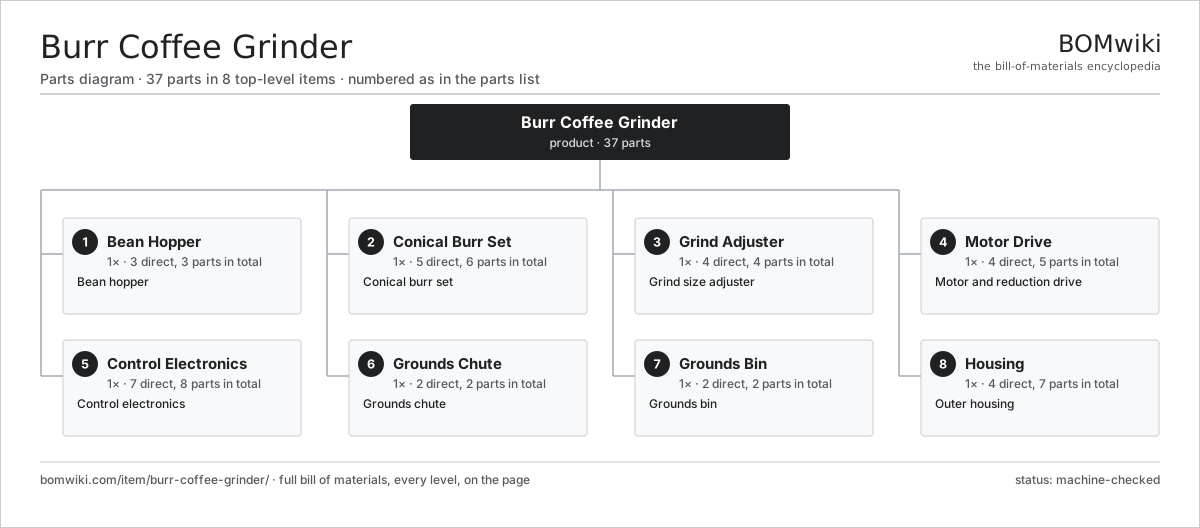
| # | Part | Qty | What it does |
|---|---|---|---|
| 1 | Bean Hopper 3 parts | 1× | Bean hopper |
| 2 | Conical Burr Set 5 parts | 1× | Conical burr set |
| 3 | Grind Adjuster 4 parts | 1× | Grind size adjuster |
| 4 | Motor Drive 4 parts | 1× | Motor and reduction drive |
| 5 | Control Electronics 7 parts | 1× | Control electronics |
| 6 | Grounds Chute 2 parts | 1× | Grounds chute |
| 7 | Grounds Bin 2 parts | 1× | Grounds bin |
| 8 | Housing 4 parts | 1× | Outer housing |
3D model
No 3D model yet. Have a CAD file of this? Add a 3D model. STL renders right on this page; STEP, FreeCAD, and OpenSCAD sources are welcome too (openly licensed, like all 3D models on BOMwiki).
Build & assembly graph
expand / collapse · shared sub-assemblies converge · links to related products · est. labourTap an assembly to expand/collapse · tap a part to open it · use “Open page” for any node · drag to pan, scroll to zoom.
Bill of materials for Burr Coffee Grinder
8 top-level lines · 39 rows shown · 37 parts total · indented to 3 levels| # | Item / sub-assembly | Part no. | Qty/assy | Ext. qty | Parts | Type |
|---|---|---|---|---|---|---|
| 1 | Bean Hopper 3 parts | burr-coffee-grinder-hopper | 1× | 1 | 3 | assembly |
| 1.1 | Hopper Body | burr-coffee-grinder-hopper-body | 1× | 1 | · | part |
| 1.2 | Hopper Lid | burr-coffee-grinder-hopper-lid | 1× | 1 | · | part |
| 1.3 | Shut-Off Gate | burr-coffee-grinder-hopper-gate | 1× | 1 | · | part |
| 2 | Conical Burr Set 5 parts | burr-coffee-grinder-burr-set | 1× | 1 | 6 | assembly |
| 2.1 | Outer Ring Burr | burr-coffee-grinder-outer-burr | 1× | 1 | · | part |
| 2.2 | Inner Cone Burr | burr-coffee-grinder-inner-burr | 1× | 1 | · | part |
| 2.3 | Burr Carrier | burr-coffee-grinder-burr-carrier | 1× | 1 | · | part |
| 2.4 | Burr Shaft | burr-coffee-grinder-burr-shaft | 1× | 1 | · | part |
| 2.5 | Ball Bearing | ball-bearing | 2× | 2 | · | part |
| 3 | Grind Adjuster 4 parts | burr-coffee-grinder-adjuster | 1× | 1 | 4 | assembly |
| 3.1 | Adjust Ring | burr-coffee-grinder-adjust-ring | 1× | 1 | · | part |
| 3.2 | Click Detent | burr-coffee-grinder-adjust-detent | 1× | 1 | · | part |
| 3.3 | Grind Scale | burr-coffee-grinder-adjust-scale | 1× | 1 | · | part |
| 3.4 | Coil Spring | coil-spring | 1× | 1 | · | part |
| 4 | Motor Drive 4 parts | burr-coffee-grinder-drive | 1× | 1 | 5 | assembly |
| 4.1 | Grinder Motor | burr-coffee-grinder-motor | 1× | 1 | · | part |
| 4.2 | Helical Gear Pair | gear-pair | 1× | 1 | · | part |
| 4.3 | Thermal Cutout | burr-coffee-grinder-thermal-cutout | 1× | 1 | · | part |
| 4.4 | Ball Bearing | ball-bearing | 2× | 2 | · | part |
| 5 | Control Electronics 7 parts | burr-coffee-grinder-control | 1× | 1 | 8 | assembly |
| 5.1 | Bare PCB | pcb-bare | 1× | 1 | · | part |
| 5.2 | Microcontroller | mcu | 1× | 1 | · | part |
| 5.3 | Relay | relay | 1× | 1 | · | part |
| 5.4 | SMD Passive (R/C/L) | smd-passives | 1× | 1 | · | part |
| 5.5 | Dose Dial | burr-coffee-grinder-dose-dial | 1× | 1 | · | part |
| 5.6 | Start Switch | burr-coffee-grinder-start-switch | 1× | 1 | · | part |
| 5.7 | Connector | connector | 2× | 2 | · | part |
| 6 | Grounds Chute 2 parts | burr-coffee-grinder-chute | 1× | 1 | 2 | assembly |
| 6.1 | Chute Body | burr-coffee-grinder-chute-body | 1× | 1 | · | part |
| 6.2 | Anti-Clump Wiper | burr-coffee-grinder-chute-wiper | 1× | 1 | · | part |
| 7 | Grounds Bin 2 parts | burr-coffee-grinder-catch-bin | 1× | 1 | 2 | assembly |
| 7.1 | Bin Body | burr-coffee-grinder-bin-body | 1× | 1 | · | part |
| 7.2 | Bin Lid | burr-coffee-grinder-bin-lid | 1× | 1 | · | part |
| 8 | Housing 4 parts | burr-coffee-grinder-housing | 1× | 1 | 7 | assembly |
| 8.1 | Body Shell | burr-coffee-grinder-housing-shell | 1× | 1 | · | part |
| 8.2 | Weighted Base | burr-coffee-grinder-base-plate | 1× | 1 | · | part |
| 8.3 | Rubber Foot | burr-coffee-grinder-foot | 4× | 4 | · | part |
| 8.4 | Fastener Set | fastener-set | 1× | 1 | · | part |
Related products
same domain, ranked by shared parts Hand Mixer
114 parts · shares 4 with this page
Hand Mixer
114 parts · shares 4 with this page
 Masticating Juicer
81 parts · shares 4 with this page
Stand Mixer
130 parts · shares 4 with this page
Super-Automatic Espresso Machine
293 parts · shares 4 with this page
Tilt-Head Stand Mixer
68 parts · shares 4 with this page
Masticating Juicer
81 parts · shares 4 with this page
Stand Mixer
130 parts · shares 4 with this page
Super-Automatic Espresso Machine
293 parts · shares 4 with this page
Tilt-Head Stand Mixer
68 parts · shares 4 with this page
Sourcing: possible vendors
Browse the supplier directory → Prices, MOQ, and lead times are algorithmic estimates, not quotes, and not claims about these companies. Company mappings are curated by keyword; est. price band $20–$600. How estimates work| Vendor | HQ | Specialty | MOQ | Lead time |
|---|---|---|---|---|
|
🇦🇺Breville
breville.com ↗
|
Sydney, AU | Kitchen appliances | 2,000 units | 6–10 wks |
| groupeseb.com ↗ | Écully, FR | Cookware & small appliances | 2,000 units | 6–10 wks |
| hamiltonbeach.com ↗ | Glen Allen, US | Small appliances | 2,000 units | 6–10 wks |
| panasonic.com ↗ | Osaka, JP | Electronics & appliances | 2,000 units | 6–10 wks |
|
🇨🇳Midea
midea.com ↗
|
Foshan, CN | Home appliances | 2,000 units | 6–10 wks |
920-word article