Stackable Food Dehydrator
ProductOverview
A stackable food dehydrator dries food by passing warm, moving air over it for hours until most of the water is gone and the food keeps for months. This is the round, tiered type rather than the box type: a Base Unit sits on the counter holding the fan and heater, and you stack mesh trays on top of it like rings on a tower. Warm air leaves the base, rises through a hollow center column formed by the tray holes, and bleeds out across each tray level before it reaches the Top Lid at the top.
The design trades the even airflow of a horizontal box machine for a smaller footprint and a stack you can grow. A typical unit ships with seven Drying Tray rings and accepts up to twelve, so a light load uses three trays and a full fruit harvest uses the lot. Each tray carries food on a coarse Tray Mesh floor, with a finer Fine Mesh Insert available for herbs, seeds, and small pieces that would fall through. For purees and wet foods there is a solid Fruit-Leather Sheet for fruit leather and a Drip Tray that catches marinade before it reaches the motor.
How it works
The heart of the machine is the Base Unit. A Fan Motor spins an axial Fan Blade that draws room air through the bottom Inlet Grille and pushes it past a coiled Heating Element. The element warms the stream to the set temperature, usually between 35 and 70 °C depending on the food, and the warm air heads up into the stack at roughly 30 CFM.
Inside the stack the airflow follows the Airflow Path path. The aligned tray holes form a Column Duct up the middle, and a Distribution Baffle at each level peels off a share of that air and turns it outward across the food on that tray. A Return Deflector under the lid spreads the last of the column air over the top tray. Humid air then escapes through the adjustable Vent Louver on the lid, which you open wide early in a run when the food is wet and close down later to hold heat.
Drying is mostly about carrying moisture away, not just adding heat. If the air is too hot the food surface hardens and seals water inside, so the Temperature Sensor reads the chamber temperature and the board cycles the heater to stay within a few degrees of the setpoint. A Thermostat backs that up by switching the element on temperature alone, and a one-shot Thermal Cutoff sits in series so that if the fan stalls and the element runs away, power is cut for good.
Control and power
The front Control Panel panel sets temperature and time. A Microcontroller on a Bare PCB reads the membrane keypad and the Timer Knob, drives an LCD Panel showing the current temperature and remaining time, and switches the heater through a Relay. The board energizes the fan and heater together so the element never runs in still air, and it ends the run automatically when the 0.5 to 48 hour countdown reaches zero.
Mains power enters through the Power Module module. A grounded Power Cord feeds a Terminal Block, a Strain Relief takes pulling loads off the internal joints, and a Power Supply drops the mains down to the low voltage the board and sensors need. Rated power runs from about 250 W on small four-tray models to 700 W on tall twelve-tray units, with 500 W typical for the seven-tray size.
Materials
The Base Housing, tray rims, and Lid Body are molded from heat-resistant food-grade plastic, usually polypropylene that tolerates the warm, damp chamber without warping. Tray mesh and the Fine Mesh Insert are BPA-free plastic grids, and the Fruit-Leather Sheet is silicone so leather peels off cleanly. The Lid Seal is silicone as well. The heating element is a sheathed resistance coil on the Element Bracket, and the Fan Shroud directs intake air over the motor to keep it cool.
Drying times and use
Times depend on the food, the slice thickness, and how full the stack is. Apple and banana slices take about 6 to 12 hours at 55 to 60 °C. Beef jerky runs 4 to 7 hours at 65 to 70 °C. Herbs dry in 2 to 4 hours at the low end near 35 to 40 °C, and tomatoes can need 10 to 18 hours. A fuller stack runs longer because the same airflow has to reach more trays, so swapping tray positions partway through a long run evens out the result. The Drip Tray goes on the bottom tray under any wet food so juice never reaches the fan and heater below.
When a run finishes, the trays, Top Lid, and inserts lift off the base and wash by hand, while the base wipes down without going near water because the motor and board live inside it.
Stackable Food Dehydrator parts and their functions
7 top-level parts · 91 parts in total · full bill of materials below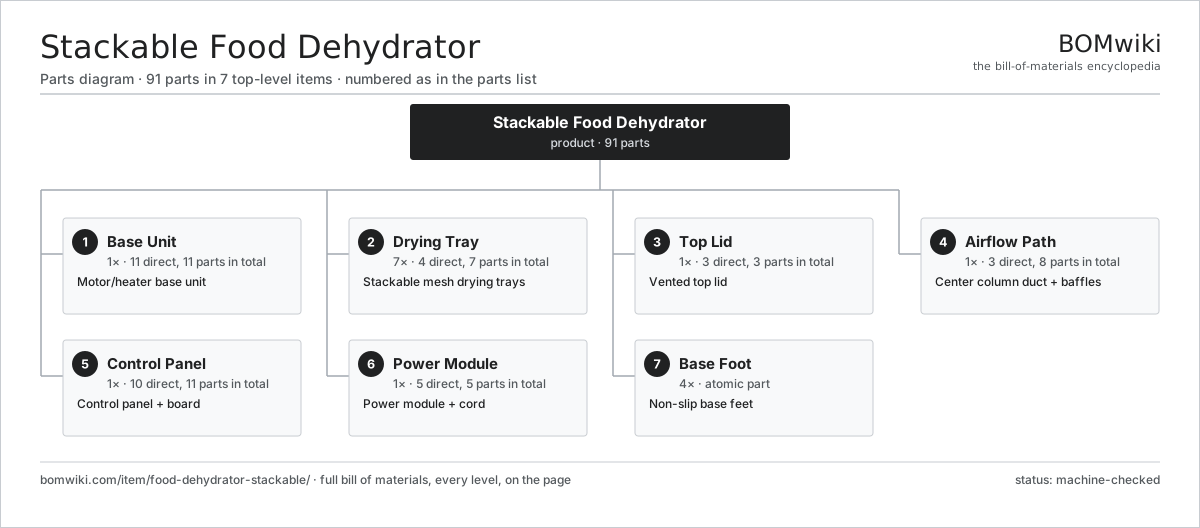
| # | Part | Qty | What it does |
|---|---|---|---|
| 1 | Base Unit 11 parts | 1× | Motor/heater base unit |
| 2 | Drying Tray 4 parts | 7× | Stackable mesh drying trays |
| 3 | Top Lid 3 parts | 1× | Vented top lid |
| 4 | Airflow Path 3 parts | 1× | Center column duct + baffles |
| 5 | Control Panel 10 parts | 1× | Control panel + board |
| 6 | Power Module 5 parts | 1× | Power module + cord |
| 7 | Base Foot | 4× | Non-slip base feet |
3D model
No 3D model yet. Have a CAD file of this? Add a 3D model. STL renders right on this page; STEP, FreeCAD, and OpenSCAD sources are welcome too (openly licensed, like all 3D models on BOMwiki).
Build & assembly graph
expand / collapse · shared sub-assemblies converge · links to related products · est. labourTap an assembly to expand/collapse · tap a part to open it · use “Open page” for any node · drag to pan, scroll to zoom.
Bill of materials for Stackable Food Dehydrator
7 top-level lines · 43 rows shown · 91 parts total · indented to 3 levels| # | Item / sub-assembly | Part no. | Qty/assy | Ext. qty | Parts | Type |
|---|---|---|---|---|---|---|
| 1 | Base Unit 11 parts | food-dehydrator-stackable-base | 1× | 1 | 11 | assembly |
| 1.1 | Heating Element | heating-element | 1× | 1 | · | part |
| 1.2 | Fan Motor | food-dehydrator-stackable-fan-motor | 1× | 1 | · | part |
| 1.3 | Fan Blade | food-dehydrator-stackable-fan-blade | 1× | 1 | · | part |
| 1.4 | Fan Shroud | food-dehydrator-stackable-fan-shroud | 1× | 1 | · | part |
| 1.5 | Base Housing | food-dehydrator-stackable-base-housing | 1× | 1 | · | part |
| 1.6 | Element Bracket | food-dehydrator-stackable-element-bracket | 1× | 1 | · | part |
| 1.7 | Thermostat | food-dehydrator-stackable-thermostat | 1× | 1 | · | part |
| 1.8 | Temperature Sensor | food-dehydrator-stackable-temp-sensor | 1× | 1 | · | part |
| 1.9 | Thermal Cutoff | food-dehydrator-stackable-thermal-cutoff | 1× | 1 | · | part |
| 1.10 | Inlet Grille | food-dehydrator-stackable-inlet-grille | 1× | 1 | · | part |
| 1.11 | Fastener Set | fastener-set | 1× | 1 | · | part |
| 2 | Drying Tray 4 parts | food-dehydrator-stackable-tray | 7× | 7 | 7 | assembly |
| 2.1 | Tray Rim | food-dehydrator-stackable-tray-rim | 1× | 7 | · | part |
| 2.2 | Tray Mesh | food-dehydrator-stackable-tray-mesh | 1× | 7 | · | part |
| 2.3 | Fine Mesh Insert | food-dehydrator-stackable-mesh-insert | 1× | 7 | · | part |
| 2.4 | Stacking Lug | food-dehydrator-stackable-tray-stack-lug | 4× | 28 | · | part |
| 3 | Top Lid 3 parts | food-dehydrator-stackable-lid | 1× | 1 | 3 | assembly |
| 3.1 | Lid Body | food-dehydrator-stackable-lid-body | 1× | 1 | · | part |
| 3.2 | Vent Louver | food-dehydrator-stackable-vent-louver | 1× | 1 | · | part |
| 3.3 | Lid Seal | food-dehydrator-stackable-lid-seal | 1× | 1 | · | part |
| 4 | Airflow Path 3 parts | food-dehydrator-stackable-airflow | 1× | 1 | 8 | assembly |
| 4.1 | Column Duct | food-dehydrator-stackable-column-duct | 1× | 1 | · | part |
| 4.2 | Distribution Baffle | food-dehydrator-stackable-baffle | 6× | 6 | · | part |
| 4.3 | Return Deflector | food-dehydrator-stackable-deflector | 1× | 1 | · | part |
| 5 | Control Panel 10 parts | food-dehydrator-stackable-control | 1× | 1 | 11 | assembly |
| 5.1 | Bare PCB | pcb-bare | 1× | 1 | · | part |
| 5.2 | Microcontroller | mcu | 1× | 1 | · | part |
| 5.3 | SMD Passive (R/C/L) | smd-passives | 1× | 1 | · | part |
| 5.4 | Relay | relay | 1× | 1 | · | part |
| 5.5 | LCD Panel | lcd-panel | 1× | 1 | · | part |
| 5.6 | Membrane Keypad | food-dehydrator-stackable-membrane | 1× | 1 | · | part |
| 5.7 | Timer Knob | food-dehydrator-stackable-timer-knob | 1× | 1 | · | part |
| 5.8 | Panel Bezel | food-dehydrator-stackable-panel-bezel | 1× | 1 | · | part |
| 5.9 | Wire Bundle | wire-bundle | 1× | 1 | · | part |
| 5.10 | Connector | connector | 2× | 2 | · | part |
| 6 | Power Module 5 parts | food-dehydrator-stackable-power | 1× | 1 | 5 | assembly |
| 6.1 | Power Supply | power-supply | 1× | 1 | · | part |
| 6.2 | Power Cord | food-dehydrator-stackable-cord | 1× | 1 | · | part |
| 6.3 | Strain Relief | food-dehydrator-stackable-strain-relief | 1× | 1 | · | part |
| 6.4 | Terminal Block | food-dehydrator-stackable-terminal-block | 1× | 1 | · | part |
| 6.5 | Wire Bundle | wire-bundle | 1× | 1 | · | part |
| 7 | Base Foot | food-dehydrator-stackable-feet | 4× | 4 | · | part |
Related products
same domain, ranked by shared parts Electric Multicooker
151 parts · shares 3 with this page
Multi-Function Rice Cooker
200 parts · shares 3 with this page
Electric Multicooker
151 parts · shares 3 with this page
Multi-Function Rice Cooker
200 parts · shares 3 with this page
 Sous Vide Immersion Circulator
294 parts · shares 3 with this page
Super-Automatic Espresso Machine
293 parts · shares 3 with this page
Portable Induction Cooktop
70 parts · shares 2 with this page
All-In-One Home Brewing System
43 parts · shares 2 with this page
Sous Vide Immersion Circulator
294 parts · shares 3 with this page
Super-Automatic Espresso Machine
293 parts · shares 3 with this page
Portable Induction Cooktop
70 parts · shares 2 with this page
All-In-One Home Brewing System
43 parts · shares 2 with this page
Sourcing: possible vendors
Browse the supplier directory → Prices, MOQ, and lead times are algorithmic estimates, not quotes, and not claims about these companies. Company mappings are curated by keyword; est. price band $20–$600. How estimates work| Vendor | HQ | Specialty | MOQ | Lead time |
|---|---|---|---|---|
|
🇦🇺Breville
breville.com ↗
|
Sydney, AU | Kitchen appliances | 2,000 units | 6–10 wks |
| groupeseb.com ↗ | Écully, FR | Cookware & small appliances | 2,000 units | 6–10 wks |
| hamiltonbeach.com ↗ | Glen Allen, US | Small appliances | 2,000 units | 6–10 wks |
| panasonic.com ↗ | Osaka, JP | Electronics & appliances | 2,000 units | 6–10 wks |
|
🇨🇳Midea
midea.com ↗
|
Foshan, CN | Home appliances | 2,000 units | 6–10 wks |
921-word article