Electric Milk Frother
ProductOverview
An electric milk frother is a small countertop appliance that heats milk and whips it into foam for coffee drinks such as cappuccino and latte, or simply warms it for hot chocolate. It looks like an electric kettle but works very differently inside. Rather than a spinning shaft passing through the jug wall, the whisk is driven across an air gap by a magnet, so the jug floor stays sealed and easy to clean. The appliance has two cooperating jobs: turn the whisk and heat the milk, and a small controller manages both to a temperature target.
The product breaks into the Milk Jug Assembly that holds the milk, the Base Station that supplies power and spins the whisk, the Whisk System that does the aerating, the Heater Assembly in the jug floor, and the Control Board that ties them together. A Lid Assembly keeps splatter in and heat from escaping too quickly.
Magnetic drive
The defining feature of this design is that the motor never touches the milk. The Drive Motor (DC) sits in the base and turns the Driving Magnet just below the jug. Inside the jug floor, the Driven Magnet follows that field, and the whisk itself carries a Whisk Magnet that locks onto the Whisk Centre Post and spins with it. Because the coupling is magnetic, there is no shaft seal to leak and no gland to clean, which is why the inside of a milk frother is a smooth bowl. The Base Power Contacts pass mains to the jug through a ring of contacts so the jug can be lifted off, poured, and dropped back on at any angle, the same trick used in cordless kettles.
Frothing versus stirring
Foam is made by folding air into milk, and the choice of whisk decides how much air gets in. The Frothing Whisk is a loose spring coil; as it spins it chops the milk surface and drags air bubbles down into the liquid, building the dense microfoam that floats on a latte. The Heating Whisk is a flat paddle that stirs the milk evenly so it heats without scorching but does not aerate it, which suits warm milk or hot chocolate where foam is not wanted. The whisks snap onto the centre post and are swapped by hand. Milk proteins are what trap the air, so the appliance works best with the milk it is filled to the marked line with, since too much milk leaves no headroom for the foam to expand into.
Heating and protection
The Heater Assembly lives under the jug floor. A Heating Element bonded to an aluminium Heat Spreader Plate spreads warmth evenly across the base, and an NTC Temperature Sensor reports the temperature back to the controller so it can stop heating around 60-65 C for foam, the range where milk tastes sweet without scalding. Protection is layered: an Bimetal Cutout bimetal cutout opens if the plate runs dry or overheats, and a Thermal Fuse is a one-shot backstop that severs power permanently if the disc ever fails. Because milk foams over and scorches easily, the non-stick Non-Stick Liner keeps residue from baking onto the wall and makes the jug wipe clean.
Control and modes
The Control Board runs the appliance from an Microcontroller that reads the Mode Buttons and the temperature sensor. Selecting hot foam runs the frothing whisk while heating to the foam target; warm milk runs the stirring whisk to a lower temperature; a cold-foam mode spins the frothing whisk with the heater off to aerate chilled milk for iced drinks. A Indicator LED Ring or backlit buttons show the chosen mode and signal when the cycle is done. The board switches the motor and heater through Relays and shuts both off the moment the target is reached or the jug is lifted from the base.
Use, cleaning, and variants
In use the appliance is simple: fit the right whisk, pour milk to the line, press a mode, and wait for the cycle to end. Cleaning is the main upkeep, since milk residue is the enemy of both taste and hygiene; the jug wipes out, the whisks rinse, and the Lid Seal Ring lifts off for washing. Variants differ mainly in the number of preset modes, whether the jug is induction-heated or plate-heated, and capacity, with larger units frothing enough for two cups at once. The magnetic whisk drive, sealed non-stick jug, and base-plate heater are common across nearly the whole category.
Electric Milk Frother parts and their functions
6 top-level parts · 125 parts in total · full bill of materials below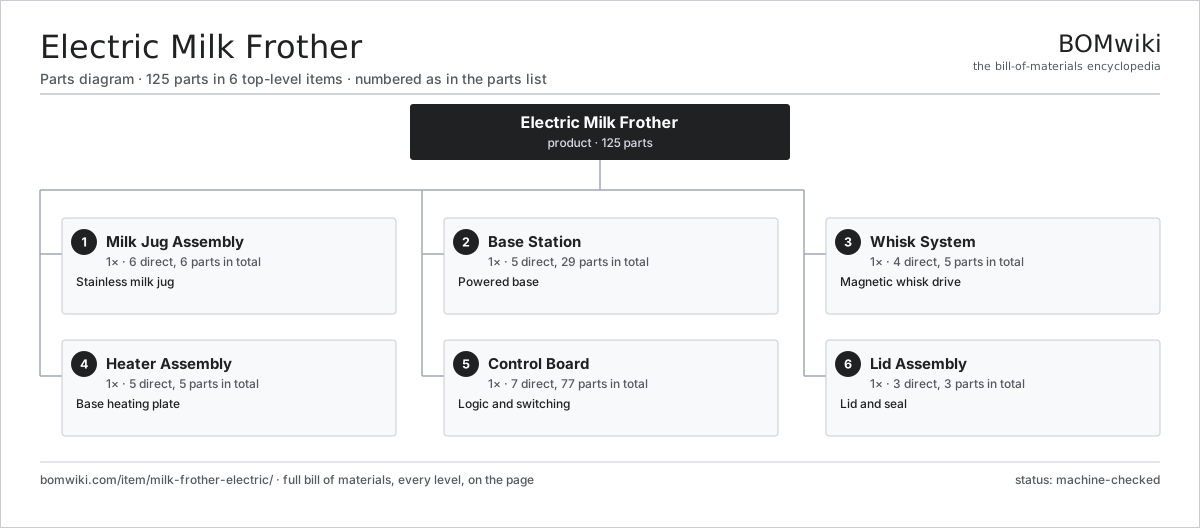
| # | Part | Qty | What it does |
|---|---|---|---|
| 1 | Milk Jug Assembly 6 parts | 1× | Stainless milk jug |
| 2 | Base Station 5 parts | 1× | Powered base |
| 3 | Whisk System 4 parts | 1× | Magnetic whisk drive |
| 4 | Heater Assembly 5 parts | 1× | Base heating plate |
| 5 | Control Board 7 parts | 1× | Logic and switching |
| 6 | Lid Assembly 3 parts | 1× | Lid and seal |
3D model
No 3D model yet. Have a CAD file of this? Add a 3D model. STL renders right on this page; STEP, FreeCAD, and OpenSCAD sources are welcome too (openly licensed, like all 3D models on BOMwiki).
Build & assembly graph
expand / collapse · shared sub-assemblies converge · links to related products · est. labourTap an assembly to expand/collapse · tap a part to open it · use “Open page” for any node · drag to pan, scroll to zoom.
Bill of materials for Electric Milk Frother
6 top-level lines · 40 rows shown · 125 parts total · indented to 3 levels| # | Item / sub-assembly | Part no. | Qty/assy | Ext. qty | Parts | Type |
|---|---|---|---|---|---|---|
| 1 | Milk Jug Assembly 6 parts | mfe-jug-assembly | 1× | 1 | 6 | assembly |
| 1.1 | Jug Outer Shell | mfe-jug-shell | 1× | 1 | · | part |
| 1.2 | Non-Stick Liner | mfe-jug-liner | 1× | 1 | · | part |
| 1.3 | Cool-Touch Handle | mfe-jug-handle | 1× | 1 | · | part |
| 1.4 | Driven Magnet | mfe-magnet-driver | 1× | 1 | · | part |
| 1.5 | Pour Spout | mfe-pour-spout | 1× | 1 | · | part |
| 1.6 | Base Power Contacts | mfe-base-contacts | 1× | 1 | · | part |
| 2 | Base Station 5 parts | mfe-base-station | 1× | 1 | 29 | assembly |
| 2.1 | Base Housing | mfe-base-housing | 1× | 1 | · | part |
| 2.2 | Drive Motor (DC) 4 parts | mfe-drive-motor | 1× | 1 | 25 | assembly |
| 2.2.1 | Stator Assembly 3 parts + deeper › | stator-assembly | 1× | 1 | 3 | assembly |
| 2.2.2 | Rotor Assembly 4 parts + deeper › | rotor-assembly | 1× | 1 | 19 | assembly |
| 2.2.3 | Ball Bearing | ball-bearing | 2× | 2 | · | part |
| 2.2.4 | Motor Housing | motor-housing | 1× | 1 | · | part |
| 2.3 | Driving Magnet | mfe-drive-magnet | 1× | 1 | · | part |
| 2.4 | Power Cord | mfe-power-cord | 1× | 1 | · | part |
| 2.5 | Cord Storage | mfe-cord-store | 1× | 1 | · | part |
| 3 | Whisk System 4 parts | mfe-whisk-system | 1× | 1 | 5 | assembly |
| 3.1 | Frothing Whisk | mfe-froth-whisk | 1× | 1 | · | part |
| 3.2 | Heating Whisk | mfe-heat-whisk | 1× | 1 | · | part |
| 3.3 | Whisk Magnet | mfe-whisk-magnet | 2× | 2 | · | part |
| 3.4 | Whisk Centre Post | mfe-whisk-post | 1× | 1 | · | part |
| 4 | Heater Assembly 5 parts | mfe-heater-assembly | 1× | 1 | 5 | assembly |
| 4.1 | Heating Element | heating-element | 1× | 1 | · | part |
| 4.2 | Heat Spreader Plate | mfe-heat-plate | 1× | 1 | · | part |
| 4.3 | NTC Temperature Sensor | mfe-temp-sensor | 1× | 1 | · | part |
| 4.4 | Thermal Fuse | thermal-fuse | 1× | 1 | · | part |
| 4.5 | Bimetal Cutout | mfe-overheat-disc | 1× | 1 | · | part |
| 5 | Control Board 7 parts | mfe-control-board | 1× | 1 | 77 | assembly |
| 5.1 | Bare PCB | pcb-bare | 1× | 1 | · | part |
| 5.2 | Microcontroller | mcu | 1× | 1 | · | part |
| 5.3 | Mode Buttons | mfe-mode-buttons | 1× | 1 | · | part |
| 5.4 | Indicator LED Ring | mfe-led-ring | 1× | 1 | · | part |
| 5.5 | Relay | relay | 2× | 2 | · | part |
| 5.6 | SMD Passive (R/C/L) | smd-passives | 70× | 70 | · | part |
| 5.7 | Wire Bundle | wire-bundle | 1× | 1 | · | part |
| 6 | Lid Assembly 3 parts | mfe-lid-assembly | 1× | 1 | 3 | assembly |
| 6.1 | Lid Body | mfe-lid-body | 1× | 1 | · | part |
| 6.2 | Lid Seal Ring | mfe-lid-seal | 1× | 1 | · | part |
| 6.3 | Steam Vent | mfe-steam-vent | 1× | 1 | · | part |
Related products
same domain, ranked by shared parts Chocolate Fondue Fountain
110 parts · shares 12 with this page
Super-Automatic Espresso Machine
293 parts · shares 12 with this page
Chocolate Fondue Fountain
110 parts · shares 12 with this page
Super-Automatic Espresso Machine
293 parts · shares 12 with this page
 Compressor Ice Cream Maker
248 parts · shares 11 with this page
Compressor Ice Cream Maker
248 parts · shares 11 with this page
 Cotton Candy Machine
127 parts · shares 11 with this page
Cotton Candy Machine
127 parts · shares 11 with this page
 High-Speed Blender
158 parts · shares 11 with this page
Stand Mixer
130 parts · shares 11 with this page
High-Speed Blender
158 parts · shares 11 with this page
Stand Mixer
130 parts · shares 11 with this page
Sourcing: possible vendors
Browse the supplier directory → Prices, MOQ, and lead times are algorithmic estimates, not quotes, and not claims about these companies. Company mappings are curated by keyword; est. price band $20–$600. How estimates work| Vendor | HQ | Specialty | MOQ | Lead time |
|---|---|---|---|---|
|
🇦🇺Breville
breville.com ↗
|
Sydney, AU | Kitchen appliances | 2,000 units | 6–10 wks |
| groupeseb.com ↗ | Écully, FR | Cookware & small appliances | 2,000 units | 6–10 wks |
| hamiltonbeach.com ↗ | Glen Allen, US | Small appliances | 2,000 units | 6–10 wks |
| panasonic.com ↗ | Osaka, JP | Electronics & appliances | 2,000 units | 6–10 wks |
|
🇨🇳Midea
midea.com ↗
|
Foshan, CN | Home appliances | 2,000 units | 6–10 wks |
770-word article