Moka Pot
ProductOverview
A moka pot brews a strong, concentrated coffee on a stovetop without any electricity or pump. It works by heating water in a sealed lower chamber until the trapped steam builds enough pressure to drive the hot water up through a bed of ground coffee and into an upper chamber. The result sits between drip coffee and true espresso: thicker and more intense than filter coffee, but at around one to one and a half bar of pressure rather than the nine bar an espresso machine produces. The design dates to 1933 and the familiar octagonal aluminium shape has barely changed since.
The pot stacks into three threaded sections. The Boiler holds the water, the Funnel and Basket holds the ground coffee, and the Upper Collector catches the finished brew. A Sealing Gasket and Filter Plate seal and filter the joint between funnel and collector, a Safety Valve guards against overpressure, and a Handle and Lid complete the pot.
How it brews
Everything depends on a sealed pressure vessel. Water goes into the Boiler, filled only to just below the Safety Valve. Ground coffee fills the Coffee Basket, whose Riser Stem dips into the water. The Upper Collector screws down onto the boiler, compressing the Sealing Gasket so the only path for steam pressure to escape is up through the coffee. As the boiler heats on the burner, steam forms above the water and pushes down on its surface. With nowhere else to go, the water is forced up the Riser Stem, through the coffee in the Coffee Basket, past the Basket Filter and the Filter Plate, and finally erupts out of the Central Column into the upper chamber. The gurgling sound at the end signals that the water is spent and only steam is coming through, the cue to take the pot off the heat.
The boiler and safety valve
The Boiler is the heart of the system. Its Boiler Body is cast aluminium, traditionally in the eight-sided form that adds rigidity and spreads heat from the burner up the walls. The Boiler Base is machined flat for good burner contact. Because the chamber is a sealed pressure vessel, it carries a Safety Valve threaded into the wall. If the coffee is ground too fine or packed too tightly, or the basket clogs, pressure can climb past the design point; the Valve Pin then lifts against its Coil Spring and vents steam before the seal fails. The valve is the single most important safety feature and the reason a moka pot can be left to build pressure unattended on a low flame.
Funnel, collector, and filtration
The Funnel and Basket meters the coffee. The dose fills the Coffee Basket level and is left loose rather than tamped, since the pot's modest pressure cannot push through a packed puck the way an espresso machine can. Water rises through the Riser Stem from the very bottom of the boiler so almost all of it is used. The brewed coffee collects in the Upper Collector, rising through the Central Column and filling the Collector Body until it can be poured from the Pour Spout. Filtration happens twice, at the Basket Filter below the grounds and the Filter Plate above them, so very little sediment reaches the cup. The Sealing Gasket between them is the wear part: it hardens and shrinks with heat over time and is replaced periodically to keep the seal tight.
Materials and variants
The classic pot is cast aluminium, prized for fast even heating and low cost, but aluminium will not work on an induction hob because it is not magnetic. Stainless steel versions exist for induction and for users who prefer not to brew acidic coffee in aluminium; they cost more and heat a little more slowly. Sizes are quoted in cups, from a single-cup pot up to twelve, though the cup is a small Italian measure rather than a mug. The Handle is phenolic resin so it stays cool enough to grip, and the Lid is usually left open at the start of the brew so the user can watch the coffee emerge and pull the pot off the heat at the right moment.
Use and care
In use the brewer fills the boiler with hot water to the valve line, fills the basket with coffee, assembles the pot, and sets it on a medium flame with the Lid up. When the Upper Collector fills and the brew starts to gurgle and lighten, the pot comes off the heat. Care is deliberately minimal: the pot is rinsed with water and never washed with detergent, because soap strips the seasoned coffee oils that protect aluminium and flavour later brews. The Sealing Gasket and the two filter plates are checked for residue and the Safety Valve is kept clear, since a blocked valve removes the pot's only overpressure protection.
Moka Pot parts and their functions
8 top-level parts · 21 parts in total · full bill of materials below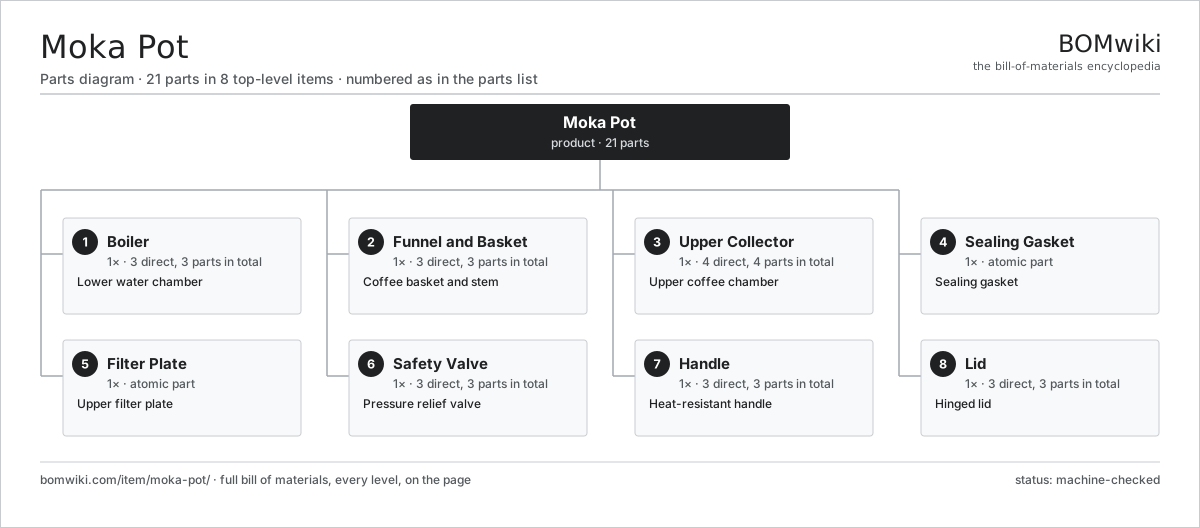
| # | Part | Qty | What it does |
|---|---|---|---|
| 1 | Boiler 3 parts | 1× | Lower water chamber |
| 2 | Funnel and Basket 3 parts | 1× | Coffee basket and stem |
| 3 | Upper Collector 4 parts | 1× | Upper coffee chamber |
| 4 | Sealing Gasket | 1× | Sealing gasket |
| 5 | Filter Plate | 1× | Upper filter plate |
| 6 | Safety Valve 3 parts | 1× | Pressure relief valve |
| 7 | Handle 3 parts | 1× | Heat-resistant handle |
| 8 | Lid 3 parts | 1× | Hinged lid |
3D model
No 3D model yet. Have a CAD file of this? Add a 3D model. STL renders right on this page; STEP, FreeCAD, and OpenSCAD sources are welcome too (openly licensed, like all 3D models on BOMwiki).
Build & assembly graph
expand / collapse · shared sub-assemblies converge · links to related products · est. labourTap an assembly to expand/collapse · tap a part to open it · use “Open page” for any node · drag to pan, scroll to zoom.
Bill of materials for Moka Pot
8 top-level lines · 27 rows shown · 21 parts total · indented to 3 levels| # | Item / sub-assembly | Part no. | Qty/assy | Ext. qty | Parts | Type |
|---|---|---|---|---|---|---|
| 1 | Boiler 3 parts | moka-pot-boiler | 1× | 1 | 3 | assembly |
| 1.1 | Boiler Body | moka-pot-boiler-body | 1× | 1 | · | part |
| 1.2 | Boiler Base | moka-pot-boiler-base | 1× | 1 | · | part |
| 1.3 | Boiler Thread | moka-pot-thread-ring | 1× | 1 | · | part |
| 2 | Funnel and Basket 3 parts | moka-pot-funnel | 1× | 1 | 3 | assembly |
| 2.1 | Coffee Basket | moka-pot-funnel-basket | 1× | 1 | · | part |
| 2.2 | Riser Stem | moka-pot-funnel-stem | 1× | 1 | · | part |
| 2.3 | Basket Filter | moka-pot-funnel-filter | 1× | 1 | · | part |
| 3 | Upper Collector 4 parts | moka-pot-collector | 1× | 1 | 4 | assembly |
| 3.1 | Collector Body | moka-pot-collector-body | 1× | 1 | · | part |
| 3.2 | Central Column | moka-pot-collector-spout | 1× | 1 | · | part |
| 3.3 | Collector Thread | moka-pot-collector-thread | 1× | 1 | · | part |
| 3.4 | Pour Spout | moka-pot-pour-spout | 1× | 1 | · | part |
| 4 | Sealing Gasket | moka-pot-gasket | 1× | 1 | · | part |
| 5 | Filter Plate | moka-pot-filter-plate | 1× | 1 | · | part |
| 6 | Safety Valve 3 parts | moka-pot-safety-valve | 1× | 1 | 3 | assembly |
| 6.1 | Valve Body | moka-pot-valve-body | 1× | 1 | · | part |
| 6.2 | Valve Pin | moka-pot-valve-pin | 1× | 1 | · | part |
| 6.3 | Coil Spring | coil-spring | 1× | 1 | · | part |
| 7 | Handle 3 parts | moka-pot-handle | 1× | 1 | 3 | assembly |
| 7.1 | Handle Body | moka-pot-handle-body | 1× | 1 | · | part |
| 7.2 | Handle Bracket | moka-pot-handle-bracket | 1× | 1 | · | part |
| 7.3 | Fastener Set | fastener-set | 1× | 1 | · | part |
| 8 | Lid 3 parts | moka-pot-lid | 1× | 1 | 3 | assembly |
| 8.1 | Lid Panel | moka-pot-lid-body | 1× | 1 | · | part |
| 8.2 | Lid Knob | moka-pot-lid-knob | 1× | 1 | · | part |
| 8.3 | Lid Hinge | moka-pot-lid-hinge | 1× | 1 | · | part |
Related products
same domain, ranked by shared parts Bread Machine
162 parts · shares 1 with this page
Bread Machine
162 parts · shares 1 with this page
 Burr Coffee Grinder
37 parts · shares 1 with this page
Burr Coffee Grinder
37 parts · shares 1 with this page
 Capsule Coffee Machine
123 parts · shares 1 with this page
Contact Grill
96 parts · shares 1 with this page
Capsule Coffee Machine
123 parts · shares 1 with this page
Contact Grill
96 parts · shares 1 with this page
 Countertop Convection Oven
77 parts · shares 1 with this page
Countertop Convection Oven
77 parts · shares 1 with this page
Sourcing: possible vendors
Browse the supplier directory → Prices, MOQ, and lead times are algorithmic estimates, not quotes, and not claims about these companies. Company mappings are curated by keyword; est. price band $20–$600. How estimates work| Vendor | HQ | Specialty | MOQ | Lead time |
|---|---|---|---|---|
|
🇦🇺Breville
breville.com ↗
|
Sydney, AU | Kitchen appliances | 2,000 units | 6–10 wks |
| groupeseb.com ↗ | Écully, FR | Cookware & small appliances | 2,000 units | 6–10 wks |
| hamiltonbeach.com ↗ | Glen Allen, US | Small appliances | 2,000 units | 6–10 wks |
| panasonic.com ↗ | Osaka, JP | Electronics & appliances | 2,000 units | 6–10 wks |
|
🇨🇳Midea
midea.com ↗
|
Foshan, CN | Home appliances | 2,000 units | 6–10 wks |
883-word article