Gun Safe
ProductOverview
A gun safe is a fire- and burglar-resistant steel cabinet designed to secure firearms, ammunition, and valuables from theft and environmental damage. The Safe Body Assembly is a welded steel box with a sophisticated insulation sandwich (drywall-fiberglass-drywall composite) sandwiched between 6–10 mm outer steel and 2–3 mm inner steel panels, rated for 30–120 minute fire endurance at 1200°C (2200°F). The Lockable Door Assembly is a similarly reinforced panel with multiple hardened steel bolts that extend into the frame when locked. Access is controlled by a Locking Mechanism, mechanical dial, electronic keypad, or biometric fingerprint reader, with a mechanical key override for emergencies. Inside, rifle racks hold firearms vertically or horizontally, and adjustable shelves store ammunition and smaller handguns. A Dehumidifier Cartridge cartridge prevents rust and corrosion in the sealed environment.
Gun safes serve multiple purposes: legal compliance (many jurisdictions require secure storage if minors are in the home), insurance discounts, protection from home invasion, and preservation of the firearms themselves. A safe is typically anchored to the floor via bolts, making it difficult to remove even with professional theft equipment.
Construction and theft resistance
The Safe Body Assembly is the fortress. The outer steel shell, 6–10 mm thick, resists drilling, prying, and cutting with standard hand tools and bolt cutters. Below that, the insulation core serves dual purposes: fire protection and thickness that makes drilling through the safe impractically difficult (a drill bit must travel 50+ mm of composite material to reach the inner cavity). The soft inner steel backing (2–3 mm) absorbs energy from drilling and provides mounting surface for interior fixtures. Corner gussets welded to the exterior add rigidity and prevent frame collapse if the safe is struck or dropped.
The Lockable Door Assembly is the most heavily engineered component. It's 8–10 mm thick steel, as thick as the side walls, and swings on heavy-duty ball-bearing hinges rated for the weight and repeated opening/closing cycles. The compressible gasket around the perimeter does two things: it air-seals the safe to minimize moisture ingress and, during a fire, it swells and hardens, trapping insulation and preventing hot gases from entering. Most safes are rated UL-TL-15 (1 hour fire, 15 minutes under sustained attack) or TL-30 (2 hours fire); premium safes reach TL-30x6 ratings.
Locking system and bolts
The bolt system is mechanical and robust. Four to eight hardened steel rods (typically 16–20 mm diameter, 4140 or 4150 grade) extend roughly 30–50 mm into the frame when locked. Each bolt is driven by a rotating cam, which is energized by the lock mechanism. Rotating a dial three times (e.g., 12-42-6-12) or entering a numeric code on an electronic keypad causes an internal motor or solenoid to drive all cams synchronously, retracting the bolts so the door can swing. A mechanical key override is built in: if the electronic lock battery dies, a specific key slot opens a mechanical lock that retracts the bolts manually.
The bolts themselves are hardened to resist drilling: a standard steel drill bit will dull and heat-up trying to penetrate them. Proprietary security drill bits exist, but they're slow (hours) and loud, making forced entry impractical in a residential setting.
Fire protection and insulation
The Fire Insulation System is a sophisticated thermal barrier. The outer layer (6 mm gypsum board) faces the interior; when heat is applied to the exterior steel, the gypsum hydration reaction absorbs energy, releasing moisture that cools the interior. Below that, 50 mm of mineral fiber insulation at 96 kg/m³ provides low thermal conductivity. The inner layer (6 mm) faces the valuables inside. The composite is bonded with high-temperature adhesive rated to 200°C.
In a house fire at 1200°C (exterior steel glowing red), the insulation holds the interior below 150°C, cool enough to preserve documents, cash, and ammunition. Ammunition stored safely doesn't detonate; it may cook off if it reaches ignition temperature, but in a sealed safe the pressure release is contained and the safe body absorbs the energy. Firearms with wood furniture (walnut stocks) are protected; paint and varnish don't ignite, and steel components are unharmed.
30-minute safes (thinner insulation) are suitable for home use; they provide meaningful protection in a typical house fire (5–20 minutes of intense heat). 1-hour or 2-hour safes (thicker insulation, heavier, more expensive) are for commercial installations, rare document vaults, and homes in wildfire zones.
Interior organization
The Interior Weapon Rack is a key practical feature. Rifles and shotguns are stored vertically or horizontally on rubber-lined cradles, preventing the barrel and stock from resting on hard metal, which can cause finish damage or warping over time. The rack is bolted through the interior back panel from the outside; no fasteners protrude into the safe, eliminating snag points.
Adjustable shelves on the lower half hold handguns, ammunition boxes, and valuables. Shelves are typically plywood (budget) or powder-coated steel (premium), rated 30 kg per pair of brackets. Ammunition is stored dry, and the Dehumidifier Cartridge cartridge becomes the guardian of longevity: it's a replaceable silica-gel or salt-based desiccant (roughly the size of a hockey puck) that sits on a shelf and absorbs moisture. When saturated, it changes color (blue to pink is common) and is replaced, a $5 consumable that extends firearm life by decades.
Anchoring and security integration
A gun safe is only as secure as its mounting. The floor mounting lugs on the bottom are drilled for 3/8-16 or M10 bolts, which are driven into concrete anchors (wedge anchors or epoxy anchors) set into the building floor or into floor joists if the safe is in a basement. A professional thief with a dolly and hydraulic jack can remove an unbolted safe; bolting makes removal a multi-hour job requiring power tools and creating noise, a strong deterrent in a residential setting.
Many homeowners also run a cable from the safe's interior to an anchor point, securing valuables inside the safe to prevent grab-and-dash theft if the safe is breached. This layered approach (bolted safe, keyed lock, cable anchor) reflects the reality that no safe is impenetrable, only more or less resistant.
Maintenance and longevity
The Dehumidifier Cartridge cartridge is the primary maintenance item, replaced annually or as needed (when it changes color, indicating saturation). The lock mechanism, if electronic, typically lasts 10+ years on a single set of batteries (CR123A or AA cells), with a battery-low indicator appearing in the last month. Mechanical locks (dial or key) are essentially maintenance-free but slower to open.
The exterior finish (powder coat or stainless steel) should be wiped clean of dust occasionally; the interior, being sealed and dry, requires no maintenance. If the safe is damaged (a corner dented, a hinge bent from impact), repair is best left to the manufacturer, as the insulation and door-seal geometry must be maintained for fire rating.
Gun Safe parts and their functions
9 top-level parts · 102 parts in total · full bill of materials below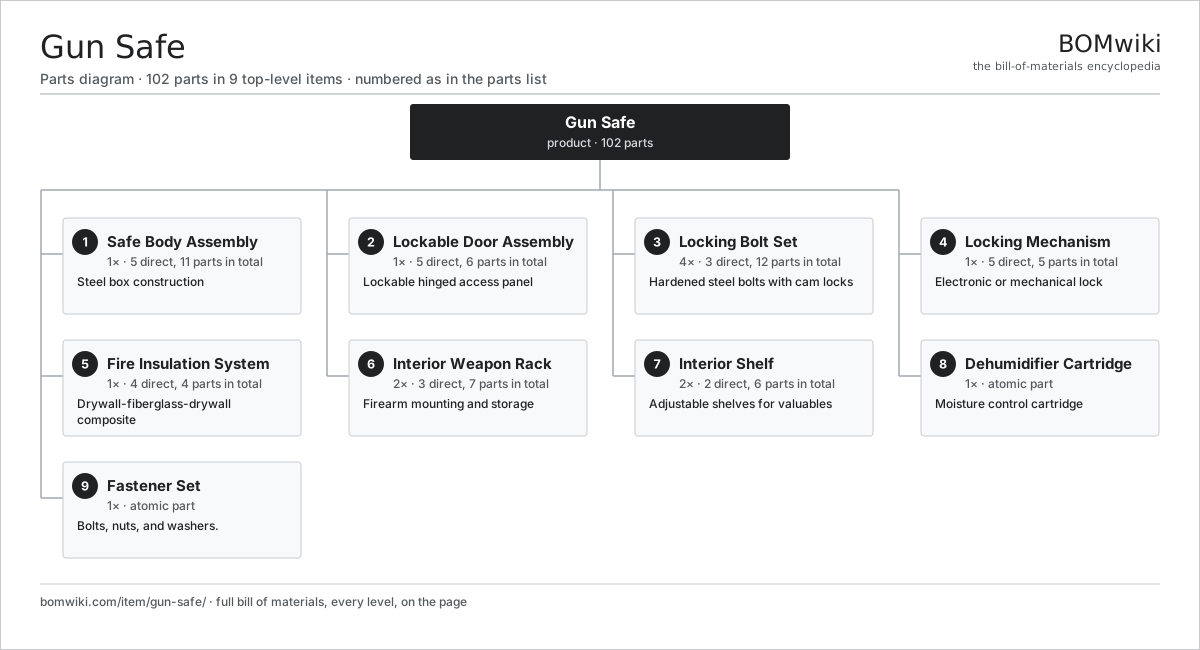
| # | Part | Qty | What it does |
|---|---|---|---|
| 1 | Safe Body Assembly 5 parts | 1× | Steel box construction |
| 2 | Lockable Door Assembly 5 parts | 1× | Lockable hinged access panel |
| 3 | Locking Bolt Set 3 parts | 4× | Hardened steel bolts with cam locks |
| 4 | Locking Mechanism 5 parts | 1× | Electronic or mechanical lock |
| 5 | Fire Insulation System 4 parts | 1× | Drywall-fiberglass-drywall composite |
| 6 | Interior Weapon Rack 3 parts | 2× | Firearm mounting and storage |
| 7 | Interior Shelf 2 parts | 2× | Adjustable shelves for valuables |
| 8 | Dehumidifier Cartridge | 1× | Moisture control cartridge |
| 9 | Fastener Set | 1× | Bolts, nuts, and washers. |
3D model
No 3D model yet. Have a CAD file of this? Add a 3D model. STL renders right on this page; STEP, FreeCAD, and OpenSCAD sources are welcome too (openly licensed, like all 3D models on BOMwiki).
Build & assembly graph
expand / collapse · shared sub-assemblies converge · links to related products · est. labourTap an assembly to expand/collapse · tap a part to open it · use “Open page” for any node · drag to pan, scroll to zoom.
Bill of materials for Gun Safe
9 top-level lines · 36 rows shown · 102 parts total · indented to 3 levels| # | Item / sub-assembly | Part no. | Qty/assy | Ext. qty | Parts | Type |
|---|---|---|---|---|---|---|
| 1 | Safe Body Assembly 5 parts | gun-safe-body | 1× | 1 | 11 | assembly |
| 1.1 | Outer Steel Shell | gun-safe-outer-steel | 1× | 1 | · | part |
| 1.2 | Insulation Core | gun-safe-insulation-core | 1× | 1 | · | part |
| 1.3 | Inner Back Panel | gun-safe-inner-steel | 1× | 1 | · | part |
| 1.4 | Corner Brace | gun-safe-corner-brace | 4× | 4 | · | part |
| 1.5 | Floor Mount Lug | gun-safe-floor-mount-lug | 4× | 4 | · | part |
| 2 | Lockable Door Assembly 5 parts | gun-safe-door | 1× | 1 | 6 | assembly |
| 2.1 | Door Panel | gun-safe-door-panel | 1× | 1 | · | part |
| 2.2 | Door Gasket | gun-safe-door-gasket | 1× | 1 | · | part |
| 2.3 | Door Hinge | gun-safe-door-hinge | 2× | 2 | · | part |
| 2.4 | Door Pull | gun-safe-door-pull | 1× | 1 | · | part |
| 2.5 | Door Trim | gun-safe-door-exterior-cover | 1× | 1 | · | part |
| 3 | Locking Bolt Set 3 parts | gun-safe-locking-bolt | 4× | 4 | 12 | assembly |
| 3.1 | Bolt Rod | gun-safe-bolt-rod | 4× | 16 | · | part |
| 3.2 | Bolt Cam | gun-safe-bolt-cam | 4× | 16 | · | part |
| 3.3 | Bolt Housing | gun-safe-bolt-housing | 4× | 16 | · | part |
| 4 | Locking Mechanism 5 parts | gun-safe-locking-mechanism | 1× | 1 | 5 | assembly |
| 4.1 | Lock Type | gun-safe-lock-type-choice | 1× | 1 | · | part |
| 4.2 | Lock Cylinder | gun-safe-lock-cylinder | 1× | 1 | · | part |
| 4.3 | Lock Battery | gun-safe-lock-battery | 1× | 1 | · | part |
| 4.4 | Lock Motor | gun-safe-lock-motor | 1× | 1 | · | part |
| 4.5 | Mechanical Override | gun-safe-deadbolt-override | 1× | 1 | · | part |
| 5 | Fire Insulation System 4 parts | gun-safe-fire-insulation | 1× | 1 | 4 | assembly |
| 5.1 | Outer Drywall | gun-safe-outer-drywall | 1× | 1 | · | part |
| 5.2 | Fiberglass Batt | gun-safe-fiberglass-batt | 1× | 1 | · | part |
| 5.3 | Inner Drywall | gun-safe-inner-drywall | 1× | 1 | · | part |
| 5.4 | Insulation Adhesive | gun-safe-insulation-adhesive | 1× | 1 | · | part |
| 6 | Interior Weapon Rack 3 parts | gun-safe-interior-rack | 2× | 2 | 7 | assembly |
| 6.1 | Rack Frame | gun-safe-rack-frame | 1× | 2 | · | part |
| 6.2 | Rifle Holder | gun-safe-rifle-holder | 2× | 4 | · | part |
| 6.3 | Rack Mounting Bolt | gun-safe-mounting-bolt | 4× | 8 | · | part |
| 7 | Interior Shelf 2 parts | gun-safe-shelf | 2× | 2 | 6 | assembly |
| 7.1 | Shelf Bracket | gun-safe-shelf-bracket | 4× | 8 | · | part |
| 7.2 | Shelf Panel | gun-safe-shelf-panel | 2× | 4 | · | part |
| 8 | Dehumidifier Cartridge | gun-safe-dehumidifier | 1× | 1 | · | part |
| 9 | Fastener Set | fastener-set | 1× | 1 | · | part |
Something wrong in this list? Report a problem with this BOM.
Sourcing: possible vendors
Browse the supplier directory → Prices, MOQ, and lead times are algorithmic estimates, not quotes, and not claims about these companies. Company mappings are curated by keyword; est. price band $50–$15k. How estimates work| Vendor | HQ | Specialty | MOQ | Lead time |
|---|---|---|---|---|
|
🇯🇵Canon
canon.com ↗
|
Tokyo, JP | Imaging & optics | 500 units | 8–12 wks |
|
🇯🇵Ricoh
ricoh.com ↗
|
Tokyo, JP | Office imaging | 500 units | 8–12 wks |
|
🇺🇸Xerox
xerox.com ↗
|
Norwalk, US | Printers & copiers | 500 units | 8–12 wks |
|
🇯🇵Epson
epson.com ↗
|
Suwa, JP | Printers & projectors | 500 units | 8–12 wks |
|
🇯🇵Brother
brother.com ↗
|
Nagoya, JP | Printers & sewing | 500 units | 8–12 wks |
1,267-word article