Paper Folding Machine
ProductOverview
A paper folding machine turns flat printed sheets into letters, leaflets, and self-mailers at rates no human can approach, a mid-range office unit folds two letter-folded sheets per second, all day. Nearly all office and light-production machines are buckle folders: the sheet is never creased by a blade but is made to buckle against itself at a precise point and then pinched through a roller nip, which sets the crease. Mail rooms run them ahead of envelope inserters; print shops run larger versions with four or six plates for brochure work.
The buckle principle
A cycle starts at the Sheet Feeder. Rubber Feed Wheel tires drag the top sheet forward while the Separator Pad retards everything underneath, the same friction-retard separation used in printers, scaled up. The Feed Clutch engages once per cycle so sheets enter with a fixed gap, and the Double-Feed Detector sensor halts the machine if two sheets travel stuck together, which would otherwise jam the nips or put unfolded pairs into the mail.
The first roller pair drives the sheet into Fold Plate 1, an inclined chute with a movable Fold Plate Stop inside. The sheet's leading edge hits the stop and the paper, still being pushed from behind, has nowhere to go: it buckles outward at the plate mouth. The buckle forms exactly at the second roller nip, which grabs the loop and pulls it through, creasing the sheet at a position determined purely by how far the stop sits up the plate. Set the stop at one-third of the sheet length and the fold lands at one-third, adjustable to a few tenths of a millimetre on the calibrated scale, or motor-positioned on automatic machines.
For a letter fold the half-folded sheet immediately enters Fold Plate 2 and buckles again at the third nip; for a Z-fold the second plate's stop is set so the second crease goes the other way; for a simple half fold a Plate Deflector flips into the second plate's mouth so the sheet bypasses it. Every standard fold pattern is just a combination of stop positions and closed plates, which is why machines ship with preset tables printed on the housing and modern ones store them in the Controller PCB.
Rollers and accuracy
The Fold Roller Stack stack, four polyurethane-faced rollers forming three nips, does the actual creasing. Nip pressure comes from Coil Spring loading, and the Roller Gap Adjuster opens the gaps to suit stock from 50 gsm airmail paper to 200 gsm card; running card through nips set for bond glazes and flat-spots the rollers. A glazed or worn Fold Roller is the usual cause of skewed or wandering folds, ahead of stop misadjustment. Roller parallelism is fixed by the machined Side Frame Plates; the geometry between plates, stops, and nips is the entire accuracy budget of the machine.
Cross-fold work (folding a sheet, rotating it 90°, folding again, the "church fold" and right-angle brochure folds) is done on production machines by chaining a second folding unit at right angles to the first, or on small machines by manually re-feeding the folded pieces.
Delivery and counting
Out of the last nip, the piece passes the Exit Roller Pair and is caught by soft Stacker Wheels that decelerate it and lay it shingled, each piece overlapping the last like roof tiles, on the Delivery Tray. Shingling keeps the output in sheet order, which matters when the stack feeds an inserter or contains sequenced documents. The Exit Sensor counts every piece for the batch counter and declares a jam if a sheet enters the rollers but never reaches the exit within the expected time, stopping the Main Drive Motor before pieces concertina inside the plates.
Operation
Setup is: square the stack with the Stack Side Guides, select the fold preset (or set both plate stops on their scales), run a test sheet, and measure the panels. Operators check the first piece against a folded sample because a stop error of 1 mm puts every address out of its envelope window. The Cover Interlock Switch kills the drive when any nip cover opens, the roller stack pulls in whatever touches it, paper or fingers alike. Routine maintenance is almost entirely consumables: feed wheels, separator pad, and roller cleaning with rubber rejuvenator to keep friction up.
Paper Folding Machine parts and their functions
7 top-level parts · 177 parts in total · full bill of materials below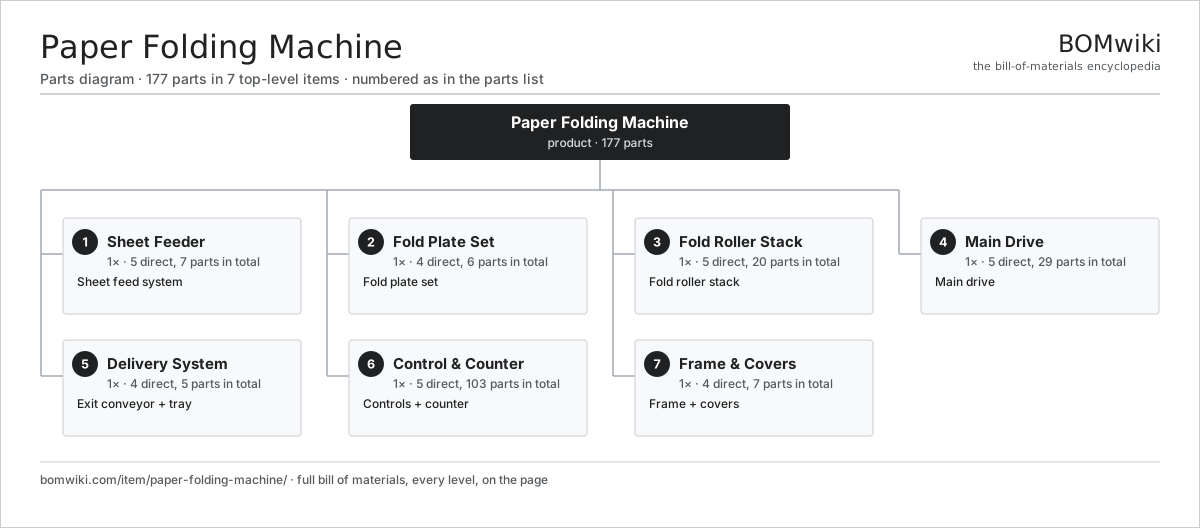
| # | Part | Qty | What it does |
|---|---|---|---|
| 1 | Sheet Feeder 5 parts | 1× | Sheet feed system |
| 2 | Fold Plate Set 4 parts | 1× | Fold plate set |
| 3 | Fold Roller Stack 5 parts | 1× | Fold roller stack |
| 4 | Main Drive 5 parts | 1× | Main drive |
| 5 | Delivery System 4 parts | 1× | Exit conveyor + tray |
| 6 | Control & Counter 5 parts | 1× | Controls + counter |
| 7 | Frame & Covers 4 parts | 1× | Frame + covers |
3D model
No 3D model yet. Have a CAD file of this? Add a 3D model. STL renders right on this page; STEP, FreeCAD, and OpenSCAD sources are welcome too (openly licensed, like all 3D models on BOMwiki).
Build & assembly graph
expand / collapse · shared sub-assemblies converge · links to related products · est. labourTap an assembly to expand/collapse · tap a part to open it · use “Open page” for any node · drag to pan, scroll to zoom.
Bill of materials for Paper Folding Machine
7 top-level lines · 47 rows shown · 177 parts total · indented to 3 levels| # | Item / sub-assembly | Part no. | Qty/assy | Ext. qty | Parts | Type |
|---|---|---|---|---|---|---|
| 1 | Sheet Feeder 5 parts | paper-folding-machine-feeder | 1× | 1 | 7 | assembly |
| 1.1 | Feed Tray | paper-folding-machine-feed-tray | 1× | 1 | · | part |
| 1.2 | Feed Wheel | paper-folding-machine-feed-wheel | 2× | 2 | · | part |
| 1.3 | Separator Pad | paper-folding-machine-separator-pad | 1× | 1 | · | part |
| 1.4 | Stack Side Guides | paper-folding-machine-side-guides | 2× | 2 | · | part |
| 1.5 | Double-Feed Detector | paper-folding-machine-double-detect | 1× | 1 | · | part |
| 2 | Fold Plate Set 4 parts | paper-folding-machine-plates | 1× | 1 | 6 | assembly |
| 2.1 | Fold Plate 1 | paper-folding-machine-plate-1 | 1× | 1 | · | part |
| 2.2 | Fold Plate 2 | paper-folding-machine-plate-2 | 1× | 1 | · | part |
| 2.3 | Fold Plate Stop | paper-folding-machine-plate-stop | 2× | 2 | · | part |
| 2.4 | Plate Deflector | paper-folding-machine-deflector | 2× | 2 | · | part |
| 3 | Fold Roller Stack 5 parts | paper-folding-machine-rollers | 1× | 1 | 20 | assembly |
| 3.1 | Fold Roller | paper-folding-machine-fold-roller | 4× | 4 | · | part |
| 3.2 | Ball Bearing | ball-bearing | 8× | 8 | · | part |
| 3.3 | Helical Gear Pair | gear-pair | 3× | 3 | · | part |
| 3.4 | Coil Spring | coil-spring | 4× | 4 | · | part |
| 3.5 | Roller Gap Adjuster | paper-folding-machine-gap-adjuster | 1× | 1 | · | part |
| 4 | Main Drive 5 parts | paper-folding-machine-drive | 1× | 1 | 29 | assembly |
| 4.1 | Main Drive Motor 4 parts | paper-folding-machine-main-motor | 1× | 1 | 24 | assembly |
| 4.1.1 | Stator Assembly 3 parts + deeper › | stator-assembly | 1× | 1 | 3 | assembly |
| 4.1.2 | Rotor Assembly 4 parts + deeper › | rotor-assembly | 1× | 1 | 19 | assembly |
| 4.1.3 | Copper Winding | copper-winding | 1× | 1 | · | part |
| 4.1.4 | Motor Housing | motor-housing | 1× | 1 | · | part |
| 4.2 | Drive Belt | drive-belt | 2× | 2 | · | part |
| 4.3 | Helical Gear Pair | gear-pair | 1× | 1 | · | part |
| 4.4 | Encoder | encoder | 1× | 1 | · | part |
| 4.5 | Feed Clutch | paper-folding-machine-clutch | 1× | 1 | · | part |
| 5 | Delivery System 4 parts | paper-folding-machine-delivery | 1× | 1 | 5 | assembly |
| 5.1 | Exit Roller Pair | paper-folding-machine-exit-rollers | 1× | 1 | · | part |
| 5.2 | Stacker Wheels | paper-folding-machine-stacker-wheels | 2× | 2 | · | part |
| 5.3 | Delivery Tray | paper-folding-machine-delivery-tray | 1× | 1 | · | part |
| 5.4 | Exit Sensor | paper-folding-machine-exit-sensor | 1× | 1 | · | part |
| 6 | Control & Counter 5 parts | paper-folding-machine-control | 1× | 1 | 103 | assembly |
| 6.1 | Controller PCB 4 parts | paper-folding-machine-control-pcb | 1× | 1 | 98 | assembly |
| 6.1.1 | Bare PCB | pcb-bare | 1× | 1 | · | part |
| 6.1.2 | Microcontroller | mcu | 1× | 1 | · | part |
| 6.1.3 | SMD Passive (R/C/L) | smd-passives | 90× | 90 | · | part |
| 6.1.4 | Connector | connector | 6× | 6 | · | part |
| 6.2 | LCD Panel | lcd-panel | 1× | 1 | · | part |
| 6.3 | Control Keypad | paper-folding-machine-keypad | 1× | 1 | · | part |
| 6.4 | Relay | relay | 2× | 2 | · | part |
| 6.5 | Wire Bundle | wire-bundle | 1× | 1 | · | part |
| 7 | Frame & Covers 4 parts | paper-folding-machine-frame | 1× | 1 | 7 | assembly |
| 7.1 | Side Frame Plates | paper-folding-machine-side-plates | 2× | 2 | · | part |
| 7.2 | Sheet Metal Panel | sheet-panel | 3× | 3 | · | part |
| 7.3 | Cover Interlock Switch | paper-folding-machine-cover-interlock | 1× | 1 | · | part |
| 7.4 | Fastener Set | fastener-set | 1× | 1 | · | part |
Something wrong in this list? Report a problem with this BOM.
Related products
same domain, ranked by shared parts Key Cutting Machine
63 parts · shares 13 with this page
Key Cutting Machine
63 parts · shares 13 with this page
 Money Counting Machine
102 parts · shares 15 with this page
Money Counting Machine
102 parts · shares 15 with this page
 Guillotine Paper Cutter
261 parts · shares 17 with this page
Guillotine Paper Cutter
261 parts · shares 17 with this page
 Pneumatic Tube Station
201 parts · shares 17 with this page
Electronic Safe
243 parts · shares 14 with this page
Pneumatic Tube Station
201 parts · shares 17 with this page
Electronic Safe
243 parts · shares 14 with this page
 Handheld Label Maker
54 parts · shares 14 with this page
Handheld Label Maker
54 parts · shares 14 with this page
Sourcing: possible vendors
Browse the supplier directory → Prices, MOQ, and lead times are algorithmic estimates, not quotes, and not claims about these companies. Company mappings are curated by keyword; est. price band $50–$15k. How estimates work| Vendor | HQ | Specialty | MOQ | Lead time |
|---|---|---|---|---|
|
🇯🇵Canon
canon.com ↗
|
Tokyo, JP | Imaging & optics | 500 units | 8–12 wks |
|
🇯🇵Ricoh
ricoh.com ↗
|
Tokyo, JP | Office imaging | 500 units | 8–12 wks |
|
🇺🇸Xerox
xerox.com ↗
|
Norwalk, US | Printers & copiers | 500 units | 8–12 wks |
|
🇯🇵Epson
epson.com ↗
|
Suwa, JP | Printers & projectors | 500 units | 8–12 wks |
|
🇯🇵Brother
brother.com ↗
|
Nagoya, JP | Printers & sewing | 500 units | 8–12 wks |
782-word article