Shopping Cart
ProductOverview
The retail shopping cart is a fundamental tool in grocery and general merchandise retail, designed to maximize customer carrying capacity while maintaining maneuverability, safety, and efficient storage. Modern carts combine a large wire basket for visibility, swivel casters for tight aisle turning, an integrated child seat for family shopping, and a nesting system that allows rapid storage and retrieval. A typical store may operate 150–300 carts in rotation, with fleet management including regular inspection, maintenance, and replacement of worn wheels and fasteners.
The standard four-wheel design balances lateral stability against turning agility. Two swivel casters at the rear enable 360-degree pivoting, while two fixed front casters prevent sideways wandering during straight-line pushing. This configuration allows experienced shoppers to execute tight corral docking with minimal floor contact, reducing space and labor.
How it Works
A customer enters the store and retrieves a Shopping Cart from the corral, a racked stack of up to 10 nested carts. The customer uses the Nesting Lock Pin to release the cart, which disengages from the cart above it. The cart rolls forward into the store.
The Chassis & Frame is the structural spine. Two main longitudinal beams (1.5" OD tube) run the full length, cross-braced with three transverse members welded at the bottom. Four Caster Mount Bracket brackets are welded to the chassis, each accepting a caster assembly. The two rear-corner brackets receive swivel casters, allowing the entire rear end of the cart to rotate independently. The two front-corner brackets receive fixed casters, which can only move forward and backward.
The Wire Basket sits atop the chassis, connected by bolts at the perimeter. The basket is a rectangular cage of 0.5" diameter welded steel rod: vertical members define the corners and sides, horizontal cross-members provide the floor, and the top rail ring serves as both structural closure and mounting point for the handle and child seat. The wire-grid design is open to customer sight lines, allowing shoppers to see products and the floor beneath.
The Push Handle is attached to two brackets bolted to the front of the chassis. The handle tube runs at 30–45 degrees from horizontal, allowing the customer to push with a natural arm angle. The handle includes a Height Lock Collar collar with three click-stop positions: low position for children (35"), standard position (38"), and tall position (40") for customers over 6 feet. A Handle Pivot Pin allows the handle to swing slightly, absorbing minor impacts without transmitting shock to the customer's wrist.
Two elastomer Grip Sleeve sleeves slip over the handle tube, providing a non-slip surface and reducing hand fatigue during extended shopping trips.
The Child Seat is mounted above the front portion of the basket on two L-brackets. The seat is a molded HDPE bucket (350×250 mm) angled at 45 degrees, with a Safety Lap Belt lap belt and a Child Foot Rest platform. A parent can hoist a child (up to 50 lb) into the seat, secure the belt, and then push the cart. The seat's position keeps the child visible while shopping and prevents interference with bagged or boxed products in the basket.
When the customer is done shopping, they queue at the Checkout Lane Conveyor to pay. The cashier scans products and bags them directly into the cart or into separate bags placed in the child seat area. The customer then exits and returns the cart to the corral.
At the corral, the customer aligns their empty cart with the stack. Two Nesting Guide Rail rails (molded plastic channels) run along the sides of each cart, guiding the incoming cart's basket into the open space above the parked cart. Once aligned, the customer presses down on the handle, sliding the cart fully into the nest. The Nesting Lock Pin (spring-loaded) automatically engages under gravity, locking the nested cart in place. The customer releases the Pin Handle Knob knob, and the pin retracts. Up to 10 carts can nest in a footprint of only 2 m² (about 6 feet × 3 feet × 8 feet tall).
Key Subsystems
The Caster & Wheel Assembly is the primary wear component. Each of the four casters contains a Ball Bearing sealed hub and a Wheel with polyurethane or elastomer tread. The two swivel casters rotate freely at any angle; the two fixed casters move only forward and backward. Under normal store conditions, wheel tread wears flat, bearing grease dries out, and axle pins bend. Most stores replace wheels and casters every 18–24 months, or sooner in high-traffic locations. The Axle Pin is a consumable stainless steel item preventing accidental wheel loss due to bearing wear.
The Wire Basket is typically zinc-plated or epoxy-coated to resist corrosion from moisture, cleaning agents, and produce juice. The spot-welded construction creates strong joints but cannot be disassembled; if a rod cracks or a weld fails, the entire basket is scrapped and recycled. Carts in good condition last 5–7 years of continuous fleet use.
The Chassis & Frame is the heaviest component, made from welded tubing for durability. Rust and corrosion are the primary degradation modes. Store maintenance staff inspect the underside quarterly, scrubbing off salt residue and applying touch-up paint. Bolts connecting the basket to the chassis are checked annually and re-torqued if loose.
The Nesting & Storage System allows rapid storage and retrieval. The guide rails are molded plastic riveted to the basket sides, and the locking pin is a simple spring-return plunger. Occasional pin sticking is the most common maintenance issue, solved by cleaning the pin bore and applying light lubrication. A worn or stuck pin can prevent safe nesting, creating a safety hazard for staff loading or retrieving carts.
The Child Seat is a secondary component but heavily used in family-oriented retail. The seat shell occasionally cracks from child climbing or impact; replacement shells are inexpensive (under $50) and bolt on in minutes. The safety belt must be inspected regularly for fraying or buckle failure, as a loose child is a liability.
Fleet Management
Larger retailers (supermarkets, warehouse clubs) operate dedicated cart management teams. In the morning, staff inspect all nested carts for visible damage, test caster mobility, and check that child seats are secure. Carts with flat tires or non-rolling casters are segregated for repair. Damaged baskets or bent chassis are sent to a scrap facility or external refurbisher.
Throughout the day, staff periodically "round up" carts from the parking lot (where customers abandon them), hose them down with high-pressure water to remove dirt and debris, and return them to the corral. At shift end, staff dock and nest all remaining carts, ensuring the corral is full for the next morning.
In high-traffic stores, cart demand can exceed supply during peak hours (weekends, holidays). Many retailers maintain a 25–50% surplus to ensure sufficient carts are always available. When cart inventory drops below threshold, the team orders replacement units or arranges for third-party rental carts.
Related Products
Shopping carts integrate with Checkout Lane Conveyor systems at the point of sale, where cashiers scan items directly from the cart into bags. The cart's nesting geometry is designed to fit the corral footprint, often located near the store entrance. In some retail formats, carts are equipped with RFID tags for automatic fleet tracking, preventing unauthorized removal from the parking lot.
Specialized carts for bulk or warehouse use adapt this same basic design with larger baskets (up to 40 cubic feet), heavier-duty wheels, or bifold nesting gates. Carts for specialty retail (clothing, hardware, office supplies) may have shorter baskets or tiered shelving instead of a single open bin.
Safety standards (ASTM F2290) govern design load, caster performance, and warning labels. Stores must display maximum weight limits and child supervision warnings prominently on the cart.
Shopping Cart parts and their functions
7 top-level parts · 120 parts in total · full bill of materials below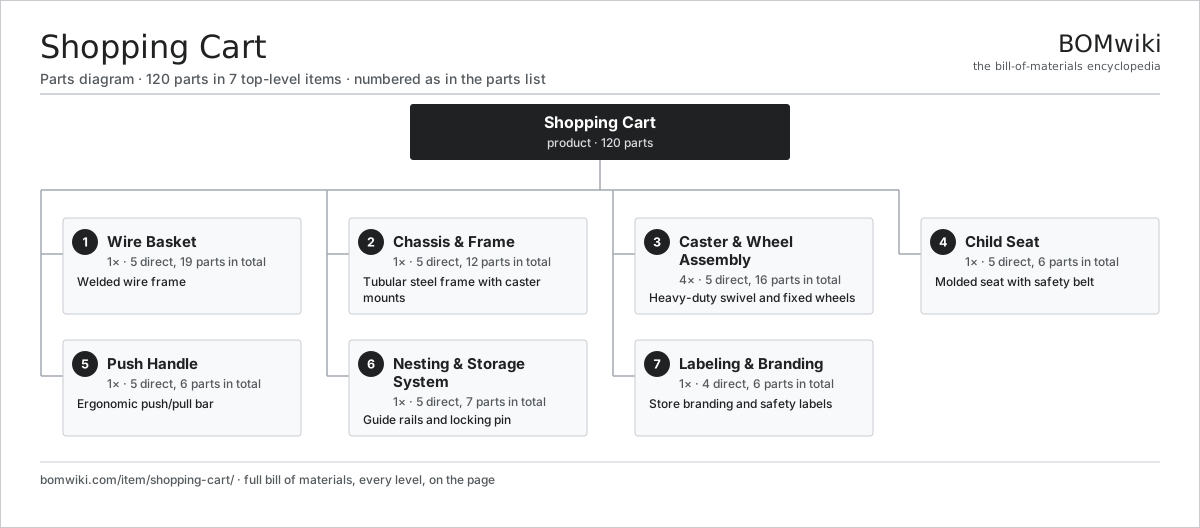
| # | Part | Qty | What it does |
|---|---|---|---|
| 1 | Wire Basket 5 parts | 1× | Welded wire frame |
| 2 | Chassis & Frame 5 parts | 1× | Tubular steel frame with caster mounts |
| 3 | Caster & Wheel Assembly 5 parts | 4× | Heavy-duty swivel and fixed wheels |
| 4 | Child Seat 5 parts | 1× | Molded seat with safety belt |
| 5 | Push Handle 5 parts | 1× | Ergonomic push/pull bar |
| 6 | Nesting & Storage System 5 parts | 1× | Guide rails and locking pin |
| 7 | Labeling & Branding 4 parts | 1× | Store branding and safety labels |
3D model
No 3D model yet. Have a CAD file of this? Add a 3D model. STL renders right on this page; STEP, FreeCAD, and OpenSCAD sources are welcome too (openly licensed, like all 3D models on BOMwiki).
Build & assembly graph
expand / collapse · shared sub-assemblies converge · links to related products · est. labourTap an assembly to expand/collapse · tap a part to open it · use “Open page” for any node · drag to pan, scroll to zoom.
Bill of materials for Shopping Cart
7 top-level lines · 41 rows shown · 120 parts total · indented to 3 levels| # | Item / sub-assembly | Part no. | Qty/assy | Ext. qty | Parts | Type |
|---|---|---|---|---|---|---|
| 1 | Wire Basket 5 parts | shopping-cart-basket-assembly | 1× | 1 | 19 | assembly |
| 1.1 | Wire Rod Stock | shopping-cart-wire-rod | 12× | 12 | · | part |
| 1.2 | Base Wire Floor Panel | shopping-cart-base-wire-grid | 1× | 1 | · | part |
| 1.3 | Side Wire Panel | shopping-cart-side-wire-grid | 4× | 4 | · | part |
| 1.4 | Top Perimeter Rail | shopping-cart-top-rail | 1× | 1 | · | part |
| 1.5 | Fastener Set | fastener-set | 1× | 1 | · | part |
| 2 | Chassis & Frame 5 parts | shopping-cart-chassis | 1× | 1 | 12 | assembly |
| 2.1 | Main Chassis Beam | shopping-cart-main-beam | 2× | 2 | · | part |
| 2.2 | Cross Brace Member | shopping-cart-cross-brace | 3× | 3 | · | part |
| 2.3 | Caster Mount Bracket | shopping-cart-caster-mount-plate | 4× | 4 | · | part |
| 2.4 | Handle Mounting Bracket | shopping-cart-handle-bracket | 2× | 2 | · | part |
| 2.5 | Fastener Set | fastener-set | 1× | 1 | · | part |
| 3 | Caster & Wheel Assembly 5 parts | shopping-cart-caster-set | 4× | 4 | 16 | assembly |
| 3.1 | Swivel Caster | shopping-cart-swivel-caster | 2× | 8 | · | part |
| 3.2 | Fixed Caster | shopping-cart-fixed-caster | 2× | 8 | · | part |
| 3.3 | Wheel | shopping-cart-wheel | 4× | 16 | · | part |
| 3.4 | Ball Bearing | ball-bearing | 4× | 16 | · | part |
| 3.5 | Axle Pin | shopping-cart-axle-pin | 4× | 16 | · | part |
| 4 | Child Seat 5 parts | shopping-cart-child-seat | 1× | 1 | 6 | assembly |
| 4.1 | Seat Shell | shopping-cart-seat-shell | 1× | 1 | · | part |
| 4.2 | Seat Mounting Bracket | shopping-cart-seat-bracket | 2× | 2 | · | part |
| 4.3 | Safety Lap Belt | shopping-cart-safety-belt | 1× | 1 | · | part |
| 4.4 | Child Foot Rest | shopping-cart-foot-rest | 1× | 1 | · | part |
| 4.5 | Fastener Set | fastener-set | 1× | 1 | · | part |
| 5 | Push Handle 5 parts | shopping-cart-handle-assembly | 1× | 1 | 6 | assembly |
| 5.1 | Handle Tube | shopping-cart-handle-tube | 1× | 1 | · | part |
| 5.2 | Grip Sleeve | shopping-cart-grip-rubber | 2× | 2 | · | part |
| 5.3 | Handle Pivot Pin | shopping-cart-pivot-pin | 1× | 1 | · | part |
| 5.4 | Height Lock Collar | shopping-cart-height-lock | 1× | 1 | · | part |
| 5.5 | Fastener Set | fastener-set | 1× | 1 | · | part |
| 6 | Nesting & Storage System 5 parts | shopping-cart-nesting-system | 1× | 1 | 7 | assembly |
| 6.1 | Nesting Guide Rail | shopping-cart-nesting-guide | 2× | 2 | · | part |
| 6.2 | Nesting Lock Pin | shopping-cart-locking-pin | 1× | 1 | · | part |
| 6.3 | Pin Handle Knob | shopping-cart-pin-handle | 1× | 1 | · | part |
| 6.4 | Nesting Buffer Pad | shopping-cart-nesting-spacer | 2× | 2 | · | part |
| 6.5 | Fastener Set | fastener-set | 1× | 1 | · | part |
| 7 | Labeling & Branding 4 parts | shopping-cart-decals | 1× | 1 | 6 | assembly |
| 7.1 | Logo Decal | shopping-cart-logo-decal | 1× | 1 | · | part |
| 7.2 | Safety Warning Label | shopping-cart-safety-label | 3× | 3 | · | part |
| 7.3 | Inventory Barcode | shopping-cart-barcode-label | 1× | 1 | · | part |
| 7.4 | Decal Adhesive & Clear Coat | shopping-cart-adhesive-tape | 1× | 1 | · | part |
Something wrong in this list? Report a problem with this BOM.
Sourcing: possible vendors
Browse the supplier directory → Prices, MOQ, and lead times are algorithmic estimates, not quotes, and not claims about these companies. Company mappings are curated by keyword; est. price band $50–$15k. How estimates work| Vendor | HQ | Specialty | MOQ | Lead time |
|---|---|---|---|---|
|
🇯🇵Canon
canon.com ↗
|
Tokyo, JP | Imaging & optics | 500 units | 8–12 wks |
|
🇯🇵Ricoh
ricoh.com ↗
|
Tokyo, JP | Office imaging | 500 units | 8–12 wks |
|
🇺🇸Xerox
xerox.com ↗
|
Norwalk, US | Printers & copiers | 500 units | 8–12 wks |
|
🇯🇵Epson
epson.com ↗
|
Suwa, JP | Printers & projectors | 500 units | 8–12 wks |
|
🇯🇵Brother
brother.com ↗
|
Nagoya, JP | Printers & sewing | 500 units | 8–12 wks |
1,342-word article