Box Fan
ProductOverview
A box fan is a square-framed axial fan built into a flat plastic or steel housing that can stand on the floor or sit in a window opening. The square shape lets it fill a typical lower window sash, where it either pulls cooler outdoor air in or pushes warm indoor air out. Most consumer models use a Frame Assembly measuring 20 inches (508 mm) on a side, with a depth of about 90 mm, and weigh 3 to 4 kg. The design has changed little in decades because it is cheap to make, moves a large volume of air for the power it draws, and has almost nothing to wear out.
The fan pulls air through the Rear Frame, accelerates it with a five-blade Blade Assembly, and discharges it through the Front Frame. A AC Motor Assembly sits on a central Motor Mount Bracket that spans the frame. Two Wire Guard grilles, one front and one rear, keep fingers away from the blade. A rotary Speed Switch Assembly on the rear pod selects three speeds, and a Power Cord Assembly feeds it from the wall. A Carry Handle on the top edge lets the user move it between rooms or windows.
How it works
The heart of the fan is a AC Motor Assembly built around a shaded-pole induction motor, the simplest practical AC motor. Its Stator Core is a stack of silicon-steel laminations with salient poles. The Main Winding energises those poles, but a plain single-phase field cannot start a rotor turning on its own because it pulses rather than rotates. The fix is the Shading Coil, a shorted loop of copper around part of each pole tip. Current induced in that loop lags the main field, so the magnetic peak sweeps across the pole face from the unshaded side to the shaded side. That moving peak gives the Squirrel-Cage Rotor a definite direction to follow, and the die-cast aluminium squirrel cage starts and runs.
The rotor sits on a Motor Shaft supported by two Sleeve Bearing bushings, one in each Motor End Bell. The bushings are sintered bronze soaked in oil, so they need no maintenance over the life of the fan. The Blade Hub keys onto the shaft through a D-shaped bore and is held by a Hub Retaining Clip. The five Fan Blade vanes are moulded in one piece with the hub at a fixed pitch, which keeps the part count and cost low.
Speed control is done the cheap way. The Rotary Switch taps the Main Winding at different points, changing the effective turns and therefore the torque the motor develops. Lower torque lets the blade settle at a lower speed against the same air load, so the three positions give roughly 900, 1100, and 1300 RPM. There is no electronic speed control and no capacitor, which is why a shaded-pole fan hums at line frequency and runs warm. A Thermal Fuse buried in the winding opens permanently if the motor overheats, for instance if the blade jams, protecting the fan from catching fire.
Frame and blade
The Front Frame and Rear Frame are injection-moulded polypropylene halves that clamp together around the Motor Mount Bracket. Polypropylene is used because it is tough, light, and survives the flexing that comes from being carried and dropped. The bracket is a stamped steel cross-brace strong enough to hold the motor centred under load without sagging. Two Base Foot mouldings let the fan stand on the floor, and four Rubber Bumper inserts at the corners damp vibration and stop the frame buzzing against a window sill.
The Fan Blade set is a five-vane axial impeller. Five blades are a compromise: fewer blades are noisier and move less air, while more blades cost more to mould and add drag without much extra flow at these speeds. The blades are pitched shallowly, around 25 degrees, because a shaded-pole motor has little starting torque and cannot spin a steeply pitched blade up to speed. The result is high airflow, between 1500 and 2500 CFM on high, at modest static pressure, which suits open-room circulation rather than pushing air through ducting.
Guards and controls
Each Wire Guard is a spot-welded Guard Grille of steel wire bonded to a rolled Guard Ring. Wire spacing follows finger-probe safety rules so that a child's finger cannot reach the blade. The ring snaps to the frame with four Guard Clip springs, which lets the front guard come off for cleaning, the one job a box fan reliably needs, since the open blade collects dust and lint quickly.
The Speed Switch Assembly mounts in a pod on the Rear Frame. A Rotary Switch with detents drives a Switch Knob marked off, low, medium, and high, and a Switch Bezel trims the opening. Internal Wire Bundle leads with crimped Connector terminals carry the winding taps to the switch. The Power Cord Assembly adds a Power Cord of roughly 1.8 m, a moulded Mains Plug, and a Strain Relief grommet so a tug on the cord cannot pull the conductors off the switch.
Use and limitations
A box fan is most useful as a whole-room or window-exchange fan. Placed in a window facing out on the warm side of a house and matched by an open window on the cooler side, it sets up a cross-breeze that flushes hot air at night. Pointed into a room it circulates air to make a space feel cooler without lowering the actual temperature. The downsides follow from the simple motor: shaded-pole designs are only 20 to 40 percent efficient, so the fan draws 50 to 100 W to do what a brushless Ceiling Fan motor would do for a fraction of the power. It is also fixed in direction unless lifted and turned, and it cannot oscillate. For quiet, swept airflow a tower or Bladeless Fan is the alternative, at several times the price. Where cost and air volume matter more than efficiency or noise, the box fan remains the most common moving-air appliance in the home.
Box Fan parts and their functions
8 top-level parts · 52 parts in total · full bill of materials below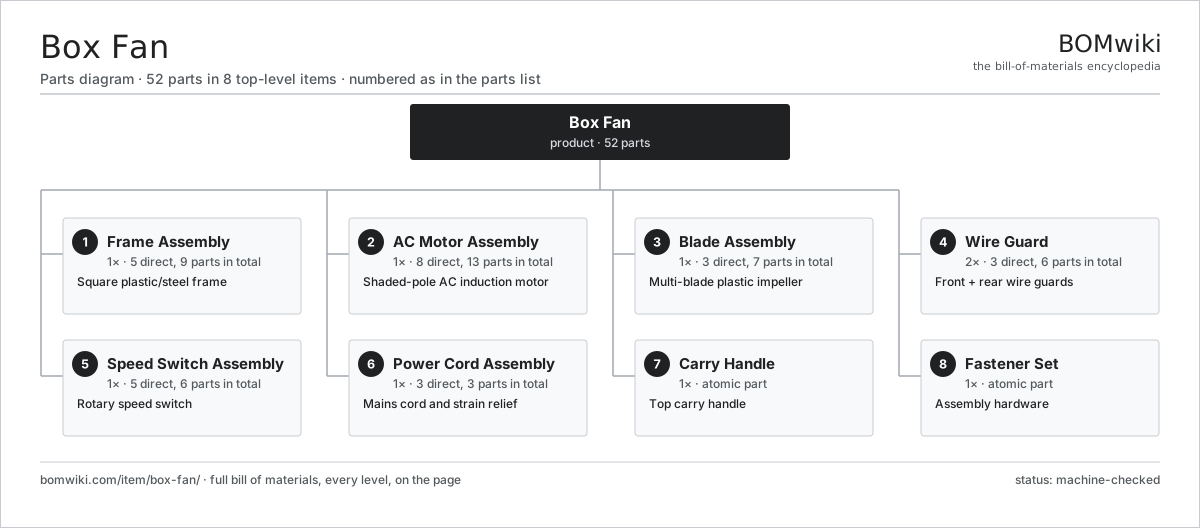
| # | Part | Qty | What it does |
|---|---|---|---|
| 1 | Frame Assembly 5 parts | 1× | Square plastic/steel frame |
| 2 | AC Motor Assembly 8 parts | 1× | Shaded-pole AC induction motor |
| 3 | Blade Assembly 3 parts | 1× | Multi-blade plastic impeller |
| 4 | Wire Guard 3 parts | 2× | Front + rear wire guards |
| 5 | Speed Switch Assembly 5 parts | 1× | Rotary speed switch |
| 6 | Power Cord Assembly 3 parts | 1× | Mains cord and strain relief |
| 7 | Carry Handle | 1× | Top carry handle |
| 8 | Fastener Set | 1× | Assembly hardware |
3D model
No 3D model yet. Have a CAD file of this? Add a 3D model. STL renders right on this page; STEP, FreeCAD, and OpenSCAD sources are welcome too (openly licensed, like all 3D models on BOMwiki).
Build & assembly graph
expand / collapse · shared sub-assemblies converge · links to related products · est. labourTap an assembly to expand/collapse · tap a part to open it · use “Open page” for any node · drag to pan, scroll to zoom.
Bill of materials for Box Fan
8 top-level lines · 35 rows shown · 52 parts total · indented to 3 levels| # | Item / sub-assembly | Part no. | Qty/assy | Ext. qty | Parts | Type |
|---|---|---|---|---|---|---|
| 1 | Frame Assembly 5 parts | box-fan-frame-assembly | 1× | 1 | 9 | assembly |
| 1.1 | Front Frame | box-fan-front-frame | 1× | 1 | · | part |
| 1.2 | Rear Frame | box-fan-rear-frame | 1× | 1 | · | part |
| 1.3 | Motor Mount Bracket | box-fan-motor-mount-bracket | 1× | 1 | · | part |
| 1.4 | Base Foot | box-fan-foot | 2× | 2 | · | part |
| 1.5 | Rubber Bumper | box-fan-rubber-bumper | 4× | 4 | · | part |
| 2 | AC Motor Assembly 8 parts | box-fan-motor-assembly | 1× | 1 | 13 | assembly |
| 2.1 | Stator Core | box-fan-stator-core | 1× | 1 | · | part |
| 2.2 | Main Winding | box-fan-main-winding | 1× | 1 | · | part |
| 2.3 | Shading Coil | box-fan-shading-coil | 4× | 4 | · | part |
| 2.4 | Squirrel-Cage Rotor | box-fan-rotor | 1× | 1 | · | part |
| 2.5 | Motor Shaft | box-fan-motor-shaft | 1× | 1 | · | part |
| 2.6 | Motor End Bell | box-fan-motor-end-bell | 2× | 2 | · | part |
| 2.7 | Sleeve Bearing | box-fan-sleeve-bearing | 2× | 2 | · | part |
| 2.8 | Thermal Fuse | box-fan-thermal-fuse | 1× | 1 | · | part |
| 3 | Blade Assembly 3 parts | box-fan-blade-assembly | 1× | 1 | 7 | assembly |
| 3.1 | Blade Hub | box-fan-blade-hub | 1× | 1 | · | part |
| 3.2 | Fan Blade | box-fan-blade | 5× | 5 | · | part |
| 3.3 | Hub Retaining Clip | box-fan-hub-clip | 1× | 1 | · | part |
| 4 | Wire Guard 3 parts | box-fan-guard-assembly | 2× | 2 | 6 | assembly |
| 4.1 | Guard Grille | box-fan-guard-grille | 1× | 2 | · | part |
| 4.2 | Guard Ring | box-fan-guard-ring | 1× | 2 | · | part |
| 4.3 | Guard Clip | box-fan-guard-clip | 4× | 8 | · | part |
| 5 | Speed Switch Assembly 5 parts | box-fan-switch-assembly | 1× | 1 | 6 | assembly |
| 5.1 | Rotary Switch | box-fan-rotary-switch | 1× | 1 | · | part |
| 5.2 | Switch Knob | box-fan-switch-knob | 1× | 1 | · | part |
| 5.3 | Switch Bezel | box-fan-switch-bezel | 1× | 1 | · | part |
| 5.4 | Wire Bundle | wire-bundle | 1× | 1 | · | part |
| 5.5 | Connector | connector | 2× | 2 | · | part |
| 6 | Power Cord Assembly 3 parts | box-fan-cord-assembly | 1× | 1 | 3 | assembly |
| 6.1 | Power Cord | box-fan-power-cord | 1× | 1 | · | part |
| 6.2 | Mains Plug | box-fan-mains-plug | 1× | 1 | · | part |
| 6.3 | Strain Relief | box-fan-strain-relief | 1× | 1 | · | part |
| 7 | Carry Handle | box-fan-carry-handle | 1× | 1 | · | part |
| 8 | Fastener Set | fastener-set | 1× | 1 | · | part |
Sourcing: possible vendors
Browse the supplier directory → Prices, MOQ, and lead times are algorithmic estimates, not quotes, and not claims about these companies. Company mappings are curated by keyword; est. price band $150–$3k. How estimates work| Vendor | HQ | Specialty | MOQ | Lead time |
|---|---|---|---|---|
| whirlpoolcorp.com ↗ | Benton Harbor, US | Home appliances | 1,000 units | 8–14 wks |
| bsh-group.com ↗ | Munich, DE | Appliances (Bosch, Siemens) | 1,000 units | 8–14 wks |
| electroluxgroup.com ↗ | Stockholm, SE | Home appliances | 1,000 units | 8–14 wks |
| lg.com ↗ | Seoul, KR | Appliances & electronics | 1,000 units | 8–14 wks |
|
🇨🇳Haier
haier.com ↗
|
Qingdao, CN | Home appliances | 1,000 units | 8–14 wks |
1,103-word article