Bladeless Fan
ProductOverview
A bladeless fan is a tower fan that hides its impeller inside the base and projects a smooth, steady stream of air out of a hollow loop with no visible moving parts. The name is a marketing term rather than an engineering one, because the fan does contain a fast-spinning impeller, just one the user never touches or sees. The benefit is real: there is no exposed blade to clean or to catch fingers, the airflow is far less choppy than a bladed fan, and the loop can oscillate quietly. A typical unit stands 70 to 110 cm tall, draws 20 to 65 W, and projects 300 to 700 CFM at the loop face.
Air enters through the Base Assembly, is pressurised by the Impeller Assembly, and is released through a thin slot around the inside of the Air Loop Assembly. A Control Board runs the motor and the user interface, a Oscillation Assembly sweeps the loop side to side, and a Acoustic Assembly suppresses the whine that a high-speed impeller would otherwise make audible.
How it works
The physics is the same air-multiplier effect used in some industrial blowers. The Impeller Assembly pulls room air through the Intake Grille and pressurises it inside the base. That pressurised air is fed up into the hollow Air Loop Assembly, which is sealed except for a continuous slot about 1.3 mm wide running around the inner edge of the Loop Rear Shell. Forcing the air through that narrow gap accelerates it into a thin, fast sheet.
The inner face of the loop is shaped by the Airfoil Ramp into a curved ramp, much like an aircraft wing. As the slot jet hugs that curved surface it stays attached and turns to flow across the open centre of the ring, an effect called the Coanda effect. The fast-moving sheet drags the still air immediately around it into motion through viscous shear, a process called entrainment. Air just behind the loop is also drawn forward by the low pressure the jet leaves behind, which is called induction. Between entrainment in front and induction behind, the volume of air leaving the front of the loop is roughly fifteen times the volume the impeller actually pushed through the slot. That is the multiplication that lets a modest impeller deliver a large, smooth column of moving air.
Impeller and motor
The pressure that drives the whole effect comes from the Impeller Assembly. Its Impeller Wheel is a glass-filled nylon mixed-flow impeller, a shape between a pure axial fan and a centrifugal blower, chosen because it produces both useful flow and the static pressure needed to push air through the narrow slot. A fixed Diffuser Stage downstream straightens the swirling discharge and recovers more of it as pressure. The wheel can turn up to about 30000 RPM, far faster than any open blade could safely run, which is exactly why it has to be enclosed in the Motor Bucket.
Driving it is a Brushless DC Motor, a brushless DC motor built from a Stator Assembly and a permanent-magnet Rotor Assembly running on two Ball Bearing supports around a balanced Motor Shaft. Three Hall Sensor devices report the rotor angle so the controller knows when to switch each phase. A brushless motor is used instead of the cheap shaded-pole motor in a Box Fan for three reasons: it can reach the very high speed the impeller needs, it is efficient enough to keep total draw under about 65 W, and its speed can be set precisely in software. The motor hangs in a rubber Motor Mount so its vibration does not reach the Base Shell.
Base and oscillation
The Base Assembly does more than hold the fan up. Its Base Shell forms the pressurised plenum that feeds the loop, the Intake Grille admits room air, and a washable Intake Filter keeps dust off the impeller, which matters because deposits unbalance a wheel spinning at 30000 RPM. A cast iron Base Ballast at the bottom lowers the centre of gravity so the tall fan does not tip, and a Base Foot Pad ring grips the floor.
Oscillation is handled by the Oscillation Assembly. A Oscillation Stepper Motor drives a Helical Gear Pair reduction that rotates the Turntable carrying the loop and base through a sweep the user can set between 70 and 350 degrees. Because the air column travels up through the rotating joint, a Slip Coupling keeps the path sealed while the platter turns, and a Coil Spring holds the mechanism against backlash so the sweep is smooth.
Electronics and acoustics
The Control Board carries the Microcontroller that runs the fan, the Inverter Stage that commutates the brushless motor, and a Power Supply that converts mains to the DC rails. SMD Passive (R/C/L) handle filtering and timing. The user controls the fan through a Touch Panel on the base and a handheld remote read by the IR Receiver. Ten speed steps and a sleep timer are all set in software by varying the motor speed, which is why a bladeless fan can be turned down far quieter than a bladed fan with mechanical speed taps.
Noise is the main engineering challenge, because a 30000 RPM impeller produces a sharp blade-pass tone that would be unpleasant if left untreated. The Acoustic Assembly addresses it. A Helmholtz Cavity is tuned to cancel the dominant tone the way a bottle neck resonates at one pitch, an open-cell Acoustic Liner absorbs the broadband hiss along the air path, and an Inlet Baffle straightens incoming air so the impeller meets clean flow rather than turbulence. Together these keep a well-designed unit between 40 and 58 dB across its range, quiet enough to run in a bedroom at low speed. The trade-off against a Box Fan is cost: the brushless motor, the precision loop tooling, and the acoustic work put a bladeless fan at several times the price for similar room airflow.
Bladeless Fan parts and their functions
8 top-level parts · 64 parts in total · full bill of materials below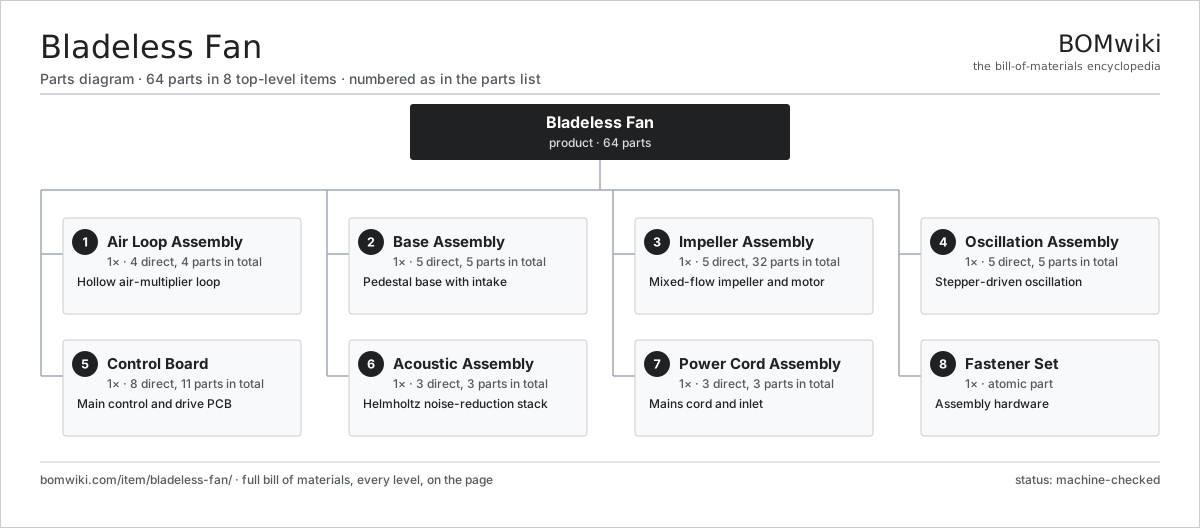
| # | Part | Qty | What it does |
|---|---|---|---|
| 1 | Air Loop Assembly 4 parts | 1× | Hollow air-multiplier loop |
| 2 | Base Assembly 5 parts | 1× | Pedestal base with intake |
| 3 | Impeller Assembly 5 parts | 1× | Mixed-flow impeller and motor |
| 4 | Oscillation Assembly 5 parts | 1× | Stepper-driven oscillation |
| 5 | Control Board 8 parts | 1× | Main control and drive PCB |
| 6 | Acoustic Assembly 3 parts | 1× | Helmholtz noise-reduction stack |
| 7 | Power Cord Assembly 3 parts | 1× | Mains cord and inlet |
| 8 | Fastener Set | 1× | Assembly hardware |
3D model
No 3D model yet. Have a CAD file of this? Add a 3D model. STL renders right on this page; STEP, FreeCAD, and OpenSCAD sources are welcome too (openly licensed, like all 3D models on BOMwiki).
Build & assembly graph
expand / collapse · shared sub-assemblies converge · links to related products · est. labourTap an assembly to expand/collapse · tap a part to open it · use “Open page” for any node · drag to pan, scroll to zoom.
Bill of materials for Bladeless Fan
8 top-level lines · 46 rows shown · 64 parts total · indented to 3 levels| # | Item / sub-assembly | Part no. | Qty/assy | Ext. qty | Parts | Type |
|---|---|---|---|---|---|---|
| 1 | Air Loop Assembly 4 parts | bladeless-fan-loop-assembly | 1× | 1 | 4 | assembly |
| 1.1 | Loop Front Shell | bladeless-fan-loop-front-shell | 1× | 1 | · | part |
| 1.2 | Loop Rear Shell | bladeless-fan-loop-rear-shell | 1× | 1 | · | part |
| 1.3 | Airfoil Ramp | bladeless-fan-loop-airfoil-ramp | 1× | 1 | · | part |
| 1.4 | Plenum Seal | bladeless-fan-loop-plenum-seal | 1× | 1 | · | part |
| 2 | Base Assembly 5 parts | bladeless-fan-base-assembly | 1× | 1 | 5 | assembly |
| 2.1 | Base Shell | bladeless-fan-base-shell | 1× | 1 | · | part |
| 2.2 | Intake Grille | bladeless-fan-intake-grille | 1× | 1 | · | part |
| 2.3 | Intake Filter | bladeless-fan-intake-filter | 1× | 1 | · | part |
| 2.4 | Base Ballast | bladeless-fan-base-weight | 1× | 1 | · | part |
| 2.5 | Base Foot Pad | bladeless-fan-base-foot | 1× | 1 | · | part |
| 3 | Impeller Assembly 5 parts | bladeless-fan-impeller-assembly | 1× | 1 | 32 | assembly |
| 3.1 | Brushless DC Motor 5 parts | bladeless-fan-motor | 1× | 1 | 28 | assembly |
| 3.1.1 | Stator Assembly 3 parts + deeper › | stator-assembly | 1× | 1 | 3 | assembly |
| 3.1.2 | Rotor Assembly 4 parts + deeper › | rotor-assembly | 1× | 1 | 19 | assembly |
| 3.1.3 | Ball Bearing | ball-bearing | 2× | 2 | · | part |
| 3.1.4 | Motor Shaft | bladeless-fan-motor-shaft | 1× | 1 | · | part |
| 3.1.5 | Hall Sensor | bladeless-fan-hall-sensor | 3× | 3 | · | part |
| 3.2 | Impeller Wheel | bladeless-fan-impeller-wheel | 1× | 1 | · | part |
| 3.3 | Diffuser Stage | bladeless-fan-diffuser-stage | 1× | 1 | · | part |
| 3.4 | Motor Bucket | bladeless-fan-motor-bucket | 1× | 1 | · | part |
| 3.5 | Motor Mount | bladeless-fan-motor-mount | 1× | 1 | · | part |
| 4 | Oscillation Assembly 5 parts | bladeless-fan-oscillation-assembly | 1× | 1 | 5 | assembly |
| 4.1 | Oscillation Stepper Motor | bladeless-fan-oscillation-stepper | 1× | 1 | · | part |
| 4.2 | Helical Gear Pair | gear-pair | 1× | 1 | · | part |
| 4.3 | Turntable | bladeless-fan-turntable | 1× | 1 | · | part |
| 4.4 | Slip Coupling | bladeless-fan-slip-coupling | 1× | 1 | · | part |
| 4.5 | Coil Spring | coil-spring | 1× | 1 | · | part |
| 5 | Control Board 8 parts | bladeless-fan-control-board | 1× | 1 | 11 | assembly |
| 5.1 | Bare PCB | pcb-bare | 1× | 1 | · | part |
| 5.2 | Microcontroller | mcu | 1× | 1 | · | part |
| 5.3 | SMD Passive (R/C/L) | smd-passives | 1× | 1 | · | part |
| 5.4 | Inverter Stage | bladeless-fan-inverter-stage | 1× | 1 | · | part |
| 5.5 | Power Supply | power-supply | 1× | 1 | · | part |
| 5.6 | IR Receiver | bladeless-fan-ir-receiver | 1× | 1 | · | part |
| 5.7 | Touch Panel | bladeless-fan-touch-panel | 1× | 1 | · | part |
| 5.8 | Connector | connector | 4× | 4 | · | part |
| 6 | Acoustic Assembly 3 parts | bladeless-fan-acoustic-assembly | 1× | 1 | 3 | assembly |
| 6.1 | Helmholtz Cavity | bladeless-fan-helmholtz-cavity | 1× | 1 | · | part |
| 6.2 | Acoustic Liner | bladeless-fan-acoustic-liner | 1× | 1 | · | part |
| 6.3 | Inlet Baffle | bladeless-fan-inlet-baffle | 1× | 1 | · | part |
| 7 | Power Cord Assembly 3 parts | bladeless-fan-cord-assembly | 1× | 1 | 3 | assembly |
| 7.1 | Power Cord | bladeless-fan-power-cord | 1× | 1 | · | part |
| 7.2 | Mains Inlet | bladeless-fan-mains-inlet | 1× | 1 | · | part |
| 7.3 | Strain Relief | bladeless-fan-strain-relief | 1× | 1 | · | part |
| 8 | Fastener Set | fastener-set | 1× | 1 | · | part |
Related products
same domain, ranked by shared parts Portable Washing Machine
167 parts · shares 12 with this page
Portable Washing Machine
167 parts · shares 12 with this page
 Stand Fan
70 parts · shares 12 with this page
Gas Clothes Dryer
99 parts · shares 12 with this page
Stand Fan
70 parts · shares 12 with this page
Gas Clothes Dryer
99 parts · shares 12 with this page
 Misting Fan
116 parts · shares 11 with this page
Misting Fan
116 parts · shares 11 with this page
 Top-Load Washing Machine
214 parts · shares 11 with this page
Top-Load Washing Machine
214 parts · shares 11 with this page
 Trash Compactor
85 parts · shares 10 with this page
Trash Compactor
85 parts · shares 10 with this page
Sourcing: possible vendors
Browse the supplier directory → Prices, MOQ, and lead times are algorithmic estimates, not quotes, and not claims about these companies. Company mappings are curated by keyword; est. price band $150–$3k. How estimates work| Vendor | HQ | Specialty | MOQ | Lead time |
|---|---|---|---|---|
| whirlpoolcorp.com ↗ | Benton Harbor, US | Home appliances | 1,000 units | 8–14 wks |
| bsh-group.com ↗ | Munich, DE | Appliances (Bosch, Siemens) | 1,000 units | 8–14 wks |
| electroluxgroup.com ↗ | Stockholm, SE | Home appliances | 1,000 units | 8–14 wks |
| lg.com ↗ | Seoul, KR | Appliances & electronics | 1,000 units | 8–14 wks |
|
🇨🇳Haier
haier.com ↗
|
Qingdao, CN | Home appliances | 1,000 units | 8–14 wks |
1,070-word article