Gas Cooktop
ProductOverview
A gas cooktop is a drop-in cooking surface that sits in a countertop cutout and burns natural gas or propane to heat cookware directly. Unlike a freestanding range, it has no oven beneath it; the cabinet space below is free for drawers or a separate wall oven. Most units carry four or five sealed burners spanning a range of outputs so the cook can sear on a power burner near 18,000 BTU/h and hold a sauce on a simmer burner near 5,000 BTU/h. The appeal of gas is immediate, visible flame control and instant response when the flame is turned down, which is why it remains common in both home and light commercial kitchens.
The unit is built from a handful of subsystems. The Burner System produces the flame, the Gas Manifold and Valve Train meters fuel to each burner, the Electronic Ignition System lights the gas and verifies the flame, the Cooktop Deck and Grates is the cleanable surface the user sees, the Control and Safety System sets and safeguards each flame, and the Base Pan and Mounting holds everything in the counter.
Burner and combustion
Each sealed burner is a small partial-premix combustion device. Gas leaves a Burner Orifice as a high-velocity jet, drawing primary air through the Burner Base by entrainment. The mixture rises into the burner head, where the Burner Cap and the drilled Burner Flame Ring shape it into a ring of small flames. Secondary air drawn from around the burner completes combustion at the flame tips. Output is set by the orifice diameter and the manifold pressure: a High-Output Burner Head uses a larger orifice and more ports than a Simmer Burner Head. A Flame Spreader keeps the flame even around the full circle so heat reaches the whole pan base.
Sealed burners differ from the older open-burner design in that the burner sits in a gasketed well rather than over a removable bowl. Spills stay on the deck surface and wipe off instead of running into the base pan, which is the main reason sealed burners dominate modern designs.
Gas train and fuel control
Gas enters through the Gas Inlet Fitting and passes the Pressure Regulator, which holds a steady 4 inches of water column for natural gas regardless of small fluctuations in line pressure. From there the Gas Manifold Tube feeds each Burner Gas Valve. The valve is a tapered plug or rotary type whose opening grows as the knob rotates from off through high to simmer, giving the smooth proportional control gas cooks expect. Converting between fuels is a defined procedure: the LP Conversion Kit swaps in smaller orifices and changes the regulator spring so the unit runs correctly on propane at 10 inches of water column. An O-Ring Set seals the valve stems and manifold joints so no gas escapes inside the chassis.
Ignition and flame safety
When a knob is turned to its light position, the Spark Ignition Module fires the Spark Electrode at that burner several times per second until combustion is detected. On many units a single push-to-turn motion on the Control Knob both opens the valve and triggers the spark. Once lit, a Flame Sensor confirms the flame by rectifying a small current through the conductive flame or by the millivolt output of a thermocouple. If that signal disappears, the thermoelectric Flame-Failure Safety Valve closes within seconds and stops the gas, the core safety function that prevents raw fuel from flowing if a flame is blown out. The Ignition Harness carries spark voltage to the electrodes while a Wire Bundle carries low-voltage signals to the module.
Deck, grates, and cleanability
The visible surface is the Cooktop Deck Panel, usually brushed stainless steel or porcelain-enameled steel. Continuous cast-iron grates, each a Cast-Iron Grate, span the burners so heavy pots can slide between zones without lifting. A Burner Seal and a Drip Collar keep boil-overs on top of the deck, and the Trim Frame finishes the edges. Matte black grates and recessed knobs have become the common look because they hide cooking marks and wipe clean.
Installation and chassis
Below the deck, a formed Sheet Metal Panel base pan encloses the wiring and gas train. The unit drops into a standard 30 or 36 inch cutout and is held from below by a Mounting Clip at each corner, while a Perimeter Gasket seals the gap to the countertop. A Fastener Set holds the internal subassemblies together. The gas line and a 120 V outlet for the ignition module must both reach the cutout, which is the main constraint when planning a kitchen around a gas cooktop.
Variants and use
Sizes run from compact two-burner units to professional-style 36 inch models with five or six burners and grates that bridge the entire surface. Higher-end designs add a center oval burner for griddles, brass burner caps for durability, and continuous grates in cast iron rather than enameled steel. Because the cooktop is independent of any oven, it pairs naturally with a separate wall oven, giving the cook flexible placement and counter height while keeping the responsive flame control that defines gas cooking.
Gas Cooktop parts and their functions
6 top-level parts · 89 parts in total · full bill of materials below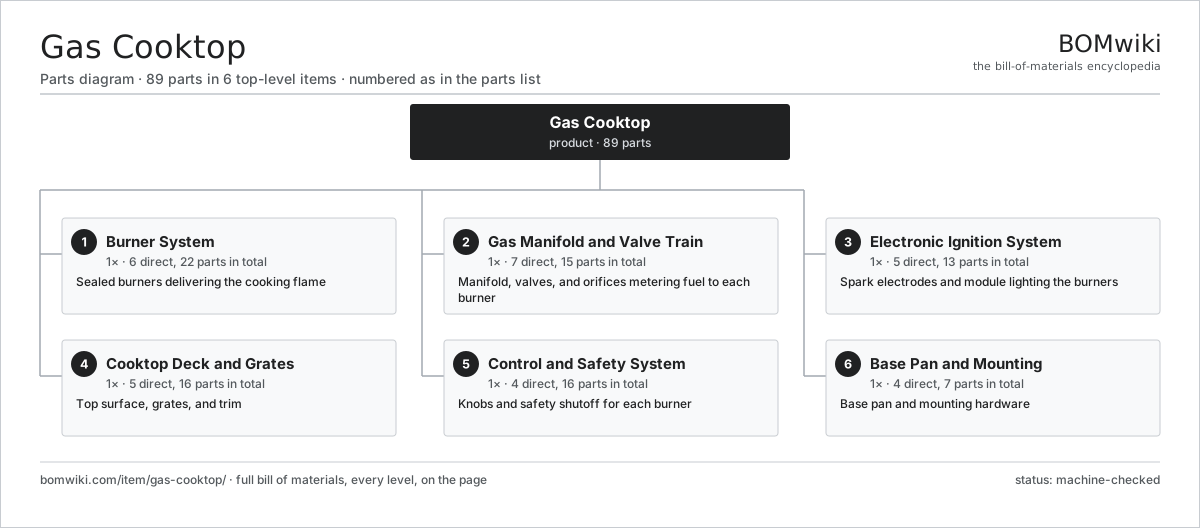
| # | Part | Qty | What it does |
|---|---|---|---|
| 1 | Burner System 6 parts | 1× | Sealed burners delivering the cooking flame |
| 2 | Gas Manifold and Valve Train 7 parts | 1× | Manifold, valves, and orifices metering fuel to each burner |
| 3 | Electronic Ignition System 5 parts | 1× | Spark electrodes and module lighting the burners |
| 4 | Cooktop Deck and Grates 5 parts | 1× | Top surface, grates, and trim |
| 5 | Control and Safety System 4 parts | 1× | Knobs and safety shutoff for each burner |
| 6 | Base Pan and Mounting 4 parts | 1× | Base pan and mounting hardware |
3D model
No 3D model yet. Have a CAD file of this? Add a 3D model. STL renders right on this page; STEP, FreeCAD, and OpenSCAD sources are welcome too (openly licensed, like all 3D models on BOMwiki).
Build & assembly graph
expand / collapse · shared sub-assemblies converge · links to related products · est. labourTap an assembly to expand/collapse · tap a part to open it · use “Open page” for any node · drag to pan, scroll to zoom.
Bill of materials for Gas Cooktop
6 top-level lines · 37 rows shown · 89 parts total · indented to 3 levels| # | Item / sub-assembly | Part no. | Qty/assy | Ext. qty | Parts | Type |
|---|---|---|---|---|---|---|
| 1 | Burner System 6 parts | gas-cooktop-burner-system | 1× | 1 | 22 | assembly |
| 1.1 | Burner Base | gas-cooktop-burner-base | 5× | 5 | · | part |
| 1.2 | Burner Cap | gas-cooktop-burner-cap | 5× | 5 | · | part |
| 1.3 | Burner Flame Ring | gas-cooktop-burner-ring | 5× | 5 | · | part |
| 1.4 | High-Output Burner Head | gas-cooktop-burner-head-high | 1× | 1 | · | part |
| 1.5 | Simmer Burner Head | gas-cooktop-burner-head-simmer | 1× | 1 | · | part |
| 1.6 | Flame Spreader | gas-cooktop-flame-spreader | 5× | 5 | · | part |
| 2 | Gas Manifold and Valve Train 7 parts | gas-cooktop-gas-train | 1× | 1 | 15 | assembly |
| 2.1 | Gas Manifold Tube | gas-cooktop-manifold-tube | 1× | 1 | · | part |
| 2.2 | Burner Gas Valve | gas-cooktop-gas-valve | 5× | 5 | · | part |
| 2.3 | Burner Orifice | gas-cooktop-burner-orifice | 5× | 5 | · | part |
| 2.4 | LP Conversion Kit | gas-cooktop-lp-conversion-kit | 1× | 1 | · | part |
| 2.5 | Pressure Regulator | gas-cooktop-pressure-regulator | 1× | 1 | · | part |
| 2.6 | Gas Inlet Fitting | gas-cooktop-inlet-fitting | 1× | 1 | · | part |
| 2.7 | O-Ring Set | oring-set | 1× | 1 | · | part |
| 3 | Electronic Ignition System 5 parts | gas-cooktop-ignition-system | 1× | 1 | 13 | assembly |
| 3.1 | Spark Ignition Module | gas-cooktop-spark-module | 1× | 1 | · | part |
| 3.2 | Spark Electrode | gas-cooktop-spark-electrode | 5× | 5 | · | part |
| 3.3 | Flame Sensor | gas-cooktop-flame-sensor | 5× | 5 | · | part |
| 3.4 | Ignition Harness | gas-cooktop-ignition-harness | 1× | 1 | · | part |
| 3.5 | Wire Bundle | wire-bundle | 1× | 1 | · | part |
| 4 | Cooktop Deck and Grates 5 parts | gas-cooktop-cooktop-deck | 1× | 1 | 16 | assembly |
| 4.1 | Cooktop Deck Panel | gas-cooktop-deck-panel | 1× | 1 | · | part |
| 4.2 | Cast-Iron Grate | gas-cooktop-grate | 4× | 4 | · | part |
| 4.3 | Burner Seal | gas-cooktop-burner-seal | 5× | 5 | · | part |
| 4.4 | Drip Collar | gas-cooktop-drip-collar | 5× | 5 | · | part |
| 4.5 | Trim Frame | gas-cooktop-trim-frame | 1× | 1 | · | part |
| 5 | Control and Safety System 4 parts | gas-cooktop-control-system | 1× | 1 | 16 | assembly |
| 5.1 | Control Knob | gas-cooktop-control-knob | 5× | 5 | · | part |
| 5.2 | Knob Coupling Shaft | gas-cooktop-knob-shaft | 5× | 5 | · | part |
| 5.3 | Flame-Failure Safety Valve | gas-cooktop-safety-valve | 5× | 5 | · | part |
| 5.4 | Control Bezel | gas-cooktop-control-bezel | 1× | 1 | · | part |
| 6 | Base Pan and Mounting 4 parts | gas-cooktop-chassis | 1× | 1 | 7 | assembly |
| 6.1 | Sheet Metal Panel | sheet-panel | 1× | 1 | · | part |
| 6.2 | Mounting Clip | gas-cooktop-mounting-clip | 4× | 4 | · | part |
| 6.3 | Perimeter Gasket | gas-cooktop-perimeter-gasket | 1× | 1 | · | part |
| 6.4 | Fastener Set | fastener-set | 1× | 1 | · | part |
Related products
same domain, ranked by shared parts


Sourcing: possible vendors
Browse the supplier directory → Prices, MOQ, and lead times are algorithmic estimates, not quotes, and not claims about these companies. Company mappings are curated by keyword; est. price band $150–$3k. How estimates work| Vendor | HQ | Specialty | MOQ | Lead time |
|---|---|---|---|---|
| whirlpoolcorp.com ↗ | Benton Harbor, US | Home appliances | 1,000 units | 8–14 wks |
| bsh-group.com ↗ | Munich, DE | Appliances (Bosch, Siemens) | 1,000 units | 8–14 wks |
| electroluxgroup.com ↗ | Stockholm, SE | Home appliances | 1,000 units | 8–14 wks |
| lg.com ↗ | Seoul, KR | Appliances & electronics | 1,000 units | 8–14 wks |
|
🇨🇳Haier
haier.com ↗
|
Qingdao, CN | Home appliances | 1,000 units | 8–14 wks |
912-word article