DMX Dimmer Rack
ProductOverview
Dimmer racks are the power-conditioning backbone of stage lighting systems. A dimmer rack receives low-voltage DMX512 control signals and converts them into proportional AC power output to each fixture. Professional dimmers use silicon-controlled rectifier (SCR) phase-control technology to vary the voltage delivered to incandescent and halogen lamps in real time, allowing operators to smoothly fade lighting levels from 0 to 100 percent.
The DMX Dimmer Rack is a 24-channel dimmer system designed for mid-to-large theater venues, concert halls, and broadcast studios. Each channel independently modulates AC power delivered to a luminaire, responding to incoming DMX512 commands with programmable fade curves and response times. The rack operates from three-phase 208V or single-phase 240V service, delivering up to 115 kW total when all 24 channels run at full brightness.
SCR Phase Control
The core dimming technology in the DMX Dimmer Rack is the silicon-controlled rectifier, or thyristor. Unlike simple rheostats (which would dissipate tremendous heat and noise), an SCR is a semiconductor switch that conducts during a controlled portion of the AC waveform. The Control and Logic Board monitors the AC line voltage with a zero-crossing detector and triggers the SCR Dimmer Channel at a precise phase angle on each cycle. By varying the trigger delay from 0 to 180 degrees, the circuit modulates the RMS voltage delivered to the load.
For example, at a 90-degree firing angle, the SCR conducts during the latter half of the positive and negative half-cycles, delivering roughly 50 percent RMS voltage. A 45-degree firing angle yields approximately 80 percent voltage. This phase-control approach generates high-frequency current harmonics and some audible noise due to the rapid turn-on edge, but it is the industry standard for theatrical dimming because it is highly efficient, extremely robust, and able to control a wide range of lamp types without special transformers.
Architecture
The Chassis and Rack Frame houses all dimming modules in a compact 19-inch wide, 3U-tall steel chassis. Four identical Dimmer Bank (6-Channel) modules are stacked vertically, each containing six independent dimming channels. A large aluminum Dimmer Heatsink Assembly extends across the top of the chassis, dissipating the conductive and switching losses from all 24 SCRs. Forced-air cooling from the Thermal Management System system pulls ambient air through the heatsink and exits through the rear panel, keeping junction temperatures within safe operating limits even during continuous operation at full load.
DMX Control Flow
The DMX Input Module receives DMX512 serial data via an XLR-3 connector at 250 kbaud. An RS485 transceiver with optical isolation decodes the protocol and buffers the 512 incoming channel values into microcontroller RAM. The Control and Logic Board then executes a firmware loop that:
- Reads the current DMX value for each dimmer channel.
- Applies any stored fade curve or delay from the console.
- Computes the required SCR firing angle for that brightness level.
- Synchronizes the Gate Drive Circuit pulse to the next zero-crossing.
- Monitors the Current Sense Module circuit for over-current or open-circuit conditions.
Update frequency is 44 Hz (synchronized with DMX frame rate), guaranteeing smooth visual fade without perceptible flicker.
Safety and Protection
The Power Entry Module includes a 100A Main Breaker Assembly that interrupts all downstream circuits if total load current exceeds 100A continuously. Each dimmer channel is also fused at the terminal block. An EMI Filter on the incoming three-phase line suppresses conducted and radiated EMI, protecting other equipment in the venue from harmonics.
The Current Sense Module module monitors RMS current on each channel; if a load exceeds 25A (indicating a short circuit or lamp failure), the control firmware logs an alarm and halts dimming commands for that channel until manually cleared.
Typical Deployment
A theater house with 32 lighting positions uses two DMX Dimmer Rack units (48 channels total) mounted in a central rack room near the stage. Two four-pair DMX512 cables distribute command signals from the lighting console to each rack's input. Heavy-gauge (2 AWG) power cables route from the Power Entry Module to individual circuit-breaker panels feeding lighting positions throughout the venue. During a show, operators on the console assign specific fixtures to DMX channels and fade brightness values; the dimmer racks translate those commands into proportional AC power in real time.
Harmonic and Thermal Considerations
SCR phase-control dimming loads generate odd-order harmonics (3rd, 5th, 7th) that can propagate upstream into the building's electrical system, potentially affecting sensitive equipment nearby. Venues with strict power-quality requirements may install additional line reactors or active harmonic filters. Thermally, a fully loaded DMX Dimmer Rack dissipates approximately 8 kW as waste heat during continuous 50 percent average dimming (the worst-case thermal scenario); the cooling system must exhaust this through the rear panel to prevent internal junction temperatures exceeding 80°C.
DMX Dimmer Rack parts and their functions
6 top-level parts · 71 parts in total · full bill of materials below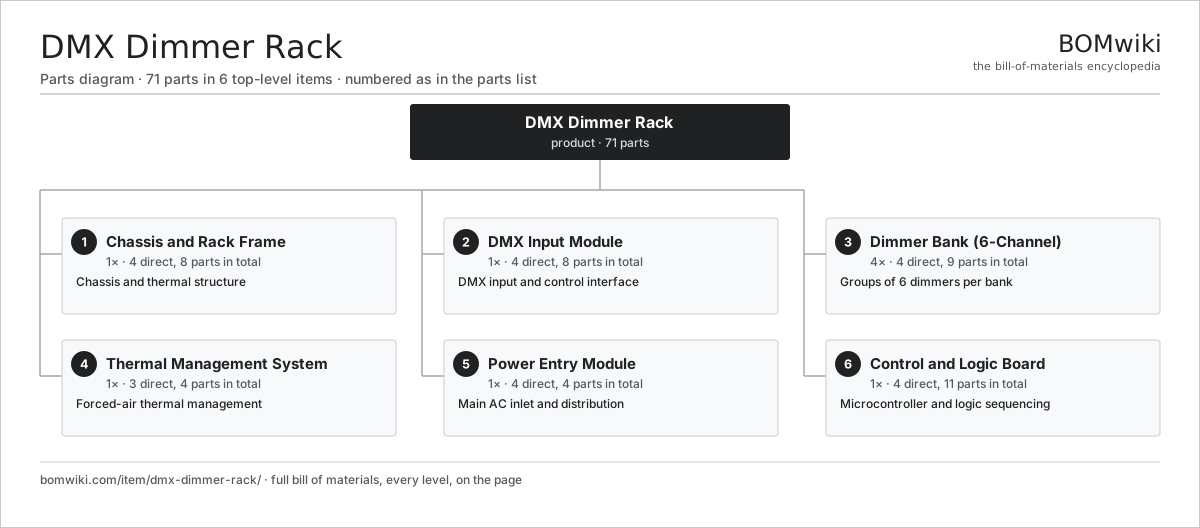
| # | Part | Qty | What it does |
|---|---|---|---|
| 1 | Chassis and Rack Frame 4 parts | 1× | Chassis and thermal structure |
| 2 | DMX Input Module 4 parts | 1× | DMX input and control interface |
| 3 | Dimmer Bank (6-Channel) 4 parts | 4× | Groups of 6 dimmers per bank |
| 4 | Thermal Management System 3 parts | 1× | Forced-air thermal management |
| 5 | Power Entry Module 4 parts | 1× | Main AC inlet and distribution |
| 6 | Control and Logic Board 4 parts | 1× | Microcontroller and logic sequencing |
3D model
No 3D model yet. Have a CAD file of this? Add a 3D model. STL renders right on this page; STEP, FreeCAD, and OpenSCAD sources are welcome too (openly licensed, like all 3D models on BOMwiki).
Build & assembly graph
expand / collapse · shared sub-assemblies converge · links to related products · est. labourTap an assembly to expand/collapse · tap a part to open it · use “Open page” for any node · drag to pan, scroll to zoom.
Bill of materials for DMX Dimmer Rack
6 top-level lines · 29 rows shown · 71 parts total · indented to 3 levels| # | Item / sub-assembly | Part no. | Qty/assy | Ext. qty | Parts | Type |
|---|---|---|---|---|---|---|
| 1 | Chassis and Rack Frame 4 parts | dmx-dimmer-rack-frame | 1× | 1 | 8 | assembly |
| 1.1 | Sheet Metal Panel | sheet-panel | 4× | 4 | · | part |
| 1.2 | Fastener Set | fastener-set | 2× | 2 | · | part |
| 1.3 | Dimmer Heatsink Assembly | dmx-dimmer-rack-heatsink | 1× | 1 | · | part |
| 1.4 | O-Ring Set | oring-set | 1× | 1 | · | part |
| 2 | DMX Input Module 4 parts | dmx-dimmer-rack-io-module | 1× | 1 | 8 | assembly |
| 2.1 | Connector | connector | 2× | 2 | · | part |
| 2.2 | Bare PCB | pcb-bare | 1× | 1 | · | part |
| 2.3 | Power MOSFET | mosfet | 4× | 4 | · | part |
| 2.4 | Relay | relay | 1× | 1 | · | part |
| 3 | Dimmer Bank (6-Channel) 4 parts | dmx-dimmer-rack-dimmer-bank | 4× | 4 | 9 | assembly |
| 3.1 | SCR Dimmer Channel | dmx-dimmer-rack-scr-dimmer | 6× | 24 | · | part |
| 3.2 | Gate Drive Circuit | dmx-dimmer-rack-gate-drive | 1× | 4 | · | part |
| 3.3 | Current Sense Module | dmx-dimmer-rack-current-sense | 1× | 4 | · | part |
| 3.4 | Fastener Set | fastener-set | 1× | 4 | · | part |
| 4 | Thermal Management System 3 parts | dmx-dimmer-rack-cooling | 1× | 1 | 4 | assembly |
| 4.1 | Blower Motor | blower-motor | 2× | 2 | · | part |
| 4.2 | Pressure Sensor | pressure-sensor | 1× | 1 | · | part |
| 4.3 | Fastener Set | fastener-set | 1× | 1 | · | part |
| 5 | Power Entry Module 4 parts | dmx-dimmer-rack-power-entry | 1× | 1 | 4 | assembly |
| 5.1 | Connector | connector | 1× | 1 | · | part |
| 5.2 | Main Breaker Assembly | dmx-dimmer-rack-breaker | 1× | 1 | · | part |
| 5.3 | EMI Filter | dmx-dimmer-rack-emf-filter | 1× | 1 | · | part |
| 5.4 | Fastener Set | fastener-set | 1× | 1 | · | part |
| 6 | Control and Logic Board 4 parts | dmx-dimmer-rack-control-pcb | 1× | 1 | 11 | assembly |
| 6.1 | Microcontroller | mcu | 1× | 1 | · | part |
| 6.2 | Bare PCB | pcb-bare | 1× | 1 | · | part |
| 6.3 | Power MOSFET | mosfet | 8× | 8 | · | part |
| 6.4 | SMD Passive (R/C/L) | smd-passives | 1× | 1 | · | part |
Something wrong in this list? Report a problem with this BOM.
Related products
same domain, ranked by shared parts Stage Lighting Console
163 parts · shares 6 with this page
Stage Lighting Console
163 parts · shares 6 with this page
 Confetti Cannon
28 parts · shares 3 with this page
Confetti Cannon
28 parts · shares 3 with this page
 Laser Show Projector
36 parts · shares 3 with this page
CO2 Jet
84 parts · shares 2 with this page
Laser Show Projector
36 parts · shares 3 with this page
CO2 Jet
84 parts · shares 2 with this page
 Fog Machine
25 parts · shares 2 with this page
Fog Machine
25 parts · shares 2 with this page
 Professional Power Amplifier
52 parts · shares 3 with this page
Professional Power Amplifier
52 parts · shares 3 with this page
Sourcing: possible vendors
Browse the supplier directory → Prices, MOQ, and lead times are algorithmic estimates, not quotes, and not claims about these companies. Company mappings are curated by keyword; est. price band $50–$3k. How estimates work| Vendor | HQ | Specialty | MOQ | Lead time |
|---|---|---|---|---|
|
🇯🇵Sony
sony.com ↗
|
Tokyo, JP | Consumer electronics | 1,000 units | 8–12 wks |
| samsung.com ↗ | Suwon, KR | Electronics & displays | 1,000 units | 8–12 wks |
|
🇺🇸Harman
harman.com ↗
|
Stamford, US | Audio (JBL, AKG) | 1,000 units | 8–12 wks |
|
🇺🇸Bose
bose.com ↗
|
Framingham, US | Audio | 1,000 units | 8–12 wks |
| yamaha.com ↗ | Hamamatsu, JP | Audio & instruments | 1,000 units | 8–12 wks |
841-word article