Choke Manifold
ProductOverview
A choke manifold is the pressure-control workhorse that sits downstream of a blowout preventer. When a well kicks and the BOP closes, the formation influx still has to be circulated out, and the only way to do that safely is to let the well flow through a small, adjustable restriction that holds backpressure on the wellbore while mud and gas escape at a controlled rate. That restriction is the choke, and the manifold is the arrangement of valves and piping that routes flow to one of several chokes, isolates any of them for repair, and delivers the discharge to the mud-gas separator or flare.
The manifold is built as a self-contained Manifold Skid connected to the BOP stack's choke line. A typical drilling configuration carries two Manual Adjustable Choke units and one Hydraulic Remote Choke, arranged in parallel branches off a central Flow Cross, with Gate Valve Set isolation on both sides of every choke. API Specification 16C governs the design; working pressures of 5,000, 10,000, and 15,000 psi match the BOP stack rating.
How it works
During a kick circulation, the driller pumps kill mud down the drill string while the well returns flow up the annulus, out the choke line, and through one choke. The choke operator watches drill-pipe and casing pressure on the Instrumentation and adjusts the choke opening continuously: opening it lowers backpressure, closing it raises backpressure. The goal is to keep bottomhole pressure just above formation pressure, enough to stop further influx without fracturing the open hole. Pressure drops of 5,000 psi or more across a single orifice are routine.
The Manual Adjustable Choke does this with a tapered tungsten-carbide Choke Needle advancing into a matching Choke Seat. The Handwheel sets the position, read on a Position Indicator graduated in 64ths of an inch of equivalent orifice, the industry's standard choke unit, so "open to 24/64ths" means a 3/8 in orifice. Carbide trim is essential: mud laden with sand crossing a 5,000 psi differential erodes ordinary steel in minutes, while carbide seats last through a full kill operation and are replaced as cartridges afterward.
The Hydraulic Remote Choke replaces the needle with rotating Gate Plate Trim discs, two carbide plates with eccentric ports whose overlap sets the flow area. A Choke Actuator driven from a remote console on the rig floor positions the trim, and a Position Transmitter plus upstream and downstream Pressure Sensor transmitters give the operator everything needed to control the kill from a safe distance. Remote operation matters because the manifold area is loud, potentially gassy, and directly in the line of fire if erosion cuts through a component.
Valves, piping, and erosion management
Every branch is bounded by full-bore Gate Valve Body units, API 6A slab-gate valves in which a Valve Gate slides between two floating Valve Seat rings. Double valves upstream of each choke allow one to be worked routinely while the second stays as a backup seal. With both chokes isolated, a straight-through bypass branch can flow the well wide open to the separator, used when pressure must be dumped faster than any choke allows.
The piping uses forged Flow Tee and Flow Cross blocks and flanged Pipe Spool pieces, every joint sealed by a metal Ring Gasket in a BX ring groove, elastomers cannot survive the pressure and gas exposure. Flow direction changes are handled by target-style tees whose blind faces wear sacrificially instead of letting the flow cut through a bend. Downstream of the chokes, the Buffer Chamber chamber catches the discharge jet: gas exiting a 15,000 psi choke approaches sonic velocity, and the replaceable Target Plate inside the Buffer Body absorbs that impingement before flow exits through the Buffer Outlet lines toward the mud-gas separator.
Materials and testing
Sour service drives the metallurgy. Wells producing hydrogen sulfide require NACE MR0175 compliance, controlled-hardness low-alloy steels (typically 4130 at 22 HRC maximum) so sulfide stress cracking cannot initiate. Material class EE or FF per API 6A covers the wetted components, and temperature class P+U spans −29 to 121 °C for arctic-to-desert deployment.
Each manifold is hydrostatically tested to 1.5 times working pressure at the factory, and field-tested with the BOP stack on the same 21-day cycle: low-pressure seat tests at 250–350 psi, then full rated pressure held against closed gates. The Pressure Gauge instruments are protected by Gauge Isolator diaphragms that keep mud solids out of the Bourdon tubes, and the whole assembly is restrained on its Skid Frame by clamped Pipe Support points, because slug flow through the manifold can shake unrestrained piping violently enough to crack welds.
Choke Manifold parts and their functions
7 top-level parts · 179 parts in total · full bill of materials below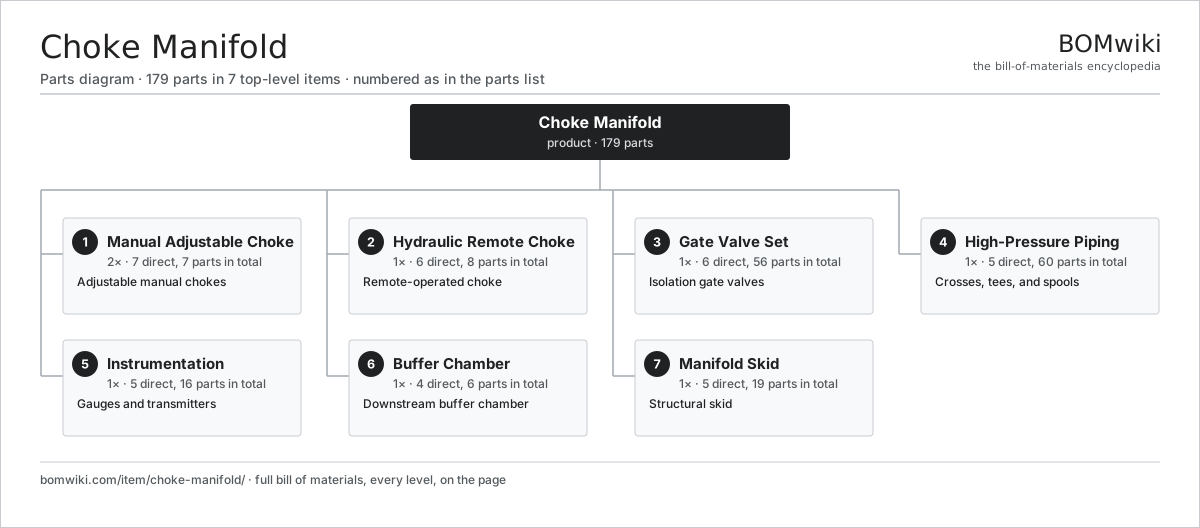
| # | Part | Qty | What it does |
|---|---|---|---|
| 1 | Manual Adjustable Choke 7 parts | 2× | Adjustable manual chokes |
| 2 | Hydraulic Remote Choke 6 parts | 1× | Remote-operated choke |
| 3 | Gate Valve Set 6 parts | 1× | Isolation gate valves |
| 4 | High-Pressure Piping 5 parts | 1× | Crosses, tees, and spools |
| 5 | Instrumentation 5 parts | 1× | Gauges and transmitters |
| 6 | Buffer Chamber 4 parts | 1× | Downstream buffer chamber |
| 7 | Manifold Skid 5 parts | 1× | Structural skid |
3D model
No 3D model yet. Have a CAD file of this? Add a 3D model. STL renders right on this page; STEP, FreeCAD, and OpenSCAD sources are welcome too (openly licensed, like all 3D models on BOMwiki).
Build & assembly graph
expand / collapse · shared sub-assemblies converge · links to related products · est. labourTap an assembly to expand/collapse · tap a part to open it · use “Open page” for any node · drag to pan, scroll to zoom.
Bill of materials for Choke Manifold
7 top-level lines · 45 rows shown · 179 parts total · indented to 3 levels| # | Item / sub-assembly | Part no. | Qty/assy | Ext. qty | Parts | Type |
|---|---|---|---|---|---|---|
| 1 | Manual Adjustable Choke 7 parts | choke-manifold-manual-choke | 2× | 2 | 7 | assembly |
| 1.1 | Choke Body | choke-manifold-choke-body | 1× | 2 | · | part |
| 1.2 | Choke Needle | choke-manifold-needle | 1× | 2 | · | part |
| 1.3 | Choke Seat | choke-manifold-seat | 1× | 2 | · | part |
| 1.4 | Handwheel | choke-manifold-handwheel | 1× | 2 | · | part |
| 1.5 | Position Indicator | choke-manifold-position-indicator | 1× | 2 | · | part |
| 1.6 | Choke Bonnet | choke-manifold-choke-bonnet | 1× | 2 | · | part |
| 1.7 | O-Ring Set | oring-set | 1× | 2 | · | part |
| 2 | Hydraulic Remote Choke 6 parts | choke-manifold-hydraulic-choke | 1× | 1 | 8 | assembly |
| 2.1 | Choke Body | choke-manifold-choke-body | 1× | 1 | · | part |
| 2.2 | Gate Plate Trim | choke-manifold-gate-plate | 2× | 2 | · | part |
| 2.3 | Choke Actuator | choke-manifold-choke-actuator | 1× | 1 | · | part |
| 2.4 | Position Transmitter | choke-manifold-position-transmitter | 1× | 1 | · | part |
| 2.5 | Pressure Sensor | pressure-sensor | 2× | 2 | · | part |
| 2.6 | O-Ring Set | oring-set | 1× | 1 | · | part |
| 3 | Gate Valve Set 6 parts | choke-manifold-gate-valve-set | 1× | 1 | 56 | assembly |
| 3.1 | Gate Valve Body | choke-manifold-gate-valve | 8× | 8 | · | part |
| 3.2 | Valve Gate | choke-manifold-valve-gate | 8× | 8 | · | part |
| 3.3 | Valve Seat | choke-manifold-valve-seat | 16× | 16 | · | part |
| 3.4 | Valve Stem | choke-manifold-valve-stem | 8× | 8 | · | part |
| 3.5 | O-Ring Set | oring-set | 8× | 8 | · | part |
| 3.6 | Fastener Set | fastener-set | 8× | 8 | · | part |
| 4 | High-Pressure Piping 5 parts | choke-manifold-piping | 1× | 1 | 60 | assembly |
| 4.1 | Flow Cross | choke-manifold-cross | 2× | 2 | · | part |
| 4.2 | Flow Tee | choke-manifold-tee | 4× | 4 | · | part |
| 4.3 | Pipe Spool | choke-manifold-spool | 6× | 6 | · | part |
| 4.4 | Ring Gasket | choke-manifold-ring-gasket | 24× | 24 | · | part |
| 4.5 | Fastener Set | fastener-set | 24× | 24 | · | part |
| 5 | Instrumentation 5 parts | choke-manifold-instrumentation | 1× | 1 | 16 | assembly |
| 5.1 | Pressure Gauge | choke-manifold-gauge | 4× | 4 | · | part |
| 5.2 | Gauge Isolator | choke-manifold-gauge-isolator | 4× | 4 | · | part |
| 5.3 | Pressure Sensor | pressure-sensor | 3× | 3 | · | part |
| 5.4 | Wire Bundle | wire-bundle | 1× | 1 | · | part |
| 5.5 | Connector | connector | 4× | 4 | · | part |
| 6 | Buffer Chamber 4 parts | choke-manifold-buffer | 1× | 1 | 6 | assembly |
| 6.1 | Buffer Body | choke-manifold-buffer-body | 1× | 1 | · | part |
| 6.2 | Target Plate | choke-manifold-target-plate | 1× | 1 | · | part |
| 6.3 | Buffer Outlet | choke-manifold-buffer-outlet | 2× | 2 | · | part |
| 6.4 | Fastener Set | fastener-set | 2× | 2 | · | part |
| 7 | Manifold Skid 5 parts | choke-manifold-skid | 1× | 1 | 19 | assembly |
| 7.1 | Skid Frame | choke-manifold-skid-frame | 1× | 1 | · | part |
| 7.2 | Pipe Support | choke-manifold-pipe-support | 8× | 8 | · | part |
| 7.3 | Lifting Eye | choke-manifold-lifting-eye | 4× | 4 | · | part |
| 7.4 | Sheet Metal Panel | sheet-panel | 2× | 2 | · | part |
| 7.5 | Fastener Set | fastener-set | 4× | 4 | · | part |
Something wrong in this list? Report a problem with this BOM.
Related products
same domain, ranked by shared parts Amine Gas Sweetening Unit
3,543 parts · shares 1 with this page
CO2 Injection Pump
463 parts · shares 1 with this page
Amine Gas Sweetening Unit
3,543 parts · shares 1 with this page
CO2 Injection Pump
463 parts · shares 1 with this page
 Condensate Stabilizer Column
2,234 parts · shares 1 with this page
Condensate Stabilizer Column
2,234 parts · shares 1 with this page
 Delayed Coker Drum
208 parts · shares 1 with this page
Delayed Coker Drum
208 parts · shares 1 with this page
 Drilling Mud Degasser
154 parts · shares 1 with this page
Drilling Mud Degasser
154 parts · shares 1 with this page
 Drilling Mud Mixing System
135 parts · shares 1 with this page
Drilling Mud Mixing System
135 parts · shares 1 with this page
Sourcing: possible vendors
Browse the supplier directory → Prices, MOQ, and lead times are algorithmic estimates, not quotes, and not claims about these companies. Company mappings are curated by keyword; est. price band $10k–$50M. How estimates work| Vendor | HQ | Specialty | MOQ | Lead time |
|---|---|---|---|---|
|
🇺🇸SLB
slb.com ↗
|
Houston, US | Oilfield services & equipment | made to order | 24–48 wks |
| halliburton.com ↗ | Houston, US | Oilfield services | made to order | 24–48 wks |
| bakerhughes.com ↗ | Houston, US | Energy technology | made to order | 24–48 wks |
|
🇺🇸NOV
nov.com ↗
|
Houston, US | Drilling equipment | made to order | 24–48 wks |
| technipfmc.com ↗ | London, GB | Subsea & surface systems | made to order | 24–48 wks |
837-word article