Perforating Gun
ProductOverview
A perforating gun is the tool that finally connects a cased well to the rock that holds the oil and gas. After a well is drilled, steel casing is run to the bottom and cemented in place, which seals the wellbore off from every formation it passes through. Nothing can flow until that barrier is breached at the right depth. The perforating gun does this by carrying an array of explosive shaped charges down to the producing zone and firing them, blasting a set of clean tunnels through the casing wall, the cement sheath, and several inches or feet into the reservoir. Each tunnel becomes a flow path, and the pattern of tunnels around and along the wellbore sets how easily the well will produce.
The complete tool is a string of one or more gun sections. Each section is built around the Charge Carrier Assembly, a sealed steel tube that holds the Shaped Charge Set at atmospheric pressure while the outside of the tool sits in well fluid at thousands of psi. The Detonating System threads through every charge so they fire together, and the Firing Head is the trigger that holds everything safe until the operator commits. Sections join through a Tandem Sub, the Centralizer keeps the gun on axis in the casing, and the Equalizing Port Plug lets pressure equalize so the spent carrier can be pulled back to surface.
Shaped charges and how they cut
The cutting is done by the Shaped Charge, a small but precisely engineered explosive device. Each charge is a pressed cone of high explosive with a thin metal Jet Liner pressed into the conical cavity and the whole assembly held in a stamped Charge Case. When the charge detonates, the explosive collapses the liner from its apex outward and squeezes it into a jet of metal particles moving at six to eight kilometers per second. That jet is what actually drills the tunnel. The pressure at the jet tip is so far above the strength of steel and rock that both behave almost like fluids and flow out of the way.
Two charge families cover most jobs. Deep penetrating charges use a copper-tungsten liner tuned for a long, narrow tunnel that reaches past any near-wellbore damage from drilling, and they are the default for hard rock and for wells that need to drain a tight formation. Big hole charges trade depth for diameter, making a wide entry hole that suits gravel pack completions and sand control, where the goal is a large flow area through the casing rather than reach into the rock. The Primer Pellet on the back of each charge links it to the explosive train.
Detonating train
All charges in a gun must fire within a few microseconds of each other, and the Detonating System makes that happen. The core of it is the Detonating Cord, a flexible cord with a continuous explosive core of RDX or HMX that runs the length of the gun past every charge. A Cord Clip holds the cord against each primer pellet. When the Detonator at the firing head initiates, detonation races down the cord at roughly seven kilometers per second and sets off each charge in turn as the wave passes it, so the whole array goes off effectively at once. Where the train must cross from one gun section to the next, a Transfer Booster carries the detonation through the tandem sub bulkhead. This redundancy and the high cord velocity are what give reliable, simultaneous firing even in guns with hundreds of charges.
Firing head and safety
The Firing Head is both the trigger and the primary safety barrier. Until the operator deliberately arms and fires the gun, the Safety Bar mechanically blocks the Firing Pin so no accidental shock can start the train. Several initiation methods exist. Electric heads fire on a current sent down a wireline. Pressure-actuated heads use a Pressure Piston that releases the firing pin when applied wellbore pressure reaches a preset value, which suits tubing-conveyed jobs where there is no electric line. Drop-bar heads fire when a steel bar is dropped from surface and strikes the pin. A Pressure Sensor in modern heads logs the firing pressure as a record that the gun actually fired. The Coil Spring behind the pin provides the impact energy, and the O-Ring Set seals the head against well pressure.
Carrier, phasing, and conveyance
The Carrier Tube does quiet but essential work. Its wall is thick enough to contain the case fragments and the firing pressure, yet it is locally thinned at each Scallop Recess opposite a charge so the jet exits without rupturing the gun and so the spent carrier comes back in one piece. Inside, the Charge Holder Tube and a Phasing Clip at each charge set the angular orientation, called phasing, so the tunnels spiral around the wellbore at 60, 90, or 120 degrees rather than all firing on one side. Good phasing spreads the perforations into the rock evenly and reduces the chance of casing splitting.
How the gun reaches depth depends on the well. Short guns run fast on wireline. Long intervals and highly deviated or horizontal wells use tubing-conveyed perforating, where the gun is made up on the end of the production tubing and run in with the completion. The Centralizer keeps charge standoff uniform in either case, since standoff strongly affects penetration. After firing, the Equalizing Port Plug vents the now-empty carrier to wellbore pressure so it can be retrieved or, in expendable systems, so debris is minimized and the well is left ready to flow.
Perforating Gun parts and their functions
7 top-level parts · 126 parts in total · full bill of materials below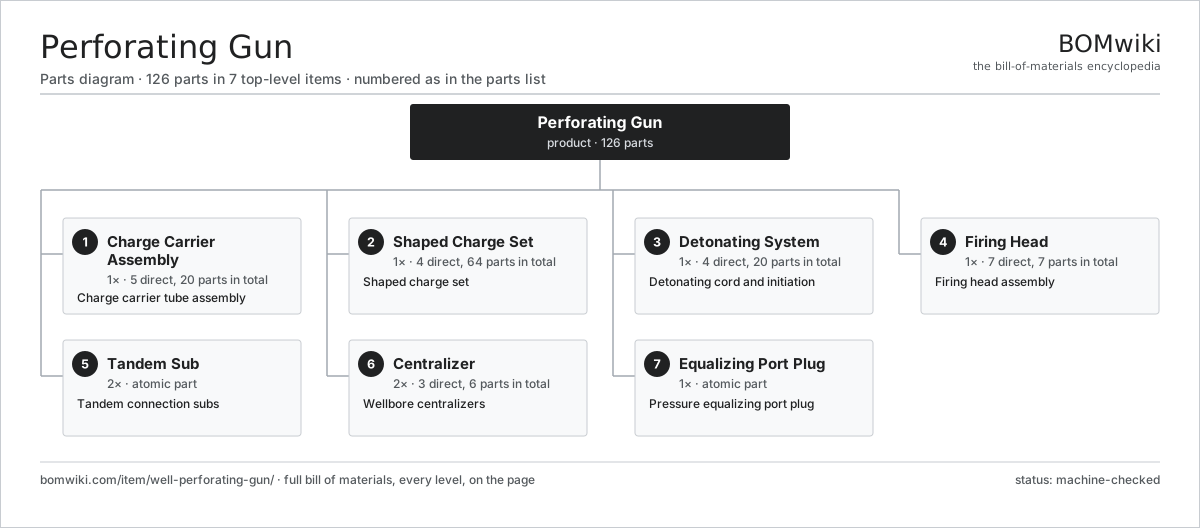
| # | Part | Qty | What it does |
|---|---|---|---|
| 1 | Charge Carrier Assembly 5 parts | 1× | Charge carrier tube assembly |
| 2 | Shaped Charge Set 4 parts | 1× | Shaped charge set |
| 3 | Detonating System 4 parts | 1× | Detonating cord and initiation |
| 4 | Firing Head 7 parts | 1× | Firing head assembly |
| 5 | Tandem Sub | 2× | Tandem connection subs |
| 6 | Centralizer 3 parts | 2× | Wellbore centralizers |
| 7 | Equalizing Port Plug | 1× | Pressure equalizing port plug |
3D model
No 3D model yet. Have a CAD file of this? Add a 3D model. STL renders right on this page; STEP, FreeCAD, and OpenSCAD sources are welcome too (openly licensed, like all 3D models on BOMwiki).
Build & assembly graph
expand / collapse · shared sub-assemblies converge · links to related products · est. labourTap an assembly to expand/collapse · tap a part to open it · use “Open page” for any node · drag to pan, scroll to zoom.
Bill of materials for Perforating Gun
7 top-level lines · 30 rows shown · 126 parts total · indented to 3 levels| # | Item / sub-assembly | Part no. | Qty/assy | Ext. qty | Parts | Type |
|---|---|---|---|---|---|---|
| 1 | Charge Carrier Assembly 5 parts | wpg-carrier-assembly | 1× | 1 | 20 | assembly |
| 1.1 | Carrier Tube | wpg-carrier-tube | 1× | 1 | · | part |
| 1.2 | Charge Holder Tube | wpg-charge-tube | 1× | 1 | · | part |
| 1.3 | Scallop Recess | wpg-scallop-recess | 1× | 1 | · | part |
| 1.4 | Phasing Clip | wpg-phasing-clip | 16× | 16 | · | part |
| 1.5 | O-Ring Set | oring-set | 1× | 1 | · | part |
| 2 | Shaped Charge Set 4 parts | wpg-charge-set | 1× | 1 | 64 | assembly |
| 2.1 | Shaped Charge | wpg-shaped-charge | 16× | 16 | · | part |
| 2.2 | Charge Case | wpg-charge-case | 16× | 16 | · | part |
| 2.3 | Jet Liner | wpg-charge-liner | 16× | 16 | · | part |
| 2.4 | Primer Pellet | wpg-primer-pellet | 16× | 16 | · | part |
| 3 | Detonating System 4 parts | wpg-detonating-system | 1× | 1 | 20 | assembly |
| 3.1 | Detonating Cord | wpg-det-cord | 1× | 1 | · | part |
| 3.2 | Detonator | wpg-detonator | 1× | 1 | · | part |
| 3.3 | Transfer Booster | wpg-booster | 2× | 2 | · | part |
| 3.4 | Cord Clip | wpg-cord-clip | 16× | 16 | · | part |
| 4 | Firing Head 7 parts | wpg-firing-head | 1× | 1 | 7 | assembly |
| 4.1 | Firing Head Body | wpg-firing-body | 1× | 1 | · | part |
| 4.2 | Firing Pin | wpg-firing-pin | 1× | 1 | · | part |
| 4.3 | Coil Spring | coil-spring | 1× | 1 | · | part |
| 4.4 | Pressure Piston | wpg-pressure-piston | 1× | 1 | · | part |
| 4.5 | Safety Bar | wpg-safety-bar | 1× | 1 | · | part |
| 4.6 | Pressure Sensor | pressure-sensor | 1× | 1 | · | part |
| 4.7 | O-Ring Set | oring-set | 1× | 1 | · | part |
| 5 | Tandem Sub | wpg-tandem-sub | 2× | 2 | · | part |
| 6 | Centralizer 3 parts | wpg-centralizer | 2× | 2 | 6 | assembly |
| 6.1 | Centralizer Collar | wpg-centralizer-body | 1× | 2 | · | part |
| 6.2 | Coil Spring | coil-spring | 4× | 8 | · | part |
| 6.3 | Fastener Set | fastener-set | 1× | 2 | · | part |
| 7 | Equalizing Port Plug | wpg-port-plug | 1× | 1 | · | part |
Related products
same domain, ranked by shared parts Amine Gas Sweetening Unit
3,543 parts · shares 1 with this page
Amine Gas Sweetening Unit
3,543 parts · shares 1 with this page
 Condensate Stabilizer Column
2,234 parts · shares 1 with this page
Downhole Production Packer
83 parts · shares 1 with this page
Condensate Stabilizer Column
2,234 parts · shares 1 with this page
Downhole Production Packer
83 parts · shares 1 with this page
 Floating-Roof Storage Tank
144 parts · shares 1 with this page
Gas Lift Mandrel and Valve
58 parts · shares 1 with this page
Floating-Roof Storage Tank
144 parts · shares 1 with this page
Gas Lift Mandrel and Valve
58 parts · shares 1 with this page
 Gas Metering Skid
1,491 parts · shares 1 with this page
Gas Metering Skid
1,491 parts · shares 1 with this page
Sourcing: possible vendors
Browse the supplier directory → Prices, MOQ, and lead times are algorithmic estimates, not quotes, and not claims about these companies. Company mappings are curated by keyword; est. price band $10k–$50M. How estimates work| Vendor | HQ | Specialty | MOQ | Lead time |
|---|---|---|---|---|
|
🇺🇸SLB
slb.com ↗
|
Houston, US | Oilfield services & equipment | made to order | 24–48 wks |
| halliburton.com ↗ | Houston, US | Oilfield services | made to order | 24–48 wks |
| bakerhughes.com ↗ | Houston, US | Energy technology | made to order | 24–48 wks |
|
🇺🇸NOV
nov.com ↗
|
Houston, US | Drilling equipment | made to order | 24–48 wks |
| technipfmc.com ↗ | London, GB | Subsea & surface systems | made to order | 24–48 wks |
961-word article