Spot Welding Robot
ProductOverview
A spot welding robot joins overlapping sheet metal panels by resistance spot welding, the dominant joining method in automotive body assembly. A car body carries several thousand spot welds, and lines of these robots place them in body shops running around the clock. The high-payload arm carries a servo weld gun and a weld transformer to each programmed point, squeezes two panels between copper electrodes, and passes a brief high current through the stack. The metal at the interface heats and fuses into a nugget, and the robot moves to the next point.
The defining feature of this robot is payload. The gun and transformer together can weigh 80 to 150 kg, so the whole arm is sized far heavier than an arc welding arm, and every joint, reducer and bearing is built to swing that mass quickly and place the electrodes within a fraction of a millimetre. The other defining feature is the closed-loop control of both current and force, because nugget quality depends on getting both right at every spot.
The high-payload arm
The arm starts from a heavy cast base and runs through three link arms to a reinforced wrist. Its six joints each pair a high-torque servo motor with an RV cycloidal reducer, chosen over a strain-wave drive because the rotary-vector design carries the high inertia and shock of a heavy gun without losing rigidity. The joints ride on stout bearings behind seals, and the tool flange is reinforced for the large overhung load of a transformer hanging off the wrist.
The weld gun
The weld gun does the joining. Its stiff C or X frame holds two electrode arms in alignment, and a servo actuator closes the moving electrode and sets the squeeze force in software. Servo force control is a major advance over the older pneumatic guns: the controller can ramp force, hold it precisely, and log it for every weld. The electrode caps make the actual contact with the sheet and pass the current, and a flexible current shunt carries that current across the moving joint. A gun equalizer lets the gun float and centre on the panel so the squeeze force is balanced on both caps rather than pushing the part sideways.
Transformer and weld current
Resistance welding needs thousands of amps at a couple of volts, which is why the transformer is mounted right at the gun. A wrist-mounted mid-frequency design keeps the secondary cable short, cutting losses and letting the controller deliver a clean DC weld pulse. The core and primary winding are fed at mid frequency by the inverter, the single-turn copper secondary delivers the high current at low voltage, and the output diodes rectify it to DC. A water jacket cools the transformer for continuous duty.
Weld controller
The weld controller manages the weld itself, separate from the robot motion controller. Its mid-frequency inverter feeds the transformer primary, the weld CPU runs the weld schedule, current, time and force profile, for each joint, and the switching stack delivers the pulse. A current and force monitor measures the actual weld current and electrode force so each spot is logged and adaptive control can compensate for shunting through nearby welds. This is how a body shop proves nugget quality without destructively testing every part.
Dress pack
The gun needs power, water and air delivered through the moving arm. The dress pack bundles the heavy weld power cable, the cooling water hoses and the air line, routed in an energy chain so it flexes through the arm's full motion without snagging. Dress pack wear is a leading downtime cause on these robots, so the routing and the chain are engineered carefully.
Tip dressing and cap changing
Copper electrode caps mushroom and pick up surface alloy as they weld, which changes the contact area and degrades the nugget. The tip dresser re-faces them automatically: the robot presses the caps into a spinning carbide cutter driven by the dresser motor every set number of welds, restoring the cap radius. When a cap is worn past dressing, the cap changer pulls it and presses on a fresh one, all without an operator. Keeping the caps in shape is what holds weld quality steady across a shift.
Robot control and safety
The robot motion controller runs the arm and sequences the welds. Its motion CPU computes the kinematics and commands one servo drive per axis, the teach pendant sets the spot positions and approach angles, and cell I/O ties the robot to the weld controller and fixtures. A 24 VDC supply feeds logic and brakes.
The safety cell encloses the arm with a welded fence and a gate switch, guards the operator load station with a light curtain, and feeds emergency stops into safety relays that cut motion and weld power together. A status beacon shows the cell state across the line.
Variants and use
Spot welding robots are defined by their gun and reach. A compact 150 kg-payload arm with a light C-gun tacks small brackets; a 250 kg-payload arm with a deep X-gun reaches into a body shell to place welds an operator could never access. In a body shop, dozens work a framing line in sequence, each placing its assigned welds as the body indexes through. The economics are settled: a body needs thousands of consistent welds, the work is heavy and hot, and the robot places every nugget identically at a tempo no manual line can match.
Spot Welding Robot parts and their functions
8 top-level parts · 1,295 parts in total · full bill of materials below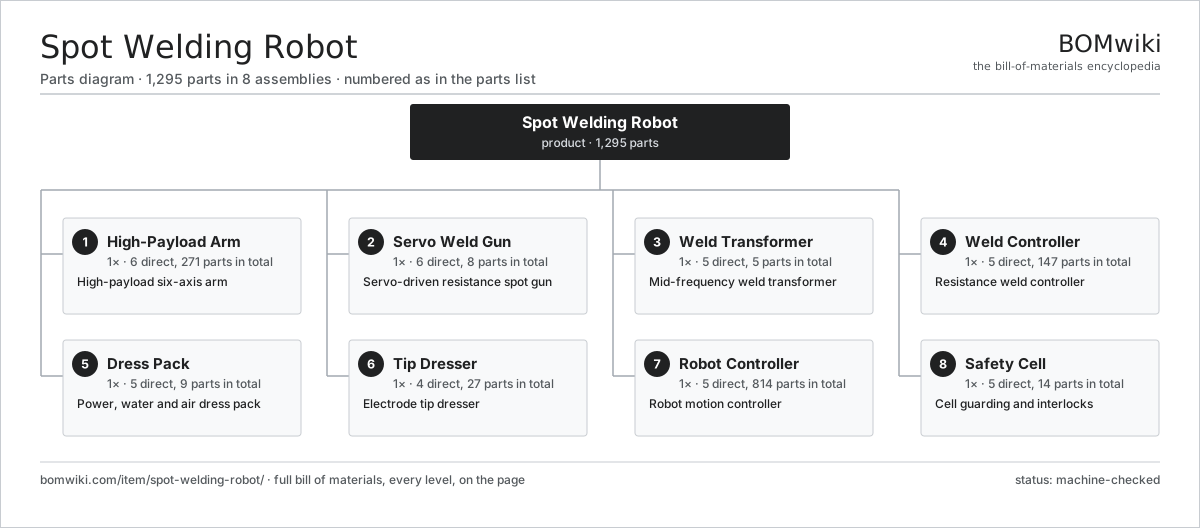
| # | Part | Qty | What it does |
|---|---|---|---|
| 1 | High-Payload Arm 6 parts | 1× | High-payload six-axis arm |
| 2 | Servo Weld Gun 6 parts | 1× | Servo-driven resistance spot gun |
| 3 | Weld Transformer 5 parts | 1× | Mid-frequency weld transformer |
| 4 | Weld Controller 5 parts | 1× | Resistance weld controller |
| 5 | Dress Pack 5 parts | 1× | Power, water and air dress pack |
| 6 | Tip Dresser 4 parts | 1× | Electrode tip dresser |
| 7 | Robot Controller 5 parts | 1× | Robot motion controller |
| 8 | Safety Cell 5 parts | 1× | Cell guarding and interlocks |
3D model
No 3D model yet. Have a CAD file of this? Add a 3D model — STL renders right on this page; STEP, FreeCAD, and OpenSCAD sources are welcome too (openly licensed, like all 3D models on BOMwiki).
Build & assembly graph
expand / collapse · shared sub-assemblies converge · links to related products · est. labourTap an assembly to expand/collapse · tap a part to open it · use “Open page” for any node · drag to pan, scroll to zoom.
Bill of materials for Spot Welding Robot
8 top-level lines · 82 rows shown · 1,295 parts total · indented to 3 levels| # | Item / sub-assembly | Part no. | Qty/assy | Ext. qty | Parts | Type |
|---|---|---|---|---|---|---|
| 1 | High-Payload Arm 6 parts | spot-welding-robot-arm | 1× | 1 | 271 | assembly |
| 1.1 | Arm Base | spot-welding-robot-base | 1× | 1 | · | part |
| 1.2 | Axis Joint 5 parts | spot-welding-robot-axis-joint | 6× | 6 | 29 | assembly |
| 1.2.1 | Servo Motor 4 parts + deeper › | servo-motor | 1× | 6 | 24 | assembly |
| 1.2.2 | RV Reducer | spot-welding-robot-reducer | 1× | 6 | · | part |
| 1.2.3 | Ball Bearing | ball-bearing | 2× | 12 | · | part |
| 1.2.4 | Oil Seal | oil-seal | 1× | 6 | · | part |
| 1.2.5 | Joint Encoder | spot-welding-robot-encoder | 1× | 6 | · | part |
| 1.3 | Link Arm | spot-welding-robot-link | 3× | 3 | · | part |
| 1.4 | Heavy Wrist 3 parts | spot-welding-robot-wrist | 1× | 1 | 91 | assembly |
| 1.4.1 | Axis Joint 5 parts + deeper › | spot-welding-robot-axis-joint | 3× | 3 | 29 | assembly |
| 1.4.2 | Helical Gear Pair | gear-pair | 2× | 2 | · | part |
| 1.4.3 | Oil Seal | oil-seal | 2× | 2 | · | part |
| 1.5 | Tool Flange | spot-welding-robot-tool-flange | 1× | 1 | · | part |
| 1.6 | Wire Bundle | wire-bundle | 1× | 1 | · | part |
| 2 | Servo Weld Gun 6 parts | spot-welding-robot-weld-gun | 1× | 1 | 8 | assembly |
| 2.1 | Gun Frame | spot-welding-robot-gun-frame | 1× | 1 | · | part |
| 2.2 | Servo Actuator | spot-welding-robot-servo-actuator | 1× | 1 | · | part |
| 2.3 | Electrode Arm | spot-welding-robot-electrode-arm | 2× | 2 | · | part |
| 2.4 | Electrode Cap | spot-welding-robot-electrode-cap | 2× | 2 | · | part |
| 2.5 | Current Shunt | spot-welding-robot-shunt | 1× | 1 | · | part |
| 2.6 | Gun Equalizer | spot-welding-robot-balancer | 1× | 1 | · | part |
| 3 | Weld Transformer 5 parts | spot-welding-robot-transformer | 1× | 1 | 5 | assembly |
| 3.1 | Transformer Core | spot-welding-robot-transformer-core | 1× | 1 | · | part |
| 3.2 | Primary Winding | spot-welding-robot-primary-winding | 1× | 1 | · | part |
| 3.3 | Secondary Winding | spot-welding-robot-secondary-winding | 1× | 1 | · | part |
| 3.4 | Output Diode | spot-welding-robot-output-diode | 1× | 1 | · | part |
| 3.5 | Water Jacket | spot-welding-robot-water-jacket | 1× | 1 | · | part |
| 4 | Weld Controller 5 parts | spot-welding-robot-weld-controller | 1× | 1 | 147 | assembly |
| 4.1 | Weld Inverter 5 parts | spot-welding-robot-inverter | 1× | 1 | 16 | assembly |
| 4.1.1 | Bare PCB | pcb-bare | 1× | 1 | · | part |
| 4.1.2 | Power MOSFET | mosfet | 8× | 8 | · | part |
| 4.1.3 | Gate Driver IC | gate-driver-ic | 2× | 2 | · | part |
| 4.1.4 | DC-Link Capacitor | dc-link-cap | 4× | 4 | · | part |
| 4.1.5 | Power Inductor | power-inductor | 1× | 1 | · | part |
| 4.2 | Weld CPU 4 parts | spot-welding-robot-weld-cpu | 1× | 1 | 128 | assembly |
| 4.2.1 | Bare PCB | pcb-bare | 1× | 1 | · | part |
| 4.2.2 | Microcontroller | mcu | 1× | 1 | · | part |
| 4.2.3 | SMD Passive (R/C/L) | smd-passives | 120× | 120 | · | part |
| 4.2.4 | Connector | connector | 6× | 6 | · | part |
| 4.3 | Current and Force Monitor | spot-welding-robot-current-monitor | 1× | 1 | · | part |
| 4.4 | Switching Stack | spot-welding-robot-scr-stack | 1× | 1 | · | part |
| 4.5 | Power Supply | power-supply | 1× | 1 | · | part |
| 5 | Dress Pack 5 parts | spot-welding-robot-dress-pack | 1× | 1 | 9 | assembly |
| 5.1 | Weld Power Cable | spot-welding-robot-power-cable | 1× | 1 | · | part |
| 5.2 | Water Hose | spot-welding-robot-water-hose | 2× | 2 | · | part |
| 5.3 | Air Line | spot-welding-robot-air-line | 1× | 1 | · | part |
| 5.4 | Energy Chain | spot-welding-robot-energy-chain | 1× | 1 | · | part |
| 5.5 | Connector | connector | 4× | 4 | · | part |
| 6 | Tip Dresser 4 parts | spot-welding-robot-tip-dresser | 1× | 1 | 27 | assembly |
| 6.1 | Dresser Cutter | spot-welding-robot-dresser-cutter | 1× | 1 | · | part |
| 6.2 | Dresser Motor | spot-welding-robot-dresser-motor | 1× | 1 | · | part |
| 6.3 | Cap Changer | spot-welding-robot-cap-changer | 1× | 1 | · | part |
| 6.4 | Servo Motor 4 parts | servo-motor | 1× | 1 | 24 | assembly |
| 6.4.1 | Stator Assembly 3 parts + deeper › | stator-assembly | 1× | 1 | 3 | assembly |
| 6.4.2 | Rotor Assembly 4 parts + deeper › | rotor-assembly | 1× | 1 | 19 | assembly |
| 6.4.3 | Encoder | encoder | 1× | 1 | · | part |
| 6.4.4 | Motor Housing | motor-housing | 1× | 1 | · | part |
| 7 | Robot Controller 5 parts | spot-welding-robot-controller | 1× | 1 | 814 | assembly |
| 7.1 | Motion CPU 4 parts | spot-welding-robot-cpu | 1× | 1 | 193 | assembly |
| 7.1.1 | Bare PCB | pcb-bare | 1× | 1 | · | part |
| 7.1.2 | Microcontroller | mcu | 2× | 2 | · | part |
| 7.1.3 | SMD Passive (R/C/L) | smd-passives | 180× | 180 | · | part |
| 7.1.4 | Connector | connector | 10× | 10 | · | part |
| 7.2 | Servo Drive 5 parts | spot-welding-robot-servo-drive | 6× | 6 | 103 | assembly |
| 7.2.1 | Bare PCB | pcb-bare | 1× | 6 | · | part |
| 7.2.2 | Power MOSFET | mosfet | 8× | 48 | · | part |
| 7.2.3 | Gate Driver IC | gate-driver-ic | 1× | 6 | · | part |
| 7.2.4 | DC-Link Capacitor | dc-link-cap | 3× | 18 | · | part |
| 7.2.5 | SMD Passive (R/C/L) | smd-passives | 90× | 540 | · | part |
| 7.3 | Teach Pendant | spot-welding-robot-pendant | 1× | 1 | · | part |
| 7.4 | Power Supply | power-supply | 1× | 1 | · | part |
| 7.5 | Cell I/O | spot-welding-robot-io | 1× | 1 | · | part |
| 8 | Safety Cell 5 parts | spot-welding-robot-safety-cell | 1× | 1 | 14 | assembly |
| 8.1 | Perimeter Fence 3 parts | spot-welding-robot-fence | 1× | 1 | 8 | assembly |
| 8.1.1 | Sheet Metal Panel | sheet-panel | 6× | 6 | · | part |
| 8.1.2 | Gate Switch | spot-welding-robot-gate-switch | 1× | 1 | · | part |
| 8.1.3 | Fastener Set | fastener-set | 1× | 1 | · | part |
| 8.2 | Light Curtain | spot-welding-robot-light-curtain | 1× | 1 | · | part |
| 8.3 | Safety Relay | spot-welding-robot-safety-relay | 2× | 2 | · | part |
| 8.4 | Emergency Stop | spot-welding-robot-estop | 2× | 2 | · | part |
| 8.5 | Status Beacon | spot-welding-robot-status-beacon | 1× | 1 | · | part |
Related products
same domain, ranked by shared parts Arc Welding Robot
1,532 parts · shares 7 with this page
Laser Welding Robot
1,294 parts · shares 6 with this page
Machine Tending Robot
1,174 parts · shares 6 with this page
Press Tending Robot
1,091 parts · shares 6 with this page
Gantry Loading Robot
800 parts · shares 5 with this page
Arc Welding Robot
1,532 parts · shares 7 with this page
Laser Welding Robot
1,294 parts · shares 6 with this page
Machine Tending Robot
1,174 parts · shares 6 with this page
Press Tending Robot
1,091 parts · shares 6 with this page
Gantry Loading Robot
800 parts · shares 5 with this page
 6-Axis Industrial Robot Arm
814 parts · shares 4 with this page
6-Axis Industrial Robot Arm
814 parts · shares 4 with this page
Sourcing: possible vendors
Prices, MOQ, and lead times are algorithmic estimates, not quotes, and not claims about these companies. Company mappings are curated by keyword; est. price band $3k–$500k. How estimates work| Vendor | HQ | Specialty | MOQ | Lead time |
|---|---|---|---|---|
|
🇯🇵Fanuc
fanuc.com ↗
|
Oshino, JP | Industrial robots & CNC | 20 units | 10–18 wks |
| abb.com ↗ | Zurich, CH | Industrial robots | 20 units | 10–18 wks |
|
🇯🇵Yaskawa
yaskawa.com ↗
|
Kitakyushu, JP | Robots & motion | 20 units | 10–18 wks |
|
🇩🇪KUKA
kuka.com ↗
|
Augsburg, DE | Industrial robots | 20 units | 10–18 wks |
| universal-robots.com ↗ | Odense, DK | Collaborative robots | 20 units | 10–18 wks |
1,160-word article