Press Tending Robot
ProductOverview
A press tending robot feeds blanks into a stamping press and pulls finished parts out, doing it fast enough to keep up with a press running 8 to 18 strokes a minute. The defining constraint is timing. A stamping press is a heavy mechanical machine whose ram comes down on a fixed cycle, and the robot tool has to be fully clear of the die before each stroke. Everything in the cell, the handling arm, the vacuum tool, the controller, is built around moving a large sheet quickly and then getting out of the way on schedule.
This makes a press tending robot different from a general machine tending arm. It runs faster, it handles flat sheet rather than chucked parts, and its motion is phase-locked to the press through a synchronization interface. A blank comes from the destacker, the robot lifts it on vacuum, places it in the die, retracts clear, the ram strikes, and the robot returns to remove the stamping to the exit conveyor. In a press line, several of these robots pass parts from one press to the next.
The handling arm
The arm is stiff and fast rather than dexterous. A rigid base carries five servo joints and a long reach arm that extends over the press bolster, ending in a two-axis wrist and a tool plate. Each joint uses a cycloidal reducer rather than a harmonic drive, because cycloidal gearing carries the shock load of repeated hard acceleration and deceleration better, and that is what the press tempo demands. The joints carry bearings, grease seals and absolute encoders, with the harness routed internally. The reach arm is designed for low deflection: at full extension and full speed a flexible link would let the tool tip overshoot and risk the die.
Vacuum tool
Sheet blanks are flat, oiled and easily marked, so the end effector grips them with vacuum. A lightweight aluminium cross-bar carries several vacuum cups on ball-joint mounts that let each cup conform to a curved or contoured blank. Vacuum sensors confirm every cup zone has reached holding vacuum before the lift begins, because a single cup that fails to seal can drop a heavy blank into the die. The cross-bar is adjustable so one tool can be set up for several blank outlines.
Destacking
Steel sheets stacked in a magazine cling together, so a press cell needs careful destacking. The destacker holds the stack in a magazine and uses fanner magnets that induce like magnetic poles in the top sheets so they repel and separate, letting the robot lift exactly one. A lift table on a ball screw keeps the top of the stack at a constant pick height as it depletes. A double-blank sensor catches the case where two sheets stick together, stopping the line before a doubled blank wrecks the die.
Synchronization with the press
The synchronization interface is what keeps the robot and the ram apart. A crank resolver reads the press crank angle continuously, so the robot always knows where the ram is in its stroke. The sync card phase-locks the robot trajectory to that angle, retiming the pick and place each cycle so the tool is guaranteed clear at top dead centre. A clearance sensor gives an independent confirmation that the tool is out of the die envelope, and the stroke input reads the press top-dead-centre signal. The robot only requests the next stroke when it has reported clear.
Control
The motion controller runs the high-speed trajectory. Its motion CPU computes the path and the press phase lock, commanding one servo drive per axis, each sized for high peak torque to hit the acceleration the tempo needs. A teach pendant sets the pick, place and clearance points during commissioning, and cell I/O ties the destacker, conveyor and press signals together. A 24 VDC supply feeds logic and the holding brakes.
Safety
Press cells are guarded harder than most because the hazards, a moving ram and a fast heavy arm, are both severe. The safety system puts a light curtain across the die area that inhibits the ram if the robot tool or a hand is detected. A perimeter fence with a gate switch encloses the robot and destacker. The critical element is the stroke interlock: a safe-rated circuit that blocks the press stroke permit until the robot reports clear, so the ram physically cannot fire while the tool is in the die. Emergency stops feed safety relays that cut robot and press power together.
Pneumatics and maintenance
The pneumatic package runs the vacuum. A vacuum generator feeds the cups through a valve block that switches vacuum on for pickup and a blow-off pulse for instant release, with a vacuum reservoir buffering against a momentary cup leak. The air preparation unit conditions the supply. Maintenance focuses on the wear items: vacuum cups harden and crack with cycles and are replaced often, the fanner magnets are checked for strength, and the cycloidal reducers and seals are serviced on a duty schedule because the shock loading wears them faster than in a slow tending arm.
Variants and use
A single press tending robot serves a stand-alone press making a high-volume part such as a bracket or panel. In a press line, a row of these robots passes a part down a series of presses, each performing one forming step, so a flat blank enters one end and a finished body panel leaves the other. They dominate automotive body shops and appliance stamping plants, where the part runs in the hundreds of thousands and the value is in keeping a fast press fed without putting a person's hands near the die.
Press Tending Robot parts and their functions
8 top-level parts · 1,091 parts in total · full bill of materials below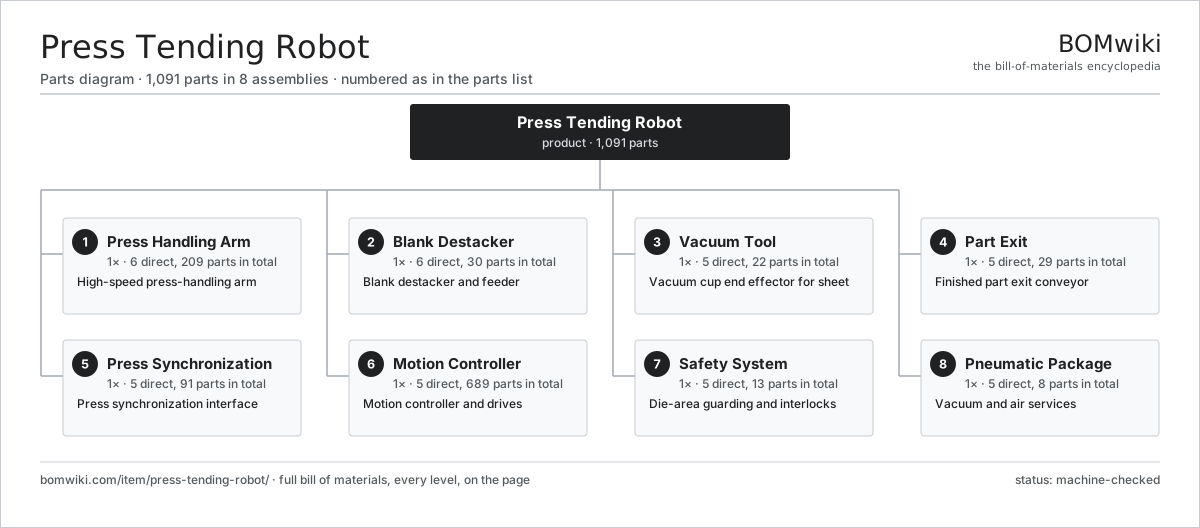
| # | Part | Qty | What it does |
|---|---|---|---|
| 1 | Press Handling Arm 6 parts | 1× | High-speed press-handling arm |
| 2 | Blank Destacker 6 parts | 1× | Blank destacker and feeder |
| 3 | Vacuum Tool 5 parts | 1× | Vacuum cup end effector for sheet |
| 4 | Part Exit 5 parts | 1× | Finished part exit conveyor |
| 5 | Press Synchronization 5 parts | 1× | Press synchronization interface |
| 6 | Motion Controller 5 parts | 1× | Motion controller and drives |
| 7 | Safety System 5 parts | 1× | Die-area guarding and interlocks |
| 8 | Pneumatic Package 5 parts | 1× | Vacuum and air services |
3D model
No 3D model yet. Have a CAD file of this? Add a 3D model — STL renders right on this page; STEP, FreeCAD, and OpenSCAD sources are welcome too (openly licensed, like all 3D models on BOMwiki).
Build & assembly graph
expand / collapse · shared sub-assemblies converge · links to related products · est. labourTap an assembly to expand/collapse · tap a part to open it · use “Open page” for any node · drag to pan, scroll to zoom.
Bill of materials for Press Tending Robot
8 top-level lines · 82 rows shown · 1,091 parts total · indented to 3 levels| # | Item / sub-assembly | Part no. | Qty/assy | Ext. qty | Parts | Type |
|---|---|---|---|---|---|---|
| 1 | Press Handling Arm 6 parts | press-tending-robot-arm | 1× | 1 | 209 | assembly |
| 1.1 | Arm Base | press-tending-robot-base | 1× | 1 | · | part |
| 1.2 | Axis Joint 5 parts | press-tending-robot-axis-joint | 5× | 5 | 29 | assembly |
| 1.2.1 | Servo Motor 4 parts + deeper › | servo-motor | 1× | 5 | 24 | assembly |
| 1.2.2 | Cycloidal Reducer | press-tending-robot-reducer | 1× | 5 | · | part |
| 1.2.3 | Ball Bearing | ball-bearing | 2× | 10 | · | part |
| 1.2.4 | Oil Seal | oil-seal | 1× | 5 | · | part |
| 1.2.5 | Axis Encoder | press-tending-robot-encoder | 1× | 5 | · | part |
| 1.3 | Reach Arm | press-tending-robot-reach-arm | 1× | 1 | · | part |
| 1.4 | Two-Axis Wrist 3 parts | press-tending-robot-wrist | 1× | 1 | 60 | assembly |
| 1.4.1 | Axis Joint 5 parts + deeper › | press-tending-robot-axis-joint | 2× | 2 | 29 | assembly |
| 1.4.2 | Helical Gear Pair | gear-pair | 1× | 1 | · | part |
| 1.4.3 | Oil Seal | oil-seal | 1× | 1 | · | part |
| 1.5 | Tool Plate | press-tending-robot-tool-plate | 1× | 1 | · | part |
| 1.6 | Wire Bundle | wire-bundle | 1× | 1 | · | part |
| 2 | Blank Destacker 6 parts | press-tending-robot-destacker | 1× | 1 | 30 | assembly |
| 2.1 | Blank Magazine | press-tending-robot-blank-magazine | 1× | 1 | · | part |
| 2.2 | Fanner Magnet | press-tending-robot-fanner-magnet | 2× | 2 | · | part |
| 2.3 | Lift Table | press-tending-robot-lift-table | 1× | 1 | · | part |
| 2.4 | Double-Blank Sensor | press-tending-robot-double-blank-sensor | 1× | 1 | · | part |
| 2.5 | Ball Screw | ball-screw | 1× | 1 | · | part |
| 2.6 | Servo Motor 4 parts | servo-motor | 1× | 1 | 24 | assembly |
| 2.6.1 | Stator Assembly 3 parts + deeper › | stator-assembly | 1× | 1 | 3 | assembly |
| 2.6.2 | Rotor Assembly 4 parts + deeper › | rotor-assembly | 1× | 1 | 19 | assembly |
| 2.6.3 | Encoder | encoder | 1× | 1 | · | part |
| 2.6.4 | Motor Housing | motor-housing | 1× | 1 | · | part |
| 3 | Vacuum Tool 5 parts | press-tending-robot-vacuum-tool | 1× | 1 | 22 | assembly |
| 3.1 | Tool Cross-Bar | press-tending-robot-tool-crossbar | 1× | 1 | · | part |
| 3.2 | Vacuum Cup | press-tending-robot-vacuum-cup | 8× | 8 | · | part |
| 3.3 | Vacuum Sensor | press-tending-robot-vacuum-sensor | 4× | 4 | · | part |
| 3.4 | Cup Mount | press-tending-robot-cup-mount | 8× | 8 | · | part |
| 3.5 | O-Ring Set | oring-set | 1× | 1 | · | part |
| 4 | Part Exit 5 parts | press-tending-robot-part-exit | 1× | 1 | 29 | assembly |
| 4.1 | Exit Belt Frame | press-tending-robot-exit-belt | 1× | 1 | · | part |
| 4.2 | Drive Belt | drive-belt | 1× | 1 | · | part |
| 4.3 | Servo Motor 4 parts | servo-motor | 1× | 1 | 24 | assembly |
| 4.3.1 | Stator Assembly 3 parts + deeper › | stator-assembly | 1× | 1 | 3 | assembly |
| 4.3.2 | Rotor Assembly 4 parts + deeper › | rotor-assembly | 1× | 1 | 19 | assembly |
| 4.3.3 | Encoder | encoder | 1× | 1 | · | part |
| 4.3.4 | Motor Housing | motor-housing | 1× | 1 | · | part |
| 4.4 | Part Counter | press-tending-robot-part-counter | 1× | 1 | · | part |
| 4.5 | Ball Bearing | ball-bearing | 2× | 2 | · | part |
| 5 | Press Synchronization 5 parts | press-tending-robot-press-sync | 1× | 1 | 91 | assembly |
| 5.1 | Crank Resolver | press-tending-robot-resolver | 1× | 1 | · | part |
| 5.2 | Sync Card 4 parts | press-tending-robot-sync-card | 1× | 1 | 86 | assembly |
| 5.2.1 | Bare PCB | pcb-bare | 1× | 1 | · | part |
| 5.2.2 | Microcontroller | mcu | 1× | 1 | · | part |
| 5.2.3 | SMD Passive (R/C/L) | smd-passives | 80× | 80 | · | part |
| 5.2.4 | Connector | connector | 4× | 4 | · | part |
| 5.3 | Clearance Sensor | press-tending-robot-clearance-sensor | 1× | 1 | · | part |
| 5.4 | Stroke Input | press-tending-robot-stroke-input | 1× | 1 | · | part |
| 5.5 | Connector | connector | 2× | 2 | · | part |
| 6 | Motion Controller 5 parts | press-tending-robot-controller | 1× | 1 | 689 | assembly |
| 6.1 | Motion CPU 4 parts | press-tending-robot-cpu | 1× | 1 | 171 | assembly |
| 6.1.1 | Bare PCB | pcb-bare | 1× | 1 | · | part |
| 6.1.2 | Microcontroller | mcu | 2× | 2 | · | part |
| 6.1.3 | SMD Passive (R/C/L) | smd-passives | 160× | 160 | · | part |
| 6.1.4 | Connector | connector | 8× | 8 | · | part |
| 6.2 | Servo Drive 5 parts | press-tending-robot-servo-drive | 5× | 5 | 103 | assembly |
| 6.2.1 | Bare PCB | pcb-bare | 1× | 5 | · | part |
| 6.2.2 | Power MOSFET | mosfet | 8× | 40 | · | part |
| 6.2.3 | Gate Driver IC | gate-driver-ic | 1× | 5 | · | part |
| 6.2.4 | DC-Link Capacitor | dc-link-cap | 3× | 15 | · | part |
| 6.2.5 | SMD Passive (R/C/L) | smd-passives | 90× | 450 | · | part |
| 6.3 | Teach Pendant | press-tending-robot-pendant | 1× | 1 | · | part |
| 6.4 | Power Supply | power-supply | 1× | 1 | · | part |
| 6.5 | Cell I/O | press-tending-robot-io | 1× | 1 | · | part |
| 7 | Safety System 5 parts | press-tending-robot-safety-system | 1× | 1 | 13 | assembly |
| 7.1 | Light Curtain | press-tending-robot-light-curtain | 1× | 1 | · | part |
| 7.2 | Perimeter Fence 3 parts | press-tending-robot-fence | 1× | 1 | 7 | assembly |
| 7.2.1 | Sheet Metal Panel | sheet-panel | 5× | 5 | · | part |
| 7.2.2 | Gate Switch | press-tending-robot-gate-switch | 1× | 1 | · | part |
| 7.2.3 | Fastener Set | fastener-set | 1× | 1 | · | part |
| 7.3 | Safety Relay | press-tending-robot-safety-relay | 2× | 2 | · | part |
| 7.4 | Emergency Stop | press-tending-robot-estop | 2× | 2 | · | part |
| 7.5 | Stroke Interlock | press-tending-robot-stroke-interlock | 1× | 1 | · | part |
| 8 | Pneumatic Package 5 parts | press-tending-robot-pneumatics | 1× | 1 | 8 | assembly |
| 8.1 | Vacuum Generator | press-tending-robot-vacuum-generator | 1× | 1 | · | part |
| 8.2 | Air Preparation | press-tending-robot-air-prep | 1× | 1 | · | part |
| 8.3 | Valve Block | press-tending-robot-valve-block | 1× | 1 | · | part |
| 8.4 | Vacuum Reservoir | press-tending-robot-air-tank | 1× | 1 | · | part |
| 8.5 | Connector | connector | 4× | 4 | · | part |
Related products
same domain, ranked by shared parts Arc Welding Robot
1,532 parts · shares 6 with this page
Arc Welding Robot
1,532 parts · shares 6 with this page
 Spot Welding Robot
1,295 parts · shares 6 with this page
Spot Welding Robot
1,295 parts · shares 6 with this page
 Robotic Assembly Cell
1,746 parts · shares 6 with this page
Robotic Assembly Cell
1,746 parts · shares 6 with this page
Sourcing: possible vendors
Prices, MOQ, and lead times are algorithmic estimates, not quotes, and not claims about these companies. Company mappings are curated by keyword; est. price band $3k–$500k. How estimates work| Vendor | HQ | Specialty | MOQ | Lead time |
|---|---|---|---|---|
|
🇯🇵Fanuc
fanuc.com ↗
|
Oshino, JP | Industrial robots & CNC | 20 units | 10–18 wks |
| abb.com ↗ | Zurich, CH | Industrial robots | 20 units | 10–18 wks |
|
🇯🇵Yaskawa
yaskawa.com ↗
|
Kitakyushu, JP | Robots & motion | 20 units | 10–18 wks |
|
🇩🇪KUKA
kuka.com ↗
|
Augsburg, DE | Industrial robots | 20 units | 10–18 wks |
| universal-robots.com ↗ | Odense, DK | Collaborative robots | 20 units | 10–18 wks |
1,197-word article