Arc Welding Robot
ProductOverview
An arc welding robot runs a welding torch along programmed paths to join steel and aluminium assemblies with a consistent, repeatable bead. It is the workhorse of automated fabrication in vehicle frames, furniture, agricultural equipment and structural sub-assemblies. The six-axis arm carries a torch fed wire by the wire feeder and current by the power source, while a positioner tilts and rotates the part so each seam is welded in the easiest orientation. A seam tracker follows the actual joint so the weld lands on the seam even when the fit-up varies part to part.
What sets arc welding apart from spot or laser welding is that it lays a continuous bead of molten filler metal along a joint, so the robot must hold a steady torch angle, height and travel speed for the full length of every seam. The quality of the weld depends as much on the power source waveform and the wire feed regulation as on the robot path, which is why these three are tuned together as one system.
The arm and its hollow wrist
The arm is a standard six-axis configuration, a cast base, three link arms and a wrist, with six servo joints, each a servo motor driving a low-backlash strain-wave reducer with an absolute encoder. The distinguishing feature is the hollow wrist. The torch cable, carrying wire, gas, current and water, runs through the centre bore of the wrist rather than draped along the outside. This keeps the cable from snagging on the work or whipping as the wrist rotates, which matters because torch cable wear and snag faults are the main cause of downtime on an exterior-dressed welding arm.
Power source and arc control
The power source is a digital inverter, not a simple transformer-rectifier. The inverter stage switches at high frequency so the waveform control board can shape the current precisely, producing pulsed transfer or controlled short-circuit transfer that puts down a clean bead with little spatter. The output rectifier and choke smooth the DC, the current shunt measures output for the closed loop, and a cooling fan holds the power electronics within thermal limits at full duty cycle. Because the source is digital, weld schedules, current, voltage and wire speed, are stored as recipes and called up by part number.
Wire feeder and torch
The wire feeder meters electrode wire to the arc with a servo feed motor and knurled drive rolls that grip the wire firmly without shaving it. A braked spool supplies the wire, a conduit guides it through the arm, and a feed sensor confirms the wire is actually advancing so a stall faults out rather than burning back into the tip.
The torch delivers wire, current and gas to the arc. The neck sets the work angle, the copper contact tip transfers current to the wire, and the gas nozzle shrouds the molten pool in shielding gas to keep the air off it. A breakaway mount trips and stops the robot if the torch strikes the work, protecting the expensive arm from a programming or fixture error.
Coordinated motion with the positioner
A weld lies flattest and penetrates most evenly when the seam is horizontal under the torch. The positioner makes that possible: its tilt drive and rotate drive hold the part on a slotted faceplate and move it so each joint comes to the torch in the downhand position. Crucially, the positioner and arm move together as coordinated axes. On a circumferential weld the positioner rotates the part while the arm holds the torch still, so the seam passes under a fixed arc at constant speed, which gives a far more uniform bead than swinging the arm around a stationary part.
Seam tracking
Real assemblies do not fit up identically, so the path taught on the first part will not sit exactly on the seam of the next. The seam tracker corrects for this. A laser profile sensor scans the joint just ahead of the torch and the tracker board shifts the path to keep the arc centred on the real seam. Before the arc strikes, a touch-sense finder uses the wire to touch and locate the joint start, so the weld begins in the right place even if the part shifted in the fixture.
Control
The robot controller ties it together. Its motion CPU runs the coordinated arm and positioner motion and the arc timing, commanding one servo drive per axis. The arc interface commands current, voltage and wire feed to the power source and reads arc feedback, closing the loop between motion and weld. A teach pendant is used to teach paths and tune weld schedules, and a 24 VDC supply feeds logic and the joint brakes.
Cell, fume and safety
Arc welding throws off intense ultraviolet light and fume, so the weld cell guards against both. Arc-flash screens block the radiation from the surrounding floor, a fume extractor draws the weld smoke away through filters, and a light curtain guards the operator load station on a two-station cell so an operator unloads one side while the robot welds the other. Emergency stops feed safety relays that drop both motion and arc power.
Consumables and maintenance
Welding is hard on consumables. The contact tip wears as wire passes through it and is replaced every few hours, the nozzle collects spatter and is cleaned in a reamer station, and the liner is changed on a schedule to prevent feed problems. The drive rolls are inspected for wear that would let the wire slip. Beyond consumables, maintenance is the joint reducers and seals on a duty schedule and periodic torch-centre-point checks to confirm the tool point has not drifted.
Variants and use
Compact arms with a 1.4 m reach weld small brackets and frames; larger arms with a 2 m reach and a heavy two-axis positioner handle vehicle chassis and structural weldments. Some cells pair two arms over one positioner for higher throughput, others put the arm on a track to weld long members. The economics favour automation wherever a part has many repeated welds and runs in volume, because the robot lays an identical bead every cycle where a manual welder's output varies with fatigue and skill.
Arc Welding Robot parts and their functions
8 top-level parts · 1,532 parts in total · full bill of materials below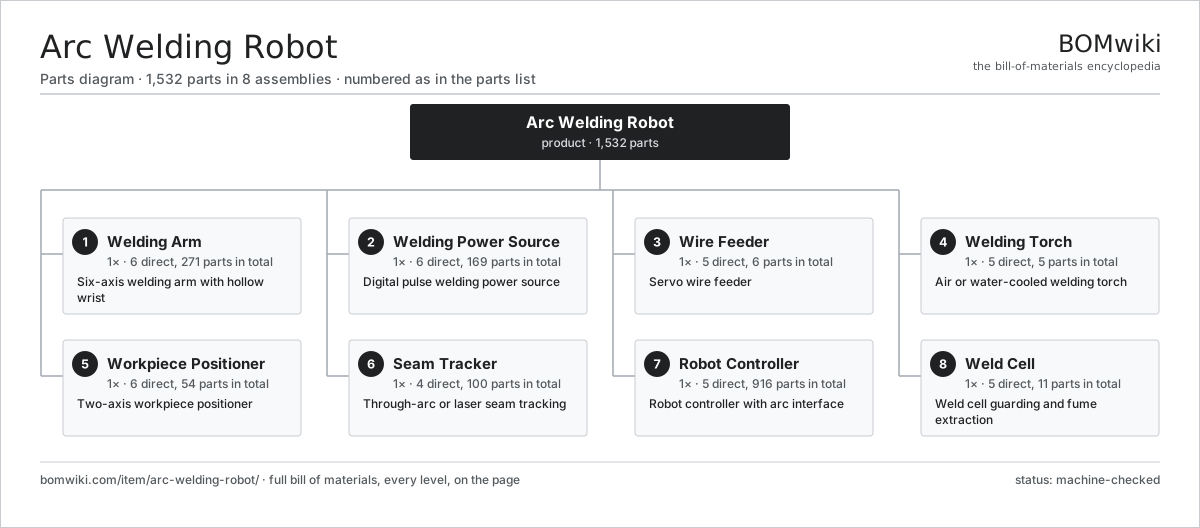
| # | Part | Qty | What it does |
|---|---|---|---|
| 1 | Welding Arm 6 parts | 1× | Six-axis welding arm with hollow wrist |
| 2 | Welding Power Source 6 parts | 1× | Digital pulse welding power source |
| 3 | Wire Feeder 5 parts | 1× | Servo wire feeder |
| 4 | Welding Torch 5 parts | 1× | Air or water-cooled welding torch |
| 5 | Workpiece Positioner 6 parts | 1× | Two-axis workpiece positioner |
| 6 | Seam Tracker 4 parts | 1× | Through-arc or laser seam tracking |
| 7 | Robot Controller 5 parts | 1× | Robot controller with arc interface |
| 8 | Weld Cell 5 parts | 1× | Weld cell guarding and fume extraction |
3D model
No 3D model yet. Have a CAD file of this? Add a 3D model — STL renders right on this page; STEP, FreeCAD, and OpenSCAD sources are welcome too (openly licensed, like all 3D models on BOMwiki).
Build & assembly graph
expand / collapse · shared sub-assemblies converge · links to related products · est. labourTap an assembly to expand/collapse · tap a part to open it · use “Open page” for any node · drag to pan, scroll to zoom.
Bill of materials for Arc Welding Robot
8 top-level lines · 86 rows shown · 1,532 parts total · indented to 3 levels| # | Item / sub-assembly | Part no. | Qty/assy | Ext. qty | Parts | Type |
|---|---|---|---|---|---|---|
| 1 | Welding Arm 6 parts | arc-welding-robot-arm | 1× | 1 | 271 | assembly |
| 1.1 | Arm Base | arc-welding-robot-base | 1× | 1 | · | part |
| 1.2 | Axis Joint 5 parts | arc-welding-robot-axis-joint | 6× | 6 | 29 | assembly |
| 1.2.1 | Servo Motor 4 parts + deeper › | servo-motor | 1× | 6 | 24 | assembly |
| 1.2.2 | Strain-Wave Reducer | arc-welding-robot-reducer | 1× | 6 | · | part |
| 1.2.3 | Ball Bearing | ball-bearing | 2× | 12 | · | part |
| 1.2.4 | Oil Seal | oil-seal | 1× | 6 | · | part |
| 1.2.5 | Joint Encoder | arc-welding-robot-encoder | 1× | 6 | · | part |
| 1.3 | Link Arm | arc-welding-robot-link | 3× | 3 | · | part |
| 1.4 | Hollow Wrist 3 parts | arc-welding-robot-hollow-wrist | 1× | 1 | 91 | assembly |
| 1.4.1 | Axis Joint 5 parts + deeper › | arc-welding-robot-axis-joint | 3× | 3 | 29 | assembly |
| 1.4.2 | Helical Gear Pair | gear-pair | 2× | 2 | · | part |
| 1.4.3 | Oil Seal | oil-seal | 2× | 2 | · | part |
| 1.5 | Tool Flange | arc-welding-robot-tool-flange | 1× | 1 | · | part |
| 1.6 | Wire Bundle | wire-bundle | 1× | 1 | · | part |
| 2 | Welding Power Source 6 parts | arc-welding-robot-power-source | 1× | 1 | 169 | assembly |
| 2.1 | Inverter Stage 5 parts | arc-welding-robot-inverter-stage | 1× | 1 | 17 | assembly |
| 2.1.1 | Bare PCB | pcb-bare | 1× | 1 | · | part |
| 2.1.2 | Power MOSFET | mosfet | 8× | 8 | · | part |
| 2.1.3 | Gate Driver IC | gate-driver-ic | 2× | 2 | · | part |
| 2.1.4 | Power Inductor | power-inductor | 2× | 2 | · | part |
| 2.1.5 | DC-Link Capacitor | dc-link-cap | 4× | 4 | · | part |
| 2.2 | Output Rectifier | arc-welding-robot-output-rectifier | 1× | 1 | · | part |
| 2.3 | Waveform Control Board 4 parts | arc-welding-robot-control-board | 1× | 1 | 148 | assembly |
| 2.3.1 | Bare PCB | pcb-bare | 1× | 1 | · | part |
| 2.3.2 | Microcontroller | mcu | 1× | 1 | · | part |
| 2.3.3 | SMD Passive (R/C/L) | smd-passives | 140× | 140 | · | part |
| 2.3.4 | Connector | connector | 6× | 6 | · | part |
| 2.4 | Cooling Fan | arc-welding-robot-cooling-fan | 1× | 1 | · | part |
| 2.5 | Current Shunt | arc-welding-robot-current-shunt | 1× | 1 | · | part |
| 2.6 | Power Supply | power-supply | 1× | 1 | · | part |
| 3 | Wire Feeder 5 parts | arc-welding-robot-wire-feeder | 1× | 1 | 6 | assembly |
| 3.1 | Feed Motor | arc-welding-robot-feed-motor | 1× | 1 | · | part |
| 3.2 | Drive Rolls | arc-welding-robot-drive-rolls | 2× | 2 | · | part |
| 3.3 | Wire Spool | arc-welding-robot-wire-spool | 1× | 1 | · | part |
| 3.4 | Feed Conduit | arc-welding-robot-feed-conduit | 1× | 1 | · | part |
| 3.5 | Feed Sensor | arc-welding-robot-feed-sensor | 1× | 1 | · | part |
| 4 | Welding Torch 5 parts | arc-welding-robot-torch | 1× | 1 | 5 | assembly |
| 4.1 | Torch Neck | arc-welding-robot-torch-neck | 1× | 1 | · | part |
| 4.2 | Contact Tip | arc-welding-robot-contact-tip | 1× | 1 | · | part |
| 4.3 | Gas Nozzle | arc-welding-robot-gas-nozzle | 1× | 1 | · | part |
| 4.4 | Torch Liner | arc-welding-robot-torch-liner | 1× | 1 | · | part |
| 4.5 | Anti-Collision Mount | arc-welding-robot-anti-collision | 1× | 1 | · | part |
| 5 | Workpiece Positioner 6 parts | arc-welding-robot-positioner | 1× | 1 | 54 | assembly |
| 5.1 | Tilt Drive | arc-welding-robot-tilt-drive | 1× | 1 | · | part |
| 5.2 | Rotate Drive | arc-welding-robot-rotate-drive | 1× | 1 | · | part |
| 5.3 | Faceplate | arc-welding-robot-faceplate | 1× | 1 | · | part |
| 5.4 | Gearbox Housing | gearbox-housing | 1× | 1 | · | part |
| 5.5 | Servo Motor 4 parts | servo-motor | 2× | 2 | 24 | assembly |
| 5.5.1 | Stator Assembly 3 parts + deeper › | stator-assembly | 1× | 2 | 3 | assembly |
| 5.5.2 | Rotor Assembly 4 parts + deeper › | rotor-assembly | 1× | 2 | 19 | assembly |
| 5.5.3 | Encoder | encoder | 1× | 2 | · | part |
| 5.5.4 | Motor Housing | motor-housing | 1× | 2 | · | part |
| 5.6 | Ball Bearing | ball-bearing | 2× | 2 | · | part |
| 6 | Seam Tracker 4 parts | arc-welding-robot-seam-tracker | 1× | 1 | 100 | assembly |
| 6.1 | Laser Profile Sensor | arc-welding-robot-laser-sensor | 1× | 1 | · | part |
| 6.2 | Tracker Board 4 parts | arc-welding-robot-tracker-board | 1× | 1 | 96 | assembly |
| 6.2.1 | Bare PCB | pcb-bare | 1× | 1 | · | part |
| 6.2.2 | Microcontroller | mcu | 1× | 1 | · | part |
| 6.2.3 | SMD Passive (R/C/L) | smd-passives | 90× | 90 | · | part |
| 6.2.4 | Connector | connector | 4× | 4 | · | part |
| 6.3 | Touch-Sense Finder | arc-welding-robot-touch-sense | 1× | 1 | · | part |
| 6.4 | Connector | connector | 2× | 2 | · | part |
| 7 | Robot Controller 5 parts | arc-welding-robot-controller | 1× | 1 | 916 | assembly |
| 7.1 | Motion CPU 4 parts | arc-welding-robot-cpu | 1× | 1 | 193 | assembly |
| 7.1.1 | Bare PCB | pcb-bare | 1× | 1 | · | part |
| 7.1.2 | Microcontroller | mcu | 2× | 2 | · | part |
| 7.1.3 | SMD Passive (R/C/L) | smd-passives | 180× | 180 | · | part |
| 7.1.4 | Connector | connector | 10× | 10 | · | part |
| 7.2 | Servo Drive 5 parts | arc-welding-robot-servo-drive | 8× | 8 | 90 | assembly |
| 7.2.1 | Bare PCB | pcb-bare | 1× | 8 | · | part |
| 7.2.2 | Power MOSFET | mosfet | 6× | 48 | · | part |
| 7.2.3 | Gate Driver IC | gate-driver-ic | 1× | 8 | · | part |
| 7.2.4 | DC-Link Capacitor | dc-link-cap | 2× | 16 | · | part |
| 7.2.5 | SMD Passive (R/C/L) | smd-passives | 80× | 640 | · | part |
| 7.3 | Arc Interface | arc-welding-robot-arc-interface | 1× | 1 | · | part |
| 7.4 | Teach Pendant | arc-welding-robot-pendant | 1× | 1 | · | part |
| 7.5 | Power Supply | power-supply | 1× | 1 | · | part |
| 8 | Weld Cell 5 parts | arc-welding-robot-safety-cell | 1× | 1 | 11 | assembly |
| 8.1 | Arc Screen 2 parts | arc-welding-robot-arc-screen | 1× | 1 | 5 | assembly |
| 8.1.1 | Sheet Metal Panel | sheet-panel | 4× | 4 | · | part |
| 8.1.2 | Fastener Set | fastener-set | 1× | 1 | · | part |
| 8.2 | Fume Extractor | arc-welding-robot-fume-extractor | 1× | 1 | · | part |
| 8.3 | Light Curtain | arc-welding-robot-light-curtain | 1× | 1 | · | part |
| 8.4 | Safety Relay | arc-welding-robot-safety-relay | 2× | 2 | · | part |
| 8.5 | Emergency Stop | arc-welding-robot-estop | 2× | 2 | · | part |
Related products
same domain, ranked by shared parts Spot Welding Robot
1,295 parts · shares 7 with this page
Laser Welding Robot
1,294 parts · shares 6 with this page
Machine Tending Robot
1,174 parts · shares 6 with this page
Press Tending Robot
1,091 parts · shares 6 with this page
Gantry Loading Robot
800 parts · shares 6 with this page
Spot Welding Robot
1,295 parts · shares 7 with this page
Laser Welding Robot
1,294 parts · shares 6 with this page
Machine Tending Robot
1,174 parts · shares 6 with this page
Press Tending Robot
1,091 parts · shares 6 with this page
Gantry Loading Robot
800 parts · shares 6 with this page
 Welding Robot Cell
999 parts · shares 5 with this page
Welding Robot Cell
999 parts · shares 5 with this page
Sourcing: possible vendors
Prices, MOQ, and lead times are algorithmic estimates, not quotes, and not claims about these companies. Company mappings are curated by keyword; est. price band $3k–$500k. How estimates work| Vendor | HQ | Specialty | MOQ | Lead time |
|---|---|---|---|---|
|
🇯🇵Fanuc
fanuc.com ↗
|
Oshino, JP | Industrial robots & CNC | 20 units | 10–18 wks |
| abb.com ↗ | Zurich, CH | Industrial robots | 20 units | 10–18 wks |
|
🇯🇵Yaskawa
yaskawa.com ↗
|
Kitakyushu, JP | Robots & motion | 20 units | 10–18 wks |
|
🇩🇪KUKA
kuka.com ↗
|
Augsburg, DE | Industrial robots | 20 units | 10–18 wks |
| universal-robots.com ↗ | Odense, DK | Collaborative robots | 20 units | 10–18 wks |
1,321-word article