Machine Tending Robot
ProductOverview
A machine tending robot is a floor-standing articulated arm that does the repetitive loading and unloading a production machine needs to run unattended. It is the most common form of factory automation around lathes, machining centres, grinders and presses. The six-axis arm sits on a riser pedestal beside the machine, reaches in through the open door with a dual gripper, swaps the finished part for a blank, and steps back so the cut can resume. A part presenter keeps the robot fed, and a safety cell lets an operator reload blanks without stopping production.
The articulated arm differs from a gantry loader in how it reaches the work. Where a gantry tends from overhead and serves a row of machines, the articulated arm tends one or two machines from the floor and offers far more flexibility in approach angle. It can tip a part to drain coolant, present it to a wash station, deburr it against a brush, or gauge it on a probe, all between the machine and the buffer. That versatility is why the same robot often does secondary operations, not just load and unload.
The arm
The arm is built from a cast iron base, three cast aluminium link arms, and a three-roll wrist, joined by six servo joints. Each joint pairs a servo motor with a harmonic drive reducer, which gives a high reduction ratio with almost no backlash in a compact package, and an absolute encoder that reports the joint angle without a homing routine. The joints ride on cross-roller bearings and are grease-packed behind seals so they run for years sealed against coolant mist. The internal dress harness carries motor power and encoder signals through the arm to keep cables off the exterior.
To put the tool flange at a precise point and orientation, the controller solves inverse kinematics: from the desired XYZ position and the three tool angles it computes the six joint angles, working around joint limits and singular poses where the wrist axes line up. Teach-repeat accuracy of ±0.03 mm means the gripper returns to a taught point identically on every cycle.
End effector
The dual gripper is built for a single machine entry. The gripper body carries two jaw sets at right angles. The robot enters with an empty jaw, grips the finished part, rotates 90 degrees, and seats the blank held in the second jaw. A compliance module floats slightly to absorb the small misalignment between the taught point and the actual chuck position, so the part seats without jamming. Each jaw set uses a pneumatic cylinder driving hardened fingers cut to the part profile, and a grip sensor confirms clamp force before the robot lifts. An air blast nozzle clears chips off the chuck face before the fresh part goes in, which is the single most common cause of a part seating crooked.
Part presentation
The robot needs parts at a known datum. The part presenter is a servo index table carrying locating pallets, each with a grid of machined nests. The robot picks blind from the nests in sequence, and pallet sensors flag when a row is empty so the table indexes the next pallet into reach. An operator reloads exhausted pallets at the load station outside the fence while the robot keeps working on the rest.
Control
The controller runs the show. Its CPU board computes the kinematics and path, commanding one servo amplifier per joint. The teach pendant lets the integrator jog the arm and record points during setup, and the cell I/O module with its output relays drives the cell actuators. A 24 VDC supply feeds the logic and the motor brakes that hold the arm if power is lost.
Talking to the machine
Unattended running depends on the machine interface. A door actuator driven by a cylinder opens and closes the machine door on robot command. The chuck signal interface tells the machine to clamp and unclamp and reads back confirmation, so the robot never lifts against a closed chuck. The handshake I/O exchanges cycle-start and cycle-complete: the robot loads, signals start, retracts, and waits for cycle-complete before it returns. This interlock is what keeps the robot and the spindle out of each other's space.
Safety
The safety cell encloses the arm with welded mesh fence panels. A light curtain guards the operator load station and mutes briefly when a pallet is exchanged, while a floor area scanner slows or stops the arm if a person approaches. Emergency stops feed two safety relays that cut drive power on a Category 0 stop. This arrangement lets the operator work the load station continuously without ever entering the robot envelope.
Utilities and maintenance
The utility package conditions and routes services. An air preparation unit filters and regulates shop air, a valve bank switches it to the gripper, door and air blast, and a vacuum generator handles flat parts when fitted. The dress pack carries cables and hoses along the arm. Maintenance is mostly the harmonic reducers and joint seals, which are inspected on a duty schedule, the gripper seals which wear with cycle count, and the fingers which are swapped per part family. A well-set cell runs two or three shifts with an operator only feeding pallets and clearing finished parts.
Variants and use
Small arms with a 900 mm reach and a single gripper tend a benchtop lathe; large arms with a 2 m reach and a deep dual gripper tend a multi-tonne machining centre with heavy forgings. Collaborative variants run fenceless at reduced speed and force, trading throughput for the freedom to share floor space with people. The common thread is the economics: a machine that cuts metal pays for itself fastest when it runs around the clock, and the tending robot is what keeps it fed when the operator goes home.
Machine Tending Robot parts and their functions
8 top-level parts · 1,174 parts in total · full bill of materials below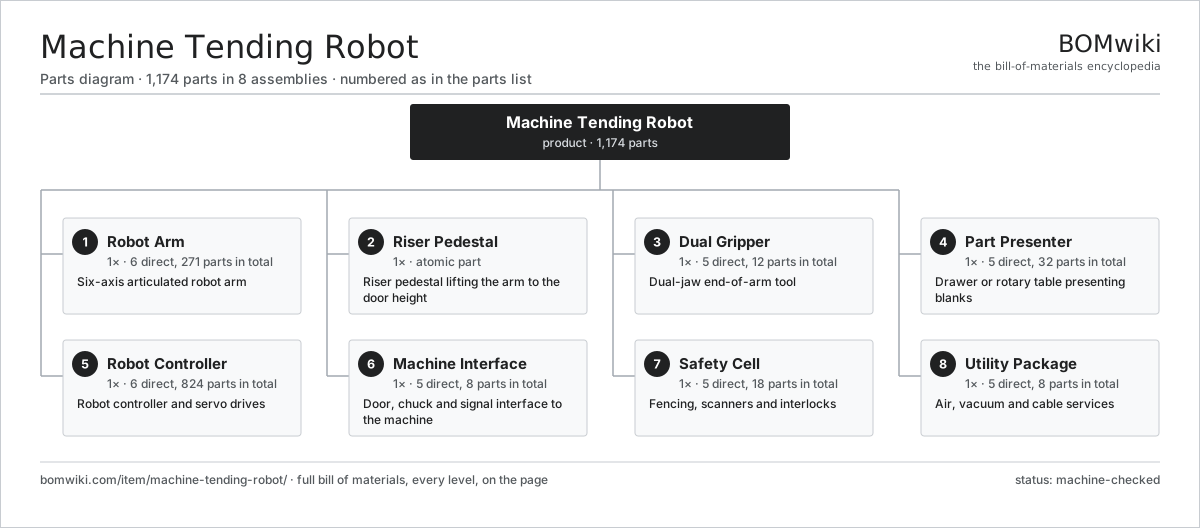
| # | Part | Qty | What it does |
|---|---|---|---|
| 1 | Robot Arm 6 parts | 1× | Six-axis articulated robot arm |
| 2 | Riser Pedestal | 1× | Riser pedestal lifting the arm to the door height |
| 3 | Dual Gripper 5 parts | 1× | Dual-jaw end-of-arm tool |
| 4 | Part Presenter 5 parts | 1× | Drawer or rotary table presenting blanks |
| 5 | Robot Controller 6 parts | 1× | Robot controller and servo drives |
| 6 | Machine Interface 5 parts | 1× | Door, chuck and signal interface to the machine |
| 7 | Safety Cell 5 parts | 1× | Fencing, scanners and interlocks |
| 8 | Utility Package 5 parts | 1× | Air, vacuum and cable services |
3D model
No 3D model yet. Have a CAD file of this? Add a 3D model — STL renders right on this page; STEP, FreeCAD, and OpenSCAD sources are welcome too (openly licensed, like all 3D models on BOMwiki).
Build & assembly graph
expand / collapse · shared sub-assemblies converge · links to related products · est. labourTap an assembly to expand/collapse · tap a part to open it · use “Open page” for any node · drag to pan, scroll to zoom.
Bill of materials for Machine Tending Robot
8 top-level lines · 71 rows shown · 1,174 parts total · indented to 3 levels| # | Item / sub-assembly | Part no. | Qty/assy | Ext. qty | Parts | Type |
|---|---|---|---|---|---|---|
| 1 | Robot Arm 6 parts | machine-tending-robot-arm | 1× | 1 | 271 | assembly |
| 1.1 | Base Casting | machine-tending-robot-base-casting | 1× | 1 | · | part |
| 1.2 | Axis Joint 5 parts | machine-tending-robot-axis-joint | 6× | 6 | 29 | assembly |
| 1.2.1 | Servo Motor 4 parts + deeper › | servo-motor | 1× | 6 | 24 | assembly |
| 1.2.2 | Harmonic Drive | machine-tending-robot-harmonic-drive | 1× | 6 | · | part |
| 1.2.3 | Ball Bearing | ball-bearing | 2× | 12 | · | part |
| 1.2.4 | Oil Seal | oil-seal | 1× | 6 | · | part |
| 1.2.5 | Joint Encoder | machine-tending-robot-joint-encoder | 1× | 6 | · | part |
| 1.3 | Link Arm | machine-tending-robot-link-arm | 3× | 3 | · | part |
| 1.4 | Three-Roll Wrist 3 parts | machine-tending-robot-wrist | 1× | 1 | 91 | assembly |
| 1.4.1 | Axis Joint 5 parts + deeper › | machine-tending-robot-axis-joint | 3× | 3 | 29 | assembly |
| 1.4.2 | Helical Gear Pair | gear-pair | 2× | 2 | · | part |
| 1.4.3 | Oil Seal | oil-seal | 2× | 2 | · | part |
| 1.5 | Tool Flange | machine-tending-robot-tool-flange | 1× | 1 | · | part |
| 1.6 | Wire Bundle | wire-bundle | 1× | 1 | · | part |
| 2 | Riser Pedestal | machine-tending-robot-pedestal | 1× | 1 | · | part |
| 3 | Dual Gripper 5 parts | machine-tending-robot-gripper | 1× | 1 | 12 | assembly |
| 3.1 | Gripper Body | machine-tending-robot-gripper-body | 1× | 1 | · | part |
| 3.2 | Jaw Set 3 parts | machine-tending-robot-jaw-set | 2× | 2 | 4 | assembly |
| 3.2.1 | Gripper Finger | machine-tending-robot-finger | 2× | 4 | · | part |
| 3.2.2 | Jaw Cylinder | machine-tending-robot-jaw-cylinder | 1× | 2 | · | part |
| 3.2.3 | O-Ring Set | oring-set | 1× | 2 | · | part |
| 3.3 | Air Blast Nozzle | machine-tending-robot-air-blast | 1× | 1 | · | part |
| 3.4 | Pressure Sensor | pressure-sensor | 1× | 1 | · | part |
| 3.5 | Compliance Module | machine-tending-robot-compliance | 1× | 1 | · | part |
| 4 | Part Presenter 5 parts | machine-tending-robot-part-presenter | 1× | 1 | 32 | assembly |
| 4.1 | Index Table | machine-tending-robot-index-table | 1× | 1 | · | part |
| 4.2 | Locating Pallet | machine-tending-robot-locating-pallet | 4× | 4 | · | part |
| 4.3 | Servo Motor 4 parts | servo-motor | 1× | 1 | 24 | assembly |
| 4.3.1 | Stator Assembly 3 parts + deeper › | stator-assembly | 1× | 1 | 3 | assembly |
| 4.3.2 | Rotor Assembly 4 parts + deeper › | rotor-assembly | 1× | 1 | 19 | assembly |
| 4.3.3 | Encoder | encoder | 1× | 1 | · | part |
| 4.3.4 | Motor Housing | motor-housing | 1× | 1 | · | part |
| 4.4 | Pallet Sensor | machine-tending-robot-pallet-sensor | 2× | 2 | · | part |
| 4.5 | Ball Bearing | ball-bearing | 1× | 1 | · | part |
| 5 | Robot Controller 6 parts | machine-tending-robot-controller | 1× | 1 | 824 | assembly |
| 5.1 | CPU Board 4 parts | machine-tending-robot-cpu-board | 1× | 1 | 213 | assembly |
| 5.1.1 | Bare PCB | pcb-bare | 1× | 1 | · | part |
| 5.1.2 | Microcontroller | mcu | 2× | 2 | · | part |
| 5.1.3 | SMD Passive (R/C/L) | smd-passives | 200× | 200 | · | part |
| 5.1.4 | Connector | connector | 10× | 10 | · | part |
| 5.2 | Servo Amplifier 5 parts | machine-tending-robot-servo-amp | 6× | 6 | 100 | assembly |
| 5.2.1 | Bare PCB | pcb-bare | 1× | 6 | · | part |
| 5.2.2 | Power MOSFET | mosfet | 6× | 36 | · | part |
| 5.2.3 | Gate Driver IC | gate-driver-ic | 1× | 6 | · | part |
| 5.2.4 | DC-Link Capacitor | dc-link-cap | 2× | 12 | · | part |
| 5.2.5 | SMD Passive (R/C/L) | smd-passives | 90× | 540 | · | part |
| 5.3 | Teach Pendant | machine-tending-robot-pendant | 1× | 1 | · | part |
| 5.4 | Power Supply | power-supply | 1× | 1 | · | part |
| 5.5 | Cell I/O Module | machine-tending-robot-io-module | 1× | 1 | · | part |
| 5.6 | Relay | relay | 8× | 8 | · | part |
| 6 | Machine Interface 5 parts | machine-tending-robot-machine-interface | 1× | 1 | 8 | assembly |
| 6.1 | Door Actuator | machine-tending-robot-door-actuator | 1× | 1 | · | part |
| 6.2 | Chuck Signal Interface | machine-tending-robot-chuck-signal | 1× | 1 | · | part |
| 6.3 | Handshake I/O | machine-tending-robot-handshake-io | 1× | 1 | · | part |
| 6.4 | Pneumatic Cylinder | pneumatic-cylinder | 1× | 1 | · | part |
| 6.5 | Connector | connector | 4× | 4 | · | part |
| 7 | Safety Cell 5 parts | machine-tending-robot-safety-cell | 1× | 1 | 18 | assembly |
| 7.1 | Fence Panel 2 parts | machine-tending-robot-fence-panel | 6× | 6 | 2 | assembly |
| 7.1.1 | Sheet Metal Panel | sheet-panel | 1× | 6 | · | part |
| 7.1.2 | Fastener Set | fastener-set | 1× | 6 | · | part |
| 7.2 | Light Curtain | machine-tending-robot-light-curtain | 1× | 1 | · | part |
| 7.3 | Area Scanner | machine-tending-robot-area-scanner | 1× | 1 | · | part |
| 7.4 | Safety Relay | machine-tending-robot-safety-relay | 2× | 2 | · | part |
| 7.5 | Emergency Stop | machine-tending-robot-estop | 2× | 2 | · | part |
| 8 | Utility Package 5 parts | machine-tending-robot-utility-package | 1× | 1 | 8 | assembly |
| 8.1 | Air Preparation Unit | machine-tending-robot-air-prep | 1× | 1 | · | part |
| 8.2 | Valve Bank | machine-tending-robot-valve-bank | 1× | 1 | · | part |
| 8.3 | Dress Pack | machine-tending-robot-dress-pack | 1× | 1 | · | part |
| 8.4 | Vacuum Generator | machine-tending-robot-vacuum-pump | 1× | 1 | · | part |
| 8.5 | Connector | connector | 4× | 4 | · | part |
Related products
same domain, ranked by shared parts Robotic Case Erector
799 parts · shares 4 with this page
Gantry Loading Robot
800 parts · shares 7 with this page
Robotic Case Erector
799 parts · shares 4 with this page
Gantry Loading Robot
800 parts · shares 7 with this page
Sourcing: possible vendors
Prices, MOQ, and lead times are algorithmic estimates, not quotes, and not claims about these companies. Company mappings are curated by keyword; est. price band $3k–$500k. How estimates work| Vendor | HQ | Specialty | MOQ | Lead time |
|---|---|---|---|---|
|
🇯🇵Fanuc
fanuc.com ↗
|
Oshino, JP | Industrial robots & CNC | 20 units | 10–18 wks |
| abb.com ↗ | Zurich, CH | Industrial robots | 20 units | 10–18 wks |
|
🇯🇵Yaskawa
yaskawa.com ↗
|
Kitakyushu, JP | Robots & motion | 20 units | 10–18 wks |
|
🇩🇪KUKA
kuka.com ↗
|
Augsburg, DE | Industrial robots | 20 units | 10–18 wks |
| universal-robots.com ↗ | Odense, DK | Collaborative robots | 20 units | 10–18 wks |
1,227-word article