Weigh-Price Labeler
ProductOverview
A weigh-price labeler (or weigh labeler) is an automated retail scale that combines three functions: weighing a product, calculating its price based on a unit cost database, and printing a barcode label with weight, price, and date. The label is then automatically applied to the product using a mechanical arm. This device is ubiquitous in supermarkets, butcher shops, delicatessens, and produce sections, where customers expect per-pound or per-kilogram pricing.
The system comprises a precision Weighing Platform (Class A load cell), a Main Processor Module running price lookup logic, an integrated 80 mm thermal Thermal Label Printer, a servo-driven Label Applicator, and a Operator Interface touchscreen for operator interface. An optional Barcode Scanner enables automatic product code entry.
How It Works
An operator places an item (meat, produce, cheese, deli item) on the Weighing Platform. The Precision Load Cell measures its weight and transmits a 4–20 mA signal to the Main Processor Module. The CPU reads the weight, filters and scales it to grams or kilograms, then looks up the unit price from its database. The price per unit is typically entered manually via the Operator Interface touchscreen or retrieved automatically if the operator scans a barcode using the Barcode Scanner.
The CPU then calculates: 'Final Price = Weight (kg) × Unit Price (€/kg)'. This value, along with the weight, current date/time, and a barcode representation of the item code, is formatted into a label template and sent to the Thermal Label Printer.
The printer's Thermal Print Head (203 DPI thermal array) burns the image onto a pre-cut adhesive label fed from a Label Feed Mechanism roll. Printing takes 2–3 seconds. Once the label is printed and detected by the Paper Sensor, a signal is sent to the Servo Motor controlling the Applicator Arm. The servo repositions the arm so that the label aligns over the product on the Transport Conveyor, and a Pressure Plate presses the label onto the product with gentle, even force to ensure good adhesion.
Optionally, the Conveyor Motor then indexes the Conveyor Belt to move the labeled product downstream and advance the next item into position, ready for the next weigh-and-label cycle. In a high-volume retail environment, this cycle repeats dozens of times per minute.
Electrical & Control
The Main Processor Module is the brain of the system. It's an ARM Cortex-A8 running embedded Linux or a proprietary real-time OS, with 512 MB RAM and 2 GB flash. The flash stores a price database (typically 100–10,000 product codes, each with weight/price rules), a transaction log, and label templates. A Real-Time Clock (real-time clock with battery backup) maintains the date and time even if mains power is lost.
The CPU communicates with:
- Precision Load Cell: A/D conversion via an instrumentation amplifier.
- Operator Interface: Touchscreen and optional Keypad Module.
- Thermal Label Printer: Thermal print head driver and paper sensor input.
- Barcode Scanner: Barcode decoder UART.
- Servo Motor: PWM servo control output.
- Conveyor Motor: Stepper motor or brushless DC driver.
The Operator Interface is a 7" color LCD (800 × 480) with capacitive touch, controlled by a separate ARM Cortex-M4 display processor. The touchscreen allows the operator to:
- Select product type and view the pre-set unit price.
- Manually adjust the price if needed (e.g., 10% discount).
- Review transaction history (weight, price, time).
- Recalibrate the scale using test weights.
- Reload price database from a USB stick or network.
Power consumption is high during printing (500–800 W peak due to the thermal print head); the scale and CPU draw only 100–200 W continuously. Most retail units run on 230 V AC single-phase.
Mechanical Design & Assembly
The Weighing Platform is a minimal, rigid frame. The Platform Top Plate (stainless steel 304, 8 mm thick) sits atop an aluminum Platform Frame that isolates and supports the single Precision Load Cell. Four adjustable feet allow the platform to be leveled precisely (±0.1 mm).
The Thermal Label Printer is a compact thermal head mechanism. A Label Feed Mechanism unrolls pre-cut adhesive labels from a roll (3" or 4" wide) through a straightening guide. A Platen Roller advances the label one line at a time under the Thermal Print Head. The printed label is then fed into the Applicator Arm, which positions it over the item.
The Applicator Arm is an aluminum beam (200–300 mm long) pivoting on a bracket. A Servo Motor (5–10 Nm torque, ±2 mm repeatability) rotates the arm to align the label with the product. The Pressure Plate (soft silicone, ∅50 mm roller) then presses the label firmly enough to activate the adhesive without damaging delicate products.
The Conveyor Belt is a modest-sized rubber or PVC belt (400 × 2000 mm) driven by a Conveyor Motor (NEMA 23 stepper or brushless DC with gearbox). The motor advances the belt in discrete steps (typically 300 mm per step), positioning each item under the weighing platform and then under the label applicator in sequence.
Calibration & Accuracy
The Weighing Platform is calibrated using certified test weights (ASTM Class 1). A technician places known weights (1, 2, 5, 10 kg) on the platform and enters trim corrections via the touchscreen. Accuracy is typically ±0.5% of full scale (±75 g on a 15 kg scale).
Thermal printers are sensitive to temperature and print head pressure. Calibration includes:
- Print darkness: Adjusted by heat setting on the print head (typically 8–20 V pulse voltage).
- Label positioning: The servo arm position is trimmed via software so that the label center aligns with product center.
The barcode scanner must be tested with various barcode formats (UPC-A, EAN-13, Code128) to ensure reliable reading at the expected distance (typically 20–40 cm).
Maintenance
Thermal print heads have a finite lifetime (~1 km of printing), after which they need replacement (typically a $100–300 part). Regular maintenance includes:
- Label path cleaning: Dust and adhesive residue accumulate; the path should be wiped weekly with isopropyl alcohol.
- Platen roller cleaning: Can be wiped with a damp cloth.
- Servo lubrication: Servo gearboxes have sealed bearings but benefit from light grease refresh every 12–24 months.
- Scale recalibration: Annual verification with test weights recommended.
Label jams are the most common operational issue; most units have a quick-access hatch for clearing the paper path.
Applications
- Supermarket Produce & Deli: Per-pound pricing for fresh fruits, vegetables, meats, and cheeses.
- Butcher Shop: Weighing and labeling meat portions with price and cut information.
- Bakery & Pastry: Labeling cakes, pastries, and breads with weight and price.
- Seafood Counter: Weighing fresh fish and shellfish.
- Delicatessen: Sliced meats, cheeses, salads, and prepared foods.
- Specialty Retail: High-end coffee beans, nuts, spices, and bulk dry goods.
- QA Laboratories: Labeling samples with batch number, weight, date, and barcode for traceability.
Related Reading: Weighing Platform, Thermal Label Printer, Label Applicator, Main Processor Module.
Weigh-Price Labeler parts and their functions
7 top-level parts · 23 parts in total · full bill of materials below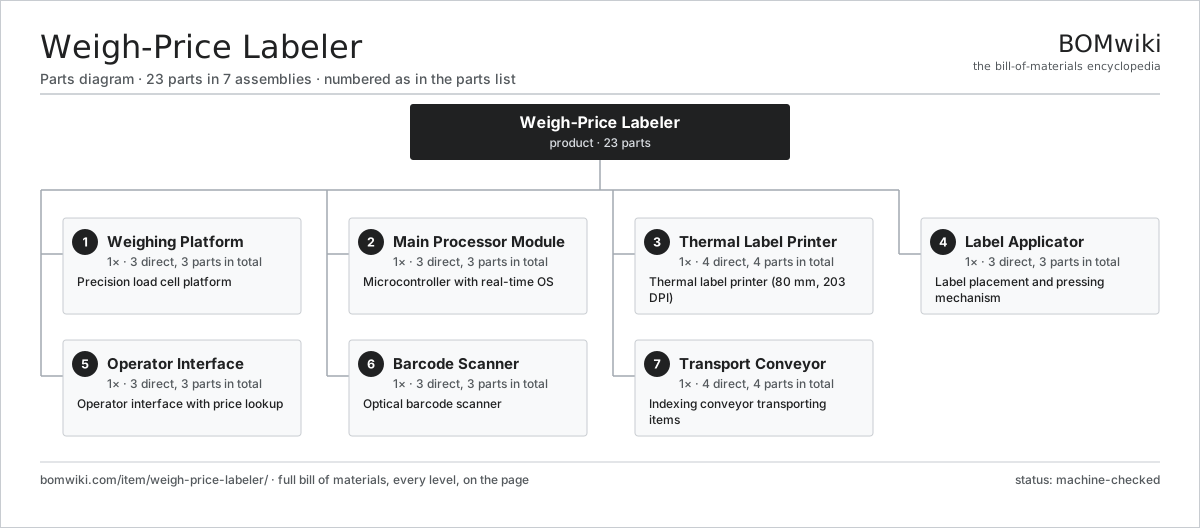
| # | Part | Qty | What it does |
|---|---|---|---|
| 1 | Weighing Platform 3 parts | 1× | Precision load cell platform |
| 2 | Main Processor Module 3 parts | 1× | Microcontroller with real-time OS |
| 3 | Thermal Label Printer 4 parts | 1× | Thermal label printer (80 mm, 203 DPI) |
| 4 | Label Applicator 3 parts | 1× | Label placement and pressing mechanism |
| 5 | Operator Interface 3 parts | 1× | Operator interface with price lookup |
| 6 | Barcode Scanner 3 parts | 1× | Optical barcode scanner |
| 7 | Transport Conveyor 4 parts | 1× | Indexing conveyor transporting items |
3D model
No 3D model yet. Have a CAD file of this? Add a 3D model — STL renders right on this page; STEP, FreeCAD, and OpenSCAD sources are welcome too (openly licensed, like all 3D models on BOMwiki).
Build & assembly graph
expand / collapse · shared sub-assemblies converge · links to related products · est. labourTap an assembly to expand/collapse · tap a part to open it · use “Open page” for any node · drag to pan, scroll to zoom.
Bill of materials for Weigh-Price Labeler
7 top-level lines · 30 rows shown · 23 parts total · indented to 3 levels| # | Item / sub-assembly | Part no. | Qty/assy | Ext. qty | Parts | Type |
|---|---|---|---|---|---|---|
| 1 | Weighing Platform 3 parts | weigh-price-labeler-scale | 1× | 1 | 3 | assembly |
| 1.1 | Precision Load Cell | weigh-price-labeler-load-cell | 1× | 1 | · | part |
| 1.2 | Platform Frame | weigh-price-labeler-platform-frame | 1× | 1 | · | part |
| 1.3 | Platform Top Plate | weigh-price-labeler-platform-plate | 1× | 1 | · | part |
| 2 | Main Processor Module 3 parts | weigh-price-labeler-cpu | 1× | 1 | 3 | assembly |
| 2.1 | Main Processor | weigh-price-labeler-main-mcu | 1× | 1 | · | part |
| 2.2 | Storage Module | weigh-price-labeler-storage | 1× | 1 | · | part |
| 2.3 | Real-Time Clock | weigh-price-labeler-rtc | 1× | 1 | · | part |
| 3 | Thermal Label Printer 4 parts | weigh-price-labeler-printer | 1× | 1 | 4 | assembly |
| 3.1 | Thermal Print Head | weigh-price-labeler-print-head | 1× | 1 | · | part |
| 3.2 | Platen Roller | weigh-price-labeler-platen-roller | 1× | 1 | · | part |
| 3.3 | Label Feed Mechanism | weigh-price-labeler-label-feed | 1× | 1 | · | part |
| 3.4 | Paper Sensor | weigh-price-labeler-paper-sensor | 1× | 1 | · | part |
| 4 | Label Applicator 3 parts | weigh-price-labeler-applicator | 1× | 1 | 3 | assembly |
| 4.1 | Applicator Arm | weigh-price-labeler-applicator-arm | 1× | 1 | · | part |
| 4.2 | Servo Motor | weigh-price-labeler-servo-motor | 1× | 1 | · | part |
| 4.3 | Pressure Plate | weigh-price-labeler-pressure-plate | 1× | 1 | · | part |
| 5 | Operator Interface 3 parts | weigh-price-labeler-display | 1× | 1 | 3 | assembly |
| 5.1 | Display Panel | weigh-price-labeler-display-panel | 1× | 1 | · | part |
| 5.2 | Display Controller | weigh-price-labeler-display-cpu | 1× | 1 | · | part |
| 5.3 | Keypad Module | weigh-price-labeler-keypad | 1× | 1 | · | part |
| 6 | Barcode Scanner 3 parts | weigh-price-labeler-barcode-reader | 1× | 1 | 3 | assembly |
| 6.1 | Barcode Scanner Head | weigh-price-labeler-scanner-head | 1× | 1 | · | part |
| 6.2 | Scanner Trigger | weigh-price-labeler-scan-trigger | 1× | 1 | · | part |
| 6.3 | Barcode Decoder | weigh-price-labeler-decode-module | 1× | 1 | · | part |
| 7 | Transport Conveyor 4 parts | weigh-price-labeler-conveyor | 1× | 1 | 4 | assembly |
| 7.1 | Conveyor Belt | weigh-price-labeler-conveyor-belt | 1× | 1 | · | part |
| 7.2 | Conveyor Motor | weigh-price-labeler-conveyor-motor | 1× | 1 | · | part |
| 7.3 | Indexing Clutch | weigh-price-labeler-conveyor-clutch | 1× | 1 | · | part |
| 7.4 | Drive Belt | drive-belt | 1× | 1 | · | part |
Related products
same domain, ranked by shared parts Auger Powder Filling Machine
102 parts · shares 1 with this page
Automatic Labeling Machine
104 parts · shares 1 with this page
Auger Powder Filling Machine
102 parts · shares 1 with this page
Automatic Labeling Machine
104 parts · shares 1 with this page
 Automatic Strapping Machine
251 parts · shares 1 with this page
Automatic Strapping Machine
251 parts · shares 1 with this page
 Blister Packaging Machine
256 parts · shares 1 with this page
Book Sewing Machine
48 parts · shares 1 with this page
Blister Packaging Machine
256 parts · shares 1 with this page
Book Sewing Machine
48 parts · shares 1 with this page
 Capping Machine
172 parts · shares 1 with this page
Capping Machine
172 parts · shares 1 with this page
Sourcing: possible vendors
Prices, MOQ, and lead times are algorithmic estimates, not quotes, and not claims about these companies. Company mappings are curated by keyword; est. price band $10k–$3M. How estimates work| Vendor | HQ | Specialty | MOQ | Lead time |
|---|---|---|---|---|
| heidelberg.com ↗ | Heidelberg, DE | Printing presses | 10 units | 12–22 wks |
|
🇨🇭Bobst
bobst.com ↗
|
Lausanne, CH | Packaging machinery | 10 units | 12–22 wks |
| koenig-bauer.com ↗ | Würzburg, DE | Printing presses | 10 units | 12–22 wks |
| wuh-group.com ↗ | Lengerich, DE | Flexible packaging machines | 10 units | 12–22 wks |
| markandy.com ↗ | Chesterfield, US | Label presses | 10 units | 12–22 wks |
1,256-word article