Booklet Maker
ProductOverview
Booklet makers are the most automated finishing equipment in print shops. They combine collation, stitching, folding, and trimming into a single continuous system. Operators load signature bins onto a rotating carousel, start the machine, and finished booklets automatically drop into a stacking tray at the other end.
The advantage over saddle stitchers is speed: a booklet maker can achieve 2000-5000 finished booklets/hour for high-volume runs, compared to 1500-3000 for saddle stitchers. They also handle thicker booklets (100+ signatures) more reliably because the rotating carousel distributes bin weight across the machine structure.
Booklet makers are capital-intensive ($80,000-$200,000) and require skilled setup, but they are essential for print shops producing catalogs, manuals, and periodicals.
How it works
The Collation Tower is a vertical rotating carousel, typically 10-14 bins arranged in a circle. Each bin holds 2000-5000 pre-folded signatures of a different page count. The Tower Drive Motor is a stepper motor with encoder and gearbox that indexes the carousel precisely one bin position per machine cycle.
At the pickup station, a Signature Pickup Arm arm reaches into the current bin, activates its vacuum cup, draws one signature, and advances forward. As it moves, it encounters the next bin (carousel advances during pickup), and the arm gathers the second signature. This repeats for all signatures in the booklet.
The gathered signatures are held in a Clamp Gripper, which squeezes them together and positions them on the Nesting Guide, a V-shaped spine-centering block. The signatures are now nested and aligned.
The Stapling Section then fires two staples through the spine using synchronized pneumatic drivers. Two staples provide better spine strength than one, especially for thicker booklets. The Dual Anvil Block clinches the staple legs inward.
After stapling, the booklet advances to the Folding Section, where a fold knife pushes it under two pressure rollers. The rollers crease the spine and fold the booklet in half.
Finally, the booklet enters the Trimming Section. Three independent blades cut the top (head), bottom (tail), and side (fore-edge) edges simultaneously or sequentially. Trim position is adjustable per book width, often set via the touchscreen.
The finished, trimmed booklet drops onto the Delivery Section conveyor and slides into a tray, completing the cycle (1 to 2 seconds for a simple booklet, 3-5 seconds for a thick one with full trim).
Carousel Bin Strategy
The beauty of the carousel design is that it separates collation (picking signatures in sequence) from gathering (physically holding them). Each bin independently stores a single signature type. If making a 100-page booklet from 10-page signatures (10 sheets), the machine needs 10 bins (one per sheet, in order).
For a 20-page booklet from 4-page signatures (5 sheets), only 5 bins are needed. The carousel advances through all populated bins, picks once per bin, and the operator presses "Finish" when all pages are gathered.
This design allows the machine to handle variable booklet page counts without hardware changes, just load different quantities into each bin.
Dual-Staple Stitching
Two staples are standard because they prevent the spine from opening under reading stress. On a 100-page booklet, a single staple at the spine center will eventually bend and allow the pages to fan open. Two staples (at 30-40 mm spacing) distribute stress and extend service life to 3-5 years.
The Primary Driver Unit and Secondary Driver Unit fire in quick sequence (milliseconds apart). Both must fire or an alarm stops the machine. A Staple Sensor detects staple formation to catch issues like broken wire or cartridge jam.
Trim Automation
Entry-level booklet makers offer optional three-edge trim. Advanced models provide automatic trim position adjustment based on book width. The operator sets the finished book size (e.g., 210×297 mm A4), and the Trim Positioning System pneumatic or stepper motor adjusts blade position accordingly.
Trim blades are hardened steel and require regular inspection. Dull blades produce torn edges and slowdowns as pressure increases to compensate. Blade replacement (three blades) costs $1000-$2000.
Speed and Capacity
Cycle time depends on booklet page count and trim complexity. A 40-page booklet (4 signatures, 2 staples, 3-edge trim) cycles in 1.5-2 seconds, roughly 1800-2400 booklets/hour.
A 200-page booklet (20 signatures, 2 staples, 3-edge trim) cycles in 4-5 seconds, roughly 600-800 booklets/hour.
The carousel advance is the main speed limiter. Faster machines use pneumatic rather than stepper-motor carousel drives, allowing index speeds of 0.5-1 second versus 1-2 seconds for stepper systems.
Operator Interface
The Touchscreen Panel displays a recipe system. Operators store jobs as named profiles: "Catalog Q1 (100 pages, 2 staples, full trim)" includes all settings, bin layout, stitch count, trim offsets, cycle speed. Loading a preset job is faster than manual setup.
Production counters track pieces made and flag targets (e.g., "Stop at 500 units"). Diagnostics log motor currents, air pressure, and error codes, helping troubleshoot jams or failures.
Maintenance and Reliability
Booklet makers are complex systems with multiple motors, solenoids, and timing dependencies. Daily maintenance includes verifying air pressure, checking for paper dust, and inspecting anvil condition.
Weekly tasks: Lubricate pivot points, verify carousel bearing smoothness, inspect fold rollers for wear.
Monthly: Replace air filters, deep-clean pickup arm vacuum pathways, inspect drive belts and pulleys.
Typical component lifespans:
- Anvil block: 6-12 months (300-500 million cycles)
- Fold rollers: 12-18 months
- Trim blades: 3-6 months depending on material cut (cardboard vs. specialty stocks)
Used booklet makers in good working order sell for $30,000-$80,000 (original price $100,000-$200,000). They hold value well in print shops because they fundamentally increase bindery throughput.
Booklet Maker parts and their functions
8 top-level parts · 58 parts in total · full bill of materials below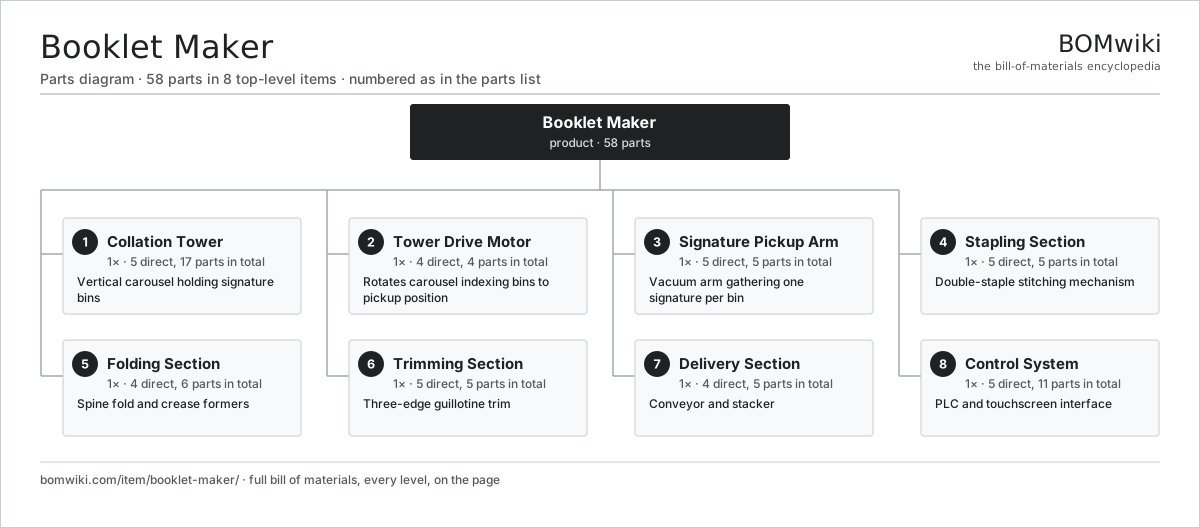
| # | Part | Qty | What it does |
|---|---|---|---|
| 1 | Collation Tower 5 parts | 1× | Vertical carousel holding signature bins |
| 2 | Tower Drive Motor 4 parts | 1× | Rotates carousel indexing bins to pickup position |
| 3 | Signature Pickup Arm 5 parts | 1× | Vacuum arm gathering one signature per bin |
| 4 | Stapling Section 5 parts | 1× | Double-staple stitching mechanism |
| 5 | Folding Section 4 parts | 1× | Spine fold and crease formers |
| 6 | Trimming Section 5 parts | 1× | Three-edge guillotine trim |
| 7 | Delivery Section 4 parts | 1× | Conveyor and stacker |
| 8 | Control System 5 parts | 1× | PLC and touchscreen interface |
3D model
No 3D model yet. Have a CAD file of this? Add a 3D model. STL renders right on this page; STEP, FreeCAD, and OpenSCAD sources are welcome too (openly licensed, like all 3D models on BOMwiki).
Build & assembly graph
expand / collapse · shared sub-assemblies converge · links to related products · est. labourTap an assembly to expand/collapse · tap a part to open it · use “Open page” for any node · drag to pan, scroll to zoom.
Bill of materials for Booklet Maker
8 top-level lines · 45 rows shown · 58 parts total · indented to 3 levels| # | Item / sub-assembly | Part no. | Qty/assy | Ext. qty | Parts | Type |
|---|---|---|---|---|---|---|
| 1 | Collation Tower 5 parts | booklet-maker-collation-tower | 1× | 1 | 17 | assembly |
| 1.1 | Tower Frame | booklet-maker-tower-frame | 1× | 1 | · | part |
| 1.2 | Carousel Base | booklet-maker-carousel-base | 1× | 1 | · | part |
| 1.3 | Signature Bin | booklet-maker-bin-assembly | 10× | 10 | · | part |
| 1.4 | Slewing Bearing | booklet-maker-carousel-bearing | 1× | 1 | · | part |
| 1.5 | Ball Bearing | ball-bearing | 4× | 4 | · | part |
| 2 | Tower Drive Motor 4 parts | booklet-maker-tower-drive | 1× | 1 | 4 | assembly |
| 2.1 | Carousel Motor | booklet-maker-drive-motor | 1× | 1 | · | part |
| 2.2 | Drive Encoder | booklet-maker-drive-encoder | 1× | 1 | · | part |
| 2.3 | Drive Gearbox | booklet-maker-drive-gearbox | 1× | 1 | · | part |
| 2.4 | Drive Coupler | booklet-maker-drive-coupler | 1× | 1 | · | part |
| 3 | Signature Pickup Arm 5 parts | booklet-maker-signature-pickup | 1× | 1 | 5 | assembly |
| 3.1 | Pickup Arm Beam | booklet-maker-pickup-arm-beam | 1× | 1 | · | part |
| 3.2 | Pickup Vacuum Cup | booklet-maker-pickup-vacuum-cup | 1× | 1 | · | part |
| 3.3 | Pickup Arm Motor | booklet-maker-pickup-motor | 1× | 1 | · | part |
| 3.4 | Clamp Gripper | booklet-maker-clamp-gripper | 1× | 1 | · | part |
| 3.5 | Nesting Guide | booklet-maker-nest-guide | 1× | 1 | · | part |
| 4 | Stapling Section 5 parts | booklet-maker-stapling-section | 1× | 1 | 5 | assembly |
| 4.1 | Dual Staple Cartridge | booklet-maker-staple-cartridge-dual | 1× | 1 | · | part |
| 4.2 | Primary Driver Unit | booklet-maker-driver-unit-1 | 1× | 1 | · | part |
| 4.3 | Secondary Driver Unit | booklet-maker-driver-unit-2 | 1× | 1 | · | part |
| 4.4 | Dual Anvil Block | booklet-maker-anvil-dual | 1× | 1 | · | part |
| 4.5 | Staple Sensor | booklet-maker-staple-sensor | 1× | 1 | · | part |
| 5 | Folding Section 4 parts | booklet-maker-folding-section | 1× | 1 | 6 | assembly |
| 5.1 | Fold Knife | booklet-maker-fold-knife | 1× | 1 | · | part |
| 5.2 | Fold Roller | booklet-maker-fold-roller-pair | 2× | 2 | · | part |
| 5.3 | Fold Drive Motor | booklet-maker-fold-motor | 1× | 1 | · | part |
| 5.4 | Ball Bearing | ball-bearing | 2× | 2 | · | part |
| 6 | Trimming Section 5 parts | booklet-maker-trimming-section | 1× | 1 | 5 | assembly |
| 6.1 | Head Trim Blade | booklet-maker-trim-head-blade | 1× | 1 | · | part |
| 6.2 | Tail Trim Blade | booklet-maker-trim-tail-blade | 1× | 1 | · | part |
| 6.3 | Fore-Edge Blade | booklet-maker-trim-fore-blade | 1× | 1 | · | part |
| 6.4 | Trim Drive Motor | booklet-maker-trim-motor | 1× | 1 | · | part |
| 6.5 | Trim Positioning System | booklet-maker-trim-positioning | 1× | 1 | · | part |
| 7 | Delivery Section 4 parts | booklet-maker-delivery-section | 1× | 1 | 5 | assembly |
| 7.1 | Delivery Conveyor Belt | booklet-maker-delivery-belt | 1× | 1 | · | part |
| 7.2 | Delivery Motor | booklet-maker-delivery-motor | 1× | 1 | · | part |
| 7.3 | Stacking Arm | booklet-maker-stacking-arm | 1× | 1 | · | part |
| 7.4 | Ball Bearing | ball-bearing | 2× | 2 | · | part |
| 8 | Control System 5 parts | booklet-maker-control-system | 1× | 1 | 11 | assembly |
| 8.1 | Microcontroller | mcu | 1× | 1 | · | part |
| 8.2 | Touchscreen Panel | booklet-maker-touch-panel | 1× | 1 | · | part |
| 8.3 | Relay | relay | 6× | 6 | · | part |
| 8.4 | Bare PCB | pcb-bare | 2× | 2 | · | part |
| 8.5 | SMD Passive (R/C/L) | smd-passives | 1× | 1 | · | part |
Something wrong in this list? Report a problem with this BOM.
Sourcing: possible vendors
Browse the supplier directory → Prices, MOQ, and lead times are algorithmic estimates, not quotes, and not claims about these companies. Company mappings are curated by keyword; est. price band $10k–$3M. How estimates work| Vendor | HQ | Specialty | MOQ | Lead time |
|---|---|---|---|---|
| heidelberg.com ↗ | Heidelberg, DE | Printing presses | 10 units | 12–22 wks |
|
🇨🇭Bobst
bobst.com ↗
|
Lausanne, CH | Packaging machinery | 10 units | 12–22 wks |
| koenig-bauer.com ↗ | Würzburg, DE | Printing presses | 10 units | 12–22 wks |
| wuh-group.com ↗ | Lengerich, DE | Flexible packaging machines | 10 units | 12–22 wks |
| markandy.com ↗ | Chesterfield, US | Label presses | 10 units | 12–22 wks |
984-word article