Piston Filling Machine
ProductOverview
A piston filling machine doses a measured volume of product into each container by drawing it into a cylinder with a piston and then pushing it back out. It is a volumetric filler, which means it meters by displaced volume rather than by weight or by timed flow, so it suits thick and difficult products that a flow meter or a pressure-time filler cannot handle: sauces, ketchup, mayonnaise, creams, gels, lotions, honey, peanut butter, and even product with particulates like salsa or pie filling. The fill volume is set by how far the piston travels, so once a cylinder bore is chosen the dose is a direct function of stroke length, and that is what makes the machine repeatable across thousands of containers.
The machine is built on a Frame and Guarding that carries a Product Hopper of product above a Piston Cylinder Block that does the metering. A Rotary Fill Valve routes product between the hopper and the nozzles, the Fill Nozzles delivers it into the container, the Nozzle Dive Mechanism lowers and lifts the nozzles, the Conveyor and Indexing moves containers through the station, the Control System runs the cycle, and the Pneumatic System drive the air-actuated parts.
How the piston and valve cycle works
The heart of the machine is the metering cycle, and it runs in two strokes. On the back stroke the Piston withdraws inside the Metering Cylinder, which creates a low pressure that draws product down from a Hopper Outlet through the Rotary Fill Valve and into the cylinder. The Rotary Plug is pointed at the hopper for this stroke. The volume drawn in equals the bore area of the cylinder times the distance the piston moved, so it is fixed and known.
The Valve Actuator then rotates the plug a quarter turn so the cylinder now connects to the Product Manifold and the nozzles instead of the hopper. On the forward stroke the piston pushes the exact volume it just drew out through the Diving Nozzle and into the container. Because the same piston that measured the dose also delivers it, what goes into the container is precisely what was metered, with no settling time or flow estimate involved. A typical machine holds plus or minus 0.5 percent of the set dose.
Fill volume is changed at the Stroke Adjuster. On a servo machine the Piston Servo drives the Ball Screw pair and the stroke is simply a number on the screen, so changing from a 250 ml to a 500 ml fill is a recipe change rather than a mechanical one. On older or simpler machines a hand screw sets a physical stop. The piston rides on a Linear Guide Rail and the bore is sealed by an O-Ring Set of FDA-grade seals that take the wear of the sliding piston.
Valves: rotary versus check
Two valve schemes are common. The rotary valve described above uses one ported Valve Body that physically swaps the cylinder between the fill port and the discharge port. It passes large Valve Port openings, so it handles chunky product and high viscosity well and is easy to strip and clean. The alternative is a pair of check valves, where one spring-loaded valve opens only on the intake stroke and a second opens only on the discharge stroke, with the cylinder direction deciding which one flows. Check-valve machines are simpler and cheaper but they can struggle with particulates that lodge in the seat, so rotary-valve machines dominate where the product has chunks or where clean-in-place matters.
Nozzles and clean cutoff
Viscous product strings and foams if it is dropped from a height, so the Fill Nozzles is designed to lay product gently. The Nozzle Dive Mechanism lowers the Dive Carriage on its Dive Lead Screw and Linear Guide Rail so each Diving Nozzle starts near the bottom of the container, and a Servo Motor raises the carriage as the container fills so the nozzle tip stays just below the product surface. This bottom-up dive fill keeps thick product from folding air into itself.
At the end of the dose the Shutoff Valve closes hard so the fill ends sharply, and the Anti-Drip Tip applies a small suck-back that pulls the trailing product up so a thread of sauce does not drape on the container rim. Anything that does escape lands on the Drip Tray and drains away instead of fouling the conveyor.
Hopper and product handling
Product reaches the cylinders from the Hopper Tank, a jacketed reservoir that can be fed warm water to keep stiff product flowing. A Agitator turns slowly, driven by the Agitator Gearmotor, to keep the product uniform and push it toward the outlets without whipping in air; the shaft runs on a Ball Bearing pair and an Oil Seal. A Level Sensor watches the level and calls for a refill before the pistons can starve and draw a short, inaccurate fill.
Control, conveyor, and pneumatics
The Control System system ties the cycle together. The PLC sequences piston, valve, dive, shutoff, and conveyor moves, with fill volume, fill speed, and dive depth set on the HMI Touchscreen and stored per product and container. The Servo Drive commands the servos and reads their encoders, a Pressure Sensor watches product pressure to catch a blockage or a dry hopper, and a Power Supply, Wire Bundle, and Connector set wire the station.
Containers ride the Slat Chain, driven by the Conveyor Gearmotor, and an Index Gate stops them under the nozzles for the fill. A No-Container Sensor enforces no-container-no-fill: if a container is missing at a nozzle, that nozzle is skipped so product is not dumped on the line. The air-driven moves run off the Pneumatic System, where a Filter-Regulator conditions the air and a Valve Bank fires each Air Cylinder.
Variants and use
Machines scale from a single-head bench unit at fifteen containers a minute to a twelve-head inline or rotary machine running well over a hundred. The choice between rotary-valve and check-valve metering follows the product: rotary for chunky or high-viscosity product and where frequent washdown is needed, check valve for thinner product and lower budgets. For thin, free-flowing liquids a piston filler is overkill and a Liquid Filling Machine is the better tool; the piston machine earns its place exactly where the product is too thick, too sticky, or too chunky for flow-based filling to stay accurate.
Piston Filling Machine parts and their functions
9 top-level parts · 112 parts in total · full bill of materials below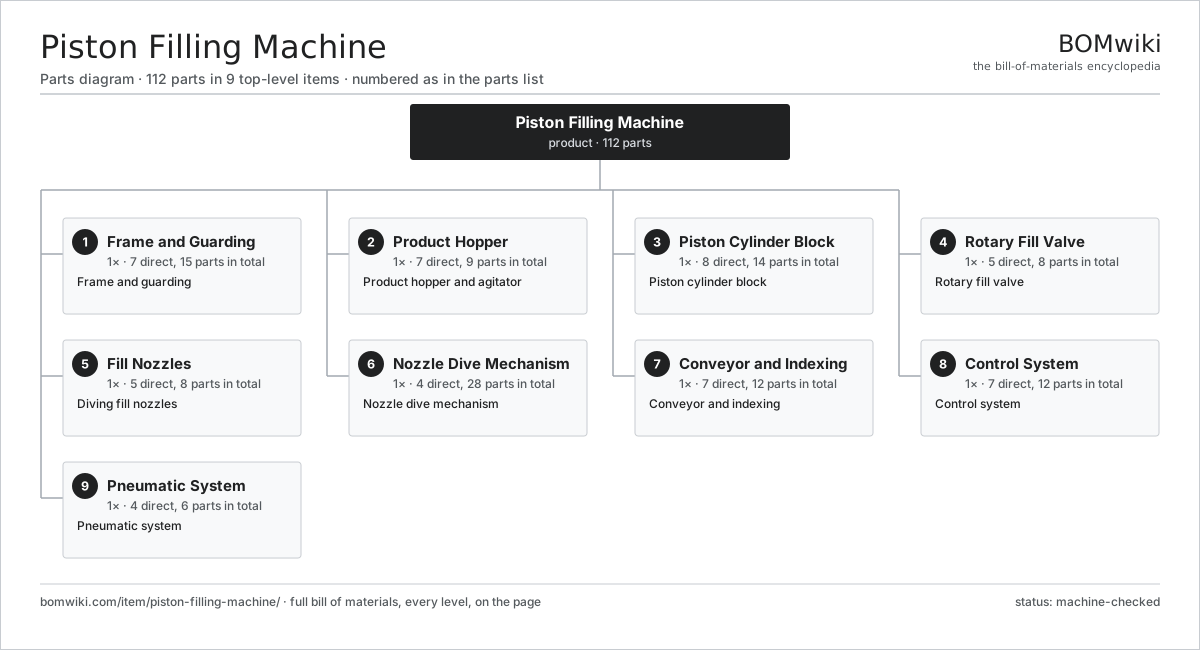
| # | Part | Qty | What it does |
|---|---|---|---|
| 1 | Frame and Guarding 7 parts | 1× | Frame and guarding |
| 2 | Product Hopper 7 parts | 1× | Product hopper and agitator |
| 3 | Piston Cylinder Block 8 parts | 1× | Piston cylinder block |
| 4 | Rotary Fill Valve 5 parts | 1× | Rotary fill valve |
| 5 | Fill Nozzles 5 parts | 1× | Diving fill nozzles |
| 6 | Nozzle Dive Mechanism 4 parts | 1× | Nozzle dive mechanism |
| 7 | Conveyor and Indexing 7 parts | 1× | Conveyor and indexing |
| 8 | Control System 7 parts | 1× | Control system |
| 9 | Pneumatic System 4 parts | 1× | Pneumatic system |
3D model
No 3D model yet. Have a CAD file of this? Add a 3D model. STL renders right on this page; STEP, FreeCAD, and OpenSCAD sources are welcome too (openly licensed, like all 3D models on BOMwiki).
Build & assembly graph
expand / collapse · shared sub-assemblies converge · links to related products · est. labourTap an assembly to expand/collapse · tap a part to open it · use “Open page” for any node · drag to pan, scroll to zoom.
Bill of materials for Piston Filling Machine
9 top-level lines · 67 rows shown · 112 parts total · indented to 3 levels| # | Item / sub-assembly | Part no. | Qty/assy | Ext. qty | Parts | Type |
|---|---|---|---|---|---|---|
| 1 | Frame and Guarding 7 parts | piston-filling-machine-frame | 1× | 1 | 15 | assembly |
| 1.1 | Base Weldment | piston-filling-machine-base-weldment | 1× | 1 | · | part |
| 1.2 | Leveling Foot | piston-filling-machine-leveling-foot | 4× | 4 | · | part |
| 1.3 | Drip Tray | piston-filling-machine-drip-tray | 1× | 1 | · | part |
| 1.4 | Guard Door | piston-filling-machine-guard-door | 2× | 2 | · | part |
| 1.5 | Door Interlock | piston-filling-machine-door-interlock | 2× | 2 | · | part |
| 1.6 | Sheet Metal Panel | sheet-panel | 4× | 4 | · | part |
| 1.7 | Fastener Set | fastener-set | 1× | 1 | · | part |
| 2 | Product Hopper 7 parts | piston-filling-machine-hopper | 1× | 1 | 9 | assembly |
| 2.1 | Hopper Tank | piston-filling-machine-hopper-tank | 1× | 1 | · | part |
| 2.2 | Agitator | piston-filling-machine-agitator | 1× | 1 | · | part |
| 2.3 | Agitator Gearmotor | piston-filling-machine-agitator-motor | 1× | 1 | · | part |
| 2.4 | Level Sensor | piston-filling-machine-level-sensor | 1× | 1 | · | part |
| 2.5 | Hopper Outlet | piston-filling-machine-hopper-outlet | 2× | 2 | · | part |
| 2.6 | Ball Bearing | ball-bearing | 2× | 2 | · | part |
| 2.7 | Oil Seal | oil-seal | 1× | 1 | · | part |
| 3 | Piston Cylinder Block 8 parts | piston-filling-machine-piston-block | 1× | 1 | 14 | assembly |
| 3.1 | Metering Cylinder | piston-filling-machine-cylinder | 2× | 2 | · | part |
| 3.2 | Piston | piston-filling-machine-piston | 2× | 2 | · | part |
| 3.3 | Piston Rod | piston-filling-machine-piston-rod | 2× | 2 | · | part |
| 3.4 | Stroke Adjuster | piston-filling-machine-stroke-adjust | 2× | 2 | · | part |
| 3.5 | Piston Servo | piston-filling-machine-piston-servo | 1× | 1 | · | part |
| 3.6 | Ball Screw | ball-screw | 2× | 2 | · | part |
| 3.7 | Linear Guide Rail | linear-guide | 2× | 2 | · | part |
| 3.8 | O-Ring Set | oring-set | 1× | 1 | · | part |
| 4 | Rotary Fill Valve 5 parts | piston-filling-machine-rotary-valve | 1× | 1 | 8 | assembly |
| 4.1 | Valve Body | piston-filling-machine-valve-body | 1× | 1 | · | part |
| 4.2 | Rotary Plug | piston-filling-machine-valve-plug | 1× | 1 | · | part |
| 4.3 | Valve Actuator | piston-filling-machine-valve-actuator | 1× | 1 | · | part |
| 4.4 | Valve Port | piston-filling-machine-valve-port | 4× | 4 | · | part |
| 4.5 | O-Ring Set | oring-set | 1× | 1 | · | part |
| 5 | Fill Nozzles 5 parts | piston-filling-machine-nozzle-assembly | 1× | 1 | 8 | assembly |
| 5.1 | Diving Nozzle | piston-filling-machine-nozzle | 2× | 2 | · | part |
| 5.2 | Shutoff Valve | piston-filling-machine-shutoff-valve | 2× | 2 | · | part |
| 5.3 | Anti-Drip Tip | piston-filling-machine-nozzle-tip | 2× | 2 | · | part |
| 5.4 | Product Manifold | piston-filling-machine-manifold | 1× | 1 | · | part |
| 5.5 | O-Ring Set | oring-set | 1× | 1 | · | part |
| 6 | Nozzle Dive Mechanism 4 parts | piston-filling-machine-dive-mechanism | 1× | 1 | 28 | assembly |
| 6.1 | Servo Motor 4 parts | servo-motor | 1× | 1 | 24 | assembly |
| 6.1.1 | Stator Assembly 3 parts + deeper › | stator-assembly | 1× | 1 | 3 | assembly |
| 6.1.2 | Rotor Assembly 4 parts + deeper › | rotor-assembly | 1× | 1 | 19 | assembly |
| 6.1.3 | Encoder | encoder | 1× | 1 | · | part |
| 6.1.4 | Motor Housing | motor-housing | 1× | 1 | · | part |
| 6.2 | Dive Carriage | piston-filling-machine-dive-carriage | 1× | 1 | · | part |
| 6.3 | Dive Lead Screw | piston-filling-machine-dive-screw | 1× | 1 | · | part |
| 6.4 | Linear Guide Rail | linear-guide | 2× | 2 | · | part |
| 7 | Conveyor and Indexing 7 parts | piston-filling-machine-conveyor | 1× | 1 | 12 | assembly |
| 7.1 | Slat Chain | piston-filling-machine-slat-chain | 1× | 1 | · | part |
| 7.2 | Conveyor Gearmotor | piston-filling-machine-conveyor-motor | 1× | 1 | · | part |
| 7.3 | Index Gate | piston-filling-machine-index-gate | 2× | 2 | · | part |
| 7.4 | No-Container Sensor | piston-filling-machine-bottle-sensor | 1× | 1 | · | part |
| 7.5 | Guide Rail | piston-filling-machine-guide-rail | 2× | 2 | · | part |
| 7.6 | Drive Belt | drive-belt | 1× | 1 | · | part |
| 7.7 | Ball Bearing | ball-bearing | 4× | 4 | · | part |
| 8 | Control System 7 parts | piston-filling-machine-control | 1× | 1 | 12 | assembly |
| 8.1 | PLC | piston-filling-machine-plc | 1× | 1 | · | part |
| 8.2 | HMI Touchscreen | piston-filling-machine-hmi | 1× | 1 | · | part |
| 8.3 | Servo Drive | piston-filling-machine-servo-drive | 1× | 1 | · | part |
| 8.4 | Pressure Sensor | pressure-sensor | 1× | 1 | · | part |
| 8.5 | Power Supply | power-supply | 1× | 1 | · | part |
| 8.6 | Wire Bundle | wire-bundle | 1× | 1 | · | part |
| 8.7 | Connector | connector | 6× | 6 | · | part |
| 9 | Pneumatic System 4 parts | piston-filling-machine-pneumatics | 1× | 1 | 6 | assembly |
| 9.1 | Filter-Regulator | piston-filling-machine-fr-unit | 1× | 1 | · | part |
| 9.2 | Valve Bank | piston-filling-machine-valve-bank | 1× | 1 | · | part |
| 9.3 | Air Cylinder | piston-filling-machine-air-cylinder | 3× | 3 | · | part |
| 9.4 | Air Tubing | piston-filling-machine-air-tubing | 1× | 1 | · | part |
Related products
same domain, ranked by shared parts Digital Inkjet Web Press
3,001 parts · shares 8 with this page
Digital Inkjet Web Press
3,001 parts · shares 8 with this page
 Industrial Screen Printing Press
162 parts · shares 8 with this page
Industrial Screen Printing Press
162 parts · shares 8 with this page
 Liquid Filling Machine
188 parts · shares 7 with this page
Ream Wrapping Machine
540 parts · shares 7 with this page
Case Labeling Machine
120 parts · shares 7 with this page
Liquid Filling Machine
188 parts · shares 7 with this page
Ream Wrapping Machine
540 parts · shares 7 with this page
Case Labeling Machine
120 parts · shares 7 with this page
Sourcing: possible vendors
Browse the supplier directory → Prices, MOQ, and lead times are algorithmic estimates, not quotes, and not claims about these companies. Company mappings are curated by keyword; est. price band $10k–$3M. How estimates work| Vendor | HQ | Specialty | MOQ | Lead time |
|---|---|---|---|---|
| heidelberg.com ↗ | Heidelberg, DE | Printing presses | 10 units | 12–22 wks |
|
🇨🇭Bobst
bobst.com ↗
|
Lausanne, CH | Packaging machinery | 10 units | 12–22 wks |
| koenig-bauer.com ↗ | Würzburg, DE | Printing presses | 10 units | 12–22 wks |
| wuh-group.com ↗ | Lengerich, DE | Flexible packaging machines | 10 units | 12–22 wks |
| markandy.com ↗ | Chesterfield, US | Label presses | 10 units | 12–22 wks |
1,200-word article