Conveyor Metal Detector
ProductOverview
A conveyor metal detector finds metal contamination in product as it passes along a line and removes any pack that contains metal. Contamination can be a fragment of a worn machine part, a broken sieve wire, swarf from maintenance, or a foreign object, and a single piece in a food or pharmaceutical pack is both a safety hazard and a recall risk. The detector senses metal by the way it disturbs a magnetic field, flags the affected pack, and a reject device pulls that pack off the line before it reaches the customer. In most plants the detector is a HACCP critical control point, so it is built not only to detect but to prove it detected, with locked rejects, fail-safe logic, and a scheduled test routine.
The machine combines a sensing head with a conveyor and reject. The Search Head holds the coils, the Detector Electronics drive and read them, the Conveyor Section carries product through, the Reject System removes contaminated packs, the Controller and HMI sets it up and logs events, and the Stainless Frame holds it all at line height with Safety and Verification hardware.
How balanced coils sense metal
The Search Head works on the balanced-coil principle. A center Transmit Coil is driven at the search frequency to fill the aperture with an alternating magnetic field. Two Receive Coil windings, one on each side and wired in opposition, are positioned so the transmitted field induces equal and opposite voltages that cancel to nearly zero. When a piece of metal enters the aperture, it disturbs the field unequally between the two receive coils and the balance breaks, producing a small signal. A rigid Coil Former keeps the coil geometry fixed, a RF Shield keeps outside noise out, and a Balance Trim nulls any residual imbalance during setup. A tough Aperture Liner protects the window from the product scraping through.
Reading a tiny signal through the product
The challenge is that the product itself often disturbs the field. Wet, salty, or warm products are conductive and produce a signal of their own, called the product effect, which can be far larger than the signal from a small piece of metal. The Detector Electronics separate the two. The Oscillator Board drives the coil with a stable current, the Receiver Board amplifies and phase-detects the unbalance, and the Signal Processor Board uses a DSP to compensate for the known product effect and flag only a real metal event. Multi-frequency operation reads the signal at several frequencies at once, since metal and product respond differently across frequency, which sharpens detection of stainless steel and of metal inside conductive product. A Shield Can keeps the sensitive boards quiet.
Carrying product without false trips
Everything that moves through the aperture must be non-metallic, or it would trip the coils. The Conveyor Section uses a non-metallic Conveyor Belt on a plastic Conveyor Bed, and the Belt Drive Motor and its iron parts are mounted well clear of the head. The Drive Roller and Idle Roller sit outside the field, and a Belt Tracker keeps the belt centered so it never rubs the liner. Plant vibration also matters, since it can shift the coils and cause false signals, so the head is carried on Vibration Mount isolators in the frame.
Rejecting and proving it
When metal is flagged, the Reject System removes the pack. The Air Valve fires the Air Cylinder and Reject Pusher to sweep it into the locked Reject Bin, timed by tracking the pack from the head to the reject point. A Confirm Sensor proves the reject happened and stops the line if it did not, and a Bin-Full Sensor stops the line if the bin fills, since an overflowing reject bin could let a contaminated pack back onto the belt. The bin is locked so no one can retrieve a rejected pack without authorization, which keeps the contaminated unit out of the food stream.
Setup, verification, and use
The Controller and HMI holds a recipe for each product with its own sensitivity and product-effect settings, and it logs every detection with a timestamp for audit. A scheduled routine passes Test Piece samples, one ferrous, one non-ferrous, and one stainless, through the aperture to confirm the detector still finds the smallest piece it is meant to, and a failed test stops the line. A Status Beacon shows run, reject, and fault states at a glance, and an Emergency Stop cuts belt power. Conveyor detectors handle packaged and loose product on belts, while related designs inspect gravity-fed powders, pumped liquids and slurries, and pharmaceutical tablets. Sensitivity is limited by the aperture size, the product effect, and the belt speed, so a detector is specified for a given pack size and product, and stainless steel, being the least magnetic and least conductive common contaminant, sets the hardest detection limit.
Conveyor Metal Detector parts and their functions
7 top-level parts · 626 parts in total · full bill of materials below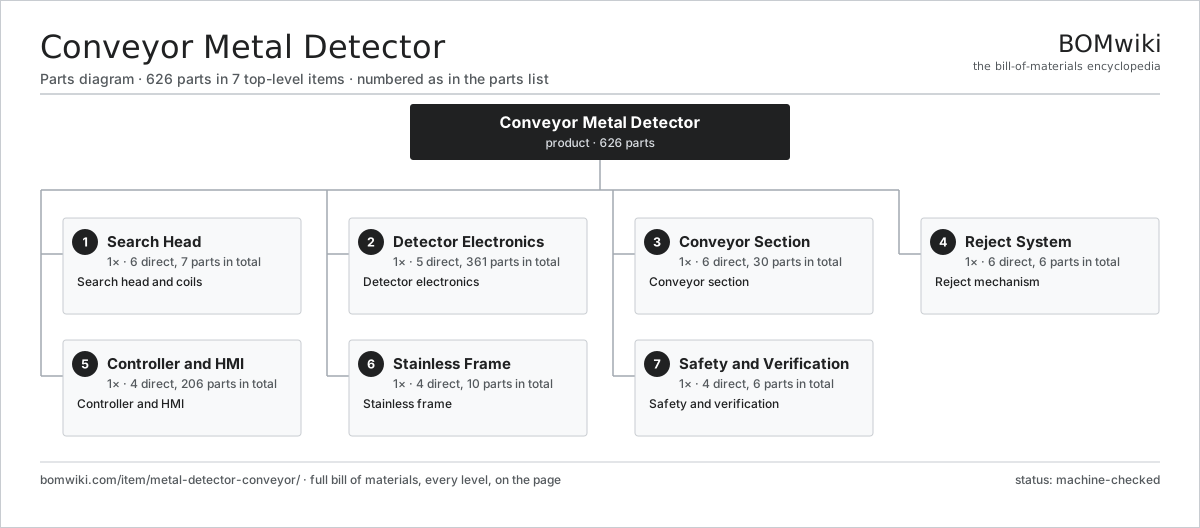
| # | Part | Qty | What it does |
|---|---|---|---|
| 1 | Search Head 6 parts | 1× | Search head and coils |
| 2 | Detector Electronics 5 parts | 1× | Detector electronics |
| 3 | Conveyor Section 6 parts | 1× | Conveyor section |
| 4 | Reject System 6 parts | 1× | Reject mechanism |
| 5 | Controller and HMI 4 parts | 1× | Controller and HMI |
| 6 | Stainless Frame 4 parts | 1× | Stainless frame |
| 7 | Safety and Verification 4 parts | 1× | Safety and verification |
3D model
No 3D model yet. Have a CAD file of this? Add a 3D model. STL renders right on this page; STEP, FreeCAD, and OpenSCAD sources are welcome too (openly licensed, like all 3D models on BOMwiki).
Build & assembly graph
expand / collapse · shared sub-assemblies converge · links to related products · est. labourTap an assembly to expand/collapse · tap a part to open it · use “Open page” for any node · drag to pan, scroll to zoom.
Bill of materials for Conveyor Metal Detector
7 top-level lines · 63 rows shown · 626 parts total · indented to 3 levels| # | Item / sub-assembly | Part no. | Qty/assy | Ext. qty | Parts | Type |
|---|---|---|---|---|---|---|
| 1 | Search Head 6 parts | metal-detector-conveyor-search-head | 1× | 1 | 7 | assembly |
| 1.1 | Transmit Coil | metal-detector-conveyor-transmit-coil | 1× | 1 | · | part |
| 1.2 | Receive Coil | metal-detector-conveyor-receive-coil | 2× | 2 | · | part |
| 1.3 | Coil Former | metal-detector-conveyor-coil-former | 1× | 1 | · | part |
| 1.4 | RF Shield | metal-detector-conveyor-shield | 1× | 1 | · | part |
| 1.5 | Aperture Liner | metal-detector-conveyor-aperture-liner | 1× | 1 | · | part |
| 1.6 | Balance Trim | metal-detector-conveyor-balance-trim | 1× | 1 | · | part |
| 2 | Detector Electronics 5 parts | metal-detector-conveyor-detector-electronics | 1× | 1 | 361 | assembly |
| 2.1 | Oscillator Board 3 parts | metal-detector-conveyor-oscillator-board | 1× | 1 | 93 | assembly |
| 2.1.1 | Bare PCB | pcb-bare | 1× | 1 | · | part |
| 2.1.2 | Power Inductor | power-inductor | 2× | 2 | · | part |
| 2.1.3 | SMD Passive (R/C/L) | smd-passives | 90× | 90 | · | part |
| 2.2 | Receiver Board 3 parts | metal-detector-conveyor-receiver-board | 1× | 1 | 123 | assembly |
| 2.2.1 | Bare PCB | pcb-bare | 1× | 1 | · | part |
| 2.2.2 | Analog Front-End IC | afe-ic | 2× | 2 | · | part |
| 2.2.3 | SMD Passive (R/C/L) | smd-passives | 120× | 120 | · | part |
| 2.3 | Signal Processor Board 4 parts | metal-detector-conveyor-dsp-board | 1× | 1 | 143 | assembly |
| 2.3.1 | Bare PCB | pcb-bare | 1× | 1 | · | part |
| 2.3.2 | Microcontroller | mcu | 1× | 1 | · | part |
| 2.3.3 | DSP | metal-detector-conveyor-dsp-chip | 1× | 1 | · | part |
| 2.3.4 | SMD Passive (R/C/L) | smd-passives | 140× | 140 | · | part |
| 2.4 | Power Supply | power-supply | 1× | 1 | · | part |
| 2.5 | Shield Can | metal-detector-conveyor-shield-can | 1× | 1 | · | part |
| 3 | Conveyor Section 6 parts | metal-detector-conveyor-conveyor-section | 1× | 1 | 30 | assembly |
| 3.1 | Conveyor Belt | metal-detector-conveyor-belt | 1× | 1 | · | part |
| 3.2 | Belt Drive Motor 4 parts | metal-detector-conveyor-drive-motor | 1× | 1 | 25 | assembly |
| 3.2.1 | Stator Assembly 3 parts + deeper › | stator-assembly | 1× | 1 | 3 | assembly |
| 3.2.2 | Rotor Assembly 4 parts + deeper › | rotor-assembly | 1× | 1 | 19 | assembly |
| 3.2.3 | Gearbox Housing | gearbox-housing | 1× | 1 | · | part |
| 3.2.4 | Ball Bearing | ball-bearing | 2× | 2 | · | part |
| 3.3 | Drive Roller | metal-detector-conveyor-drive-roller | 1× | 1 | · | part |
| 3.4 | Idle Roller | metal-detector-conveyor-idle-roller | 1× | 1 | · | part |
| 3.5 | Conveyor Bed | metal-detector-conveyor-bed | 1× | 1 | · | part |
| 3.6 | Belt Tracker | metal-detector-conveyor-belt-tracker | 1× | 1 | · | part |
| 4 | Reject System 6 parts | metal-detector-conveyor-reject-system | 1× | 1 | 6 | assembly |
| 4.1 | Reject Pusher | metal-detector-conveyor-pusher | 1× | 1 | · | part |
| 4.2 | Air Valve | metal-detector-conveyor-air-valve | 1× | 1 | · | part |
| 4.3 | Air Cylinder | metal-detector-conveyor-air-cylinder | 1× | 1 | · | part |
| 4.4 | Reject Bin | metal-detector-conveyor-reject-bin | 1× | 1 | · | part |
| 4.5 | Bin-Full Sensor | metal-detector-conveyor-bin-full-sensor | 1× | 1 | · | part |
| 4.6 | Confirm Sensor | metal-detector-conveyor-confirm-sensor | 1× | 1 | · | part |
| 5 | Controller and HMI 4 parts | metal-detector-conveyor-controller | 1× | 1 | 206 | assembly |
| 5.1 | LCD Panel | lcd-panel | 1× | 1 | · | part |
| 5.2 | Control Board 3 parts | metal-detector-conveyor-control-board | 1× | 1 | 122 | assembly |
| 5.2.1 | Bare PCB | pcb-bare | 1× | 1 | · | part |
| 5.2.2 | Microcontroller | mcu | 1× | 1 | · | part |
| 5.2.3 | SMD Passive (R/C/L) | smd-passives | 120× | 120 | · | part |
| 5.3 | I/O Board 4 parts | metal-detector-conveyor-io-board | 1× | 1 | 75 | assembly |
| 5.3.1 | Bare PCB | pcb-bare | 1× | 1 | · | part |
| 5.3.2 | Relay | relay | 4× | 4 | · | part |
| 5.3.3 | Connector | connector | 10× | 10 | · | part |
| 5.3.4 | SMD Passive (R/C/L) | smd-passives | 60× | 60 | · | part |
| 5.4 | Connector | connector | 8× | 8 | · | part |
| 6 | Stainless Frame 4 parts | metal-detector-conveyor-frame | 1× | 1 | 10 | assembly |
| 6.1 | Frame Weldment | metal-detector-conveyor-frame-weldment | 1× | 1 | · | part |
| 6.2 | Leveling Foot | metal-detector-conveyor-leveling-foot | 4× | 4 | · | part |
| 6.3 | Vibration Mount | metal-detector-conveyor-vibration-mount | 4× | 4 | · | part |
| 6.4 | Fastener Set | fastener-set | 1× | 1 | · | part |
| 7 | Safety and Verification 4 parts | metal-detector-conveyor-safety | 1× | 1 | 6 | assembly |
| 7.1 | Test Piece | metal-detector-conveyor-test-piece | 3× | 3 | · | part |
| 7.2 | Status Beacon | metal-detector-conveyor-beacon | 1× | 1 | · | part |
| 7.3 | Emergency Stop | metal-detector-conveyor-estop | 1× | 1 | · | part |
| 7.4 | Wire Bundle | wire-bundle | 1× | 1 | · | part |
Related products
same domain, ranked by shared parts Checkweighing Conveyor
369 parts · shares 1 with this page
Checkweighing Conveyor
369 parts · shares 1 with this page
 Automatic Strapping Machine
251 parts · shares 1 with this page
Automatic Strapping Machine
251 parts · shares 1 with this page
 Capping Machine
172 parts · shares 1 with this page
Carton Overwrapping Machine
261 parts · shares 1 with this page
Capping Machine
172 parts · shares 1 with this page
Carton Overwrapping Machine
261 parts · shares 1 with this page
 Cartoning Machine
280 parts · shares 1 with this page
Cartoning Machine
280 parts · shares 1 with this page
Sourcing: possible vendors
Browse the supplier directory → Prices, MOQ, and lead times are algorithmic estimates, not quotes, and not claims about these companies. Company mappings are curated by keyword; est. price band $10k–$3M. How estimates work| Vendor | HQ | Specialty | MOQ | Lead time |
|---|---|---|---|---|
| heidelberg.com ↗ | Heidelberg, DE | Printing presses | 10 units | 12–22 wks |
|
🇨🇭Bobst
bobst.com ↗
|
Lausanne, CH | Packaging machinery | 10 units | 12–22 wks |
| koenig-bauer.com ↗ | Würzburg, DE | Printing presses | 10 units | 12–22 wks |
| wuh-group.com ↗ | Lengerich, DE | Flexible packaging machines | 10 units | 12–22 wks |
| markandy.com ↗ | Chesterfield, US | Label presses | 10 units | 12–22 wks |
919-word article