Bag Dump Station
ProductOverview
A Bag Dump Station is a workstation where an operator empties hand-carried sacks of powder or granules into a process while a hood and filter capture the dust the dumping releases. Powders arrive at plants in 15-50 kg paper or plastic sacks: flour, sugar, starch, pigments, minerals, plastic additives, pharmaceutical excipients. Cutting a sack open and tipping it into a hopper raises a cloud of fine dust. That dust is a housekeeping nuisance, often a respiratory hazard, and for many organic powders an explosion risk. The bag dump station lets the same manual dumping happen while pulling the released dust away from the operator's breathing zone and back into the product stream.
It sits between manual handling and fully automated bulk handling. Where volumes are too small to justify a bulk bag discharger or pneumatic delivery, sacks remain the practical package, and the dump station makes emptying them clean and safe.
Capture hood and work area
The Hooded Enclosure is a three-sided hood that surrounds the dump opening. Side and back Hood Panel enclose the space so that air drawn into the station flows across the opening and carries dust inward rather than out toward the operator. A Work Shelf at waist height supports the sack while the operator slits and tips it. A perforated Air Baffle at the rear spreads the extraction airflow evenly across the whole opening, so capture velocity is uniform and there are no dead spots where dust escapes. A sealed Work Light keeps the work area lit.
The hood is the heart of the design. Capture velocity at the opening, typically 1 to 1.5 m/s, has to be high enough to overcome the puff of air a tipped sack pushes outward, but not so high that it pulls product out of the sack as airborne loss.
Grate and lump screening
The sack is emptied onto the Support Grate. Parallel Grate Bars support the sack and screen out lumps, caked product, and tramp material like string or sack fragments, protecting the downstream process. A Grate Vibrator shakes the grate so residual powder falls through quickly, letting the operator move on to the next sack. The grate sits in a hinged Grate Frame that lifts out for cleaning. Automated variants add a fixed Bag Breaker Knife under the grate that splits the sack as it is pushed across.
Dust collection
The Dust Collector is integral to the station rather than ducted to a remote unit, which keeps installation simple. A Extraction Fan, typically 1 to 3 kW, pulls 1000 to 3000 m3/h to hold the hood under negative pressure. Dust collects on Filter Cartridge elements. A Pulse-Jet Valve periodically fires a reverse burst of compressed air, drawn from a small Air Receiver Tank, to shake the captured dust off the cartridge so it drops into the hopper below as recovered product. A Pulse-Jet Valve cycle is triggered either on a timer or by the Dust Collector differential pressure rising as the filter loads.
Returning captured dust to the hopper matters: it means no product is lost and no separate waste stream is created. Only the air leaves the station, having passed through the filter.
Receiving hopper and metering
Below the grate, the Receiving Hopper catches the dumped product. The Hopper Body is a cone-bottom vessel with walls steeper than the powder's angle of repose so material drains rather than hanging up. The outlet feeds the downstream process at a controlled rate through either a Screw Feeder auger or a Rotary Valve, depending on whether the next step is a mechanical conveyor or a pneumatic line. A Level Probe tells the controller when the hopper is filling or running low so dumping and downstream draw stay balanced.
Empty bag disposal
Empty sacks still carry residual powder and release dust when shaken or folded. A Bag Compactor handles this under containment. The operator pushes spent sacks into a hooded Empty Bag Chute inside the enclosure, so shake-off dust is captured by the same collector. A Compactor Ram, driven by a Ram Cylinder, compresses the stuffed sacks into a Waste Bin or liner, cutting waste volume and keeping disposal clean.
Controls and safety
The Control System are modest. A Controller in the Control Panel runs the dust-collector pulse cycle and the feeder rate, and a Start/Stop Station station starts the fan before the operator begins dumping and stops the line if needed. A common interlock prevents the feeder from running unless the dust collector fan is on, so dumping never happens without active dust capture.
Materials and variants
Stations are built in painted carbon steel for general industry, and in 304 or 316 stainless for food, dairy, and pharmaceutical service where washdown and contamination control are required. Variants include sanitary designs with crevice-free welds and tool-free filter access for clean-in-place duty, explosion-protected stations with rupture panels and grounding for combustible powders such as sugar or aluminum, and wide-mouth stations that accept two operators dumping side by side for high throughput. Some are mounted directly over a mixer or blender inlet; others discharge into a screw conveyor or pneumatic system feeding a remote process.
Bag Dump Station parts and their functions
6 top-level parts · 134 parts in total · full bill of materials below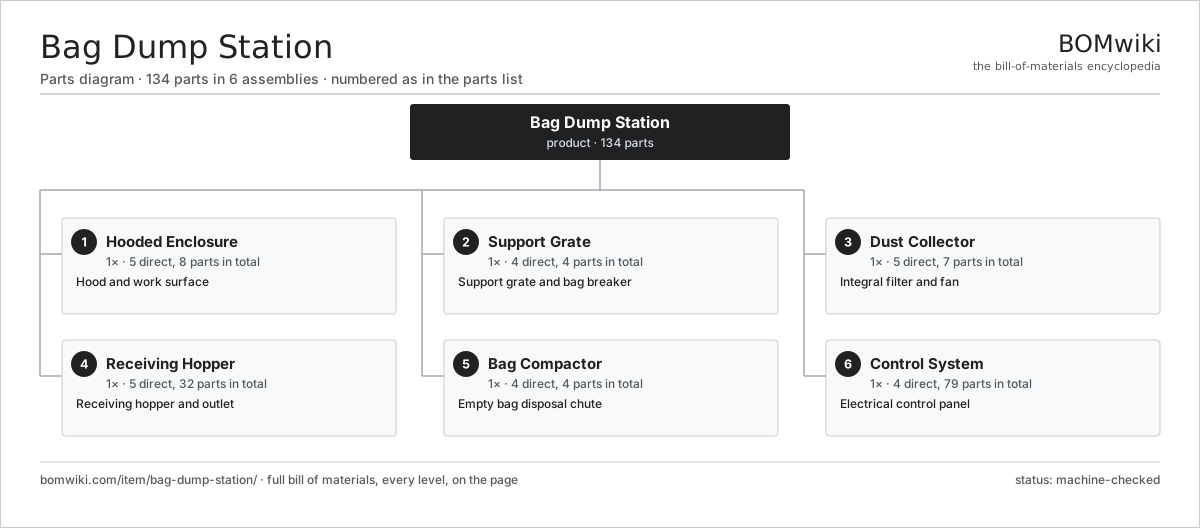
| # | Part | Qty | What it does |
|---|---|---|---|
| 1 | Hooded Enclosure 5 parts | 1× | Hood and work surface |
| 2 | Support Grate 4 parts | 1× | Support grate and bag breaker |
| 3 | Dust Collector 5 parts | 1× | Integral filter and fan |
| 4 | Receiving Hopper 5 parts | 1× | Receiving hopper and outlet |
| 5 | Bag Compactor 4 parts | 1× | Empty bag disposal chute |
| 6 | Control System 4 parts | 1× | Electrical control panel |
3D model
No 3D model yet. Have a CAD file of this? Add a 3D model — STL renders right on this page; STEP, FreeCAD, and OpenSCAD sources are welcome too (openly licensed, like all 3D models on BOMwiki).
Build & assembly graph
expand / collapse · shared sub-assemblies converge · links to related products · est. labourTap an assembly to expand/collapse · tap a part to open it · use “Open page” for any node · drag to pan, scroll to zoom.
Bill of materials for Bag Dump Station
6 top-level lines · 41 rows shown · 134 parts total · indented to 3 levels| # | Item / sub-assembly | Part no. | Qty/assy | Ext. qty | Parts | Type |
|---|---|---|---|---|---|---|
| 1 | Hooded Enclosure 5 parts | bag-dump-station-enclosure | 1× | 1 | 8 | assembly |
| 1.1 | Hood Panel | bag-dump-station-hood-panels | 4× | 4 | · | part |
| 1.2 | Work Shelf | bag-dump-station-work-shelf | 1× | 1 | · | part |
| 1.3 | Air Baffle | bag-dump-station-air-baffle | 1× | 1 | · | part |
| 1.4 | Work Light | bag-dump-station-light-fixture | 1× | 1 | · | part |
| 1.5 | Fastener Set | fastener-set | 1× | 1 | · | part |
| 2 | Support Grate 4 parts | bag-dump-station-grate | 1× | 1 | 4 | assembly |
| 2.1 | Grate Bars | bag-dump-station-grate-bars | 1× | 1 | · | part |
| 2.2 | Bag Breaker Knife | bag-dump-station-bag-breaker-knife | 1× | 1 | · | part |
| 2.3 | Grate Frame | bag-dump-station-grate-frame | 1× | 1 | · | part |
| 2.4 | Grate Vibrator | bag-dump-station-grate-vibrator | 1× | 1 | · | part |
| 3 | Dust Collector 5 parts | bag-dump-station-dust-collector | 1× | 1 | 7 | assembly |
| 3.1 | Filter Cartridge | bag-dump-station-filter-cartridge | 2× | 2 | · | part |
| 3.2 | Pulse-Jet Valve | bag-dump-station-pulse-valve | 2× | 2 | · | part |
| 3.3 | Extraction Fan | bag-dump-station-fan | 1× | 1 | · | part |
| 3.4 | Air Receiver Tank | bag-dump-station-air-tank | 1× | 1 | · | part |
| 3.5 | Pressure Sensor | pressure-sensor | 1× | 1 | · | part |
| 4 | Receiving Hopper 5 parts | bag-dump-station-hopper | 1× | 1 | 32 | assembly |
| 4.1 | Hopper Body | bag-dump-station-hopper-body | 1× | 1 | · | part |
| 4.2 | Screw Feeder 4 parts | bag-dump-station-screw-feeder | 1× | 1 | 28 | assembly |
| 4.2.1 | Screw Flight | bag-dump-station-screw-flight | 1× | 1 | · | part |
| 4.2.2 | Screw Trough | bag-dump-station-screw-trough | 1× | 1 | · | part |
| 4.2.3 | Servo Motor 4 parts + deeper › | servo-motor | 1× | 1 | 24 | assembly |
| 4.2.4 | Ball Bearing | ball-bearing | 2× | 2 | · | part |
| 4.3 | Rotary Valve | bag-dump-station-rotary-valve | 1× | 1 | · | part |
| 4.4 | Level Probe | bag-dump-station-level-probe | 1× | 1 | · | part |
| 4.5 | O-Ring Set | oring-set | 1× | 1 | · | part |
| 5 | Bag Compactor 4 parts | bag-dump-station-bag-compactor | 1× | 1 | 4 | assembly |
| 5.1 | Empty Bag Chute | bag-dump-station-bag-chute | 1× | 1 | · | part |
| 5.2 | Compactor Ram | bag-dump-station-compactor-ram | 1× | 1 | · | part |
| 5.3 | Ram Cylinder | bag-dump-station-ram-cylinder | 1× | 1 | · | part |
| 5.4 | Waste Bin | bag-dump-station-waste-bin | 1× | 1 | · | part |
| 6 | Control System 4 parts | bag-dump-station-controls | 1× | 1 | 79 | assembly |
| 6.1 | Control Panel | bag-dump-station-control-panel | 1× | 1 | · | part |
| 6.2 | Controller 4 parts | bag-dump-station-controller | 1× | 1 | 76 | assembly |
| 6.2.1 | Bare PCB | pcb-bare | 1× | 1 | · | part |
| 6.2.2 | Microcontroller | mcu | 1× | 1 | · | part |
| 6.2.3 | SMD Passive (R/C/L) | smd-passives | 70× | 70 | · | part |
| 6.2.4 | Relay | relay | 4× | 4 | · | part |
| 6.3 | Start/Stop Station | bag-dump-station-start-stop | 1× | 1 | · | part |
| 6.4 | Wire Bundle | wire-bundle | 1× | 1 | · | part |
Related products
same domain, ranked by shared parts Container Handler
552 parts · shares 6 with this page
Open-Mouth Sack Filler
214 parts · shares 6 with this page
Container Handler
552 parts · shares 6 with this page
Open-Mouth Sack Filler
214 parts · shares 6 with this page
 Reach Truck
832 parts · shares 6 with this page
Turret Truck
664 parts · shares 6 with this page
Pop-Up Wheel Sorter
705 parts · shares 5 with this page
Reach Truck
832 parts · shares 6 with this page
Turret Truck
664 parts · shares 6 with this page
Pop-Up Wheel Sorter
705 parts · shares 5 with this page
 Layer Palletizer
857 parts · shares 5 with this page
Layer Palletizer
857 parts · shares 5 with this page
Sourcing: possible vendors
Prices, MOQ, and lead times are algorithmic estimates, not quotes, and not claims about these companies. Company mappings are curated by keyword; est. price band $2k–$300k. How estimates work| Vendor | HQ | Specialty | MOQ | Lead time |
|---|---|---|---|---|
| toyota-industries.com ↗ | Kariya, JP | Forklifts & logistics | 20 units | 10–16 wks |
| kiongroup.com ↗ | Frankfurt, DE | Forklifts (Linde, STILL) | 20 units | 10–16 wks |
| jungheinrich.com ↗ | Hamburg, DE | Warehouse trucks | 20 units | 10–16 wks |
| crown.com ↗ | New Bremen, US | Forklifts | 20 units | 10–16 wks |
|
🇨🇳Hangcha
hcforklift.com ↗
|
Hangzhou, CN | Forklifts & material handling | 20 units | 10–16 wks |
957-word article