Vacuum Powder Conveyor
ProductOverview
A vacuum powder conveyor lifts a measured amount of powder from a source such as a sack, drum, or hopper up to a process inlet by sucking it through a hose. Unlike a pressure conveyor, the air mover sits at the destination and pulls a vacuum on the whole line, so the powder is drawn toward it rather than pushed. The unit mounts directly over the receiving point, typically a mixer, reactor, or packing machine inlet. It is built from a vacuum pump, a receiver hopper that collects the powder, a filter module that separates powder from air, a discharge valve that drops each batch, and a pickup wand and hose at the source.
Vacuum conveyors dominate in pharmaceutical, food, and fine chemical work for two reasons. Because the line is under vacuum, any leak draws air inward rather than blowing dust out, so the system is inherently dust-tight and contains hazardous or potent powders. And because the unit pulls from an open source, an operator can simply drop a wand into a sack or drum without a pressurized feeder. The trade-off is limited capacity and distance: a vacuum can only pull so hard, so these units handle modest throughput over short runs rather than plant-wide bulk transfer.
The suction cycle
A vacuum conveyor works in batches, not continuously. In the suction phase the vacuum pump draws air through the wand and hose, pulling powder along with it into the receiver hopper while the discharge valve at the bottom stays closed and sealed by the vacuum itself. The powder collects in the hopper while the air passes on through the filter. When the level sensor sees the hopper is full or a timer ends the fill, the pump stops, the vacuum breaks, and the blowback valve fires a reverse pulse to shed the powder cake off the filters. With the vacuum gone, the discharge valve opens and the batch drops by gravity into the process below. The cycle then repeats, usually several times a minute.
Vacuum pump
The vacuum pump is most often a side-channel blower, where a single impeller spins in a housing with a curved side channel that gives many compression stages in one pass, producing a deep vacuum with no contacting parts to wear. It is driven directly by a motor and runs oil-free, which matters for clean processes. An exhaust silencer quiets the discharge and a vacuum relief valve caps the suction so a blocked hose cannot overload the pump. Larger or more demanding units use a claw pump for higher vacuum.
Receiver and filtration
The receiver hopper is a 316L stainless chamber rated to hold the working vacuum without collapsing, sealed by vacuum gaskets and held together with a tool-free clamp ring so it can be opened and wiped down between products. A sight glass lets the operator watch the fill. The key part is the filter module: PTFE membrane cartridges let air through to the pump while holding back even sub-micron powder, and a blowback air tank stores the compressed air for the reverse pulse that cleans them each cycle. A pressure sensor across the filter warns when the media is blinding.
Pickup and hose
At the source, the pickup wand is a stainless tube with a suction nozzle that the operator pushes into the powder. An air bleed valve lets controlled make-up air into the wand so the powder mixes with enough air to flow rather than packing solid. The flexible conveying hose is anti-static and FDA-grade, with a steel helix so it does not collapse under vacuum, and joins with quick couplings for cleaning.
Control and hygiene
The control unit runs the timed cycle from a small control board driving solenoid valves for the vacuum break, blowback, and discharge steps, with an HMI panel for setting cycle times. Because these units serve regulated industries, the whole product path is designed to come apart without tools for cleaning, with crevice-free welds and FDA-contact surfaces. The same architecture scales from a small bench loader feeding a tablet press up to a large unit charging a production reactor.
Variants and selection
Vacuum is chosen over pressure conveying when containment matters most, when the source is open and an operator wants to dip a wand into a sack or drum, or when several pickup points feed one destination through a shared vacuum. A central vacuum unit can serve a whole floor of process machines in turn. The limits are real: a vacuum tops out below one atmosphere of pressure difference, so throughput and distance are modest compared with a pressure system, and very long or very high lifts need a pressure conveyor instead. Pharmaceutical units add wash-in-place spray balls and split-butterfly valves for contained charging of potent compounds, while food units favor mirror-polished surfaces and quick teardown for allergen changeovers. The vacuum conveyor is the workhorse for short, clean, contained powder transfer where keeping dust out of the room is the first requirement.
Vacuum Powder Conveyor parts and their functions
6 top-level parts · 210 parts in total · full bill of materials below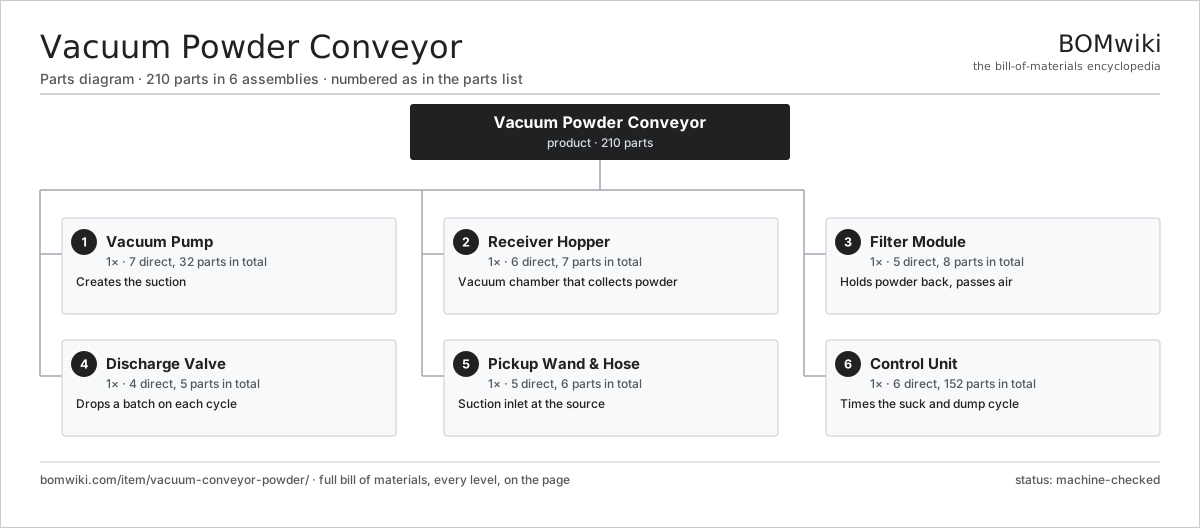
| # | Part | Qty | What it does |
|---|---|---|---|
| 1 | Vacuum Pump 7 parts | 1× | Creates the suction |
| 2 | Receiver Hopper 6 parts | 1× | Vacuum chamber that collects powder |
| 3 | Filter Module 5 parts | 1× | Holds powder back, passes air |
| 4 | Discharge Valve 4 parts | 1× | Drops a batch on each cycle |
| 5 | Pickup Wand & Hose 5 parts | 1× | Suction inlet at the source |
| 6 | Control Unit 6 parts | 1× | Times the suck and dump cycle |
3D model
No 3D model yet. Have a CAD file of this? Add a 3D model — STL renders right on this page; STEP, FreeCAD, and OpenSCAD sources are welcome too (openly licensed, like all 3D models on BOMwiki).
Build & assembly graph
expand / collapse · shared sub-assemblies converge · links to related products · est. labourTap an assembly to expand/collapse · tap a part to open it · use “Open page” for any node · drag to pan, scroll to zoom.
Bill of materials for Vacuum Powder Conveyor
6 top-level lines · 51 rows shown · 210 parts total · indented to 3 levels| # | Item / sub-assembly | Part no. | Qty/assy | Ext. qty | Parts | Type |
|---|---|---|---|---|---|---|
| 1 | Vacuum Pump 7 parts | vacuum-conveyor-powder-vacuum-pump | 1× | 1 | 32 | assembly |
| 1.1 | Side-Channel Impeller | vacuum-conveyor-powder-pump-impeller | 1× | 1 | · | part |
| 1.2 | Pump Housing | vacuum-conveyor-powder-pump-housing | 1× | 1 | · | part |
| 1.3 | Pump Motor 4 parts | vacuum-conveyor-powder-pump-motor | 1× | 1 | 25 | assembly |
| 1.3.1 | Stator Assembly 3 parts + deeper › | stator-assembly | 1× | 1 | 3 | assembly |
| 1.3.2 | Rotor Assembly 4 parts + deeper › | rotor-assembly | 1× | 1 | 19 | assembly |
| 1.3.3 | Motor Housing | motor-housing | 1× | 1 | · | part |
| 1.3.4 | Ball Bearing | ball-bearing | 2× | 2 | · | part |
| 1.4 | Exhaust Silencer | vacuum-conveyor-powder-exhaust-silencer | 1× | 1 | · | part |
| 1.5 | Vacuum Relief Valve | vacuum-conveyor-powder-vacuum-relief-valve | 1× | 1 | · | part |
| 1.6 | Ball Bearing | ball-bearing | 2× | 2 | · | part |
| 1.7 | Oil Seal | oil-seal | 1× | 1 | · | part |
| 2 | Receiver Hopper 6 parts | vacuum-conveyor-powder-receiver-hopper | 1× | 1 | 7 | assembly |
| 2.1 | Hopper Shell | vacuum-conveyor-powder-hopper-shell | 1× | 1 | · | part |
| 2.2 | Hopper Lid | vacuum-conveyor-powder-hopper-lid | 1× | 1 | · | part |
| 2.3 | Sight Glass | vacuum-conveyor-powder-sight-glass | 1× | 1 | · | part |
| 2.4 | Quick-Release Clamp Ring | vacuum-conveyor-powder-clamp-ring | 1× | 1 | · | part |
| 2.5 | Vacuum Gasket | vacuum-conveyor-powder-gasket | 2× | 2 | · | part |
| 2.6 | Capacitive Level Sensor | vacuum-conveyor-powder-level-sensor | 1× | 1 | · | part |
| 3 | Filter Module 5 parts | vacuum-conveyor-powder-filter-module | 1× | 1 | 8 | assembly |
| 3.1 | PTFE Filter Cartridge | vacuum-conveyor-powder-filter-cartridge | 4× | 4 | · | part |
| 3.2 | Filter Mounting Plate | vacuum-conveyor-powder-filter-plate | 1× | 1 | · | part |
| 3.3 | Blowback Pulse Valve | vacuum-conveyor-powder-blowback-valve | 1× | 1 | · | part |
| 3.4 | Blowback Air Tank | vacuum-conveyor-powder-blowback-tank | 1× | 1 | · | part |
| 3.5 | Pressure Sensor | pressure-sensor | 1× | 1 | · | part |
| 4 | Discharge Valve 4 parts | vacuum-conveyor-powder-discharge-valve | 1× | 1 | 5 | assembly |
| 4.1 | Discharge Flap | vacuum-conveyor-powder-valve-flap | 1× | 1 | · | part |
| 4.2 | Valve Seat | vacuum-conveyor-powder-valve-seat | 1× | 1 | · | part |
| 4.3 | Pneumatic Valve Actuator | vacuum-conveyor-powder-valve-actuator | 1× | 1 | · | part |
| 4.4 | O-Ring Set | oring-set | 2× | 2 | · | part |
| 5 | Pickup Wand & Hose 5 parts | vacuum-conveyor-powder-pickup-wand | 1× | 1 | 6 | assembly |
| 5.1 | Wand Tube | vacuum-conveyor-powder-wand-tube | 1× | 1 | · | part |
| 5.2 | Suction Nozzle | vacuum-conveyor-powder-suction-nozzle | 1× | 1 | · | part |
| 5.3 | Flexible Conveying Hose | vacuum-conveyor-powder-conveying-hose | 1× | 1 | · | part |
| 5.4 | Hose Coupling | vacuum-conveyor-powder-hose-coupling | 2× | 2 | · | part |
| 5.5 | Air Bleed Valve | vacuum-conveyor-powder-air-bleed | 1× | 1 | · | part |
| 6 | Control Unit 6 parts | vacuum-conveyor-powder-control-unit | 1× | 1 | 152 | assembly |
| 6.1 | Control Board 4 parts | vacuum-conveyor-powder-control-board | 1× | 1 | 90 | assembly |
| 6.1.1 | Bare PCB | pcb-bare | 1× | 1 | · | part |
| 6.1.2 | Microcontroller | mcu | 1× | 1 | · | part |
| 6.1.3 | Connector | connector | 8× | 8 | · | part |
| 6.1.4 | SMD Passive (R/C/L) | smd-passives | 80× | 80 | · | part |
| 6.2 | Solenoid Valve | vacuum-conveyor-powder-solenoid-valve | 3× | 3 | · | part |
| 6.3 | HMI Touch Panel 4 parts | vacuum-conveyor-powder-hmi | 1× | 1 | 53 | assembly |
| 6.3.1 | Bare PCB | pcb-bare | 1× | 1 | · | part |
| 6.3.2 | Microcontroller | mcu | 1× | 1 | · | part |
| 6.3.3 | LCD Panel | lcd-panel | 1× | 1 | · | part |
| 6.3.4 | SMD Passive (R/C/L) | smd-passives | 50× | 50 | · | part |
| 6.4 | Power Supply | power-supply | 1× | 1 | · | part |
| 6.5 | Relay | relay | 4× | 4 | · | part |
| 6.6 | Wire Bundle | wire-bundle | 1× | 1 | · | part |
Related products
same domain, ranked by shared parts Articulated Forklift
2,417 parts · shares 6 with this page
Articulated Forklift
2,417 parts · shares 6 with this page
 Reach Truck
832 parts · shares 6 with this page
Reach Truck
832 parts · shares 6 with this page
 Dilute-Phase Conveying System
509 parts · shares 5 with this page
Dilute-Phase Conveying System
509 parts · shares 5 with this page
 Layer Palletizer
857 parts · shares 5 with this page
Layer Palletizer
857 parts · shares 5 with this page
 Rail-Mounted Gantry Crane
1,474 parts · shares 5 with this page
Rail-Mounted Gantry Crane
1,474 parts · shares 5 with this page
 Rubber-Tyred Gantry Crane
1,417 parts · shares 5 with this page
Rubber-Tyred Gantry Crane
1,417 parts · shares 5 with this page
Sourcing: possible vendors
Prices, MOQ, and lead times are algorithmic estimates, not quotes, and not claims about these companies. Company mappings are curated by keyword; est. price band $2k–$300k. How estimates work| Vendor | HQ | Specialty | MOQ | Lead time |
|---|---|---|---|---|
| toyota-industries.com ↗ | Kariya, JP | Forklifts & logistics | 20 units | 10–16 wks |
| kiongroup.com ↗ | Frankfurt, DE | Forklifts (Linde, STILL) | 20 units | 10–16 wks |
| jungheinrich.com ↗ | Hamburg, DE | Warehouse trucks | 20 units | 10–16 wks |
| crown.com ↗ | New Bremen, US | Forklifts | 20 units | 10–16 wks |
|
🇨🇳Hangcha
hcforklift.com ↗
|
Hangzhou, CN | Forklifts & material handling | 20 units | 10–16 wks |
1,030-word article